
CGIC Exam Guide: Format, Syllabus and a Six-Week Study Plan
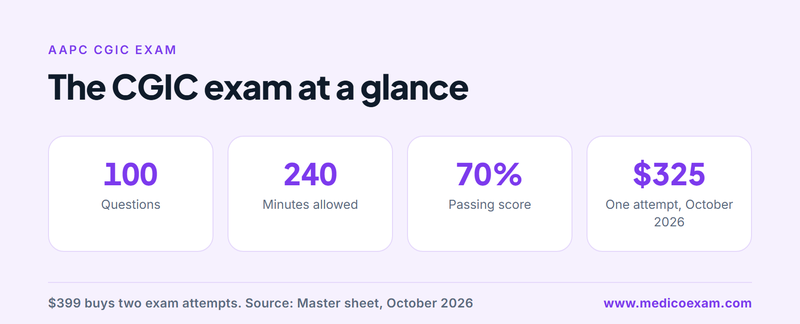
The AAPC Certified Gastroenterology Coder (CGIC) exam asks you to answer 100 questions in four hours (240 minutes) and to score at least 70%. In October 2026 a first attempt cost $325, and $399 bought two. The questions turn diagnoses, endoscopies, operations and tests from the gastrointestinal tract into correct codes.
Below you will find how the paper is put together, what the four syllabus areas demand and where marks usually slip, followed by a six-week plan. To measure where you stand before you start, take the CGIC practice test and keep the first score as your baseline.
How is the CGIC exam structured, scored and priced?
Four hours for 100 questions leaves 144 seconds for each one, and the cut-off is 70%. AAPC offers two ways to sit the paper, online under a live proctor who watches remotely, or inside a testing center, and the open dates and times become visible once you have bought an exam voucher. The fee AAPC listed in October 2026 started at $325 for one attempt, with $399 covering two exam attempts.
Because the Master data for this exam does not show a split between scored and unscored items, treat all 100 as counting and plan to answer every one. Four hours is generous for most coders, so pacing is rarely the problem. The real risk is reading a scenario too quickly and coding the procedure you expected rather than the one the report describes.
| Detail | What to know |
|---|---|
| Credential | AAPC Certified Gastroenterology Coder (CGIC) |
| Awarding body | AAPC |
| Questions | 100 |
| Time limit | 240 minutes |
| Passing score | 70% |
| Price, October 2026 | $325 for one attempt; $399 for two exam attempts |
| Delivery | Online with a remote proctor, or in a testing center |
| Validity | 2 years, kept current with continuing education |
Check the fee and the delivery options on AAPC's CGIC page before you book, because prices and policies change. If you want guided instruction, AAPC runs a self-paced course of its own. Many candidates prefer to read the syllabus first and decide afterward how much instruction they need.
What does the CGIC credential prove, and who should sit it?
The CGIC tells an employer that you can code gastroenterology work from the provider's documentation without someone double-checking every claim line. Gastroenterology is a procedure-heavy specialty. A single visit can involve a diagnostic scope, a biopsy, a polyp removal and a separate evaluation, and each piece has its own code, its own modifier question and its own payer edit. A coder who understands how those pieces combine prevents denials that would otherwise come back weeks later.
AAPC presents the credential as evidence of advanced skill in assigning diagnosis, procedure and supply codes to gastrointestinal disease, diagnostic testing and endoscopy, following current guidelines and payer requirements. The people it suits are coders in gastroenterology practices, ambulatory endoscopy centers, multispecialty groups and hospitals, plus billers handling GI claims, and auditors who review gastroenterology documentation.
Is there a formal eligibility rule?
AAPC's page does not set a number of years of experience. It describes the expected background instead: a thorough working knowledge of gastroenterology terminology, anatomy and pathophysiology, plus confidence applying all three code sets to real claims. If that description does not yet fit you, AAPC suggests its preparation course first. In practice, coders who already work claims in a GI practice find the vocabulary familiar, while generalists need extra time on anatomy and on the procedure families.
Is the credential worth the effort for a generalist coder?
That depends on where you work. A coder inside a gastroenterology group uses these skills every day, so the exam mostly formalizes what the job already demands. A generalist who sees GI claims only occasionally has more to learn, but the specialty rules around bundling and endoscopic hierarchies reward careful study. Treat the credential as a way to show depth in one specialty rather than as a replacement for a broad coding certification.
What are the four syllabus areas on the CGIC exam?
AAPC splits the content into four blocks. They run from core knowledge through endoscopy and surgery to diagnostic testing, and each gets a subsection below. The MedicoExam syllabus page for the CGIC lists the same four, and neither source publishes how many questions each area carries, so do not trust any site that quotes a percentage split. Study all four, and let your own practice results tell you which one needs more hours.
Core knowledge: diagnoses, service types and payer rules
This area covers ICD-10-CM coding for gastrointestinal conditions, and AAPC names GERD, Crohn's disease, ulcerative colitis, diverticulitis, liver disease, pancreatitis, GI bleeding and cancers of the digestive system. It also covers preventive, diagnostic and problem-oriented gastroenterology services, and the correct use of modifiers, NCCI edits and payer rules. Expect scenarios where the diagnosis you choose decides whether a procedure is medically supported, and where the first-listed diagnosis depends on the reason for the encounter rather than on the most serious finding.
Endoscopic and colonoscopy procedures
This is the heart of the specialty. AAPC lists diagnostic and therapeutic upper endoscopy (EGD) including biopsy, dilation and polypectomy, colonoscopy for screening, diagnostic evaluation and therapeutic work such as polyp removal and control of bleeding, and capsule endoscopy with other specialized scopes. The recurring skill is choosing the right code from a family of related endoscopy codes, identifying the technique used to remove a lesion, and recognizing when more than one family member is reported for the same session.
Gastroenterology surgical and therapeutic services
Here the paper moves to esophageal, gastric, intestinal and anorectal surgery performed in gastroenterology settings. AAPC names PEG tube placement, hemorrhoidectomy and fistula repair, and adds ablation, stent placement and other therapeutic interventions. These questions reward the habit of reading the whole operative note, because the approach, the site and the method decide the code, and a single missed word can move you to a different procedure.
Diagnostic testing and specialty services
The last area covers GI-related diagnostic imaging, ultrasound and manometry, liver biopsy, paracentesis and diagnostic aspiration or biopsy of GI structures, and motility studies along with other specialty tests. Questions here often turn on whether the facility or the physician is billing, on whether interpretation is separate from the test itself, and on which tests can be reported together without a modifier.
For the full topic list with the exam details alongside it, open the CGIC syllabus. It reproduces the four areas in the order above.
Which parts of the CGIC exam do candidates find hardest?
No body publishes domain-level pass rates for this exam, so what follows is reasoning about the format and not a statistic. Three habits cost the most marks on a specialty procedure paper like this one: coding from memory rather than from the scenario, ignoring payer context and misreading what a modifier is for.
Endoscopy code families
A diagnostic scope, a scope with biopsy and a scope with polyp removal sit in related code ranges. Candidates who memorize one code per procedure get caught when a scenario describes two techniques in one session. Learn each family as a ladder: which action raises the code, and what the guidelines say about reporting only the most extensive service in the family.
Screening versus diagnostic
A colonoscopy that began as a screening and turned up a polyp is a classic trap. The documentation, the diagnosis codes and the payer's rules together decide how it is reported, and the correct answer can differ between a Medicare scenario and a commercial one. Read what the question tells you about the payer, then apply that payer's rule, not the one you use at work.
Modifiers and bundling edits
The exam expects you to know why a modifier exists, not just its number. A modifier that signals a separately identifiable evaluation, one that reduces a service, one that marks a discontinued procedure and one that marks a distinct procedural service answer four different questions. Learn the question each one answers, then test yourself on NCCI pairs to see where a modifier is allowed and where it is not.
Anatomy and terminology
Candidates from outside gastroenterology often lose time on location. The difference between the sigmoid and the descending colon, between the ileum and the cecum, or between the duodenum and the jejunum changes which code applies. A one-page anatomy sheet you can sketch from memory is worth an evening.
What do real coding scenarios on the CGIC exam look like?
Expect short case descriptions followed by a request for a code, a modifier, a sequence or a reason an edit applies. The examples below are original illustrations of the thinking, not exam items, and the final code must always come from your current code books and your payer's policy.
A screening colonoscopy that finds and removes a polyp
The report documents a colonoscopy booked as a screening, a polyp found in the descending colon and removed with a snare. Your job is to name the service by what was done, not by how it was scheduled. Work through four points: which technique removed the lesion, what the diagnosis codes should show, how the payer treats a screening that becomes therapeutic, and whether a modifier or a screening-specific code is needed to report the intent.
An upper endoscopy with several actions
A patient has an EGD in which the physician takes biopsies and also dilates a stricture. The skill tested is family logic: when two actions fall in the same endoscopy family, the guidelines limit what you report, and you must find out whether the scenario describes one session or two. Read for words such as same session, separate site and distinct lesion before you choose.
A procedure that stops early
The physician cannot advance the scope as far as planned and ends the procedure. You must decide whether the incompleteness changes the code or only calls for a modifier, and the answer depends on how far the scope reached and on the base code for the planned service. These questions test whether you know the difference between a reduced service and a discontinued one.
A diagnosis with a clear first-listed reason
A patient attends for abdominal complaints, and the workup shows diverticulitis with a complication documented by the physician. Sequencing depends on the reason for the visit and on the documentation, so check which condition occasioned the encounter, whether the complication is documented as such and what the ICD-10-CM guidelines say about the combination.
A diagnostic test with a technical and a professional part
A motility study, an ultrasound or a liver biopsy may be reported by a facility, by a physician or by both. The question will usually say who is billing and what that party did. Separate the work of performing the test from the work of interpreting it, and check whether the scenario describes a global service or only one component. Missing that single word, global or component, is a common reason a correct-looking code is marked wrong.
A paracentesis or biopsy with imaging guidance
Some GI procedures include image guidance in their descriptor, and others let you report it separately. When a scenario mentions ultrasound for a needle placement, read the code descriptor before you add a second code. The rule to carry into the exam is that you never add a service the descriptor already includes, and you never drop one the guidelines allow you to report on its own.
How to read a scenario question
Read the last sentence first so you know what is asked, then read the stem for the facts that answer it. Underline the technique, the site, the intent, the payer and the time frame if they appear. Rule out the options that conflict with any of those facts, and choose between the ones that remain by returning to the code descriptor or the guideline. This routine is slower than guessing and much faster than redoing a question you got wrong.
How should you prepare for the CGIC exam in six weeks?
Six weeks suits a working coder who can give an hour or two on most days. If you have more daily time, compress the plan, but keep the order, because each step builds on the one before it. Allow extra time if you are new to GI claims.
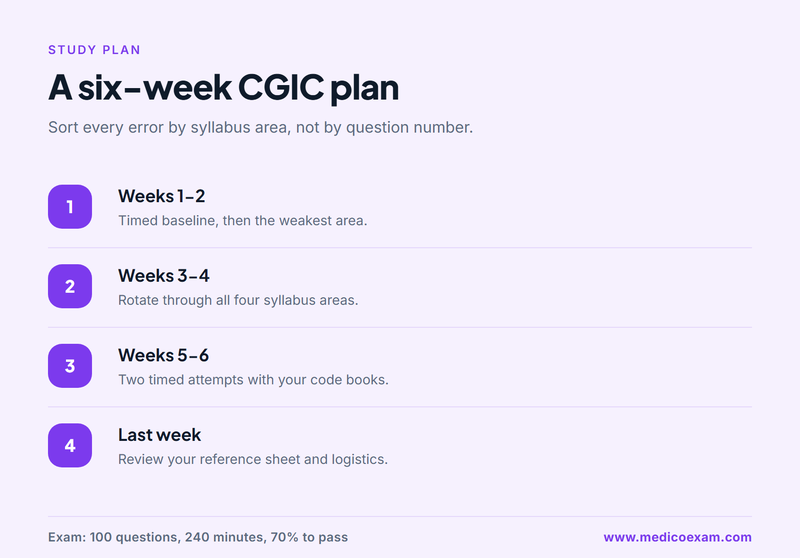
Weeks 1 and 2: baseline and the weakest area
Take one timed full attempt before you study anything. Mark every miss against its syllabus area, not its question number. The area with the most misses gets the first block of study. Read the guideline text behind each miss and code a handful of fresh scenarios in that area from scratch.
Weeks 3 and 4: rotate through all four areas
Cycle through core knowledge, endoscopy, surgical services and diagnostics, spending a few sessions on each. Keep a reference sheet of code families, modifier purposes and NCCI habits that you write yourself, because writing forces the recall that rereading does not.
Weeks 5 and 6: rehearse the sitting
Do two full timed attempts with the same code books you will bring on the day, and review every error within a day. MedicoExam's CGIC practice exam is built for this stage: scenario-based questions let you rehearse pacing and the best-answer reading the real paper expects. No resource guarantees a pass, so judge your readiness by your last two scores, not by the number of hours you logged.
If you want instruction as well as practice, look at AAPC's CGIC preparation course. Candidates who know the content but have not sat a timed coding paper in years often gain most from the practice rather than from more reading.
How to review a missed question
A wrong answer is useful only if you can name why it was wrong. Sort each miss into one of four causes: you did not know the rule, you knew it but misread the scenario, you chose the wrong payer logic, or you ran short of attention late in the sitting. The first cause calls for study, the second for slower reading, the third for a payer summary sheet and the fourth for shorter, more frequent practice blocks. Tally the causes after each attempt so the pattern becomes visible within a week.
What to do in the last week
Stop learning new material two days before the exam. Re-read your reference sheet, sit one short mixed set to stay sharp, and confirm your voucher, your identification and, for an online sitting, your room and your equipment. Arrive with a plan for the first scenario, which is to read the whole stem before you look at the options.
How do you keep the CGIC credential after you pass?
AAPC sets two conditions for keeping the CGIC. The first is an annual AAPC membership that never lapses. The second is 36 CEUs in each two-year period, and 8 of them have to relate directly to gastroenterology. The Master data shows the credential as valid for 2 years, which matches that two-year cycle. Plan CEUs across the cycle instead of leaving them for the final month.
Choose education that builds on what the exam taught: updated CPT and ICD-10-CM changes for the digestive system, payer policy updates on screening and therapeutic endoscopy, and audit lessons from your own claims. Keep certificates and records together so you can report them without a scramble. For the current rules, check AAPC's CGIC page again before each renewal, since requirements can change.
Frequently Asked Questions
How many questions are on the CGIC exam?
There are 100 questions on the paper, and you have 240 minutes to answer them, roughly 144 seconds apiece. Most items present a brief gastroenterology case and ask which code, modifier or order is correct, which rewards close reading over quick clicking.
What is the passing score for the CGIC exam?
The passing score is 70%. Counting every item, that is at least 70 correct answers out of 100, AAPC does not publish a per-area minimum, so strong results in one syllabus area can make up for a weaker one.
How much does the CGIC exam cost?
In October 2026 the CGIC exam cost $325 for one attempt, or $399 for two exam attempts. AAPC's own preparation course is sold separately. Fees change, so confirm the current price on AAPC's CGIC page before you buy a voucher.
What does the CGIC exam cover?
Four blocks make up the paper: diagnosis coding with payer rules, colon and upper-GI scopes, surgical and therapeutic work, and diagnostic tests. Throughout, you apply diagnosis, procedure and supply code sets to digestive conditions and the services that investigate or treat them.
Can I take the CGIC exam online?
Yes. You can sit it from home while a proctor supervises you live over the internet, or travel to a testing center. You buy an exam voucher first, and the available dates and times appear after purchase, so choose a slot only once you know your study plan.
How do I keep the CGIC credential active?
Renewal needs a current annual AAPC membership and 36 CEUs per two-year cycle, with 8 of those tied to gastroenterology. Log each unit as you earn it and spread them across the cycle, so renewal does not turn into a last-month rush.
- AAPC CGIC Question Bank |
- AAPC CGIC Eligibility & Requirements |
- AAPC Gastroenterology Coder Practice Test |
- AAPC CGIC Exam Cost |
- AAPC CGIC Registration Process |
- AAPC Gastroenterology Coder Study Guide |
- AAPC CGIC Recertification |
- AAPC CGIC Certification Overview |
- AAPC Gastroenterology Coder Syllabus |
- AAPC CGIC Preparation Time |
- AAPC CGIC Passing Score |
- AAPC CGIC Exam Format |
- AAPC Gastroenterology Coder Sample Questions |
- AAPC CGIC Career Opportunities


