Blogs

COBGC Practice Test Prep: Where OB/GYN Coders Lose Marks

The AAPC Certified Obstetrics Gynecology Coder (COBGC) exam asks 100 questions over 240 minutes and you pass with 70%. One attempt cost $325 in October 2026, and a pair of attempts cost $399. Most marks are lost not on obscure codes but on small slips in maternity packages, modifiers and documentation.

This guide shows how the paper is built, what its four syllabus areas ask, where capable coders trip, and a preparation routine that fits around a full-time job. To learn where you stand today, sit the COBGC practice test before you read further and treat the first score as a map, not a verdict.

Cover for the COBGC exam guide with an illustrated coder's study desk

How is the COBGC exam structured, scored and priced?

Split 240 minutes across 100 questions and each one gets 144 seconds. The pass mark of 70% equals 70 correct answers out of 100. You choose the setting: AAPC lets you test from home under a live remote proctor, or in a testing center. Available dates and times appear only after you have bought an exam voucher, and the syllabus page on this site notes that one exam attempt can be scheduled at a time.

AAPC showed the voucher starting at $325 in October 2026, while our own records also list a $399 package of two tries. The sources we hold never split the 100 questions into counted and trial items, so answer every question and assume each counts. For a working coder, four hours is a comfortable allowance. The usual problem is skimming a long scenario and missing the one detail that changes the answer.

What Does the CGSC Exam Really Test? A General Surgery Coder's Guide

Passing the AAPC Certified General Surgery Coder (CGSC) exam means scoring 70% on a paper of 100 questions that runs for 240 minutes. A single attempt was priced at $325 in October 2026, and a bundle of two was $399. What it tests is whether you can turn operative documentation for abdominal, breast, endocrine, soft tissue and trauma surgery into correct codes and modifiers.

This guide explains how the paper is built, what each of its four syllabus areas asks of you, where capable coders lose marks and how to prepare without wasting weeks. To find your starting point, take the CGSC practice test early and treat your first result as a starting point.

Cover for the CGSC exam guide with a 3D surgical coding icon

How is the CGSC exam structured, scored and priced?

Divide 240 minutes by 100 questions and you get 144 seconds a question. The cut-off is 70%, which equals 70 right answers from 100. Where you sit is your choice: AAPC offers a remote-proctored session from your own room, or an appointment at a testing center. Dates and times become visible once an exam voucher has been bought.

The fee AAPC advertised in October 2026 started at $325, and our records add a $399 option covering two exam attempts. Nothing we hold splits the 100 questions into scored and unscored items, so assume every one counts and answer all of them. Four hours is generous for most working coders. Pacing is seldom the problem; reading a report too fast is.

How to Pass the CUC Urology Coder Exam: A Four-Area Study Plan

Passing the CUC means answering 100 questions in 240 minutes and reaching a score of 70 on AAPC's Certified Urology Coder exam. The questions all concern urology claims: diagnosis, procedure and supply codes. Build your preparation around its four content areas, and use the CUC practice test to find the one that needs the most work.

Medical coder reviewing urology coding documents for the CUC exam

Does a CUC practice exam exist, and who sells one?

Looking at AAPC's CUC page, two products appear: an exam voucher that starts at $325 and a self-paced online course that starts at $660. No practice exam or question bank is shown there, which means buying a voucher does not bring one with it. MedicoExam is a separate company from AAPC. The practice test on our site is a question set we wrote ourselves from AAPC's published content areas, and it carries no AAPC authorship or endorsement.

The cart for our set sits on the CUC practice test page linked in the opening paragraph. A short sample of questions is available next to the syllabus page for anyone who wants a preview first. Judge any set, ours included, by one test: does it spread questions across all four content areas AAPC names, or does it lean on whichever topic is simplest to write? Lopsided practice produces a score that flatters you and then fails you on the day.

Stop Studying Everything: Prepare for the CDN Exam by Weight

The NNCC Certified Dialysis Nurse (CDN) exam has 150 questions, a three-hour limit and a passing score of 70%. About 25 of the questions are unscored pilot items. More than half of the paper, 52%, comes from one area, chronic hemodialysis care for patients with end-stage renal disease. Here is how it is put together.

Curious how ready you are today? Try the CDN practice test first. The sections below show what your result should be measured against and how NNCC's blueprint becomes a plan.

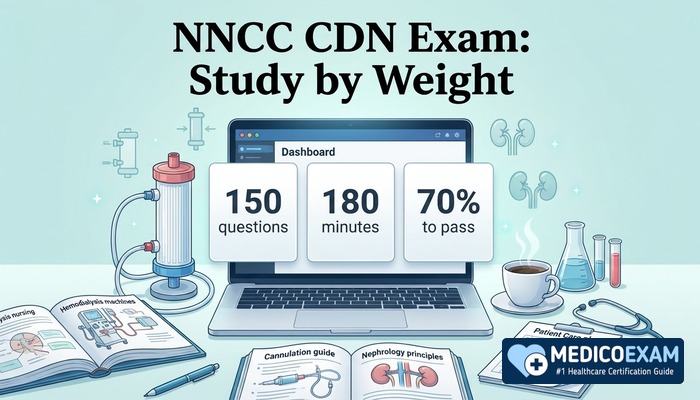
Laptop dashboard showing CDN exam questions, time limit and passing score

What does the CDN certification prove, and who is eligible?

A dialysis nurse carries a very particular set of responsibilities. In one shift that can mean preparing and starting treatments, watching the machine and the patient at the same time, teaching a person with kidney failure how to manage fluid and diet, and keeping the water treatment system and the unit safe for everyone in the room. The Certified Dialysis Nurse credential is built around that work. It tells an employer and a patient that the nurse passed a standard examination written for registered nurses who practise in dialysis facilities.

CRHC Exam Guide: 100 Questions in 240 Minutes

The CRHC is AAPC's Certified Rheumatology Coder exam: 100 questions in 240 minutes, with a passing score of 70. It tests ICD-10-CM, E/M, infusion and injection, procedure and chronic disease coding for rheumatology. Start with the CRHC practice test, then work through the four syllabus areas below.

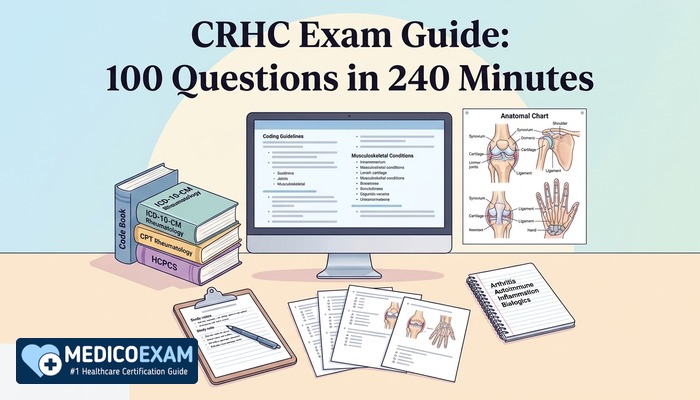
Medical coder at a desk with code books preparing for the CRHC exam

Where can you get CRHC practice questions, and does AAPC provide any?

On AAPC's CRHC page, AAPC offers two things: an online self-paced exam preparation course, listed as starting at $560, and an exam voucher, listed as starting at $325. The page does not show a practice exam, so do not assume one comes with the voucher. MedicoExam is an independent practice provider and is not AAPC: our practice test is our own question set, written against the published CRHC content areas, and it is not AAPC material.

To get it, open the CRHC practice test page, which holds the cart. If you only want to see the style of question first, the sample questions for this exam sit beside the syllabus page. Whatever source you use, check it against the content areas AAPC publishes, because a question bank is only useful if it matches what the exam covers.

COSC Exam Guide: 100 Questions, 240 Minutes, Four Areas

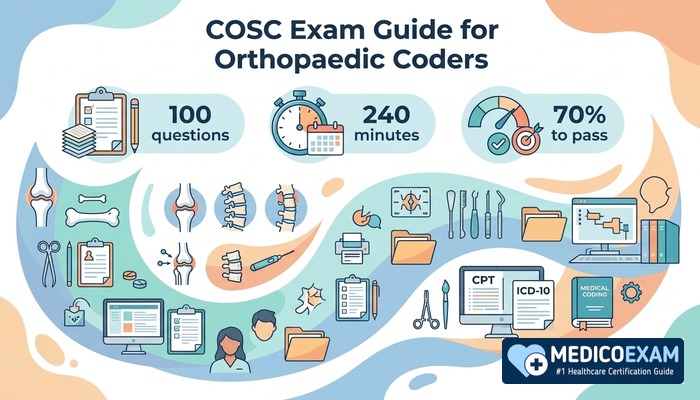
Sitting the AAPC Certified Orthopaedic Surgery Coder (COSC) exam asks 100 questions across 240 minutes, and you need 70% to pass. The questions draw on diagnosis, E/M, procedure and supply coding for bone, joint and spine care. Below you will find the structure, the four areas AAPC lists and a plan for getting ready.

Curious how ready you are today? Take the COSC practice test first and keep the result as a starting point to measure progress against.

Orthopaedic surgery coding study desk with exam facts for the COSC certification

What is the COSC credential, and who is it written for?

Orthopaedic coding rewards precision more than most specialties. A single operative report can describe a fracture reduction, a screw fixation, a cast and a follow-up plan, and each of those pieces is reported differently. The COSC credential from AAPC is meant to show an employer that you can read that kind of record and turn it into correct, defensible codes.

AAPC describes the credential as validating a medical coder's advanced expertise in orthopaedic surgery coding, with skill in applying diagnosis, procedure and supply code sets to musculoskeletal conditions and surgical procedures. It says the certification suits coders working in orthopaedic practices, ambulatory surgical centers, multispecialty groups and hospitals where musculoskeletal surgery is performed.

CPCO Exam Guide: Nine Domains, 100 Questions

The CPCO is AAPC's Certified Professional Compliance Officer exam: 100 multiple-choice questions in 240 minutes, with a pass mark of 70%. It tests healthcare compliance programs, fraud and abuse law, privacy rules and the audit process. Start with the CPCO practice test, then use the nine domains below to plan your study.

Compliance checklist icon beside the title of the CPCO exam guide

Where can you get CPCO practice questions, and does AAPC provide any?

AAPC's CPCO pages, the certification overview and the exam-day page, list two products: an exam voucher starting at $425 and an online self-paced training course starting at $1,195 (October 2026 prices). You will not find a practice exam on either page, so a voucher should not be expected to include one. MedicoExam is separate from AAPC: the questions on our practice test are our own work, written against the published CPCO outline, not AAPC content.

Our CPCO product page describes a premium practice exam with 195+ exam-aligned questions, two months of unlimited access to the question bank, and a result history that shows your answers beside the correct ones. A short demo lets you try the interface first, and sample questions for this exam are available next to the syllabus. Compare any question bank you consider with the nine-domain outline later in this guide; a bank is worth using only if its topics line up with what the exam covers.

RMA Exam Guide: 210 Questions and 4 Weighted Areas

The AMT Registered Medical Assistant (RMA) exam has 210 questions, a 120-minute time limit and a passing score of 70 on a scale of 0-100. Its content falls into four areas, and clinical patient interaction is the heaviest at 33.8%. This guide shows how the exam is built and how to plan your study around it.

If you want to see where you stand before you read further, start the RMA practice test and treat your first score as a baseline. The rest of this article explains what that score should be compared against.

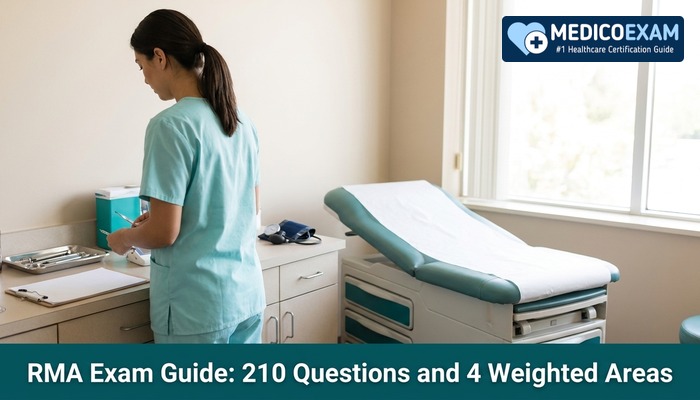
Medical assistant preparing an examination room while studying for the RMA exam

What does the RMA credential show, and who can sit the exam?

A medical assistant works in two worlds at once. In the morning that may mean checking a patient in, verifying insurance and keeping the schedule moving. An hour later it may mean taking vital signs, preparing a room or setting up an instrument tray. The Registered Medical Assistant credential from American Medical Technologists (AMT) is built around that mix. It tells an employer that you passed a standard exam covering both the front office and the clinical side of an outpatient practice.

AMT is the certifying body, and its own page for the credential is the place to confirm anything that can change. At the time of writing, AMT's Medical Assistant (RMA) page says that all applicants must pass the AMT examination for RMA to become certified. It also says that applicants must meet one of its eligibility routes before they can apply.

ACRP CPI Practice Test and Exam Guide: Six Weighted Areas

The ACRP Certified Principal Investigator (CPI) exam has 125 questions (100 scored and 25 pretest), runs for 180 minutes and reports a scaled score, with 600 on a 200-800 scale needed to pass. It tests six areas of clinical research, led by ethical and safety considerations at 22% of the weighting.

The exam is built for people who have already led or co-led studies, so preparation is mostly about judgment, not memory. To see where you stand before you pay ACRP, take the CPI practice test first and use that result as your starting point.

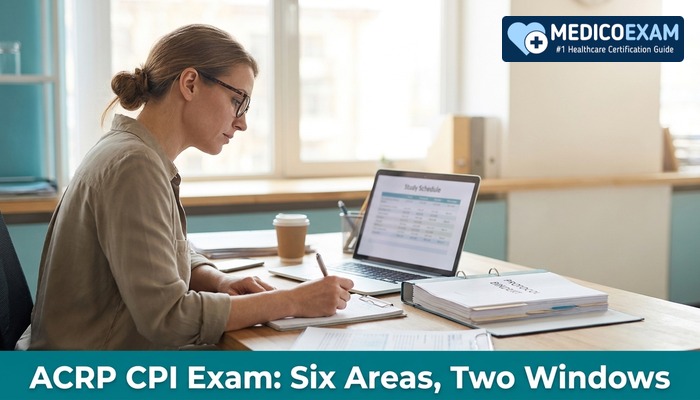
Clinical research investigator at a desk with a laptop and protocol binder preparing for the CPI exam

CGIC Exam Guide: Format, Syllabus and a Six-Week Study Plan

The AAPC Certified Gastroenterology Coder (CGIC) exam asks you to answer 100 questions in four hours (240 minutes) and to score at least 70%. In October 2026 a first attempt cost $325, and $399 bought two. The questions turn diagnoses, endoscopies, operations and tests from the gastrointestinal tract into correct codes.

Below you will find how the paper is put together, what the four syllabus areas demand and where marks usually slip, followed by a six-week plan. To measure where you stand before you start, take the CGIC practice test and keep the first score as your baseline.
Medical coder at a desk in an endoscopy center office preparing for the CGIC exam

How is the CGIC exam structured, scored and priced?

Four hours for 100 questions leaves 144 seconds for each one, and the cut-off is 70%. AAPC offers two ways to sit the paper, online under a live proctor who watches remotely, or inside a testing center, and the open dates and times become visible once you have bought an exam voucher. The fee AAPC listed in October 2026 started at $325 for one attempt, with $399 covering two exam attempts.

Because the Master data for this exam does not show a split between scored and unscored items, treat all 100 as counting and plan to answer every one. Four hours is generous for most coders, so pacing is rarely the problem. The real risk is reading a scenario too quickly and coding the procedure you expected rather than the one the report describes.

Syndicate content