
COPC Exam Guide: 100 Questions, 240 Minutes, Four Topic Areas
The AAPC Certified Ophthalmology Coder (COPC) exam has 100 questions, a 240-minute limit and a 70% pass mark, and the fee is $325 for one attempt or $399 for two exam attempts (October 2026). It tests ICD-10-CM, CPT and HCPCS Level II coding for eye care, from routine eye exams to microsurgery.
Before you read the topic breakdown, take the COPC practice test, untimed if you prefer, and note which question types slow you down. That list is more useful than any generic study schedule, because ophthalmology coding rewards knowing a small number of rules cold.
What does the COPC credential show, and who should sit it?
AAPC describes the COPC as proof of advanced expertise in ophthalmology coding. It covers ICD-10-CM, CPT and HCPCS Level II coding for eye-related conditions, diagnostics and surgical procedures, applied in line with current guidelines and payer requirements. The credential is meant for people who already code, and who want an employer to see that they can handle the specific problems eye care creates for a claim.
AAPC names four groups on its COPC page: professional coders in ophthalmology practices, surgical centers or hospitals; medical billers and reimbursement specialists who handle ophthalmology claims; auditors and compliance professionals who check documentation and coding accuracy in eye care; and experienced coders who want to specialize. If you are a general coder who keeps meeting eye claims, the credential is a way to turn that exposure into something you can show.
The experience statement matters more than most candidates expect. AAPC describes the expected background as high-level knowledge of ophthalmology-related medical terminology, anatomy and pathophysiology, together with correct use of CPT procedure codes, HCPCS Level II procedure and supply codes and ICD-10-CM diagnosis codes. It also says that a candidate who does not feel ready can take its exam preparation course. The text describes experience, not a prerequisite credential, but eligibility rules can change, so confirm them on AAPC's page before you buy a voucher.
Keeping the credential has its own cost. According to AAPC's page (October 2026), you maintain a COPC by keeping your annual AAPC membership and earning 36 continuing education units every two years, 8 of which must be ophthalmology specific. A candidate who passes and then works outside eye care for two years will find those 8 specific units the hardest part, so it is worth asking before you sit the exam whether your job will keep you close to ophthalmology.
Why does a specialty credential exist for eye care at all? Because the specialty has habits that a general coding course covers only briefly. Almost everything happens on one eye or both, many procedures carry long global periods, diagnostic tests are paired with an interpretation, and payers publish their own bundling and bilateral rules. AAPC lists these exact themes in its description of what the exam covers, and they come back in every section below.
How is the COPC exam structured, priced and scored?
The figures below come from AAPC's COPC page and the MedicoExam syllabus page for the exam. Fees are stated as of October 2026 and belong to AAPC, so check the current price before you pay.
| Item | COPC exam |
|---|---|
| Credential | AAPC Certified Ophthalmology Coder (COPC) |
| Number of questions | 100 |
| Time limit | 240 minutes |
| Passing score | 70% |
| Fee | $325 for one attempt, $399 for two exam attempts |
| Delivery | Electronic exam, online under remote proctoring or in a testing center |
| Renewal | AAPC membership plus 36 CEUs every two years, 8 ophthalmology specific |
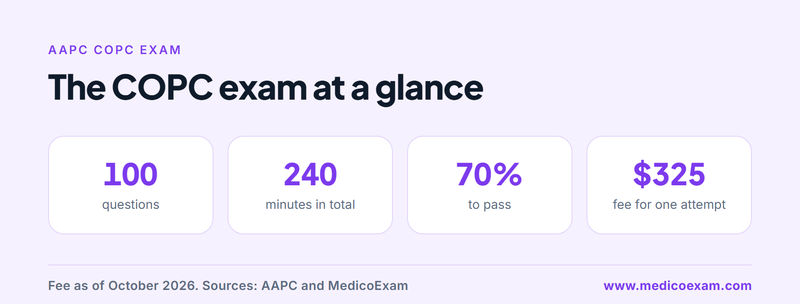
Start with the arithmetic, because it shapes how you practice. A limit of 240 minutes for 100 questions is 2.4 minutes, or 144 seconds, for each question. That is generous for a multiple-choice paper, and it tells you the questions are not quick recall. A scenario may give you a short operative or exam note and ask which code, modifier or reporting approach is most appropriate, and reading the note carefully takes most of the time.
On a 100-question paper, 70% works out to 70 correct answers, provided every question is worth the same. AAPC's page does not describe item weighting or how results are reported by topic, so treat 70 as a floor, not a target. Candidates who aim for 70 in practice tend to fall just below it on the day, because nerves and unfamiliar wording cost a few points. Aim for 80 or higher on full timed papers before you book.
The booking order is also worth knowing. According to AAPC, you purchase the exam voucher first and then see the available dates and times, and you choose between sitting it online at home under remote proctoring and travelling to a testing center. AAPC's exam guidance asks candidates to select print or ebook code books from its approved list when they redeem the voucher, so decide which format you will practice with early. Learning the layout of a book you will not have on the day is wasted effort.
AAPC also sells a self-paced instruction course for the COPC. Its COPC exam preparation course page has the current details. The course is optional, and the exam voucher is a separate purchase, so budget for both if you plan to use the course.
What are the four COPC topic areas, and how do they fit together?
AAPC groups the content of the COPC into four areas. MedicoExam's syllabus page for the exam repeats the same four, with their details, and neither source publishes a question count per area. That matters: you cannot rank the areas by weight, and any article that does so is guessing.
- Core knowledge areas. ICD-10-CM diagnosis coding for eye diseases such as glaucoma, cataracts, retinal conditions, strabismus and corneal disorders; E/M and eye exam coding; and modifiers with payer-specific rules.
- Surgical procedures of the eye. Cataract extraction and lens implants, corneal transplants, keratoplasty and refractive surgery, retinal procedures, and strabismus correction.
- Diagnostic and therapeutic services. Fluorescein angiography, fundus photography and OCT; diagnostic ultrasound and visual field testing; intravitreal injections and laser therapies.
- Specialized ophthalmology services. Oculoplastic procedures, pediatric ophthalmology including congenital anomalies, and compliance rules for global periods, bilateral procedures and bundling.
Read the four areas as layers, not as separate subjects. The core area gives you the diagnosis and the visit, the surgical area gives you the operation, the diagnostic area gives you the tests that justify and follow it, and the specialized area gives you the rules that decide what a payer will pay. A single exam scenario can touch three of them: a diagnosis from the first, a procedure from the second and a bundling rule from the fourth.
Because no weighting is published, start by treating the four areas as equal and let your first timed practice paper correct you. If you miss most of the surgical questions and few of the others, move your hours there. The plan later in this guide is built on that idea, not on a ranking the sources do not give.
What does the core knowledge area expect you to code?
AAPC lists three skills here: ICD-10-CM coding for eye diseases, E/M and eye exam coding, and the correct use of modifiers within payer-specific rules. They look basic, but they are the layer every other question sits on, and errors here repeat in every later section.
For diagnoses, AAPC names glaucoma, cataracts, retinal conditions, strabismus and corneal disorders. The habits to build are laterality and specificity. Many eye codes distinguish the right eye, the left eye and both, and several families, glaucoma among them, add a final character for the stage. A coder who stops at the first matching code loses the point. Also practice conditions that cross chapters, such as an eye complication of a systemic disease, where the sequencing of the two diagnoses decides the answer. That last point is study advice, not a list of what is on the exam, but it is the kind of reasoning scenario questions reward.
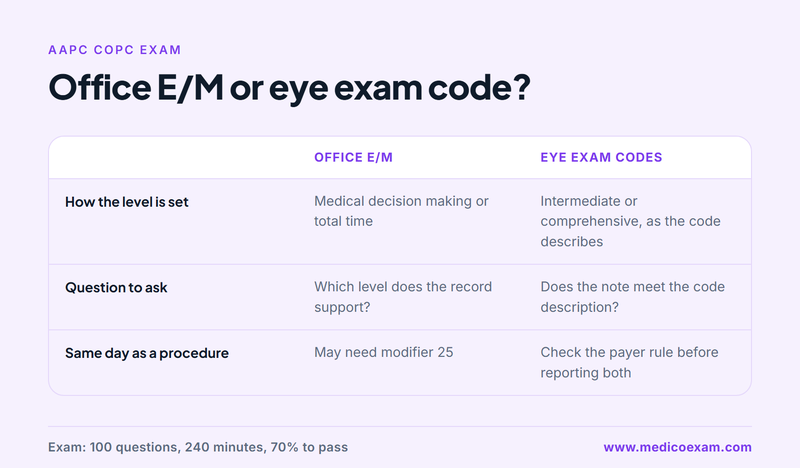
For the visit itself, AAPC refers to comprehensive, intermediate and problem-focused eye exams, alongside E/M. Learn the two frameworks separately. Office E/M levels follow medical decision making or total time on the date of the encounter, and history and examination no longer set the level. The ophthalmological service codes, 92002 to 92014 in the CPT book, are described as intermediate or comprehensive and as new or established patient services. The skill is deciding which framework the note supports, and spotting the day when the record supports both.
The same day often does support both, and that is where modifiers come in. Modifier 25 flags an E/M visit that was significant and separate from the procedure done the same day. Modifier 57 marks the visit at which the decision for major surgery was made. Modifier 50 reports a bilateral procedure, RT and LT report a single side, and modifier 79 reports an unrelated procedure during a postoperative period. For each one, ask three questions: what does the documentation have to show, which payers accept it, and what happens to payment if it is missing.
Here is a practice scenario of the kind worth writing out in your own words. A note documents an intravitreal injection in both eyes on the same day. Do you report one line with modifier 50, two lines with RT and LT, or something else? The answer depends on the code's bilateral indicator and on the payer's instruction, and the drug supply is reported separately with HCPCS Level II using units that match what the record says was given. If you can explain that chain in four sentences, you can answer the multiple-choice version in under two minutes.
Which eye surgeries does the COPC exam cover?
AAPC lists four groups of surgery. Each has a coding trap that is worth learning before you open a question bank.
Cataract extraction and lens implants come first. The questions turn on how the procedure was done, whether an intraocular lens was inserted in the same session, whether the case was complicated, and which eye was operated on. These procedures carry a global surgical period, so any later visit in that period has to be judged against it. Learn what falls inside the global package and what a modifier can separate from it.
Corneal transplants, keratoplasty and refractive surgery form the second group. Transplant codes depend on the layers of cornea replaced and on how the graft was prepared. Refractive procedures are often treated by payers as elective and are frequently not covered, so questions may ask how to handle the patient's responsibility. Read the payer rule in the scenario carefully rather than assuming coverage.
Retinal procedures include detachment repair, photocoagulation and vitrectomy. These are the longest descriptors in the specialty, and the code is often chosen by a single phrase: the technique used, the reason for the surgery or whether another procedure was done in the same session. Underline that phrase in every practice question and say why it decided the answer.
Strabismus correction and other extraocular muscle surgery completes the list. Here the coder counts muscles, notes whether one eye or both were operated on, and checks whether the procedure was a first operation or a revision. The details change the code and the reporting, so the number of muscles in the note is the fact to find first.
A practical way to study the whole area is to build one table. Give each procedure a row, and give the columns the code family, the global period, the laterality rule, the usual modifiers and the common payer edit, such as bundling under the National Correct Coding Initiative. Filling the table from your code books teaches you the books, and rereading it is faster than rereading chapters.
What do the diagnostic, therapeutic and specialized areas add?
The diagnostic and therapeutic area covers fluorescein angiography, fundus photography and optical coherence tomography, diagnostic ultrasound and visual field testing, and intravitreal injections, laser therapies and other therapeutic interventions. The recurring coding questions are about the report, the sides and the components.
- The report. A diagnostic test is reported when the record contains an interpretation and report, not only the images. A scenario that mentions pictures taken but no written reading is testing exactly this.
- The sides. Many descriptors in this group say unilateral or bilateral, so a test done on both eyes may be one unit, not two. Read the descriptor before you apply a bilateral modifier.
- The components. When a practice owns the equipment and the doctor reads the result, the technical and professional components may be reported together. When they are split, modifiers TC and 26 apply.
- The supply. Injections report the procedure and, separately, the drug, with units matched to the documented dose.
The specialized area adds three themes. First, oculoplastic procedures such as eyelid repairs, blepharoplasty and orbital surgeries. The central issue for blepharoplasty is whether the record shows a functional need, such as a visual field limitation, or only a cosmetic one, since payers treat the two very differently. Second, pediatric ophthalmology, including congenital anomalies. Congenital eye conditions are found in the ICD-10-CM chapter on congenital malformations, not in the eye chapter, so locating the right chapter is part of the skill.
Third, and the one AAPC states most directly, are the compliance considerations for global periods, bilateral procedures and bundling rules that are unique to ophthalmology. Questions here read like a short audit: a claim is described, and you decide whether it is compliant, which line should change or which modifier is unsupported. Practicing with a reviewer's eye, asking what the record has to show for each line to stand, prepares you for this better than memorizing code lists.
This is a coding exam, not a clinical one. Nothing in these questions asks you to diagnose or treat a patient; they ask you to report what a clinician documented. If a practice scenario seems to need clinical judgment to answer, the answer is probably in the documentation wording, so look there.
Which COPC topic is hardest, and what study order works?
The hardest area depends on where you started. A coder from a general or multispecialty office usually knows the E/M and modifier rules and finds the eye-specific procedures and anatomy new. Someone from a clinical or technician background often has the opposite problem: the anatomy and the procedures are familiar, but code selection, bundling and payer rules are not. A biller sits between the two. Your first timed paper will show which group you are in.
Whatever your group, this order moves from the shared base to the narrow rules, and it avoids a weighting the sources do not provide:
- Baseline. Take one full timed practice paper cold. Log every miss with its topic and the reason: knowledge, misreading or time.
- Core knowledge. Rebuild diagnosis laterality and specificity, then the two visit frameworks and the modifiers listed earlier.
- Surgery. Fill the procedure table for cataract, cornea, retina and strabismus, with global periods and bilateral rules.
- Diagnostics and specialized services. Cover the report, sides and components rules, then oculoplastic, pediatric and compliance scenarios.
- Mixed timed practice. Take full papers across all four areas and review the error log after each one.
How long should it take? That depends on your hours and experience, and AAPC does not publish a recommended study time, so plan from your baseline. A coder who scores in the 50s on the first paper needs a different plan from one in the 70s. Work in blocks of an hour or less, finish each block with ten questions on the topic just studied, and keep one longer session each week for a full paper.
Two habits separate candidates who pass from those who come close. The first is explaining each answer in a sentence, including the wrong options. The second is keeping the error log current. Reviewing the log the night before the exam beats any last pass through the books, because it targets your own mistakes.
Is there a COPC practice test, and how should you use one?
AAPC's COPC page, as read in October 2026, lists the exam voucher and the self-paced training course. It does not list a practice exam, so look at AAPC's current offerings before you assume one exists and do not pay for something its page does not describe.
MedicoExam's COPC practice test is an independent resource. It is scenario based, and it comes with a free sample set so you can judge the question style first. MedicoExam is not affiliated with AAPC, and no practice test, ours or anyone's, reproduces the real exam. Use practice to build the reasoning and the pace, and use AAPC's own page to confirm the rules.
Use practice papers in this way. Take the first one cold and untimed if you need to, to see the style. From the second paper on, time yourself at the real limit. Split the 240 minutes into 210 for a first pass and 30 for review: that is about 126 seconds per question on the first pass. Answer what you know, mark what you do not and move on, because a hard question early costs the same single point as an easy one late.
In the review half hour, go to the marked questions first, then re-read any question where your answer rested on the laterality, the global period or the modifier. Those three details decide more eye-coding questions than any rare code does. If a question gives a payer rule, treat it as part of the record: the exam is testing whether you apply the rule you were given.
On the day, have your voucher confirmation, your identification and your approved code books ready according to AAPC's instructions, and read the testing rules for your delivery method (remote proctor or testing center) the week before. Then trust the work in your error log. The COPC rewards coders who read documentation carefully and apply rules in order, and that is a skill you build by practice, not by cramming.
Frequently Asked Questions
How many questions and how much time does the COPC exam have?
The AAPC COPC exam allows 240 minutes for 100 questions, about 144 seconds each. Many questions are short coding scenarios built on a note, so reading the documentation carefully takes more of the clock than choosing between the answer options does.
What is the passing score for the COPC exam?
The passing score for the COPC exam is 70%. On a 100-question paper that equals 70 correct answers when all questions are worth the same. AAPC's page does not describe item weighting, so aim for 80% or higher on timed practice papers before you book the exam.
How much does the COPC exam cost?
As of October 2026, the COPC exam costs $325 for one attempt or $399 for two exam attempts. AAPC sets these fees and can change them, so check its page before you pay. The optional self-paced training course is a separate purchase.
What topics does the COPC exam cover?
AAPC groups the COPC into four areas: core knowledge, covering ICD-10-CM, eye exams, E/M and modifiers; surgical procedures of the eye; diagnostic and therapeutic services; and specialized ophthalmology services, including oculoplastic and pediatric coding and compliance rules for global periods, bilateral procedures and bundling.
How do you keep the COPC credential after passing?
AAPC's page says an active annual AAPC membership and 36 CEUs in each two-year cycle keep the COPC valid, with 8 of those CEUs in ophthalmology. These rules belong to AAPC and can change, so read the current requirements on its COPC page before you plan your continuing education. Rules can change, so read the current requirements on AAPC's page.
- AAPC COPC Question Bank |
- AAPC COPC Eligibility & Requirements |
- AAPC Ophthalmology Coder Practice Test |
- AAPC COPC Exam Cost |
- AAPC COPC Registration Process |
- AAPC Ophthalmology Coder Study Guide |
- AAPC COPC Recertification |
- AAPC COPC Certification Overview |
- AAPC Ophthalmology Coder Syllabus |
- AAPC COPC Preparation Time |
- AAPC COPC Passing Score |
- AAPC COPC Exam Format |
- AAPC Ophthalmology Coder Sample Questions |
- AAPC COPC Career Opportunities


