
CPPM Exam Guide: 135 Questions, 240 Minutes, Five Areas
The AAPC Certified Physician Practice Manager (CPPM) exam carries 135 questions, allows 240 minutes and sets the pass mark at 70%. It tests whether you can run the business side of a physician practice: money, compliance, people, health information and patient relations. The fee is $425 for one attempt or $499 for two.
Unlike a coding exam, there is no code set to memorise here, so preparation is about judgment across five management areas. To see how you read these scenarios today, start the CPPM practice test and treat your first score as a baseline.

| CPPM exam fact | What the sources say |
|---|---|
| Questions | 135 |
| Time limit | 240 minutes |
| Passing score | 70% |
| Fee, as of October 2026 | $425 for one attempt, $499 for two exam attempts |
| Delivery | Remote with live supervision, or in person at a test site |
| Credential validity | 2 years |
| Exam areas | Five, listed by AAPC without question counts |
What does the CPPM show, and who should sit it?
The CPPM is a credential for people who run a medical practice rather than code or bill inside one. AAPC describes it as proof of skill in managing the business operations of a practice, from compliance and revenue cycle to human resources, health information and governance. It is listed in the Master record under the categories Core and Practice Management, so it sits beside the coding and billing credentials rather than replacing them.
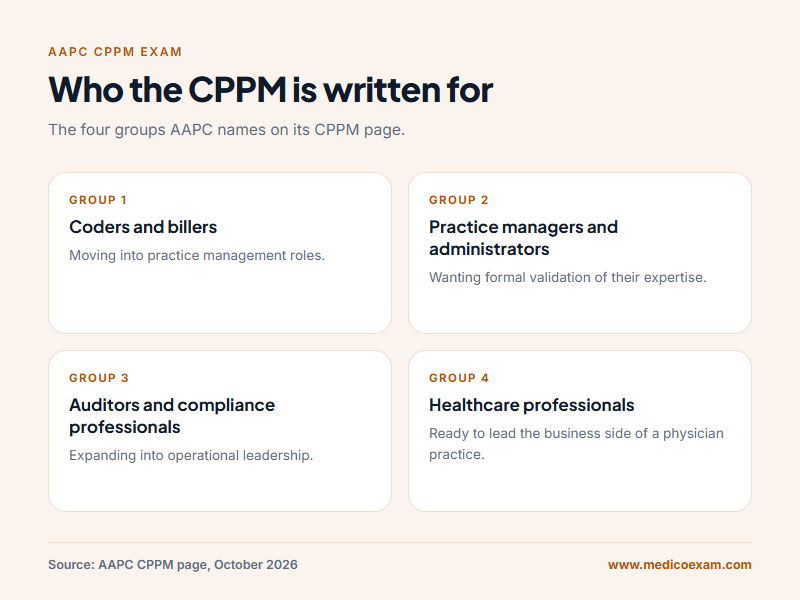
AAPC names four kinds of candidate. Coders and billers who want to move into management are the first. Practice managers and administrators who want formal validation of what they already do are the second. Auditors and compliance professionals who want operational leadership form the third, and healthcare professionals ready for business leadership in physician practices are the fourth. If you recognise yourself in any of them, the exam is aimed at you.
It is also an exam that expects experience. AAPC says on its own page that this is a difficult, high-level examination and not intended for individuals with limited practice management background. Read that as a real filter. A first-year front-desk employee will find the scenarios abstract, while a coder who has watched denials, audits and staffing problems from the side will find many of them familiar.
How is the CPPM exam structured and scored?
You buy the exam first, which gives you a voucher, and then you choose a date and a delivery mode. AAPC offers a supervised sitting from your own home or a seat on a computer at a test site, and availability varies by mode, location and date range. The paper holds 135 questions and runs 240 minutes, which works out at about 106 seconds per question if you spent the time evenly.
The passing score is 70%. Because 70% of 135 is 94.5, plan on getting about 95 answers right rather than aiming at a round 90. The sources do not state that questions carry different weights, so treat each one as worth the same and do not spend five minutes on a single scenario at the expense of five others.
As of October 2026, the fee is $425 for one attempt and $499 for two exam attempts, a difference of $74. For an exam AAPC itself calls difficult, the second attempt is cheap insurance for most people. If you already manage a practice and sit the mock papers comfortably above the pass mark, the single attempt is reasonable. AAPC sets and revises its prices, so confirm the amount on the official CPPM page before you pay.
What are the five CPPM exam areas?
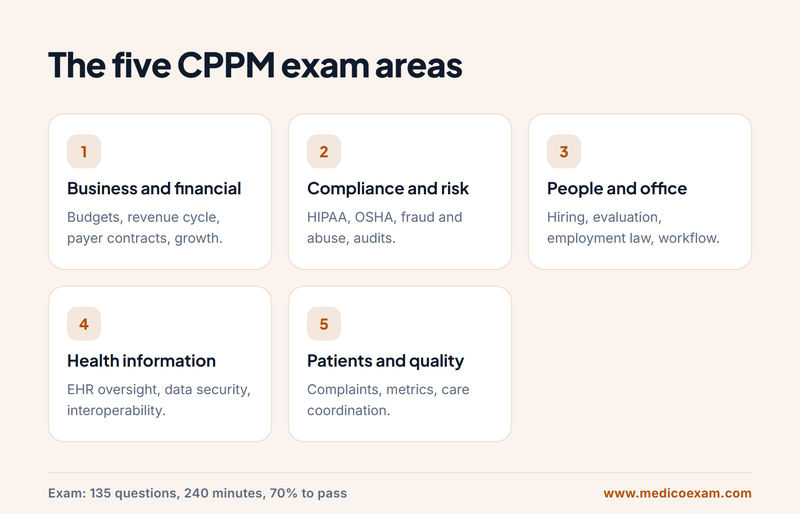
AAPC and the MedicoExam exam syllabus page both list the same five areas: business and financial management; compliance and risk management; human resources and office management; health information and technology; and patient relations and quality improvement. Neither source publishes a question count or percentage for each one, so there is no honest way to say which area carries most marks. Prepare all five.
That has a practical consequence. With no weighting to lean on, a candidate who is strong in finance but has never run a hiring process, or who knows compliance well but has little contact with the health record system, has a gap the exam can find. Your plan should aim to remove your single weakest area before it polishes your strongest.
What does business and financial management cover?
This area covers budgeting, accounting and financial reporting for medical practices, revenue cycle management, payer contracts and reimbursement strategies, and business planning and practice growth. It is the area where a practice manager is most accountable to the owners, because the numbers show whether the practice is healthy.
Learn to read a practice through its indicators. Days in accounts receivable, the denial rate, the net collection rate and the share of claims paid on first submission each tell you something different about the revenue cycle. A scenario might describe a rise in one of them and ask what to examine first. The sound answer usually starts with the stage of the cycle that the indicator belongs to, such as registration for eligibility denials, rather than with a general plan to work harder on billing.
Payer contracts reward careful reading. Know what a fee schedule is, why a contract that looks generous on paper can underpay once the practice's own mix of services is applied, and why an organisation reviews its largest payers before renewal. Practice growth questions tend to ask you to weigh cost against capacity: adding a service line, extending hours or hiring another clinician. Think about what the practice can support, not what sounds ambitious.
Which compliance and risk topics matter most?
AAPC lists federal healthcare regulations including HIPAA, OSHA and the fraud and abuse laws, developing, implementing and monitoring compliance programs, and managing audits, risk assessments and corrective actions. A practice manager is often the person who carries these duties in a small organisation, which is why the exam treats them as practical responsibilities and not as legal trivia.
Treat a compliance program as a cycle. Written standards come first, then training, then monitoring and auditing, then a route for staff to report concerns without fear, then a prompt response and corrective action when something is found, and then a check that the fix held. Questions often describe one step and ask what should follow. When two answers both sound responsible, pick the one that closes the loop with documentation.
Keep HIPAA and OSHA separate in your mind. HIPAA concerns the privacy and security of patient information, so a question about who may see a record, how a breach is handled or what a staff member must be trained on points there. OSHA concerns workplace safety, so a question about exposure, safety training or incident records points there. The fraud and abuse laws concern claims and referrals, so a scenario where billing behaviour is questionable points there. Naming the right regime first removes half the wrong options.
Risk assessment is the habit of asking what could go wrong before it does. Be able to describe how a practice finds its risks, ranks them by likelihood and effect, assigns an owner, and checks again later. If a scenario describes an internal audit that found a repeated error, the expected response is to correct it, find the cause and prevent a recurrence, not to quietly fix the single claim.
How are people and office management tested?
The human resources and office management area covers staff hiring, training, evaluation and retention, employment laws and workplace policies in the healthcare setting, and office workflow, communication and team leadership. These questions are the ones that most reward candidates who have really managed people.
For hiring, think in a sequence: define the role, advertise it, screen, interview with consistent questions, check references, make an offer and onboard. For performance, know why a written, documented evaluation protects both the employee and the practice. For retention, know the common causes of turnover in a practice, such as unclear roles, uneven workloads and little feedback, and the low-cost fixes that address them.
Employment law questions rarely ask for statute numbers. They ask what a manager should do when an employee reports harassment, requests leave, or is disciplined. The safe pattern is to follow written policy, document facts rather than opinions, treat similar cases alike and involve the right person, such as human resources or counsel, before acting. Answers that rely on a manager's informal judgment or a verbal warning with no record are usually the wrong ones.
Workflow questions test whether you can see a bottleneck. If patients wait too long at check-in, the cause may be forms, staffing at a peak hour or an appointment template with no room for overruns. Choose the answer that measures the problem first and changes the process second.
What do health information and patient relations include?
The health information and technology area covers oversight of health information management and electronic health records, data security, privacy and interoperability requirements, and using technology for efficiency and quality. You are not expected to configure software. You are expected to govern it: decide who has access, require audit trails, plan for backups and downtime, and choose tools with a clear aim.
Interoperability means that systems can exchange information in a form the other side can use. A practice manager meets it when a referral, a lab result or a record request has to move between organisations. Know why access should follow job role, why a lost laptop or a misdirected message has to be assessed as a possible breach, and why the practice keeps a plan for the days when the system is down.
Patient relations and quality improvement covers satisfaction, communication and conflict resolution, quality reporting initiatives and performance metrics, and care coordination. In a complaint scenario, the best answer normally listens first, acknowledges the concern, gathers the facts, resolves what can be resolved, and records the outcome so the practice can learn from it. It does not argue the point or promise something the practice cannot deliver.
For quality, understand the idea of measuring, comparing to a target, acting and measuring again. You should be able to explain why a metric needs a clear definition, a baseline and an owner. A question may give you a rate that has stalled and ask for the next improvement step. Look for the answer that tests a change on a small scale and checks the result.
Which area is hardest, and for whom?
It depends on where you start. Coders and billers usually know the revenue cycle and some compliance, but have seldom hired, evaluated or disciplined anyone. For them the human resources area is often the steepest climb. Office managers who have run a team for years usually have the opposite profile: confident with people, less sure about contract terms, financial statements and regulatory structure.
Auditors and compliance staff tend to be strong in one area and thin in two or three. Whichever group you belong to, the quickest way to find out is to sit a timed practice paper and sort each wrong answer under one of the five headings. Most people discover that their lost marks cluster in one or two areas, and that is where the first weeks of study belong.
What study plan works for the CPPM?
Because the areas are not weighted publicly, order your study by your own weakness. A working professional can use these five stages, each ending with practice questions in the area just studied.
Stage 1: a timed baseline
Sit a full-length paper under the clock before reading anything. Record the score for each of the five areas, not only the total, and rank the areas from weakest to strongest. That ranking is your plan.
Stage 2: your two weakest areas
Spend the most time here. For each, write down the common situations a practice manager faces and what the sound response is, in your own words. Then answer fresh questions without notes to see whether the idea has stuck.
Stage 3: the remaining areas
Revise the three stronger areas more briefly, concentrating on the topics from the AAPC list that you cannot explain in two sentences. Strong areas still lose marks when a topic you have never met appears.
Stage 4: mixed timed practice
Take full papers that mix all five areas and keep to the 240 minutes. Review every wrong answer and every right answer you guessed, and write the reason the correct option is better than the one you chose.
Stage 5: the last days
Stop learning new topics two days before the exam. Reread your notes, check your delivery arrangements and rest. If you plan to test at home, confirm in advance what AAPC requires of your room and equipment.
AAPC also sells its own self-paced CPPM preparation course. It is a sensible option if you want structured instruction rather than practice alone, and you can compare its outline with your own gaps before you decide.
How many weeks you need depends on how far your baseline sits from 70%. A manager who starts close needs a short refresh, whereas someone changing careers needs a longer, steadier plan. Let the score decide, not a calendar you copied from someone else.
How should you manage the 240 minutes?
Split the paper into three blocks of 45 questions and look at the clock after each. If you are behind by more than ten minutes at a checkpoint, flag the long scenarios and come back to them. Keep a final stretch for review so that flagged questions are answered, not left blank.
Management questions often present several answers that are all reasonable. Read the question for its real ask: first step, best step or most appropriate person. Eliminate answers that skip a step, ignore policy or act without information, then choose between those left by asking which one protects the patient, the staff and the practice at once.
Do not bring a rule from one practice into every answer. The exam is written for the general case, so a habit that works in your own office but is not the standard approach can mislead you. When your instinct and the standard process disagree, choose the standard process.
How do you keep the CPPM after you pass?
AAPC states that to maintain the credential you must keep your annual AAPC membership and earn 36 continuing education units every two years. That fits the 2-year validity in the Master record. The rule can change, so check the official page when you pass and diarise the end of the cycle on day one rather than in the last month.
Plan the units as you go. Webinars, conferences and courses in the same five areas that you studied keep your knowledge fresh and count toward the total when AAPC accepts them. Keep your certificates in one folder so renewal takes an hour, not a weekend.
Does AAPC publish a CPPM practice exam, and which should you pick?
The certifying body is AAPC. It publishes its own training for the CPPM, including the course described above, and it controls the real exam. MedicoExam is not affiliated with AAPC and does not call its own question bank official. The MedicoExam practice exam offers timed, scenario-based practice across the five areas so you can find weak spots before you pay for the real attempt.
Whatever you use, judge a practice set by whether it asks you to decide, not to recite. Management exams reward the candidate who can read a situation and pick a sound response, and a set that mostly asks for definitions teaches the wrong skill. When two full timed papers in a row land at or above 70%, you have good evidence that you are ready to book.
Your first score tells you more than any reading list, so sit a complete timed paper today and let the result choose where you begin.
Frequently Asked Questions
How many questions and how much time does the CPPM exam have?
The CPPM exam has 135 questions and a 240-minute time limit, about 106 seconds per question if time is spread evenly. Many questions describe a management situation and ask for the best response, so reading each scenario carefully takes more time than the answer options.
What is the CPPM passing score?
The passing score for the AAPC Certified Physician Practice Manager exam is 70%. Of 135 questions, 70% is 94.5, so plan on about 95 correct answers. The sources do not describe any question weighting, so treat every question as equal.
How much does the CPPM exam cost?
As of October 2026, the CPPM exam costs $425 for one attempt or $499 for two exam attempts. The second attempt adds $74. AAPC also sells a self-paced preparation course. Prices change, so confirm them on AAPC's CPPM page before buying.
What are the five CPPM exam areas?
Money, compliance, people, health information and patients. In AAPC's wording these are business and financial management, compliance and risk management, HR and office management, health information and technology, and patient relations. No question count per area is published.
Can I take the CPPM exam online?
Yes. You can sit the CPPM from home under a live proctor, or travel to a test center instead. Buy the voucher first, then pick a slot. Which dates you see depends on the mode and the location you choose.
How do I keep the CPPM credential?
Per AAPC, holders keep an active yearly AAPC membership and collect 36 CEUs in each two-year period. The Master record gives the credential a 2-year validity. Read AAPC's CPPM page for the current renewal rules once you pass.
- AAPC CPPM Question Bank |
- AAPC CPPM Eligibility & Requirements |
- AAPC Physician Practice Manager Practice Test |
- AAPC CPPM Exam Cost |
- AAPC CPPM Registration Process |
- AAPC Physician Practice Manager Study Guide |
- AAPC CPPM Recertification |
- AAPC CPPM Certification Overview |
- AAPC Physician Practice Manager Syllabus |
- AAPC CPPM Preparation Time |
- AAPC CPPM Passing Score |
- AAPC CPPM Exam Format |
- AAPC Physician Practice Manager Sample Questions |
- AAPC CPPM Career Opportunities


