
CCI CCT Certification Sample Questions
The CCI Certified Cardiographic Technician Certification Sample Question Set on this page is designed to familiarize you with the actual CCI CCT exam format and question types. These sample questions help you understand how questions are structured and what to expect on test day. While they provide a useful starting point, they represent only a limited preview of the real exam experience.
These sample questions are intended for evaluation and familiarization only. To understand exam style, pacing, and reasoning patterns more clearly, we recommend trying our online sample practice environment. If you are preparing for the CCI Certified Cardiographic Technician (CCT) and want to assess your readiness more rigorously, structured, timed, scenario-based practice is recommended. This approach aligns with the cognitive demands and professional expectations typically associated with cardiovascular technicians, ECG/EKG technicians, allied health professionals working in settings such as hospitals, cardiology clinics, diagnostic cardiac testing facilities.
Try Sample Exam » | Access Full CCI CCT Practice Exam »
The demo introduces core concepts, while full-length premium simulations provide deeper, scenario-based coverage that more closely reflects the actual cognitive demands of the CCI Certified Cardiographic Technician exam, particularly in areas such as resting ECG acquisition and analysis, stress and ambulatory monitoring, cardiac rhythm analysis. You can use these sample questions as a starting point, then progress to the CCI CCT Certification Practice Exam for stronger readiness. Our premium simulations are designed to mirror real exam conditions, helping you refine reasoning, pacing, and decision-making before your official exam attempt.
CCI CCT Sample Questions:
01. A patient reports brief episodes of palpitations occurring one or two times every day. The clinician wants continuous rhythm recording over the next 24 to 48 hours to quantify ectopy and correlate symptoms.
Which ambulatory-monitoring approach best matches this request?
a) A resting 12-lead ECG repeated once per month
b) No monitoring because daily symptoms are too frequent for ambulatory recording
c) Continuous Holter monitoring
d) A patient-triggered event monitor used only for symptoms occurring once every several months
02. After cardiac surgery, a patient develops a regular narrow-complex rhythm at 136/min. Sinus P waves continue independently at 92/min and repeatedly drift through the QRS complexes, producing atrioventricular dissociation. The ventricular rhythm is faster than the atrial rhythm.
Which rhythm is most likely?
a) Complete atrioventricular block with a junctional escape rhythm
b) Junctional ectopic tachycardia
c) Sinus tachycardia
d) Atrial flutter with fixed conduction
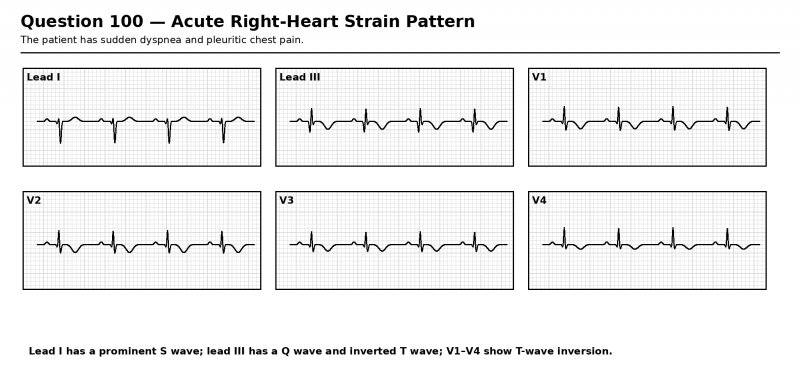
03. Refer to the displayed ECG. A patient has sudden dyspnea and pleuritic chest pain. Lead I has a prominent S wave, lead III has a Q wave with T-wave inversion, and V1 through V4 show anterior T-wave inversion.
Select two correct responses.
a) The ECG pattern alone definitively proves pulmonary embolism
b) The T-wave inversion in V1 through V4 localizes an acute posterior infarction
c) The S wave in lead I and Q wave with inverted T wave in lead III form an S1Q3T3 pattern
d) The combined findings are compatible with acute right-ventricular strain and warrant prompt clinical communication
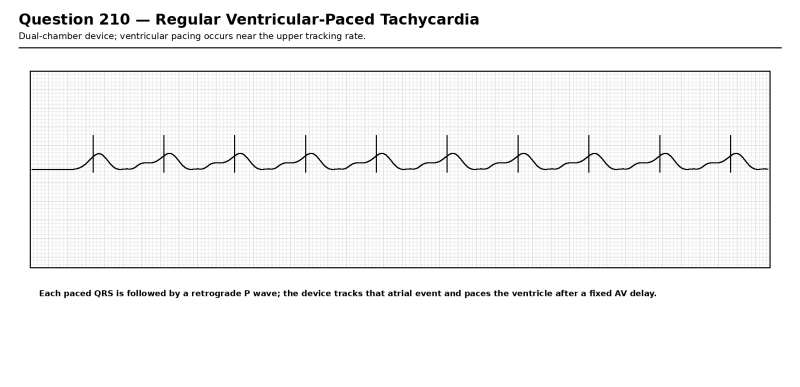
04. Refer to the dual-chamber pacing strip. A regular ventricular-paced tachycardia occurs near the programmed upper tracking rate. Each paced QRS is followed by a retrograde P wave, which is sensed by the device and followed after a fixed AV delay by the next ventricular pacing stimulus.
Which mechanism best explains the rhythm?
a) Pacemaker-mediated tachycardia using retrograde atrial conduction as part of a reentrant loop
b) Atrial oversensing with inappropriate inhibition of all ventricular pacing
c) Ventricular failure to capture
d) Normal sinus tracking because each atrial wave precedes the ventricular complex
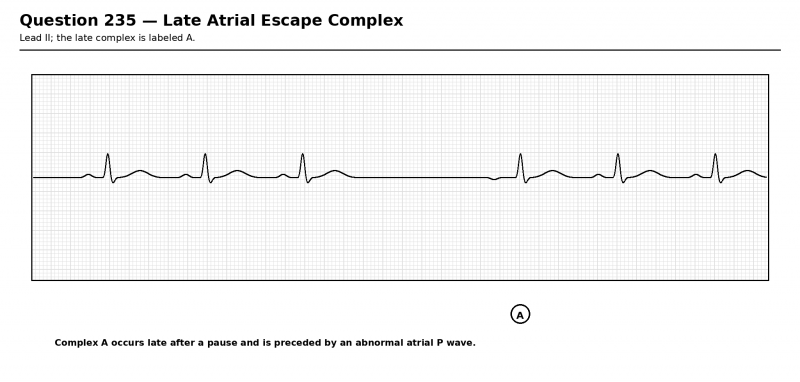
05. Refer to the lead-II strip. Complex A occurs late after a pause and is preceded by an abnormal P wave, followed by a narrow QRS complex.
Which type of beat is Complex A?
a) Junctional escape complex
b) Premature atrial complex
c) Ventricular escape complex
d) Atrial escape complex
06. Refer to the onset and termination strips. Abnormal atrial P waves precede every narrow QRS. The rhythm gradually accelerates at onset and gradually slows before termination.
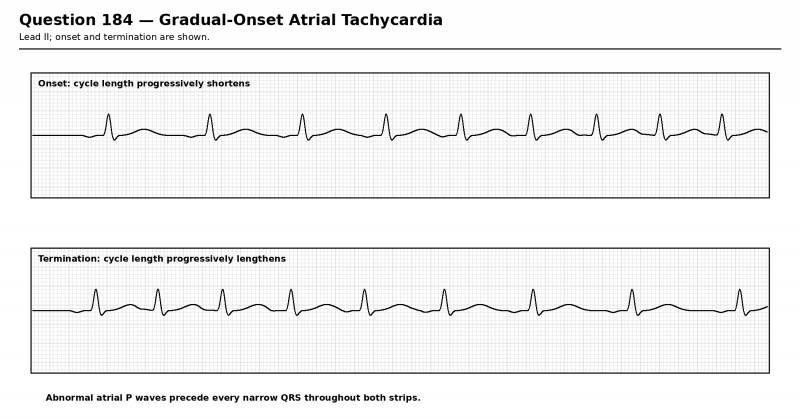
Which rhythm mechanism is most consistent with this warm-up and cool-down pattern?
a) Focal atrial tachycardia caused by enhanced automaticity
b) Atrioventricular nodal reentrant tachycardia
c) Sinus tachycardia
d) Atrial fibrillation
07. Refer to the simultaneous ECG and arterial pulse display during transcutaneous pacing. Every pacing spike is followed by a wide QRS complex, but no arterial waveform or palpable pulse follows. The patient is unresponsive.
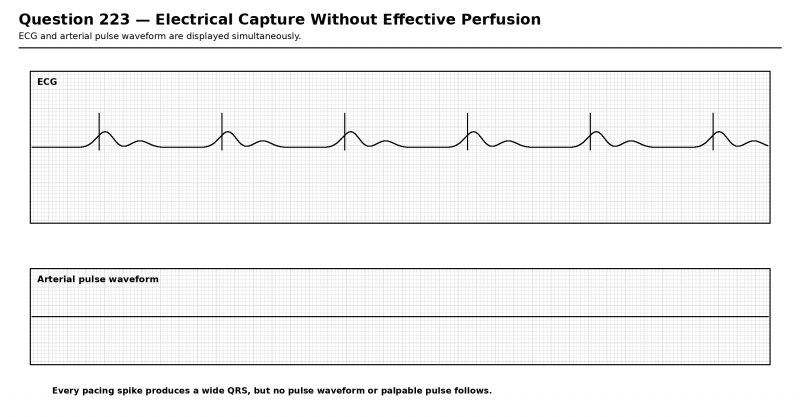
Select two correct responses.
a) The absence of a pulse means that every pacing spike failed to capture electrically
b) Mechanical capture is proven by the presence of a wide paced QRS
c) Electrical capture is present, but effective mechanical capture is absent
d) Treat the patient as pulseless electrical activity and continue the cardiac-arrest response while the pacing setup and reversible causes are evaluated
08. A cooperative 3-year-old child requires a standard 12-lead ECG. Adult electrodes overlap when placed at the correct precordial landmarks.
What is the best approach?
a) Use only limb leads because precordial leads are not obtained in young children
b) Use appropriately sized pediatric electrodes while preserving the standard anatomical landmarks
c) Stack overlapping adult electrodes and rely on the machine to separate the signals
d) Place all six precordial electrodes in a straight line across the upper abdomen
09. A patient with bilateral above-knee amputations requires a resting 12-lead ECG. The upper extremities are intact, and no prior tracing is available for comparison.
Which approach is most appropriate for the lower-limb electrodes?
a) Attach the lower-limb electrodes to the wheelchair frame because it is in contact with the patient
b) Place both lower-limb electrodes on the same side of the abdomen to keep the wires together
c) Place the right-leg and left-leg electrodes symmetrically on the lower torso according to protocol and document the modified placement
d) Omit the lower-limb electrodes and record only the six precordial leads
10. Before a standard resting 12-lead ECG, the technician confirms that the four limb electrodes and electrodes V1 through V5 are attached. No electrode is available for the V6 position.
What should the technician do?
a) Obtain and place a separate electrode at the correct V6 location before recording
b) Place a second wire on the V5 electrode and label the duplicate signal as V6
c) Begin the acquisition because nine electrodes are sufficient to generate all 12 leads
d) Move the V4 electrode to the V6 position after the first half of the tracing without documenting the change
Answers:
|
Question: 01 Answer: c |
Question: 02 Answer: b |
Question: 03 Answer: c, d |
Question: 04 Answer: a |
Question: 05 Answer: d |
|
Question: 06 Answer: a |
Question: 07 Answer: c, d |
Question: 08 Answer: b |
Question: 09 Answer: c |
Question: 10 Answer: a |
For full-length, timed, scenario-based practice aligned with the official exam framework - and to build pacing, consistency, and confidence - explore our Premium CCI CCT Certification Practice Exam.
Note: These sample questions are not official exam questions and are intended only for familiarization and study purposes. If you find any typos or data entry errors in these CCI Certified Cardiographic Technician (CCT) sample questions, please let us know by emailing us at feedback@medicoexam.com


