
CCI CRAT Certification Sample Questions
The CCI Certified Rhythm Analysis Technician Certification Sample Question Set on this page is designed to familiarize you with the actual CCI CRAT exam format and question types. These sample questions help you understand how questions are structured and what to expect on test day. While they provide a useful starting point, they represent only a limited preview of the real exam experience.
These sample questions are intended for evaluation and familiarization only. To understand exam style, pacing, and reasoning patterns more clearly, we recommend trying our online sample practice environment. If you are preparing for the CCI Certified Rhythm Analysis Technician (CRAT) and want to assess your readiness more rigorously, structured, timed, scenario-based practice is recommended. This approach aligns with the cognitive demands and professional expectations typically associated with Cardiac monitoring professionals, cardiovascular technologists and technicians, allied health professionals working in settings such as Hospital and cardiac telemetry settings, ambulatory cardiac monitoring services, cardiovascular diagnostic settings.
Try Sample Exam » | Access Full CCI CRAT Practice Exam »
The demo introduces core concepts, while full-length premium simulations provide deeper, scenario-based coverage that more closely reflects the actual cognitive demands of the CCI Certified Rhythm Analysis Technician exam, particularly in areas such as Cardiac rhythm analysis and interpretation, ECG monitoring and troubleshooting, processing and prioritizing cardiac test findings. You can use these sample questions as a starting point, then progress to the CCI CRAT Certification Practice Exam for stronger readiness. Our premium simulations are designed to mirror real exam conditions, helping you refine reasoning, pacing, and decision-making before your official exam attempt.
CCI CRAT Sample Questions:
01. A patient is using an automatically recording ambulatory monitor that also has a symptom button. What instruction best supports symptom-rhythm correlation?
a) Press the symptom button as instructed and record the exact time, symptom, and activity.
b) Record symptoms only when the patient believes the rhythm is dangerous.
c) Avoid using the symptom button because the device records every clinically important event automatically.
d) Press the symptom button at the end of each day for all symptoms experienced during that day.
02. A rhythm is regular at 48 beats/min with upright uniform P waves before every narrow QRS complex and a constant PR interval. Which two contexts can produce physiologic sinus bradycardia in an otherwise stable adult? (Select two correct responses.)
a) Brisk exercise requiring increased cardiac output
b) Deep sleep with increased parasympathetic influence
c) Acute emotional stress with catecholamine release
d) Resting state in a well-trained endurance athlete
e) High fever with sympathetic activation
03. Channel 1 becomes abruptly flat while Channel 2 continues to show normal sinus complexes. A lead-disconnection alert occurs at the same time.
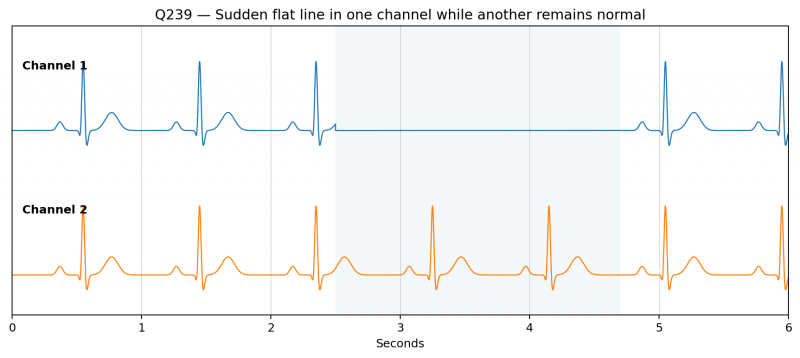
Which interpretation is most accurate?
a) True asystole
b) Fine ventricular fibrillation
c) Lead-off or electrode-disconnection artifact in Channel 1
d) Ventricular standstill
04. The displayed rhythm is regular at approximately 48 beats/min with narrow QRS complexes. Small inverted P waves appear shortly after the QRS complexes.
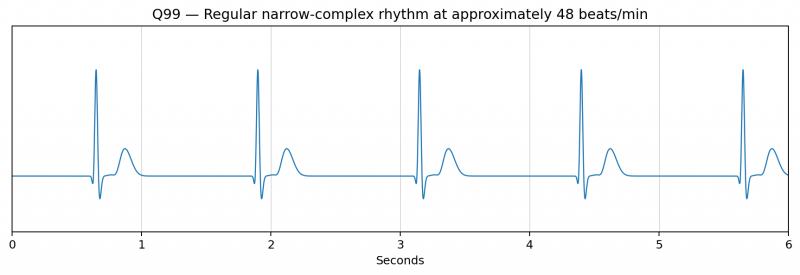
Which rhythm is most likely?
a) Atrial fibrillation with slow ventricular response
b) Sinus bradycardia
c) Accelerated junctional rhythm
d) Junctional escape rhythm
05. The tracing contains normal sinus complexes and full ventricular ectopic complexes. One labeled complex has an intermediate morphology because intrinsic and ventricular ectopic impulses activate the ventricles nearly simultaneously.
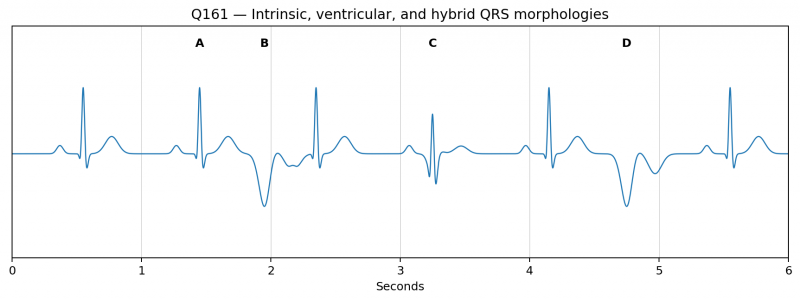
Which label identifies the fusion beat?
a) Label B
b) Label D
c) Label C
d) Label A
06. Which information is most important for a patient to record when symptoms occur during ambulatory ECG monitoring?
a) Only the meals and beverages consumed during the monitoring period.
b) The exact time, the symptom experienced, and the activity being performed.
c) Only whether the symptom felt mild, moderate, or severe.
d) A general summary written after the monitor is returned.
07. Which three findings support identification of a premature ventricular complex? (Select three correct responses.)
a) No normally conducted P wave immediately precedes the premature QRS complex.
b) The rhythm must become permanently irregular after one PVC.
c) The QRS complex is wide and has an abnormal morphology.
d) The premature complex is always narrow and identical to the sinus QRS.
e) The complex occurs earlier than expected.
08. The underlying rhythm is sinus. One narrow QRS complex occurs earlier than expected without a preceding sinus P wave, and a small inverted P wave follows it.
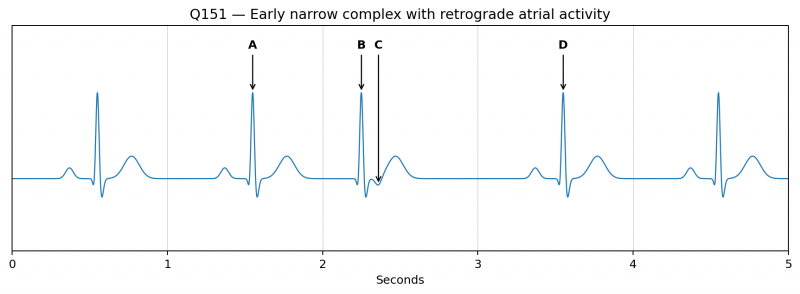
Which label identifies the premature junctional complex?
a) Label C
b) Label A
c) Label D
d) Label B
09. A normal rhythm strip shows QRS complexes measuring 0.08 second. The atrial impulses conduct through the AV node with a stable PR interval. Which physiologic explanation best accounts for the narrow QRS morphology?
a) The impulse is distributed rapidly through the His-Purkinje system, producing coordinated ventricular depolarization.
b) The T wave overlaps and shortens the QRS complex.
c) The ventricles are activated slowly from one myocardial cell to the next without using the conduction system.
d) The atria and ventricles depolarize simultaneously from the sinus node.
10. Each atrial pacing stimulus is followed by a ventricular pacing stimulus after an unusually short, fixed interval. The behavior begins when a small signal is detected on the ventricular channel shortly after atrial pacing.
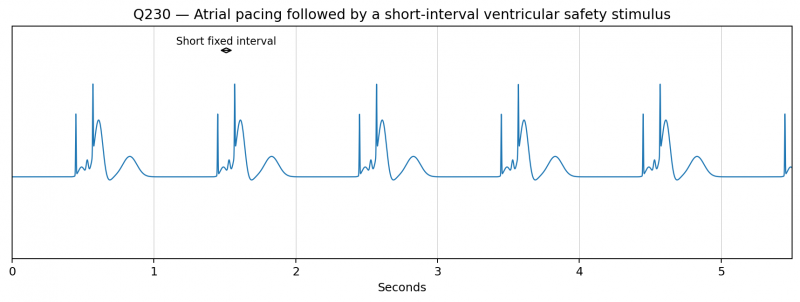
Which device behavior is most likely?
a) Pacemaker-mediated tachycardia
b) Normal atrioventricular sequential pacing at the programmed AV delay
c) Intermittent ventricular failure to capture
d) Ventricular safety pacing after suspected crosstalk
Answers:
|
Question: 01 Answer: a |
Question: 02 Answer: b, d |
Question: 03 Answer: c |
Question: 04 Answer: d |
Question: 05 Answer: c |
|
Question: 06 Answer: b |
Question: 07 Answer: a, c, e |
Question: 08 Answer: d |
Question: 09 Answer: a |
Question: 10 Answer: d |
For full-length, timed, scenario-based practice aligned with the official exam framework - and to build pacing, consistency, and confidence - explore our Premium CCI CRAT Certification Practice Exam.
Note: These sample questions are not official exam questions and are intended only for familiarization and study purposes. If you find any typos or data entry errors in these CCI Certified Rhythm Analysis Technician (CRAT) sample questions, please let us know by emailing us at feedback@medicoexam.com


