
CCI RCCS Certification Sample Questions
The CCI Registered Congenital Cardiac Sonographer Certification Sample Question Set on this page is designed to familiarize you with the actual CCI RCCS exam format and question types. These sample questions help you understand how questions are structured and what to expect on test day. While they provide a useful starting point, they represent only a limited preview of the real exam experience.
These sample questions are intended for evaluation and familiarization only. To understand exam style, pacing, and reasoning patterns more clearly, we recommend trying our online sample practice environment. If you are preparing for the CCI Registered Congenital Cardiac Sonographer (RCCS) and want to assess your readiness more rigorously, structured, timed, scenario-based practice is recommended. This approach aligns with the cognitive demands and professional expectations typically associated with Congenital cardiac sonographers, cardiac sonographers and echocardiography professionals, cardiovascular ultrasound professionals working in settings such as Pediatric cardiology and echocardiography laboratories, adult congenital heart disease programs, hospitals and outpatient cardiac imaging settings.
Try Sample Exam » | Access Full CCI RCCS Practice Exam »
The demo introduces core concepts, while full-length premium simulations provide deeper, scenario-based coverage that more closely reflects the actual cognitive demands of the CCI Registered Congenital Cardiac Sonographer exam, particularly in areas such as Congenital cardiac image acquisition and optimization, disease-specific echocardiographic assessment, patient care and preliminary reporting. You can use these sample questions as a starting point, then progress to the CCI RCCS Certification Practice Exam for stronger readiness. Our premium simulations are designed to mirror real exam conditions, helping you refine reasoning, pacing, and decision-making before your official exam attempt.
CCI RCCS Sample Questions:
01. A focal saccular dilation arises from the left pulmonary artery and fills with arterial flow. There is no ductal connection or adjacent mass. Which diagnosis is most consistent?
a) Pulmonary venous varix
b) Left atrial appendage aneurysm
c) Ductus arteriosus aneurysm
d) Left pulmonary artery aneurysm
02. A teenager with unrepaired coarctation has extensive intercostal collateral arteries and only a modest Doppler gradient across the isthmus. Which interpretation is most appropriate?
a) Collateral flow may decompress the obstruction and cause Doppler gradient to underestimate anatomical severity.
b) The modest gradient excludes clinically important coarctation.
c) Intercostal collaterals prove the aortic isthmus is normal.
d) Only the peak gradient should be reported; arch anatomy is irrelevant.
03. Refer to the apical three-chamber LVOT schematic.
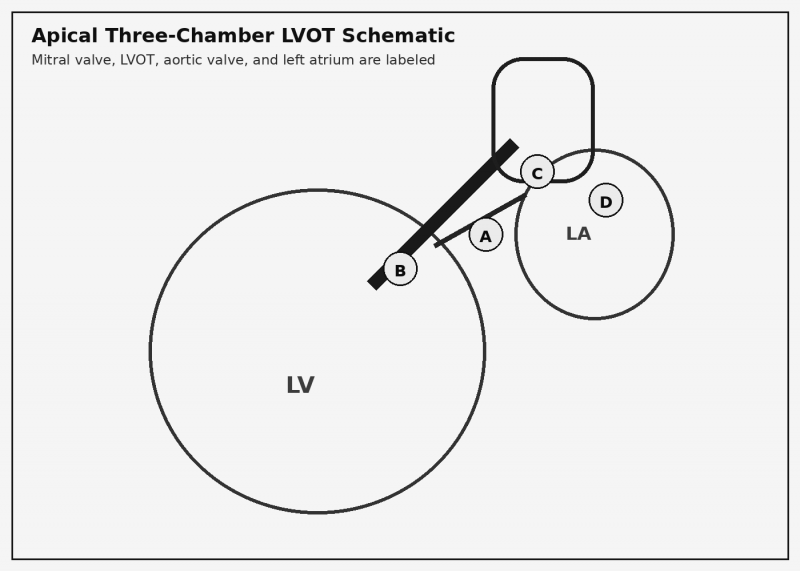
Select two correct structure-to-zone mappings.
a) The apical three-chamber view does not display the aortic valve.
b) Zone D — inferior vena cava
c) Zone C — right ventricular outflow tract
d) Zone A — mitral valve
e) Zone B — left ventricular outflow tract
04. Refer to the coronary fistula schematic.
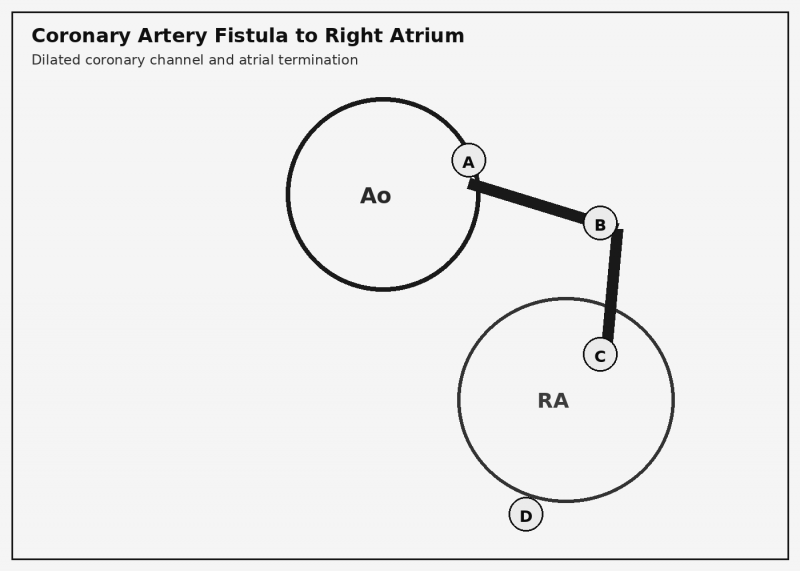
Which labeled site represents the terminal entry of the coronary fistula into the right atrium?
a) Site D
b) Site C
c) Site A
d) Site B
05. Refer to the inferior vena cava respiratory measurement schematic.
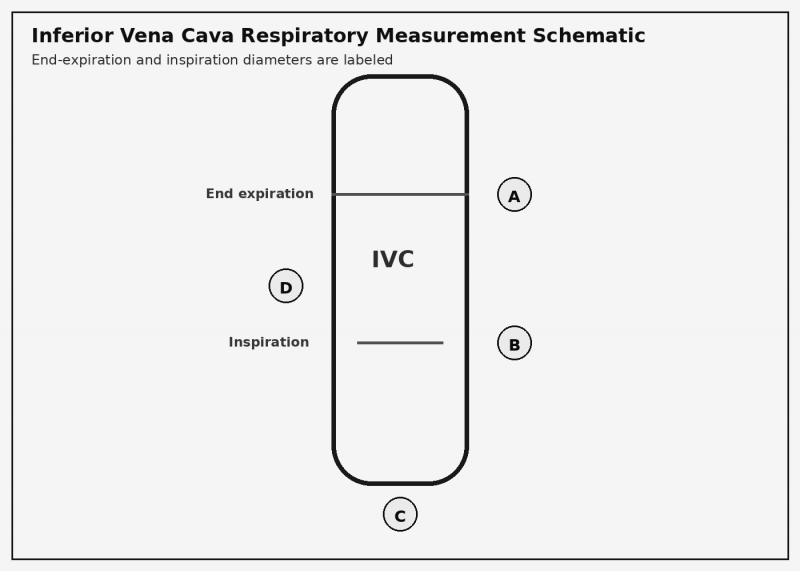
Select two correct responses.
a) Measurement A represents the larger end-expiratory diameter.
b) Respiratory variation should be assessed from unrelated vessel segments.
c) Measurement B represents the smaller inspiratory diameter.
d) Measurement C represents the aortic annulus.
e) Diameter change can be interpreted without considering ventilation or Fontan physiology.
06. Refer to the mid-esophageal right ventricular inflow-outflow TEE schematic.
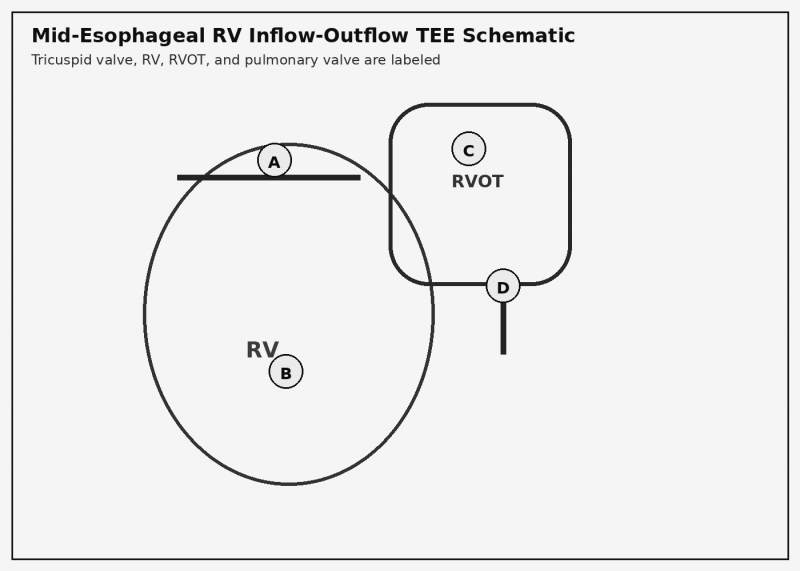
Select two correct mappings.
a) Zone B — left atrial appendage
b) Zone C — right ventricular outflow tract
c) Zone A — tricuspid valve
d) Zone D — mitral valve
e) The view cannot assess the pulmonary valve.
07. The anterior ventricular wall is well visualized, but deep posterior structures remain dark despite high overall gain. Increasing overall gain causes near-field blooming. Which adjustment is most appropriate?
a) Increase the deeper time-gain compensation sliders while reducing excessive overall gain.
b) Increase only the near-field time-gain compensation.
c) Raise the color Doppler scale.
d) Lower output power and deep gain simultaneously.
08. The sonographer is estimating the pressure gradient across a restrictive ventricular septal defect. (Select two correct responses.)
a) Use pulsed-wave Doppler only because the defect is small.
b) Assume the left ventricular-to-right ventricular pressure difference is zero when the jet is high velocity.
c) Measure a truncated spectral envelope as the true peak.
d) Use color Doppler to identify the jet direction and align continuous-wave Doppler as parallel as possible.
e) Record the highest complete reproducible systolic velocity from the best available window.
09. Pulmonary regurgitation end-diastolic velocity is 2.0 m/s, and estimated right atrial pressure is 8 mm Hg. Assuming no significant right ventricular outflow obstruction, which estimated pulmonary artery diastolic pressure is closest?
a) Approximately 24 mm Hg
b) Approximately 40 mm Hg
c) Approximately 20 mm Hg
d) Approximately 12 mm Hg
10. A sedated child undergoing transesophageal echocardiography develops new stridor, decreasing oxygen saturation, and reduced chest movement. What should the sonographer do first?
a) Continue probe manipulation until the planned views are obtained.
b) Stop image acquisition, alert the sedation and airway team immediately, and assist according to the emergency plan.
c) Document the event only after the child returns to the recovery area.
d) Increase probe depth because the stridor is probably caused by a shallow imaging position.
Answers:
|
Question: 01 Answer: d |
Question: 02 Answer: a |
Question: 03 Answer: d, e |
Question: 04 Answer: b |
Question: 05 Answer: a, c |
|
Question: 06 Answer: b, c |
Question: 07 Answer: a |
Question: 08 Answer: d, e |
Question: 09 Answer: a |
Question: 10 Answer: b |
For full-length, timed, scenario-based practice aligned with the official exam framework - and to build pacing, consistency, and confidence - explore our Premium CCI RCCS Certification Practice Exam.
Note: These sample questions are not official exam questions and are intended only for familiarization and study purposes. If you find any typos or data entry errors in these CCI Registered Congenital Cardiac Sonographer (RCCS) sample questions, please let us know by emailing us at feedback@medicoexam.com
- CCI Registered Congenital Cardiac Sonographer Practice Test |
- CCI RCCS Registration Process |
- CCI RCCS Recertification |
- CCI RCCS Certification Overview |
- CCI RCCS Preparation Time |
- CCI RCCS Exam Format |
- CCI Registered Congenital Cardiac Sonographer Sample Questions |
- CCI RCCS Career Opportunities


