
CCI RCES Certification Sample Questions
The CCI Registered Cardiac Electrophysiology Specialist Certification Sample Question Set on this page is designed to familiarize you with the actual CCI RCES exam format and question types. These sample questions help you understand how questions are structured and what to expect on test day. While they provide a useful starting point, they represent only a limited preview of the real exam experience.
These sample questions are intended for evaluation and familiarization only. To understand exam style, pacing, and reasoning patterns more clearly, we recommend trying our online sample practice environment. If you are preparing for the CCI Registered Cardiac Electrophysiology Specialist (RCES) and want to assess your readiness more rigorously, structured, timed, scenario-based practice is recommended. This approach aligns with the cognitive demands and professional expectations typically associated with Cardiovascular technologists, cardiac electrophysiology professionals, allied health professionals working in settings such as Electrophysiology laboratories, cardiac device and implant services, hospital cardiovascular services.
Try Sample Exam » | Access Full CCI RCES Practice Exam »
The demo introduces core concepts, while full-length premium simulations provide deeper, scenario-based coverage that more closely reflects the actual cognitive demands of the CCI Registered Cardiac Electrophysiology Specialist exam, particularly in areas such as Diagnostic and therapeutic cardiac electrophysiology, advanced mapping and EP recording, CIED implantation and interrogation. You can use these sample questions as a starting point, then progress to the CCI RCES Certification Practice Exam for stronger readiness. Our premium simulations are designed to mirror real exam conditions, helping you refine reasoning, pacing, and decision-making before your official exam attempt.
CCI RCES Sample Questions:
01. A left atrial macroreentrant tachycardia is entrained from the mitral isthmus with concealed fusion and a PPI 6 ms longer than the tachycardia cycle length. Entrainment from the right atrium gives a PPI 120 ms longer. Which mechanism is favored?
a) Junctional tachycardia
b) Sinus tachycardia
c) Mitral-isthmus-dependent atypical flutter
d) Typical cavotricuspid-isthmus flutter
02. A long-RP tachycardia has concentric atrial activation. Ventricular overdrive pacing produces a V–A–V response with a PPI–TCL of 180 ms, and His-refractory ventricular stimuli do not alter the atrium. Which diagnosis is favored?
a) Atypical AVNRT
b) Orthodromic AVRT over a septal pathway
c) Antidromic AVRT
d) Focal atrial tachycardia
03. An atrial tachycardia map shows one site activating 45 ms before the surface P wave, with centrifugal spread away from that point. Which mechanism is most likely?
a) Orthodromic AVRT
b) Typical AVNRT
c) Ventricular tachycardia
d) Focal atrial tachycardia
04. Atrial tachycardia activation is earliest inside the left superior pulmonary vein and becomes later toward the antrum and left atrium. Which interpretation is most appropriate?
a) A pulmonary-vein focal atrial tachycardia is likely
b) The cavotricuspid isthmus is the critical circuit
c) The rhythm is infra-Hisian block
d) The earliest site must be a far-field ventricular signal
05. During a narrow-complex tachycardia, atrioventricular dissociation occurs transiently while the junctional rate continues unchanged. Which mechanism is favored?
a) Sinus tachycardia
b) Junctional tachycardia
c) Typical atrial flutter with 1:1 conduction
d) Orthodromic AVRT
06. Entrainment from the cavotricuspid isthmus during atrial flutter produces concealed fusion and a postpacing interval 8 ms longer than the flutter cycle length. Which conclusion is most appropriate?
a) The rhythm is focal atrial tachycardia
b) The pacing site lies within the flutter circuit
c) The isthmus is remote from the circuit
d) The atrium was not captured
07. The team is confirming bidirectional cavotricuspid-isthmus block after ablation. (Select three supportive findings.)
a) Reversal of activation sequence when pacing from opposite sides of the line
b) Unchanged short transisthmus conduction in both directions
c) Differential pacing consistent with detoured conduction around the tricuspid annulus
d) Widely separated double potentials along the ablation line
08. Three atrial activation sequences are shown in the accompanying table.
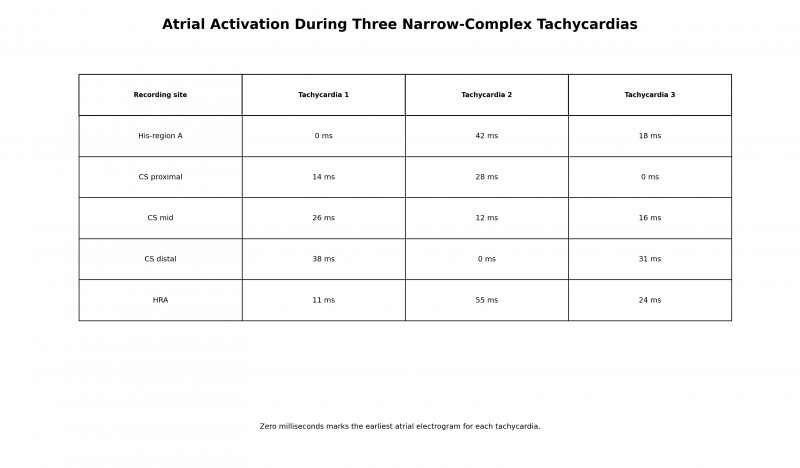
Which tachycardia has an eccentric left free-wall activation pattern?
a) Tachycardia 3
b) Tachycardia 1
c) Tachycardia 2
d) All three are concentric
09. A regular narrow-complex tachycardia is suspected to be orthodromic AVRT. (Select two expected characteristics.)
a) Atrial activation that continues unchanged during complete AV block
b) Retrograde atrial activation through an accessory pathway
c) Complete independence of the ventricle from the circuit
d) Antegrade conduction through the AV node and His–Purkinje system
10. A long-RP narrow-complex tachycardia is being differentiated between focal atrial tachycardia and atypical AVNRT. (Select two findings that favor focal atrial tachycardia.)
a) A His-refractory ventricular stimulus advances the atrium
b) Ventricular entrainment produces a short PPI–TCL
c) Atrial overdrive pacing produces an A–A–H–V response
d) Atrial activity continues unchanged during adenosine-induced AV block
Answers:
|
Question: 01 Answer: c |
Question: 02 Answer: a |
Question: 03 Answer: d |
Question: 04 Answer: a |
Question: 05 Answer: b |
|
Question: 06 Answer: b |
Question: 07 Answer: a, c, d |
Question: 08 Answer: c |
Question: 09 Answer: b, d |
Question: 10 Answer: c, d |
For full-length, timed, scenario-based practice aligned with the official exam framework - and to build pacing, consistency, and confidence - explore our Premium CCI RCES Certification Practice Exam.
Note: These sample questions are not official exam questions and are intended only for familiarization and study purposes. If you find any typos or data entry errors in these CCI Registered Cardiac Electrophysiology Specialist (RCES) sample questions, please let us know by emailing us at feedback@medicoexam.com
- CCI Registered Cardiac Electrophysiology Specialist Practice Test |
- CCI RCES Registration Process |
- CCI RCES Recertification |
- CCI RCES Certification Overview |
- CCI RCES Preparation Time |
- CCI RCES Exam Format |
- CCI Registered Cardiac Electrophysiology Specialist Sample Questions |
- CCI RCES Career Opportunities


