
CCI RCIS Certification Sample Questions
The CCI Registered Cardiovascular Invasive Specialist Certification Sample Question Set on this page is designed to familiarize you with the actual CCI RCIS exam format and question types. These sample questions help you understand how questions are structured and what to expect on test day. While they provide a useful starting point, they represent only a limited preview of the real exam experience.
These sample questions are intended for evaluation and familiarization only. To understand exam style, pacing, and reasoning patterns more clearly, we recommend trying our online sample practice environment. If you are preparing for the CCI Registered Cardiovascular Invasive Specialist (RCIS) and want to assess your readiness more rigorously, structured, timed, scenario-based practice is recommended. This approach aligns with the cognitive demands and professional expectations typically associated with invasive cardiovascular technologists, cardiac catheterization nurses, radiologic technologists and related allied health professionals working in settings such as cardiac catheterization laboratories, interventional cardiology departments, hospital cardiovascular procedure units.
Try Sample Exam » | Access Full CCI RCIS Practice Exam »
The demo introduces core concepts, while full-length premium simulations provide deeper, scenario-based coverage that more closely reflects the actual cognitive demands of the CCI Registered Cardiovascular Invasive Specialist exam, particularly in areas such as diagnostic cardiac catheterization and hemodynamics, interventional cardiovascular procedures, patient safety and emergency/post-procedural care. You can use these sample questions as a starting point, then progress to the CCI RCIS Certification Practice Exam for stronger readiness. Our premium simulations are designed to mirror real exam conditions, helping you refine reasoning, pacing, and decision-making before your official exam attempt.
CCI RCIS Sample Questions:
01. A heavily calcified coronary lesion is being prepared before stenting. (Select two findings that support the need for dedicated calcium-modification rather than simply increasing stent inflation pressure.)
a) A noncompliant balloon develops a pronounced waist that does not resolve at appropriate high pressure.
b) A normal compliant vessel expands fully at low balloon pressure.
c) Circumferential or thick calcium on intravascular imaging with poor lesion compliance.
d) The coronary artery is angiographically normal without plaque.
02. After a two-stent bifurcation technique, final kissing-balloon inflation is planned. What is the principal mechanical goal of simultaneous balloon inflation?
a) Improve stent geometry at the bifurcation and optimize the side-branch ostium and main-vessel relationship.
b) Eliminate the need for antiplatelet therapy after PCI.
c) Create a controlled coronary perforation so the two lumens communicate.
d) Convert a bifurcation lesion into a chronic total occlusion.
03. During alcohol septal ablation for hypertrophic obstructive cardiomyopathy, contrast is injected selectively into a candidate septal perforator while myocardial echocardiography is observed. What is the purpose of this step?
a) Confirm that the selected septal branch supplies the intended hypertrophied basal septal territory and not an unintended myocardial region.
b) Create immediate complete heart block before alcohol administration.
c) Measure coronary FFR across the septal branch.
d) Confirm that the septal branch drains directly into the coronary sinus.
04. During CRT lead testing, two pacing vectors produce acceptable LV capture thresholds. One vector also causes diaphragmatic contraction at outputs only slightly above the capture threshold. What is the preferred response?
a) Disable LV pacing and use right-ventricular pacing alone.
b) Select a vector with adequate LV capture and a wider safety margin before phrenic-nerve stimulation.
c) Increase output until diaphragmatic contraction stops.
d) Use the vector that stimulates the diaphragm because it proves the lead is near the LV free wall.
05. During retrograde CTO PCI, a microcatheter is advanced through a collateral channel toward the distal cap. Which principle is most important?
a) Use the stiffest available wire from the beginning because collateral perforation has no clinical consequence.
b) Remove the antegrade guide catheter because only one coronary access is needed.
c) Advance gently with continuous attention to collateral anatomy because aggressive manipulation can injure or perforate the collateral vessel.
d) Avoid imaging the donor vessel because contrast can obscure the collateral.
06. Refer to the provided coronary-sinus venous anatomy schematic during CRT implantation. The target branch courses over the lateral left-ventricular free wall.
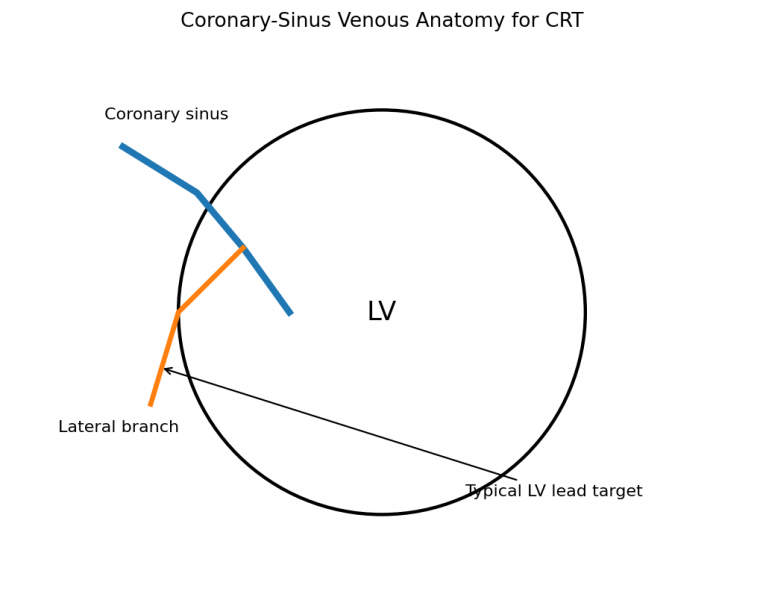
Why is this branch often desirable for left-ventricular lead placement?
a) It places the LV lead inside the left-ventricular cavity across the mitral valve.
b) It directly stimulates the right atrial appendage and improves atrial sensing.
c) It guarantees absence of phrenic-nerve stimulation regardless of output.
d) It can provide electrical stimulation of a delayed lateral LV region and improve resynchronization when anatomy and thresholds are suitable.
07. Refer to the provided rotational-atherectomy schematic. A diamond-coated burr is advanced over a dedicated wire through a severely calcified coronary lesion.
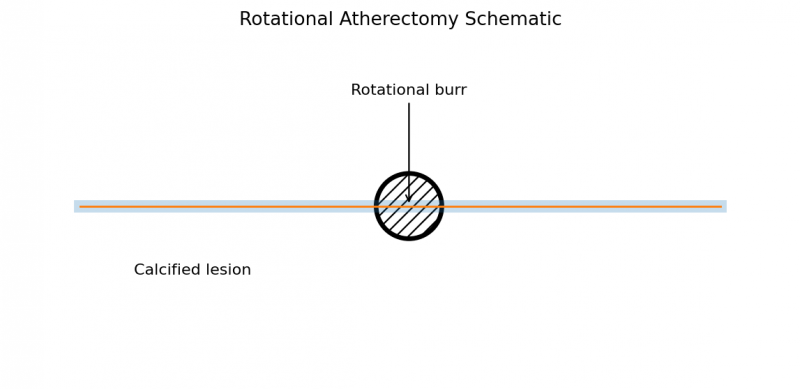
Which procedural principle is most appropriate?
a) Use brief pecking passes and avoid prolonged decelerations of burr speed.
b) Push the burr continuously until it stops against the calcium.
c) Use a standard workhorse coronary wire as the rotating drive shaft.
d) Inflate the burr like a balloon to fracture calcium.
08. Select two consequences that appropriate stent length should help avoid during PCI.
a) All future progression of coronary atherosclerosis.
b) Unnecessary extension into healthy vessel or important side branches.
c) Leaving diseased plaque uncovered at the stent edge.
d) The need to use any guidewire during PCI.
09. An ICD ventricular lead is being implanted. (Select two functions that must be assessed before the lead is accepted.)
a) Ability to measure pulmonary capillary wedge pressure.
b) Reliable sensing of ventricular electrograms.
c) Acceptable pacing capture threshold and lead impedance.
d) Ability to opacify the coronary arteries during contrast injection.
10. A patient has recurrent unexplained syncope occurring only every several months after nondiagnostic short-term ambulatory monitoring. Which implanted device is most suited to prolonged rhythm surveillance without providing pacing therapy?
a) Coronary pressure wire.
b) Implantable loop recorder.
c) Intra-aortic balloon pump.
d) Temporary transvenous pacemaker.
Answers:
|
Question: 01 Answer: a, c |
Question: 02 Answer: a |
Question: 03 Answer: a |
Question: 04 Answer: b |
Question: 05 Answer: c |
|
Question: 06 Answer: d |
Question: 07 Answer: a |
Question: 08 Answer: b, c |
Question: 09 Answer: b, c |
Question: 10 Answer: b |
For full-length, timed, scenario-based practice aligned with the official exam framework - and to build pacing, consistency, and confidence - explore our Premium CCI RCIS Certification Practice Exam.
Note: These sample questions are not official exam questions and are intended only for familiarization and study purposes. If you find any typos or data entry errors in these CCI Registered Cardiovascular Invasive Specialist (RCIS) sample questions, please let us know by emailing us at feedback@medicoexam.com
- CCI Registered Cardiovascular Invasive Specialist Practice Test |
- CCI RCIS Registration Process |
- CCI RCIS Recertification |
- CCI RCIS Certification Overview |
- CCI RCIS Preparation Time |
- CCI RCIS Exam Format |
- CCI Registered Cardiovascular Invasive Specialist Sample Questions |
- CCI RCIS Career Opportunities


