
NREMT AEMT Certification Sample Questions
The NREMT Advanced Emergency Medical Technician Certification Sample Question Set on this page is designed to familiarize you with the actual NREMT AEMT exam format and question types. These sample questions help you understand how questions are structured and what to expect on test day. While they provide a useful starting point, they represent only a limited preview of the real exam experience.
These sample questions are intended for evaluation and familiarization only. To understand exam style, pacing, and reasoning patterns more clearly, we recommend trying our online sample practice environment. If you are preparing for the NREMT Advanced Emergency Medical Technician (AEMT) and want to assess your readiness more rigorously, structured, timed, scenario-based practice is recommended. This approach aligns with the cognitive demands and professional expectations typically associated with Advanced EMTs, EMS clinicians, ambulance-based emergency care personnel working in settings such as EMS response systems, ambulance services, prehospital emergency care settings.
Try Sample Exam » | Access Full NREMT AEMT Practice Exam »
The demo introduces core concepts, while full-length premium simulations provide deeper, scenario-based coverage that more closely reflects the actual cognitive demands of the NREMT Advanced Emergency Medical Technician exam, particularly in areas such as basic and limited advanced emergency care, patient assessment and transportation, clinical judgment under medical oversight. You can use these sample questions as a starting point, then progress to the NREMT AEMT Certification Practice Exam for stronger readiness. Our premium simulations are designed to mirror real exam conditions, helping you refine reasoning, pacing, and decision-making before your official exam attempt.
NREMT AEMT Sample Questions:
01. A 29-year-old patient who is 36 weeks pregnant was involved in a side-impact collision. The patient is supine on the stretcher with spinal motion restriction in place and reports dizziness. Vital signs are BP 86/50, P 128, R 24, and skin is pale and cool. There is no obvious external bleeding.
Which action is most appropriate while continuing trauma assessment and transport?
a) Relieve possible aortocaval compression while maintaining spinal precautions as much as possible
b) Delay transport until fetal movement can be counted for 30 minutes
c) Have the patient stand briefly to improve venous return
d) Keep the patient flat and supine because all trauma patients must remain exactly horizontal
02. A 42-year-old patient is removed from a warehouse fire and is confused, hypotensive, and breathing rapidly. The patient has soot in the mouth but no major burns. Vital signs are BP 78/44, P 136, R 32, SpO₂ 100% on high-flow oxygen, and skin is flushed.
Which interpretation should guide the AEMT’s care?
a) The patient is stable because SpO₂ is 100% on oxygen
b) The problem is only thermal burn injury because soot is present
c) Oxygen should be reduced because the saturation is already maximal
d) A serious toxic inhalation syndrome is possible despite a normal pulse oximeter reading
03. Review the endurance event field history and reassessment information provided with this question.
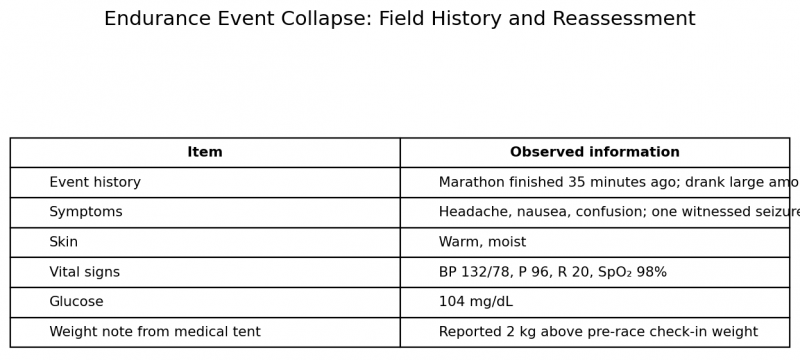
A 31-year-old marathon runner collapses in the medical tent after finishing the race. The patient is confused and had a brief seizure before EMS arrival. The findings are shown. Which interpretation is most appropriate?
a) The patient is clearly dehydrated because the event was a marathon
b) The patient should be encouraged to drink more water immediately
c) Exercise-associated hyponatremia or another serious metabolic problem is possible, so avoid assuming dehydration alone
d) The normal glucose value proves the patient can safely refuse care
04. A 57-year-old patient with liver disease vomits a large amount of bright red blood and is now weak and dizzy. Blood is visible around the mouth, and the patient is nauseated. Vital signs are BP 82/46, P 138, R 26, SpO₂ 94% on oxygen, and skin is cool and clammy.
Select two actions that are most appropriate for the AEMT.
a) Give oral fluids to replace blood volume
b) Treat for shock and rapidly transport
c) Place the patient flat on the back to prevent fainting
d) Delay transport until the source of bleeding is identified
e) Prepare suction and protect the airway because recurrent vomiting may occur
05. A 73-year-old patient taking an anticoagulant has heavy bleeding from both nostrils after a fall. The patient is seated, coughing blood into a towel, and says blood is running down the throat. Vital signs are BP 158/86, P 118, R 24, and SpO₂ 93% on room air.
Which action is most appropriate?
a) Pack both nostrils deeply with gauze until no blood can drain
b) Have the patient lean forward, apply direct pressure to the soft part of the nose, and suction as needed
c) Place the patient supine so blood pressure to the nose decreases
d) Encourage the patient to swallow blood to reduce visible bleeding
06. Review the MCI re-triage snapshot provided with this question.
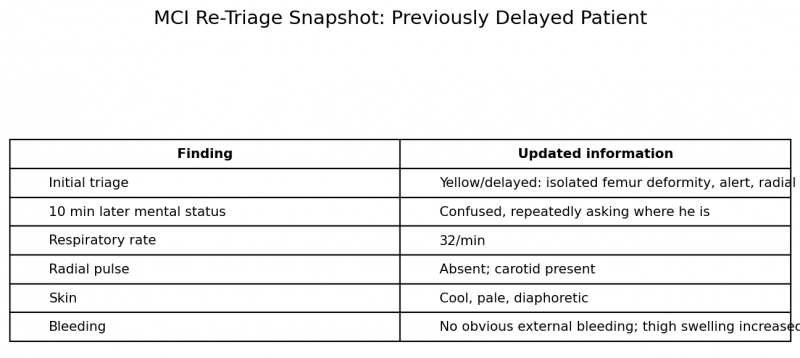
An AEMT is reassessing patients after the initial triage of a multi-casualty crash. One patient who was initially tagged delayed now has the updated findings shown. Which action is most appropriate?
a) Keep the original delayed category because initial triage tags should not be changed
b) Move the patient to the minor treatment area because no external bleeding is visible
c) Ignore the absent radial pulse because the patient was alert earlier
d) Re-triage the patient as immediate and communicate the change to the transport or triage officer
07. An AEMT is evaluating a 58-year-old patient initially reported as “intoxicated.” The patient is drowsy, has slurred speech, and smells of alcohol. During assessment, the AEMT finds an opioid pain patch on the patient’s shoulder. Vital signs are BP 110/68, P 62, R 6 and shallow, SpO₂ 86%, and pupils are pinpoint.
Which action best reflects clinical judgment?
a) Revise the working hypothesis to include opioid toxicity and immediately support ventilation
b) Remove oxygen because alcohol intoxication commonly causes low respiratory rate
c) Continue treating the patient as alcohol intoxication because dispatch gave that impression
d) Wait for the patient to become fully unresponsive before intervening
08. An AEMT is giving a handoff for a patient with a chainsaw injury to the lower leg. A tourniquet was applied before EMS arrival and tightened by the crew when bleeding continued. The patient received shock management and is now pale but awake. Transport time was 18 minutes.
Which handoff statement is most clinically useful?
a) “The tourniquet worked, so the rest of the assessment was not important.”
b) “Lower-leg chainsaw injury; tourniquet initially applied at 14:10 and tightened at 14:16 for continued bleeding; no further external bleeding seen; distal status not assessable below the tourniquet; patient remained pale with BP 92/58.”
c) “The patient had a bad leg injury, but we controlled it and came straight here.”
d) “The patient was awake, so blood loss was probably minimal.”
09. Review the pediatric upper-airway reassessment trend provided with this question.
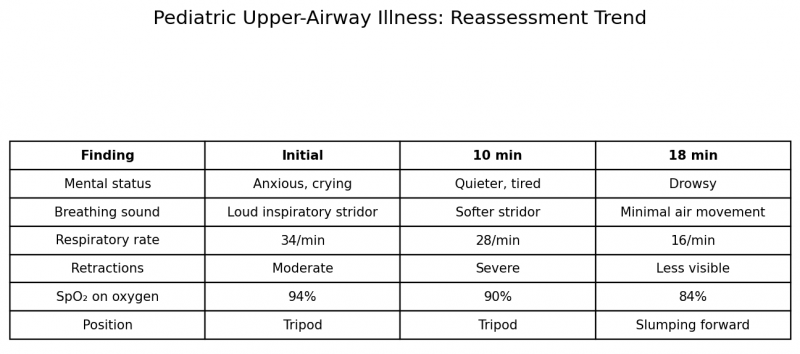
A 3-year-old child with a barking cough and inspiratory stridor is being transported on oxygen. The caregiver says the child has become less noisy but also less responsive. The reassessment trend is shown. Which interpretation should guide the AEMT’s next action?
a) The child is deteriorating because quieter breathing is occurring with fatigue, bradypnea, and worsening hypoxemia
b) The child should be given oral fluids because the cough is barking
c) The child is improving because the stridor has become softer
d) The child can be observed without intervention because retractions are less visible
10. A 22-year-old patient states, “I took a whole bottle of acetaminophen about an hour ago.” The patient is awake, tearful, and currently has no abdominal pain or vomiting. Vital signs are BP 124/76, P 96, R 18, and SpO₂ 98% on room air.
Which action is most appropriate?
a) Encourage vomiting to remove the medication
b) Wait on scene until abdominal pain develops to confirm toxicity
c) Allow the patient to stay home because acetaminophen overdose causes immediate severe symptoms if dangerous
d) Treat as a time-sensitive overdose and transport promptly even though symptoms are minimal
Answers:
|
Question: 01 Answer: a |
Question: 02 Answer: d |
Question: 03 Answer: c |
Question: 04 Answer: b, e |
Question: 05 Answer: b |
|
Question: 06 Answer: d |
Question: 07 Answer: a |
Question: 08 Answer: b |
Question: 09 Answer: a |
Question: 10 Answer: d |
For full-length, timed, scenario-based practice aligned with the official exam framework - and to build pacing, consistency, and confidence - explore our Premium NREMT AEMT Certification Practice Exam.
Note: These sample questions are not official exam questions and are intended only for familiarization and study purposes. If you find any typos or data entry errors in these NREMT Advanced Emergency Medical Technician (AEMT) sample questions, please let us know by emailing us at feedback@medicoexam.com
- NREMT Advanced Emergency Medical Technician Practice Test |
- NREMT AEMT Registration Process |
- NREMT AEMT Recertification |
- NREMT AEMT Certification Overview |
- NREMT AEMT Preparation Time |
- NREMT AEMT Exam Format |
- NREMT Advanced Emergency Medical Technician Sample Questions |
- NREMT AEMT Career Opportunities


