
ANCC NEA-BC Exam Guide: Eligibility, Fees, Passing Score & FAQs
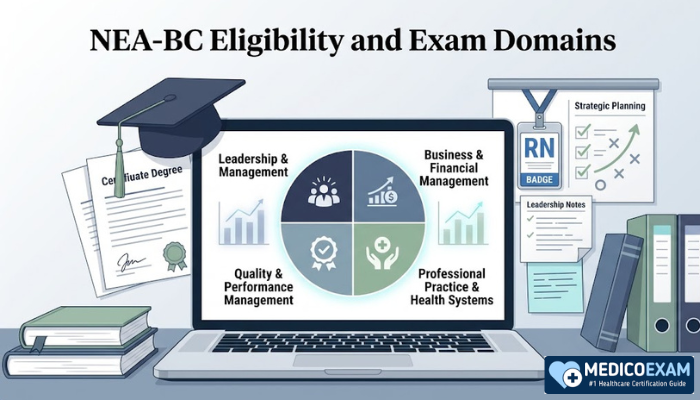 The ANCC Nurse Executive Advanced Board Certification (NEA-BC) validates executive-level nursing leadership for professionals with organization-wide or system-wide influence. The computer-based exam contains 150 questions (125 scored and 25 unscored pretest items), allows 3 hours of testing time, and requires a minimum scaled score of 350 out of 500 to pass. This guide covers everything senior nurse leaders need to know about eligibility, exam content, study strategies, costs, and renewal for 2026.
| Full Name | Nurse Executive, Advanced — Board Certified |
| Credentialing Body | American Nurses Credentialing Center (ANCC) |
| Accreditation | ABSNC and NCCA accredited |
| Total Questions | 150 (125 scored + 25 pretest) |
| Time Limit | 3 hours |
| Passing Score | 350 / 500 (scaled) |
| Cost (Non-Member) | $395 |
| Cost (ANA Member) | $295 |
| Certification Validity | 5 years |
| Testing Format | Computer-based at Prometric centers |
| Scheduling Window | 120 days after application approval |
What Is the NEA-BC Certification?
The NEA-BC is a competency-based credential awarded by the American Nurses Credentialing Center (ANCC), a subsidiary of the American Nurses Association (ANA). It is designed for nurses who hold system-wide or organization-wide influence — professionals who are accountable for multiple groups of nurses and may oversee non-nurse personnel and operations. According to ANCC, these nurse executives "focus, in part, on strategy, high-level finance, resource management, and system integration" and "make higher-level decisions and serve as external representatives of the organization."
Typical NEA-BC holders include Chief Nursing Officers (CNOs), Vice Presidents of Nursing, system-level Directors of Nursing, and other C-suite nursing leaders.
Who Is Eligible for the NEA-BC Exam?
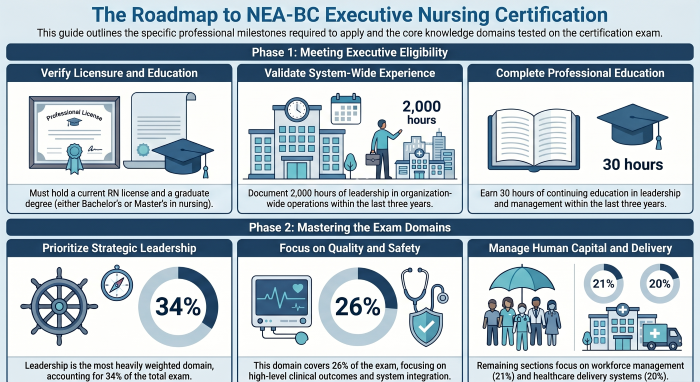
Candidates must satisfy four primary requirements before they apply:
-
Hold a current, active RN license in a U.S. state or territory, or the legally recognized equivalent in another country
-
Hold a graduate degree, and either the baccalaureate or graduate degree must be in nursing
-
Have at least 2,000 hours of experience in a leadership, management, or administration position with primary responsibility for organization-wide or system-wide operations and outcomes that include nursing, completed within the last 3 years
-
Complete 30 hours of continuing education in leadership, management, or administration within the last 3 years
This eligibility structure makes the NEA-BC distinct from the NE-BC. The NE-BC supports unit- and department-level leaders, while the NEA-BC is built for executives whose decisions affect broad nursing systems, enterprise strategy, and cross-functional operations.
What Are the NEA-BC Exam Content Domains?
As of the current ANCC test content outline, the NEA-BC exam is divided into four domains:
| Domain | Weight |
|---|---|
| Leadership | 34% |
| Quality and Safety | 26% |
| Human Capital Management | 21% |
| Health Care Delivery | 20% |
Domain I — Leadership (34%)
Leadership is the largest domain on the NEA-BC exam. It assesses your ability to guide organizational vision, strategy, innovation, and executive decision-making. Topics include strategic planning, governance, systems thinking, finance at the executive level, enterprise-wide resource allocation, and external representation of the organization.
Candidates should expect questions that test how nurse executives align nursing priorities with the broader health system mission. This may include strategic partnerships, policy influence, organizational transformation, and culture-setting.
Domain II — Quality and Safety (26%)
This domain focuses on your ability to improve patient outcomes through quality measurement, performance improvement, safety systems, and regulatory alignment. You may see questions on quality dashboards, system-wide patient safety initiatives, root cause analysis, enterprise benchmarking, and outcome reporting.
Executive nurse leaders are expected to connect quality performance with strategic goals, accreditation readiness, reimbursement models, and interdisciplinary accountability.
Domain III — Human Capital Management (21%)
Human Capital Management evaluates how nurse executives lead workforce planning, succession development, retention strategy, executive coaching, and talent systems at scale. Topics include staffing models, labor trends, workforce engagement, leadership development, conflict management, and change leadership across large teams.
Questions often focus on long-range workforce sustainability rather than day-to-day scheduling issues.
Domain IV — Health Care Delivery (20%)
This domain covers care delivery systems, operations design, service-line integration, patient flow, system-wide care coordination, and the executive role in optimizing access, throughput, and organizational outcomes.
Candidates should understand how nursing leadership connects with value-based care, population health, care transitions, and service delivery redesign across departments or facilities.
How Does the NEA-BC Compare to the NE-BC?
The NE-BC and NEA-BC are both ANCC nurse executive credentials, but they are designed for different leadership levels.
The NE-BC supports nurse leaders with unit-level, department-level, or program-level influence. It focuses on tactical leadership, staffing, frontline operations, and daily management responsibilities.
The NEA-BC supports executives with organization-wide or system-wide influence. It focuses on strategic planning, executive finance, enterprise workforce development, and high-level health system leadership.
The educational requirements also differ. The NE-BC requires a BSN or higher in nursing. The NEA-BC requires a graduate degree, and either the baccalaureate or graduate degree must be in nursing.
How Much Does the NEA-BC Exam Cost?
The standard ANCC pricing for the NEA-BC exam is:
-
$395 for non-members
-
$295 for ANA members
These fees include a $140 non-refundable administrative fee. If you qualify for a discount, it must typically be claimed within 5 business days after ANCC receives your application.
For renewal, the fee is:
-
$350 for non-members
-
$250 for ANA members
What Is the NEA-BC Pass Rate and Scoring?
The NEA-BC exam uses a scaled scoring system from 100 to 500, and the minimum passing score is 350. Only 125 questions count toward your score. The remaining 25 questions are pretest items used for future exam development and do not affect your result.
The exam is criterion-referenced, which means your performance is measured against a defined competency standard rather than against other candidates.
The average pass rate is often cited at approximately 75%, though figures may vary by year and source. As with many advanced executive exams, pass-rate interpretation should be cautious because candidate experience levels differ significantly from one credential to another.
How Should You Study for the NEA-BC Exam?
The most effective NEA-BC preparation strategy blends executive nursing experience with structured review. A strong study plan typically includes:
-
Reviewing the official ANCC Test Content Outline first
-
Allocating study time according to domain weight
-
Using practice questions and timed simulations
-
Reviewing leadership frameworks, finance concepts, quality systems, and workforce strategy
-
Studying for roughly 8 to 12 weeks, depending on your baseline experience
Because the exam emphasizes executive judgment, candidates benefit most from preparation that includes scenario-based reasoning, not just memorization.
What Are the NEA-BC Renewal Requirements?
ANCC NEA-BC certification is valid for 5 years. To renew, certificants must complete:
-
75 continuing education contact hours in leadership, management, or administration
-
Plus at least one professional development category
Examples of professional development options may include:
-
1,000 practice hours in the certification role
-
Additional continuing education
-
Academic credits
-
Presentations
-
Publication or research
-
Preceptorship
-
Volunteer service
-
Retaking the exam
Renewal applications can be submitted up to 1 year before certification expiration.
What Career Opportunities Does the NEA-BC Unlock?
The NEA-BC is intended for senior nurse leaders who already hold or are moving into executive positions. It may support advancement into roles such as:
-
Chief Nursing Officer (CNO)
-
Associate Chief Nursing Officer
-
Vice President of Nursing
-
Executive Director of Nursing
-
System Director of Nursing
-
Chief Clinical Operations leader with nursing oversight
In many organizations, the credential signals readiness for broader enterprise responsibilities, especially in strategic planning, quality oversight, and executive operations.
How Does the NEA-BC Exam Day Work?
The NEA-BC is delivered as a computer-based exam at Prometric testing centers. Once ANCC approves your application, you receive a 120-day testing window to schedule and sit for the exam.
Key exam-day facts:
-
150 total questions
-
3 hours total testing time
-
Computer-based testing
-
Four answer choices per question
-
Results are generally provided through the ANCC/Prometric process after the exam
Time management matters. With 150 questions in 180 minutes, you have about 1 minute and 12 seconds per question. It is usually best to answer straightforward items quickly, flag uncertain questions, and return later if time remains.
Frequently Asked Questions (FAQ)
1. How many questions are on the NEA-BC exam?
The NEA-BC exam contains 150 total questions. Of these, 125 are scored and 25 are unscored pretest items.
2. What is the passing score for the NEA-BC?
The passing score is 350 on a 100 to 500 scaled score range.
3. How long is the NEA-BC exam?
You have 3 hours to complete the exam.
4. What degree do I need for NEA-BC eligibility?
You need a graduate degree, and either your baccalaureate or graduate degree must be in nursing.
5. What is the difference between NE-BC and NEA-BC?
The NE-BC is designed for nurse leaders with unit- or department-level influence. The NEA-BC is designed for executives with organization-wide or system-wide influence.
6. How much does the NEA-BC exam cost?
The exam costs $395 for non-members and $295 for ANA members.
7. How do I renew my NEA-BC certification?
You renew every 5 years by completing 75 contact hours of CE plus one professional development category, or by retaking the exam.
8. What are the four domains on the NEA-BC exam?
The four domains are Leadership, Quality and Safety, Human Capital Management, and Health Care Delivery.
9. Can I take the NEA-BC exam with a BSN only?
No. The NEA-BC requires a graduate degree.
10. Where can I find NEA-BC practice questions?
Candidates often begin with the official ANCC content outline and review resources, then add simulation-based practice questions and timed mock exams for readiness.
Start Your NEA-BC Exam Preparation Today
Passing the NEA-BC demonstrates that your leadership extends beyond departmental management into enterprise-level nursing strategy. The strongest preparation combines official ANCC content review with realistic question practice that reflects the scope and judgment demands of executive nursing leadership.
MedicoExam offers simulation-based NEA-BC practice exams aligned with the current ANCC content outline. Each question includes answer rationales and domain-level feedback to help you focus your study time where it matters most. Start practicing at MedicoExam.com and build the confidence to earn your Nurse Executive Advanced certification.
Disclaimer: This article is for informational purposes only. It does not contain actual exam questions or proprietary ANCC content. Always verify the latest eligibility criteria and exam details at nursingworld.org. Exam policies, fees, and content outlines may change without notice.
Written by the MedicoExam Content Team — Healthcare Education Specialists at MedicoExam.com
- ANCC NEA-BC Question Bank |
- ANCC NEA-BC Eligibility & Requirements |
- ANCC Nurse Executive Advanced Practice Test |
- ANCC NEA-BC Exam Cost |
- ANCC NEA-BC Registration Process |
- ANCC Nurse Executive Advanced Study Guide |
- ANCC NEA-BC Recertification |
- ANCC NEA-BC Certification Overview |
- ANCC Nurse Executive Advanced Syllabus |
- ANCC NEA-BC Preparation Time |
- ANCC NEA-BC Passing Score |
- ANCC NEA-BC Exam Format |
- ANCC Nurse Executive Advanced Sample Questions |
- ANCC NEA-BC Career Opportunities


