
ANCC NE-BC Exam: Nurse Executive Certification Complete Guide & Study Plan
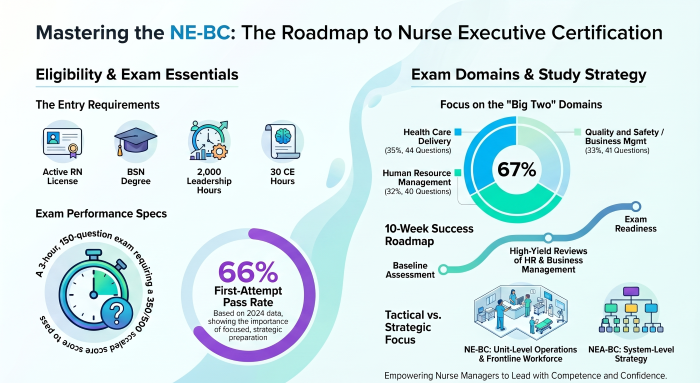
 he ANCC Nurse Executive Board Certified (NE-BC) credential validates the leadership competency of registered nurses who manage daily unit operations, staffing, and staff development. Awarded by the American Nurses Credentialing Center, the NE-BC exam contains 150 questions (125 scored plus 25 unscored pretest items), allows 3 hours, and requires a scaled score of 350 out of 500 to pass. In 2024, 1,317 candidates sat for the exam, and approximately 66 percent passed on their first attempt. This guide covers every detail you need — eligibility requirements, domain breakdowns, a week-by-week study plan, and a side-by-side comparison with the NEA-BC credential.
| Full credential | Nurse Executive — Board Certified (NE-BC) |
|---|---|
| Issuing body | American Nurses Credentialing Center (ANCC) |
| Total questions | 150 (125 scored + 25 pretest) |
| Time limit | 3 hours |
| Passing score | 350 / 500 scaled |
| First-attempt pass rate (2024) | ≈ 66 % |
| Exam fee | $395 non-member · $295 ANA member |
| Certification validity | 5 years |
| Renewal fee | $350 non-member · $250 ANA member |
| Testing format | Computer-based at Prometric centers, year-round |
Who Is the NE-BC Certification Designed For?
The NE-BC is built for nurse managers, supervisors, directors, and assistant directors who hold unit-level, team-level, service-line, department, or program-level influence. According to ANCC, the credential assesses "entry-level knowledge and skills of nurses with unit, team, service line, department, or program influence." These professionals are accountable for a single group of nurses and/or non-nursing staff. Their daily work centers on operations, staffing decisions, staff development, individual and group performance, and tactical decision-making that is visible to the frontline workforce.
If your role focuses on organization-wide or system-wide strategy — such as a Chief Nursing Officer overseeing multiple departments — the NEA-BC (Nurse Executive Advanced) credential is the more appropriate fit. We compare both certifications later in this guide.
What Are the NE-BC Eligibility Requirements?
Candidates must satisfy four requirements before applying. ANCC lists the following criteria:
-
Active RN license — Hold a current, active registered nurse license in a U.S. state or territory, or the legally recognized equivalent in another country.
-
BSN or higher in nursing — A baccalaureate degree in nursing is the minimum educational requirement. A master's degree is strongly recommended and common among candidates but is not mandatory for NE-BC (unlike NEA-BC, which requires a graduate degree).
-
2,000 hours of nurse executive experience — Accumulate at least 2,000 hours in a leadership, management, or administrative role with primary responsibility for the daily operations and outcomes of one or more units or departments within the last 3 years.
-
30 continuing education hours — Complete 30 contact hours in leadership, management, or administration within the last 3 years.
Transcript Requirements
ANCC accepts unofficial transcripts (photocopies, academic progress records, or printouts of completed coursework) to process applications initially. However, a final official transcript — sent directly from the institution and showing degree conferral and date — is required before the credential is officially awarded.
What Are the Four NE-BC Exam Domains?
The NE-BC exam covers four content domains. The ANCC Test Content Outline (effective October 15, 2025) breaks down the 125 scored questions as follows:
| Domain | Scored Questions | Weight |
|---|---|---|
| I. Human Resource Management | 40 | 32 % |
| II. Quality and Safety | 21 | 17 % |
| III. Business Management | 20 | 16 % |
| IV. Health Care Delivery | 44 | 35 % |
| Total | 125 | 100 % |
Health Care Delivery is the single largest domain at 35 percent, followed closely by Human Resource Management at 32 percent. Together, these two domains account for 84 of the 125 scored items — roughly two-thirds of your exam score.
What Does Domain I — Human Resource Management (32 %) Cover?
This domain tests 40 scored questions spanning workforce leadership and people management. The ANCC TCO divides it into knowledge and skill areas:
Knowledge areas:
-
Federal employment laws (FMLA, ADA, Fair Labor Standards Act, National Labor Relations Act)
-
Principles and styles of communication
-
Cultural humility — diversity, equity, inclusion, and belonging
-
Leadership styles (human-centered, transformational, transactional, situational, coaching)
Skill areas:
-
Employee performance management (competency validation, performance appraisals)
-
Employee engagement and retention strategies
-
Team performance management (group dynamics, conflict resolution)
Expect scenario-based questions that ask you to choose the best leadership intervention for staffing conflicts, apply progressive discipline in compliance with labor law, or select the right retention strategy for a high-turnover unit. With 40 scored items, Human Resource Management is the second-heaviest domain and one where real-world management experience gives you a significant advantage. Review the key provisions of FMLA (12 weeks unpaid leave for qualifying events), ADA (reasonable accommodations), and the NLRA (collective bargaining protections) — these laws appear repeatedly in exam scenarios.
What Does Domain II — Quality and Safety (17 %) Cover?
Quality and Safety carries 21 scored questions. This domain centers on the nurse executive's role in building a culture of safety and driving continuous improvement.
Knowledge areas:
-
Change management frameworks
-
Culture of safety (risk management, employee and patient safety standards, healthy work environment, just culture, workplace violence prevention, high reliability principles)
Skill areas:
-
Continuous process improvement (Plan-Do-Study-Act cycle, Lean methodology, root cause analysis)
-
Research and evidence-based practice methods (literature review, developing clinical questions, translation, and dissemination)
Study tip: master the difference between root cause analysis (used after an event) and failure mode and effects analysis (used proactively to prevent events). Both appear frequently in NE-BC exam items. Also review the Plan-Do-Study-Act (PDSA) cycle, which ANCC lists as a core continuous process improvement methodology, and familiarize yourself with just culture principles — the framework that distinguishes between human error, at-risk behavior, and reckless conduct when evaluating safety events.
What Does Domain III — Business Management (16 %) Cover?
Business Management contributes 20 scored questions and tests financial acumen — a core competency for any nurse managing a unit budget.
Knowledge areas:
-
Patient payor mix (value-based purchasing, care continuum, patient throughput)
-
Financial compliance laws (Stark Law, Anti-Kickback Statute)
Skill areas:
-
Financial management (budgeting, hours per patient day, resource utilization, cost-benefit analysis)
-
Staffing fundamentals (staffing models, skill mix, scheduling)
This is the smallest domain by question count, but weak financial literacy can derail your score. Be comfortable calculating hours per patient day (HPPD), interpreting variance reports, and building a basic business case with return-on-investment figures. Understand how value-based purchasing ties reimbursement to quality metrics, and know the basics of the Stark Law (prohibits physician self-referral for designated health services) and the Anti-Kickback Statute (prohibits offering or receiving payment to induce referrals). These compliance topics bridge the gap between business management and ethical practice.
What Does Domain IV — Health Care Delivery (35 %) Cover?
The largest domain contributes 44 scored questions on the regulatory, ethical, and care-delivery frameworks nurse executives must navigate.
Knowledge areas:
-
ANA Code of Ethics
-
ANA Nursing Leadership Scope and Standards of Practice
-
Regulatory and compliance standards (HIPAA, EMTALA, corporate compliance)
-
Emergency and disaster preparedness
-
Social determinants of health and health equity
Skill areas:
-
Person-centered care (leader rounding, patient engagement, service recovery)
-
Care delivery evaluation (nurse-sensitive indicators, core measures, care coordination)
-
Technology innovation and integration (telehealth, predictive analytics, remote monitoring, virtual nursing)
The 2025 TCO update added explicit references to technology innovation, including AI and predictive analytics — reflecting the expanding role of digital tools in nursing leadership. Be prepared for questions about telehealth implementation, virtual nursing models, remote patient monitoring, and cybersecurity considerations. Additionally, review EMTALA requirements (hospitals must screen and stabilize anyone with an emergency condition regardless of ability to pay) and HIPAA privacy and security rules, which are perennial exam topics. Understanding how social determinants of health — such as housing instability, food insecurity, and transportation barriers — influence care delivery is another high-yield focus area for this domain.
How Is the NE-BC Exam Scored?
The NE-BC uses a criterion-referenced scoring model. According to Mometrix, the passing standard is established using the modified-Angoff method: a panel of ANCC subject-matter experts evaluates each question and sets a cut score independent of other test-takers' performance. Your raw score (number of correct answers out of 125 scored items) is converted to a scale of 1 to 500. A scaled score of 350 or higher is required to pass. Preliminary results appear on screen immediately after you finish, and a final score report is posted to your ANCC account.
The 25 pretest questions are interspersed throughout the exam and look identical to scored items. They do not affect your score, but because you cannot identify which questions are pretest, treat every question as if it counts.
How Do You Register and Schedule the NE-BC Exam?
The application process follows four steps outlined by ANCC:
-
Review eligibility and pricing. Confirm you meet all four requirements. Non-members pay $395; ANA members pay $295 (includes a $140 non-refundable administrative fee). Discounts must be claimed within 5 business days of application receipt.
-
Apply online. Submit the application through your ANCC account and upload supporting documents (transcripts, CE records).
-
Submit transcripts. Mail or email unofficial transcripts to ANCC Certification, 8403 Colesville Road, Suite 500, Silver Spring, MD 20910 (or aprnvalidation@ana.org). An official transcript is required before the credential is conferred.
-
Schedule at Prometric. After approval, visit Prometric to book your exam within a 120-day testing window at a date and location convenient to you. Testing is available year-round.
If you do not pass, you may retake the exam up to three times within a 12-month period, with a mandatory 60-day waiting period between attempts.
What Is an Effective NE-BC Study Plan?
A structured 8-to-12-week study plan aligned with domain weights gives you the best chance of passing. Below is a sample weekly framework for a 10-week preparation window:
| Weeks | Focus Area | Suggested Activities |
|---|---|---|
| 1–2 | Baseline assessment + Health Care Delivery (35 %) | Take a diagnostic practice test. Review ANA Code of Ethics, HIPAA, EMTALA, nurse-sensitive indicators. |
| 3–4 | Human Resource Management (32 %) | Study federal employment laws, leadership theories, conflict resolution models, retention strategies. |
| 5–6 | Quality and Safety (17 %) | Learn PDSA, Lean, root cause analysis, high reliability principles, just culture framework. |
| 7 | Business Management (16 %) | Cover budgeting, HPPD calculations, variance analysis, Stark Law, value-based purchasing. |
| 8–9 | Integration + weak-area review | Take full-length timed practice tests. Review missed questions. Cross-reference domains. |
| 10 | Final review + exam-day logistics | Light review of high-yield topics. Confirm Prometric appointment. Prepare ID documents. |
“The NE-BC exam rewards practical leadership judgment, not textbook memorization. Candidates who reflect on how they handle real staffing conflicts, budget variances, and quality events in their daily work tend to perform best.” — Dr. Karen Mitchell, DNP, RN, NEA-BC, Healthcare Leadership Consultant
Recommended Resources
-
ANCC Test Content Outline — Free download from nursingworld.org; your single most important study document.
-
ANCC Reference List — The official bibliography tied to each TCO edition.
-
ANCC Readiness Test — A practice assessment from ANCC that mirrors exam conditions.
-
NE-BC review courses — Institutions like Houston Methodist offer two-day review courses covering all four domains.
-
MedicoExam NE-BC practice tests — Simulation-based practice with timed, exam-format questions across all NE-BC domains.
How Does NE-BC Compare to NEA-BC?
Choosing between the two ANCC nurse executive credentials depends on your scope of responsibility. The NE-BC is for unit-to-department-level leaders; the NEA-BC is for system-wide executives. Here is a detailed comparison:
| Feature | NE-BC | NEA-BC |
|---|---|---|
| Scope | Unit, team, service line, or department | Organization-wide or system-wide |
| Typical roles | Nurse manager, supervisor, director | CNO, VP of Nursing, system director |
| Education minimum | BSN in nursing | Graduate degree (BSN or graduate must be in nursing) |
| Experience requirement | 2,000 hrs in unit/department leadership (last 3 yrs) | 2,000 hrs in org-wide/system-wide leadership (last 3 yrs) |
| CE requirement | 30 hrs in leadership/management/admin | 30 hrs in leadership/management/admin |
| Exam questions | 150 (125 scored + 25 pretest) | 150 (125 scored + 25 pretest) |
| Time limit | 3 hours | 3 hours |
| Passing score | 350 / 500 | 350 / 500 |
| Domain focus | HR Management 32 %, Health Care Delivery 35 %, Quality/Safety 17 %, Business Mgmt 16 % | Leadership 34 %, Quality/Safety 26 %, Human Capital Mgmt 21 %, Health Care Delivery 20 % |
| Exam fee | $395 (non-member) / $295 (ANA) | $395 (non-member) / $295 (ANA) |
| Validity | 5 years | 5 years |
| Accreditation | ABSNC and NCCA | ABSNC and NCCA |
The NEA-BC domains emphasize strategic leadership (34 %) and a broader quality-and-safety scope (26 %), while the NE-BC weights operational delivery (35 %) and frontline HR management (32 %) more heavily.
How Do You Renew Your NE-BC Certification?
NE-BC certification is valid for 5 years. According to Vivian Health, renewal requires:
-
75 contact hours of continuing education — All CE must relate to your certification specialty. At least 60 of the 75 hours must be formally approved (ANCC-accredited, AMA PRA Category 1, or Joint Accreditation–approved).
-
One professional development component — Complete at least one of eight categories, such as an additional 75 CE hours, 5 semester credits in leadership, a qualifying publication or research project, 1,000 practice hours in leadership, or retaking the NE-BC exam.
-
Active RN license — Maintain an unrestricted license throughout the renewal period.
Renewal applications can be submitted online up to one year before the expiration date. The renewal fee is $350 for non-members or as low as $250 for ANA members.
What Career Opportunities Does NE-BC Certification Unlock?
Earning the NE-BC signals validated competency in nursing leadership and opens doors to management roles across acute care, ambulatory, and long-term care settings. According to PayScale/Salary), professionals with the NE-BC credential hold titles such as:
-
Nurse Manager — overseeing unit-level staffing and operations
-
Director of Nursing — managing multiple units or a service line
-
Clinical Operations Director — driving quality and throughput initiatives
-
Assistant Vice President of Patient Care — bridging frontline management and C-suite strategy
Salary data from RegisteredNursing.org shows that certified nurse executives earn between $58,000 and over $148,500 annually, with a median around $93,552. Many employers offer certification differentials, exam-fee reimbursement, or annual bonuses for board-certified nurse leaders.
The credential is also increasingly valued by Magnet-designated hospitals, where nursing certification rates factor into designation standards. According to Western Governors University, the 2024 Nurse Salary and Work-Life Report found that 40 percent of nurses reported certification resulted in a salary increase. Beyond compensation, certification strengthens clinical leadership credibility and supports Magnet Recognition Program standards. For nurses exploring the broader ANCC portfolio, our ANCC certification hub covers all 17 credentials, and our MedicoExam homepage provides additional exam resources.
Frequently Asked Questions (FAQ)
1. How many questions are on the NE-BC exam?
The NE-BC exam contains 150 total questions. Of these, 125 are scored and 25 are unscored pretest items used by ANCC to evaluate future exam questions. Your score is based only on the 125 scored questions.
2. What is the passing score for the NE-BC exam?
You need a scaled score of 350 out of 500 to pass. The passing standard is set using the modified-Angoff method, meaning your score depends solely on your own performance, not on how other candidates perform.
3. How much does the NE-BC exam cost?
The exam fee is $395 for non-members and $295 for ANA members. Both prices include a $140 non-refundable administrative fee. Discount claims must be made within 5 business days of application receipt.
4. What is the NE-BC first-attempt pass rate?
In 2024, approximately 66 percent of candidates passed the NE-BC on their first attempt. Out of 1,317 test-takers, 874 earned a passing score.
5. Can I retake the NE-BC exam if I fail?
Yes. You may retake the exam up to three times within a 12-month period. Each retake requires a minimum 60-day waiting period.
6. Do I need a master's degree for NE-BC?
No. The minimum education requirement is a baccalaureate degree in nursing (BSN). A master's degree is recommended but not mandatory. The NEA-BC, by contrast, requires a graduate degree.
7. How is NE-BC different from NEA-BC?
NE-BC targets unit-to-department-level leaders and requires a BSN minimum. NEA-BC targets organization-wide or system-wide executives and requires a graduate degree. The exam domains also differ: NE-BC emphasizes operational delivery and HR management, while NEA-BC focuses on strategic leadership and quality systems.
8. How long is NE-BC certification valid?
The NE-BC credential is valid for 5 years. Renewal requires 75 CE hours, one professional development component, and an active RN license.
9. Where do I take the NE-BC exam?
The NE-BC is a computer-based exam administered year-round at Prometric testing centers nationwide. After ANCC approves your application, you have a 120-day window to schedule and complete the exam.
10. How many CE hours do I need to maintain NE-BC certification?
You need 75 contact hours of continuing education over the 5-year certification period. At least 60 of these hours must come from formally accredited providers (ANCC-approved, AMA PRA Category 1, or Joint Accreditation–approved).
Start Preparing for the NE-BC Exam Today
Passing the NE-BC validates the leadership skills you use every day — from managing staffing challenges to driving quality outcomes across your unit. The most effective preparation combines targeted content review with realistic practice testing.
Try MedicoExam's NE-BC practice tests — simulation-based preparation designed to mirror the official exam format, timing, and domain distribution. Each question includes detailed rationales so you can learn from every attempt.
For more ANCC certification resources, explore the ANCC hub.
Disclaimer: This article is for informational purposes only. It does not contain actual exam questions or proprietary ANCC content. Always verify the latest eligibility criteria and exam details at the official ANCC NE-BC page. Exam policies, fees, and content outlines may change without notice.
Written by the MedicoExam Content Team — Healthcare Education Specialists at MedicoExam.com
- ANCC NE-BC Question Bank |
- ANCC NE-BC Eligibility & Requirements |
- ANCC Nurse Executive Practice Test |
- ANCC NE-BC Exam Cost |
- ANCC NE-BC Registration Process |
- ANCC Nurse Executive Study Guide |
- ANCC NE-BC Recertification |
- ANCC NE-BC Certification Overview |
- ANCC Nurse Executive Syllabus |
- ANCC NE-BC Preparation Time |
- ANCC NE-BC Passing Score |
- ANCC NE-BC Exam Format |
- ANCC Nurse Executive Sample Questions |
- ANCC NE-BC Career Opportunities


