
NREMT Paramedic Certification Sample Questions
The NREMT Paramedic Certification Sample Question Set on this page is designed to familiarize you with the actual NREMT Paramedic exam format and question types. These sample questions help you understand how questions are structured and what to expect on test day. While they provide a useful starting point, they represent only a limited preview of the real exam experience.
These sample questions are intended for evaluation and familiarization only. To understand exam style, pacing, and reasoning patterns more clearly, we recommend trying our online sample practice environment. If you are preparing for the NREMT Paramedic and want to assess your readiness more rigorously, structured, timed, scenario-based practice is recommended. This approach aligns with the cognitive demands and professional expectations typically associated with Paramedics, EMS clinicians, advanced life support clinicians working in settings such as Ambulance services, EMS agencies, emergency response systems.
Try Sample Exam » | Access Full NREMT Paramedic Practice Exam »
The demo introduces core concepts, while full-length premium simulations provide deeper, scenario-based coverage that more closely reflects the actual cognitive demands of the NREMT Paramedic exam, particularly in areas such as Advanced emergency medical care, patient assessment and transport, clinical judgment. You can use these sample questions as a starting point, then progress to the NREMT Paramedic Certification Practice Exam for stronger readiness. Our premium simulations are designed to mirror real exam conditions, helping you refine reasoning, pacing, and decision-making before your official exam attempt.
NREMT Paramedic Sample Questions:
01. A 29-year-old diver surfaces rapidly after running low on air. Within minutes, the diver develops chest pain, shortness of breath, dizziness, and right-sided weakness. Vital signs are BP 132/78 mmHg, HR 118/min, RR 28/min, SpO₂ 91%, and the patient is anxious but awake.
Which action is most appropriate?
a) Administer high-concentration oxygen, minimize exertion, and transport to an appropriate facility with early consultation or notification
b) Place the patient in a head-down position to trap bubbles away from the brain
c) Encourage the diver to return underwater to equalize pressure
d) Delay care because neurologic symptoms after diving are usually anxiety
02. A 46-year-old patient is found lethargic beside an empty bottle of extended-release verapamil. Vital signs are BP 68/40 mmHg, HR 42/min, RR 16/min, SpO₂ 96%, and blood glucose 238 mg/dL. The skin is cool and pale, and the ECG shows sinus bradycardia without ST elevation.
Which interpretation should guide management?
a) Simple hypoglycemia because altered mental status is present
b) Acute asthma exacerbation because verapamil causes bronchospasm as the primary effect
c) Opioid toxicity because the patient is lethargic and hypotensive
d) Calcium-channel blocker toxicity with cardiogenic shock physiology
03. A 64-year-old patient with wheezing and shortness of breath receives repeated nebulized bronchodilator treatments during transport. Initially, wheezing improves. Ten minutes later, the patient reports chest pressure and becomes diaphoretic. Vital signs are BP 158/92 mmHg, HR 178/min and irregular, RR 28/min, and SpO₂ 95%. The patient has a history of atrial fibrillation.
Which action best reflects the evaluation step of clinical judgment?
a) Coach the patient to cough until the irregular rhythm resolves
b) Continue repeated bronchodilators without reassessment because wheezing improved initially
c) Reassess the rhythm and overall response, withhold additional bronchodilator doses temporarily, and treat the new tachydysrhythmia concern according to protocol or medical direction
d) Ignore the chest pressure because oxygen saturation is acceptable
04. A paramedic and EMT arrive for a 72-year-old patient with severe respiratory distress. The patient is sitting upright, speaking one-word answers, and has cyanosis around the lips. Vital signs are BP 178/96 mmHg, HR 132/min, RR 34/min, and SpO₂ 78%. The EMT begins asking the family for the medication list while the patient becomes less responsive.
Which action best demonstrates effective clinical judgment and leadership?
a) Direct the EMT to assist ventilations and prepare airway equipment while the paramedic reassesses breathing
b) Complete the secondary assessment before changing the treatment plan
c) Ask the family to drive the patient to the hospital while EMS gathers equipment
d) Allow the EMT to finish the medication history before intervening
05. A septic shock patient is being transported with a norepinephrine infusion from the sending facility. The reassessment trend is shown.
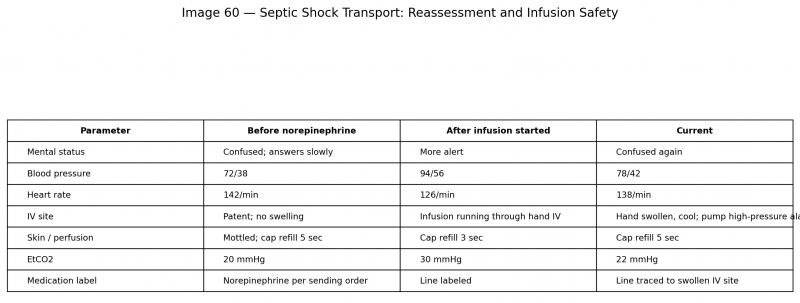
Which actions should the paramedic prioritize? Select the three answer options that are correct.
a) Increase the pump rate through the swollen IV because the blood pressure is falling
b) Recognize possible vasopressor infiltration with recurrent shock
c) Remove monitoring because the medication order already defines the treatment plan
d) Ignore the cool swollen hand because the line is labeled correctly
e) Stop using the compromised IV site and establish alternate access according to protocol or medical direction
f) Notify the receiving facility or medical direction and document the infusion problem and patient response
06. Before responding to a call, a paramedic notices the partner smells of alcohol, has slurred speech, and is fumbling with equipment. The partner says, “I am fine. Do not make this a big deal.”
Which action is most appropriate?
a) Ignore the concern unless the partner makes a patient-care error
b) Allow the partner to drive only if the call is low priority
c) Remove the partner from patient-care duties and notify supervision according to policy
d) Ask the partner to drink coffee and reassess later during the call
07. En route to a motel for an “unknown problem,” dispatch adds that a bystander found a 19-year-old unresponsive in a bathroom with powder on the sink. Law enforcement has not arrived. On scene, the patient is cyanotic with snoring respirations at 6/min, pinpoint pupils, and a weak carotid pulse.
Which actions should the paramedic prioritize? Select the three answer options that are correct.
a) Confirm scene safety and use appropriate PPE before patient contact
b) Allow refusal immediately if the patient awakens and becomes angry
c) Administer naloxone according to protocol while continuing ventilatory support
d) Begin airway positioning and assisted ventilations with oxygen
e) Wait for naloxone to work before assisting ventilations
f) Search the room thoroughly to identify every substance before treating the patient
08. EMS is caring for a patient with severe respiratory distress on the 18th floor of a building with no working elevator.
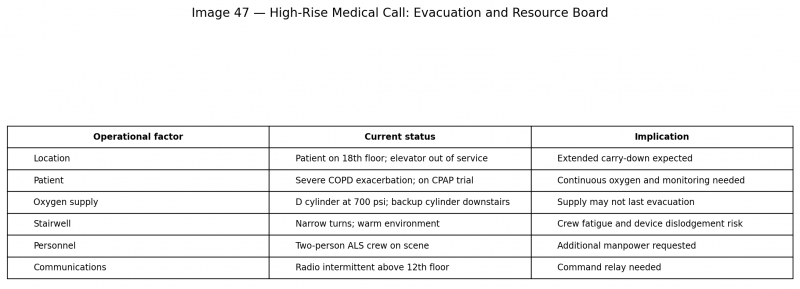
Which actions are appropriate? Select the three answer options that are correct.
a) Turn off monitoring during the stairwell move because it may slow the crew
b) Request additional personnel and equipment before beginning a prolonged stairwell evacuation
c) Begin the carry-down immediately with only the two-person crew to save time
d) Maintain monitoring and reassess for respiratory deterioration during movement
e) Ensure adequate oxygen supply and backup equipment for the evacuation
f) Continue CPAP without checking whether the oxygen supply will last
09. A 73-year-old patient reports dizziness and near-syncope. Vital signs are BP 78/44 mmHg, HR 38/min, RR 20/min, and SpO₂ 96% on oxygen. The rhythm strip is shown.
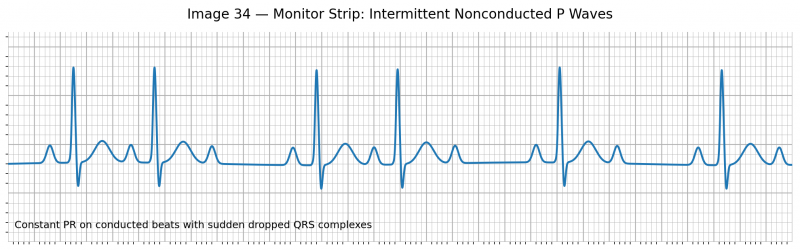
Which action is most appropriate?
a) Reassure the patient because some QRS complexes are present
b) Delay treatment until the patient becomes pulseless
c) Prepare for transcutaneous pacing while supporting oxygenation and perfusion
d) Treat with adenosine because the rhythm has intermittent pauses
10. A 17-year-old patient is being transferred from an outpatient surgical center after general anesthesia. The patient becomes rigid and hyperthermic. Vital signs are BP 168/94 mmHg, HR 168/min, RR ventilated at 22/min, SpO₂ 97%, and EtCO₂ rises from 38 to 72 mmHg despite increased ventilation. The surgical nurse reports a rapidly increasing temperature.
Which field impression should guide management?
a) Opioid overdose because the patient had surgery
b) Mild postoperative fever requiring only passive observation
c) Simple anxiety during emergence from anesthesia
d) Malignant hyperthermia with rapidly rising CO₂ and hypermetabolic crisis
Answers:
|
Question: 01 Answer: a |
Question: 02 Answer: d |
Question: 03 Answer: c |
Question: 04 Answer: a |
Question: 05 Answer: b, e, f |
|
Question: 06 Answer: c |
Question: 07 Answer: a, c, d |
Question: 08 Answer: b, d, e |
Question: 09 Answer: c |
Question: 10 Answer: d |
For full-length, timed, scenario-based practice aligned with the official exam framework - and to build pacing, consistency, and confidence - explore our Premium NREMT Paramedic Certification Practice Exam.
Note: These sample questions are not official exam questions and are intended only for familiarization and study purposes. If you find any typos or data entry errors in these NREMT Paramedic (Paramedic) sample questions, please let us know by emailing us at feedback@medicoexam.com


