
NHA CPCT/A Exam: Complete Guide & Study Plan

The NHA Certified Patient Care Technician/Assistant (CPCT/A) exam is a 120-question, 2-hour certification test that validates competency across patient care, phlebotomy, and EKG — three skill sets employers increasingly want in a single hire. The exam costs $165, uses scaled scoring from 200 to 500 with a passing threshold of 390, and is offered at PSI testing centers, through schools, or via live remote proctoring. A major blueprint update arriving in Fall 2026 shifts Patient Care from 30 % to 45–49 % of scored items, so the timing of your exam matters. This guide covers every domain, the upcoming changes, eligibility, salary data, and a week-by-week study plan to get you past 390 on the first attempt.
CPCT/A Key Facts at a Glance
| Detail | Data |
|---|---|
| Full Name | Certified Patient Care Technician/Assistant |
| Certifying Body | National Healthcareer Association (NHA) |
| Total Questions | 120 (100 scored + 20 unscored pretest) |
| Time Limit | 2 hours |
| Exam Fee | $165 |
| Score Scale | 200–500; passing score 390 |
| 2024 Pass Rate | 73.31 % (17,816 exams administered) |
| Active Certifications | 30,974 as of December 31, 2024 |
| Renewal Cycle | Every 2 years; 10 CE credits required |
| CE Cost | Free for active credential holders through NHA |
| Testing Options | School-sponsored, PSI center, or live remote proctoring |
| Results Turnaround | Within 2 business days for online exams |
What Is the NHA CPCT/A Certification?
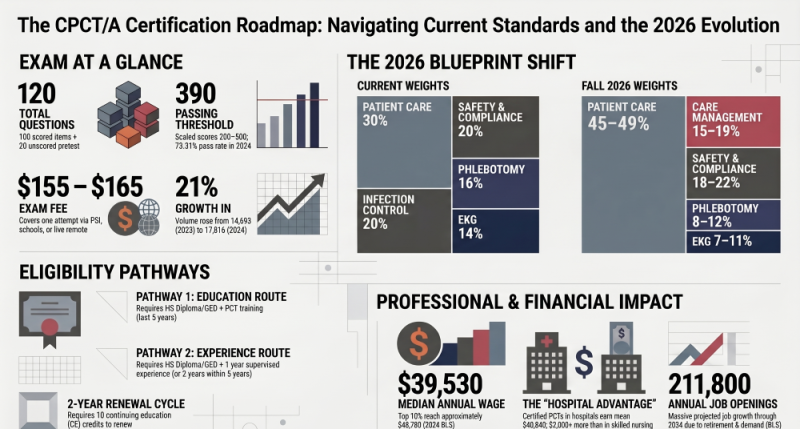
The CPCT/A is a nationally recognized credential administered by the National Healthcareer Association (NHA)), headquartered in Leawood, Kansas. NHA has awarded over 1 million certifications to date across all its programs. The CPCT/A specifically validates that a patient care technician can deliver bedside care, perform phlebotomy draws, and obtain EKG tracings — a combined skill set that makes certified PCTs more versatile than non-certified nursing assistants or CNAs.
According to NHA's 2025 Industry Outlook, 96 % of employers require or encourage certification for patient care technicians. That statistic explains why the credential has grown rapidly: NHA administered 17,816 CPCT/A exams in 2024, up from 14,693 in 2023, representing a 21 % year-over-year increase in testing volume.
The CPCT/A is accredited by the National Commission for Certifying Agencies (NCCA), the gold standard for healthcare certification program accreditation in the United States.
Who Is Eligible to Take the CPCT/A Exam?
The NHA offers two eligibility pathways. You must meet one of the following to sit for the exam:
Pathway 1 — Education Route
-
Hold a high school diploma or GED (or be scheduled to earn one within 12 months)
-
Have completed a patient care technician training or education program within the last 5 years
Pathway 2 — Experience Route
-
Hold a high school diploma or GED
-
Have 1 year of supervised PCT work experience within the last 3 years, or 2 years of supervised PCT work experience within the last 5 years
High school health science students may qualify under a special certification pathway — check the NHA Candidate Handbook for details. for details. There is no prerequisite certification (such as a CNA) required before testing.
What Are the Current CPCT/A Exam Domains and Weights?
The CPCT/A exam covers 5 domains. Each domain has a fixed percentage weight, which determines how many of the 100 scored questions come from that topic. The 20 pretest items are unscored and scattered throughout the exam — you will not know which questions are pretest.
| Domain | Weight | Scored Items (est.) |
|---|---|---|
| 1. Patient Care | 30 % | 30 |
| 2. Infection Control | 20 % | 20 |
| 3. Safety & Compliance | 20 % | 20 |
| 4. Phlebotomy | 16 % | 16 |
| 5. EKG | 14 % | 14 |
| Total | 100 % | 100 |
Note: The percentages above reflect the current exam blueprint used for tests taken before Fall 2026. A revised blueprint takes effect in Fall 2026 — see the next section for details.
Domain 1 — Patient Care (30 %)
-
The largest domain covers direct bedside tasks under nursing supervision: ADLs (bathing, oral care, catheter care), vital signs, patient transfers and ambulation, range-of-motion exercises, intake/output monitoring, ostomy and feeding tube care, recognizing changes in patient condition, end-of-life care, and healthcare provider CPR.
Domain 2 — Infection Control (20 %)
-
Tests how infections spread and how to stop them: standard and transmission-based precautions (CDC), chain of infection, PPE selection and donning/doffing, aseptic vs. sterile technique, equipment disinfection, biohazardous waste disposal (OSHA), common HAIs (MRSA, C. difficile, UTI), and exposure control plans.
Domain 3 — Safety & Compliance (20 %)
-
Covers regulatory knowledge and professional responsibility: HIPAA and PHI, two-identifier patient verification (National Patient Safety Goals), Joint Commission guidelines, OSHA workplace safety and SDS, Patients' Bill of Rights, abuse/neglect identification and mandated reporting, emergency preparedness (RACE, PASS), EHR documentation, scope of practice, and the Five Rights of Delegation.
Domain 4 — Phlebotomy (16 %)
-
Covers blood and specimen collection: venipuncture (evacuated tube, syringe, winged infusion), capillary puncture, order of draw, tube additives, blood culture collection, specimen labeling and transport, nonblood specimen collection, preanalytical errors (hemolysis, QNS), chain of custody, and CLIA-waived quality control.
Domain 5 — EKG (14 %)
-
Tests cardiac monitoring fundamentals: 3-lead, 5-lead, and 12-lead electrode placement, skin preparation and positioning, cardiac conduction anatomy, waveform identification (P wave, QRS, ST segment, T wave), artifact recognition and resolution, dysrhythmia reporting, life-threatening arrhythmias (V-tach, V-fib), and EKG machine calibration.
What Is Changing in the Fall 2026 CPCT/A Blueprint?
NHA announced in July 2025 that a new version of the CPCT/A exam will launch in Fall 2026, following a comprehensive job task analysis with industry professionals. The updated blueprint reflects how the patient care technician role has evolved — with significantly more emphasis on direct patient care and the introduction of a new Care Management domain.
Current vs. Fall 2026 Blueprint Comparison
| Domain | Current Weight | Fall 2026 Weight |
|---|---|---|
| Patient Care | 30 % | 45–49 % |
| Care Management & Coordination | — (new) | 15–19 % |
| Safety & Compliance | 20 % | 18–22 % |
| Phlebotomy | 16 % | 8–12 % |
| EKG | 14 % | 7–11 % |
| Infection Control | 20 % | (merged into other domains) |
Key changes to understand:
-
Patient Care nearly doubles from 30 % to 45–49 %, making it by far the dominant domain. This reflects the expanding bedside responsibilities of PCTs in hospitals and long-term care.
-
Care Management & Coordination is brand new at 15–19 %. It likely covers care planning, interdisciplinary communication, and patient discharge coordination — topics that were formerly embedded within other domains.
-
Infection Control disappears as a standalone domain. Its content has been redistributed across Patient Care and Safety & Compliance.
-
Phlebotomy drops by roughly half from 16 % to 8–12 %. Blood collection remains tested, but with fewer dedicated questions.
-
EKG also drops by roughly half from 14 % to 7–11 %. Basic cardiac monitoring knowledge is still required, but the exam's center of gravity has shifted toward direct patient care.
According to NHA's media center announcement, updated study materials will launch in Summer 2026 ahead of the new exam. Anyone who fails the exam within 30 days of the new version's launch will need to retest using the new blueprint.
Bottom line: If you are testing before Fall 2026, study the current 5-domain blueprint. If you are testing after, prioritize Patient Care and Care Management content and use the updated NHA study materials.
How Hard Is the CPCT/A Exam? Pass Rates and Scoring Explained
The CPCT/A exam uses NHA's standard scaled scoring system. Your raw score (number of correct answers out of 100 scored items) is converted to a scale from 200 to 500. A score of 390 or above is passing.
According to NHA's official pass rate data, the CPCT/A pass rate in 2024 was 73.31 %, meaning roughly 1 in 4 candidates did not pass on their attempt. In 2023, the pass rate was 74.55 %. These rates place the CPCT/A in the middle of NHA's difficulty spectrum — easier than the CMAA (62.68 % pass rate) and CET (69.66 %), but harder than the CCMA (81.38 %).
| Year | Exams Administered | Pass Rate | Active Certifications |
|---|---|---|---|
| 2024 | 17,816 | 73.31 % | 30,974 |
| 2023 | 14,693 | 74.55 % | 21,462 |
The 20 pretest questions do not count toward your score. They are embedded in the exam to field-test future questions, and there is no way to identify them. Answer every question as if it counts.
The CPCT/A is a mile wide — it tests patient care, phlebotomy, and EKG all in one exam. Candidates who only study patient care and neglect the technical domains are the ones who fall below 390. — Jennifer Torres, MSN, RN, Clinical Education Director
How Should You Prepare? An 8–12 Week CPCT/A Study Plan
The following study plan allocates weekly hours proportional to each domain's weight on the current blueprint. Adjust the phlebotomy and EKG emphasis upward if those are weak areas for you, or shift toward the Fall 2026 weights if you are testing after the blueprint update.
Weeks 1–2: Foundation Building
| Focus | Hours/Week | Activities |
|---|---|---|
| Anatomy & physiology review | 4 | Body systems, medical terminology, disease processes |
| Patient Care basics | 4 | ADLs, vital signs, body mechanics, transfers |
| Baseline assessment | 2 | Take NHA's timed baseline practice test to identify weak areas |
Weeks 3–4: Infection Control & Safety Deep Dive
| Focus | Hours/Week | Activities |
|---|---|---|
| Infection Control | 4 | Chain of infection, PPE, standard precautions, HAIs |
| Safety & Compliance | 4 | HIPAA, Joint Commission, OSHA, patient ID, scope of practice |
| Review Patient Care | 2 | Flashcards on ADLs, I&O, skin assessment |
Weeks 5–6: Phlebotomy Domain
| Focus | Hours/Week | Activities |
|---|---|---|
| Venipuncture & capillary techniques | 4 | Order of draw, tube colors, site selection |
| Specimen handling | 3 | Labeling, transport, preanalytical errors |
| Practice questions | 3 | Domain-specific practice sets |
Weeks 7–8: EKG Domain
| Focus | Hours/Week | Activities |
|---|---|---|
| Lead placement | 3 | 3-lead, 5-lead, 12-lead placement memorization |
| Rhythm interpretation | 3 | Normal sinus, common dysrhythmias, life-threatening arrhythmias |
| Artifacts & troubleshooting | 2 | Wandering baseline, somatic interference |
| Practice questions | 2 | Domain-specific practice sets |
Weeks 9–10: Integration & Weak-Area Remediation
| Focus | Hours/Week | Activities |
|---|---|---|
| Full-length practice exams | 5 | Simulate timed 2-hour conditions |
| Weak-area review | 3 | Target domains where practice scores are below 75 % |
| Crossover topics | 2 | Infection control in phlebotomy, patient safety during EKG |
Weeks 11–12 (If Needed): Final Review
| Focus | Hours/Week | Activities |
|---|---|---|
| Final timed practice test | 3 | NHA's final summative practice exam |
| Quick-reference review | 3 | Order of draw, lead placement, vital sign ranges, PPE protocols |
| Rest and confidence building | — | Light review only in the final 48 hours |
Study tip: NHA offers an interactive study guide and practice tests aligned to the current exam blueprint. If you are testing after Fall 2026, wait for the updated study materials launching in Summer 2026 before purchasing.
Where Do CPCT/A-Certified Technicians Work?
NHA-certified CPCT/A holders combine bedside care with technical procedures, making them valuable across multiple settings:
-
Hospitals — Med-surg floors, telemetry units, EDs, and ICUs
-
Dialysis centers — Monitoring patients during hemodialysis, performing draws, recording vitals
-
Skilled nursing facilities — ADL assistance, wound care support, patient monitoring
-
Long-term acute care (LTAC) — Complex medical needs requiring technical skills
-
Home healthcare — Direct patient care in residential settings
-
Rehabilitation centers — Mobility exercises, transfers, daily care
Qualifying job titles include Patient Care Technician, Patient Care Associate, Certified Patient Care Assistant, and Home Health Aide. The CPCT/A scope meets or exceeds the CNA scope, so many employers accept it for CNA-titled positions as well.
What Do Patient Care Technicians Earn?
According to the Bureau of Labor Statistics (BLS), the median annual wage for nursing assistants — the occupational category that includes patient care technicians — was $39,530 in May 2024. The BLS projects 211,800 annual job openings for nursing assistants and orderlies through 2034, driven primarily by replacement demand as workers retire or change careers.
| Salary Metric | Amount |
|---|---|
| Median Annual Wage (2024) | $39,530 |
| 10th Percentile | ~$30,020 |
| 90th Percentile | ~$48,780 |
| Hospital Setting (Mean) | $40,840 |
| Government Setting (Mean) | $48,580 |
| Skilled Nursing Facilities (Mean) | $38,730 |
Wages vary significantly by state. California, New York, Alaska, Oregon, and Washington, D.C. are among the highest-paying areas, with mean annual wages exceeding $46,000. Southern states like Mississippi, Louisiana, and Arkansas typically fall at the lower end, near $26,000–$28,000.
Certified PCTs generally earn more than non-certified counterparts. The phlebotomy and EKG skills validated by the CPCT/A credential open doors to hospital roles — where average pay ($40,840) exceeds the nursing facility average ($38,730) by over $2,000 annually.
How Does the CPCT/A Compare to Related NHA Certifications?
If you are considering multiple NHA credentials, this comparison clarifies where the CPCT/A fits.
| Feature | CPCT/A | CCMA | CET |
|---|---|---|---|
| Focus | Bedside care + phlebotomy + EKG | Clinical + administrative medical assisting | EKG monitoring only |
| Questions | 120 (100 scored) | 120 (100 scored) | 100 |
| Time | 2 hours | 2 hours | 2 hours |
| Cost | $165 | $155 | $129 |
| Domains | 5 | 3 | 2 |
| 2024 Pass Rate | 73.31 % | 81.38 % | 69.66 % |
| Work Setting | Hospitals, dialysis, SNFs | Physician offices, clinics | Cardiology, hospitals |
| EKG Content | 14 % | Minimal | 60 % |
| Phlebotomy Content | 16 % | Included | None |
The CPCT/A is the broadest clinical NHA credential — it combines patient care (the CNA/PCT core) with phlebotomy (a CPT skill) and EKG (a CET skill) in one exam. The CCMA includes administrative duties that the CPCT/A does not. Many technicians stack CPCT/A with CET or CCMA to maximize employability.
For a detailed head-to-head breakdown, see our NHA CCMA vs. CPCT/A comparison guide and NHA CET guide.
How Do You Register for the CPCT/A Exam?
Registration follows a 5-step process through NHA's online portal:
-
Create a free NHA account
-
Submit your CPCT/A application and verify your eligibility pathway
-
Schedule your exam — choose a date and location (school, PSI center, or remote proctoring). The $165 fee is collected at this step.
-
Prepare using NHA study materials, practice tests, or third-party resources
-
Take the exam — 120 questions in 2 hours
Results post to your NHA account within 2 business days. Your CPCT/A certification is valid for 2 years from the date of issue.
How Do You Maintain Your CPCT/A Certification?
The CPCT/A must be renewed every 2 years. Renewal requires completing 10 continuing education (CE) credits before your certification expiration date. NHA provides free CE courses through its online library — available 24/7 and continuously updated — for all active credential holders. The renewal fee is $185 (or $8/month if paid through NHA's subscription plan). If you hold additional NHA certifications, each additional renewal costs $60.
Frequently Asked Questions
Q1. How many questions are on the CPCT/A exam?
-
The CPCT/A exam contains 120 total questions. Of these, 100 are scored and 20 are unscored pretest items used by NHA to evaluate future exam questions. All 120 questions appear in random order, so you should answer every question as if it counts toward your score.
Q2. What is the passing score for the CPCT/A exam?
-
You need a scaled score of 390 out of 500 to pass. NHA converts your raw score (correct answers out of 100) to a scaled score ranging from 200 to 500. The exact number of raw correct answers needed to reach 390 varies slightly by exam form.
Q3. How much does the CPCT/A exam cost?
-
The CPCT/A exam fee is $165. This covers one exam attempt. Retake fees apply if you do not pass, and NHA requires a waiting period before retesting.
Q5. What is the CPCT/A pass rate?
-
According to NHA's official 2024 data, the CPCT/A pass rate was 73.31 % across 17,816 exams administered. This means approximately 3 out of 4 candidates passed.
Q6. Is the CPCT/A exam changing in 2026?
-
Yes. NHA will release a new CPCT/A exam blueprint in Fall 2026. The most significant change is Patient Care increasing from 30 % to 45–49 % of scored items. A new Care Management & Coordination domain (15–19 %) will be introduced, while Phlebotomy drops to 8–12 % and EKG drops to 7–11 %. Updated study materials launch in Summer 2026.
Q7. Can I take the CPCT/A exam online?
-
Yes. NHA offers three testing options: school-sponsored exams, PSI testing center locations, and live remote proctoring from any location with a stable internet connection, webcam, and private room.
Q8. Do I need a CNA before taking the CPCT/A?
-
No. The CPCT/A has no prerequisite certification. You need a high school diploma or GED plus either a PCT training program (within 5 years) or 1–2 years of supervised work experience.
Q9. How long is the CPCT/A certification valid?
- The CPCT/A is valid for 2 years. Renewal requires 10 continuing education credits, which are free through NHA's online CE library for active certification holders. The renewal fee is $185.
Q10. What is the difference between CPCT/A and CNA?
-
The CPCT/A scope of practice meets or exceeds the CNA scope. While CNAs focus on basic patient care and ADLs, the CPCT/A also validates phlebotomy and EKG competency, making certified PCTs eligible for a broader range of hospital and clinical roles.
Q11. How long should I study for the CPCT/A exam?
-
Most candidates need 8 to 12 weeks of structured preparation, studying approximately 8–10 hours per week. Candidates with recent PCT clinical experience may need less time, while career changers or those weak in phlebotomy and EKG should plan for the full 12 weeks.
Start Your CPCT/A Exam Prep Today
Passing the CPCT/A on your first attempt starts with practice that mirrors the real exam. MedicoExam's simulation-based CPCT/A practice tests replicate the 120-question, 2-hour format with domain-weighted question distribution so you know exactly where you stand before test day. Pair these with our NHA certification hub for study schedules, domain breakdowns, and comparison guides across all NHA credentials.
Written by the MedicoExam Content Team — Healthcare Education Specialists at MedicoExam
Disclaimer: This guide is for informational purposes only. MedicoExam is not affiliated with or endorsed by the National Healthcareer Association. Exam content, fees, and policies are subject to change — always verify current requirements at nhanow.com. This guide does not contain exam recalls, leaked questions, or proprietary NHA content.
Written by the MedicoExam Content Team — Healthcare Education Specialists at MedicoExam.com
Last Updated: April 2026
Disclaimer: This guide is for informational purposes only. MedicoExam is not affiliated with or endorsed by the National Healthcareer Association. Exam content, fees, and policies are subject to change — always verify current requirements at nhanow.com. This guide does not contain exam recalls, leaked questions, or proprietary NHA content.
- NHA CPCT/A Question Bank |
- NHA CPCT/A Eligibility & Requirements |
- NHA Patient Care Technician/Assistant Practice Test |
- NHA CPCT/A Exam Cost |
- NHA CPCT/A Registration Process |
- NHA Patient Care Technician/Assistant Study Guide |
- NHA CPCT/A Recertification |
- NHA CPCT/A Certification Overview |
- NHA Patient Care Technician/Assistant Syllabus |
- NHA CPCT/A Preparation Time |
- NHA CPCT/A Passing Score |
- NHA CPCT/A Exam Format |
- NHA Patient Care Technician/Assistant Sample Questions |
- NHA CPCT/A Career Opportunities |
- NHA CPCT/A Exam Difficulty


