
AHIMA RHIT vs RHIA: Which Health Information Credential Should You Get?
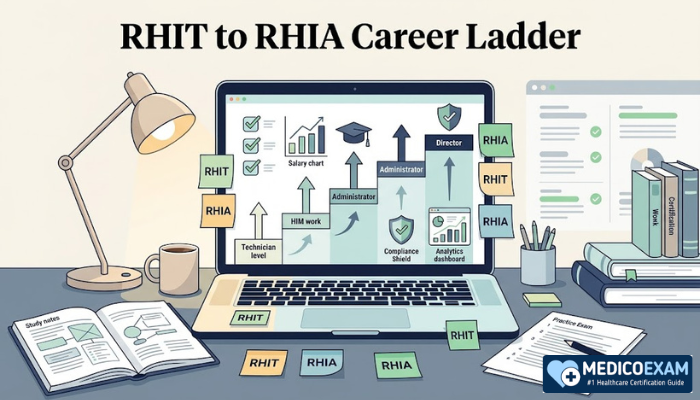 Choose RHIT if you hold an associate degree and want to start working in health information management quickly — it covers 6 exam domains and qualifies you for technical roles earning a median of $50,250 per year. Choose RHIA if you have a bachelor's degree or higher and want to move into management, compliance, or data analytics leadership — RHIA holders earn a median of $67,310 per year and qualify for director-level positions that exceed $100,000 annually.
Both credentials are issued by the American Health Information Management Association (AHIMA), and each exam has 150 questions with a 3.5-hour time limit. The real difference comes down to education level, exam content, and the career trajectory each credential unlocks.
RHIT vs RHIA at a Glance: Key Facts
| Feature | RHIT | RHIA |
|---|---|---|
| Full Name | Registered Health Information Technician | Registered Health Information Administrator |
| Issuing Body | AHIMA | AHIMA |
| Education Required | Associate degree (CAHIIM-accredited) | Bachelor's degree or higher (CAHIIM-accredited) |
| Exam Questions | 150 (130 scored + 20 pretest) | 150 (130 scored + 20 pretest) |
| Exam Duration | 3.5 hours | 3.5 hours |
| Exam Domains | 6 domains | 5 domains |
| Passing Score | 300 out of 400 | 300 out of 400 |
| Exam Fee | $299 (non-member) / $229 (AHIMA member) | $299 (non-member) / $229 (AHIMA member) |
| Recertification Cycle | Every 2 years | Every 2 years |
| CEUs Required | 20 CEUs per cycle | 30 CEUs per cycle |
| 2024 First-Time Pass Rate | 78% | 71% |
| Certified Professionals (Jan 2024) | ~28,030 | ~14,378 |
| Median Salary (BLS, 2024) | $50,250 | $67,310 |
| Testing Vendor | Pearson VUE | Pearson VUE |
What Is the Difference Between RHIT and RHIA?
The core difference is scope. RHIT is a technician-level credential focused on the day-to-day operations of health information — coding, data quality, release of information, and record maintenance. RHIA is an administrator-level credential focused on managing departments, developing policies, leading compliance programs, and directing analytics strategy.
RHIT requires completion of an associate degree from a program accredited by the Commission on Accreditation for Health Informatics and Information Management Education (CAHIIM). RHIA requires a bachelor's degree or higher from a CAHIIM-accredited program. According to AHIMA, RHIA supersedes RHIT in the credential hierarchy — once you earn RHIA, the RHIT credential is no longer required for recertification.
Think of RHIT as the credential that proves you can do the work. RHIA proves you can lead the team doing the work.
What Does the RHIT Exam Cover?
The RHIT exam tests competency across 6 content domains. Each domain is weighted differently, and questions fall into three cognitive complexity levels: Recall, Application, and Analysis. The majority of RHIT questions are at the Application level.
RHIT Domain Breakdown
| Domain | Weight |
|---|---|
| 1. Data Content, Structure, and Information Governance | 19–25% |
| 2. Access, Disclosure, Privacy, and Security | 14–18% |
| 3. Data Analytics and Use | 12–18% |
| 4. Revenue Cycle Management | 19–25% |
| 5. Compliance | 13–17% |
| 6. Informatics and Health IT | 8–12% |
Two domains dominate the RHIT exam: Data Content/Structure/Information Governance and Revenue Cycle Management, each carrying 19–25% of the total weight. Together they account for up to half the scored questions. Candidates preparing for the RHIT should prioritize these areas while ensuring solid coverage of Compliance and Access/Disclosure, which together represent another 27–35%.
RHIT questions focus on practical, technical knowledge — correctly coding a diagnosis, applying a data retention policy, or identifying the right release-of-information procedure.
If you are preparing for an AHIMA coding credential at any level, MedicoExam's AHIMA practice tests offer simulation-based preparation across all AHIMA exam formats.
What Does the RHIA Exam Cover?
The RHIA exam is organized into 5 domains with an emphasis on management, analytics, and organizational leadership. Like the RHIT, questions use three complexity levels (Recall, Application, Analysis), but the RHIA contains a higher proportion of Analysis-level questions that require critical thinking and case-based reasoning.
RHIA Domain Breakdown
| Domain | Weight |
|---|---|
| 1. Data and Information Governance | 17–20% |
| 2. Compliance with Access, Use, and Disclosure of PHI | 15–18% |
| 3. Data Analytics and Informatics | 23–26% |
| 4. Revenue Cycle Management | 20–23% |
| 5. Organizational Management and Leadership | 15–18% |
The heaviest domain on the RHIA exam is Data Analytics and Informatics at 23–26%, reflecting the growing importance of data-driven decision-making in health information management. Revenue Cycle Management follows at 20–23%. The RHIA-exclusive domain — Organizational Management and Leadership — accounts for 15–18% and covers topics like budget preparation, strategic planning, team management, and quality improvement that do not appear on the RHIT exam.
RHIA questions test your ability to design policies, evaluate compliance programs, interpret analytics reports, and lead HIM operations at the organizational level.
How Do the RHIT and RHIA Exam Domains Compare Side by Side?
While both exams cover overlapping content areas, they approach the material from different perspectives. RHIT tests operational execution; RHIA tests strategic oversight.
| Content Area | RHIT Domain | RHIT Weight | RHIA Domain | RHIA Weight |
|---|---|---|---|---|
| Data governance and records management | Domain 1 | 19–25% | Domain 1 | 17–20% |
| Privacy, access, and PHI compliance | Domain 2 | 14–18% | Domain 2 | 15–18% |
| Data analytics | Domain 3 | 12–18% | Domain 3 | 23–26% |
| Revenue cycle | Domain 4 | 19–25% | Domain 4 | 20–23% |
| Compliance | Domain 5 | 13–17% | Covered within Domain 2 | — |
| Informatics / Health IT | Domain 6 | 8–12% | Included in Domain 3 | — |
| Organizational management & leadership | Not tested | — | Domain 5 | 15–18% |
The biggest takeaway: RHIA places nearly double the weight on analytics and informatics (23–26% vs. 12–18% on the RHIT) and adds an entire domain for management and leadership. RHIT dedicates separate domains to Compliance and Informatics, while RHIA consolidates these into broader domains that test management-level understanding of the same concepts.
Who Is Eligible for Each Exam?
-
RHIT eligibility requires completion of one of the following:
-
An associate degree in Health Information Management from a CAHIIM-accredited program
-
A Health Information Management program from a foreign association with AHIMA reciprocity
-
RHIA eligibility requires completion of one of the following:
-
A bachelor's degree in Health Information Management from a CAHIIM-accredited program
-
A master's degree in HIM from a CAHIIM-accredited program
-
A post-baccalaureate certificate program accredited by CAHIIM
-
A foreign degree approved through AHIMA reciprocity
-
Active RHIT credential plus proviso conditions approved by the CCHIIM
That last pathway is important: RHIT holders can upgrade to RHIA by completing a bachelor's degree and meeting the CCHIIM proviso requirements. According to AHIMA, the RHIA credential then supersedes the RHIT, and you only need to maintain the RHIA going forward.
Both exams are administered through Pearson VUE testing centers. The eligibility window is 120 calendar days from application approval, with 30-day extensions available for $50 each (up to 90 additional days). Candidates who do not pass must wait at least 30 days before reapplying.
How Much Do RHIT and RHIA Professionals Earn?
Salary is one of the clearest differences between the two credentials. The higher education requirement and broader scope of RHIA consistently translate into higher earnings.
-
According to the U.S. Bureau of Labor Statistics (BLS) for May 2024:
-
Medical Records Specialists (RHIT-aligned roles): Median annual wage of $50,250
-
Health Information Technologists and Medical Registrars (RHIA-aligned roles): Median annual wage of $67,310
That is a $17,060 difference in median annual salary between the two credential levels.
Salary Comparison by Role Level
| Career Stage | Typical Role | Approximate Annual Salary |
|---|---|---|
| Entry-level RHIT | Health Information Technician, Coder | $40,000–$55,000 |
| Experienced RHIT | Senior Coder, Billing Coordinator, Data Quality Analyst | $50,000–$65,000 |
| Entry-level RHIA | HIM Analyst, Compliance Coordinator | $55,000–$75,000 |
| Experienced RHIA | HIM Manager, Coding Manager, Data Analytics Manager | $70,000–$95,000 |
| HIM Director (typically RHIA + experience) | Director of Health Information Management | $84,000–$133,000 |
According to ZipRecruiter, the average HIM Director salary is $105,973 per year, with top earners in states like Massachusetts and New York exceeding $150,000 annually. PayScale reports the average HIM Director salary at $83,576 in 2026, with a range from $59,000 to $125,000 depending on experience and location.
The BLS projects employment of health information technologists and medical registrars to grow 15% from 2024 to 2034 — much faster than the average for all occupations — with approximately 6,200 new positions expected over the decade.
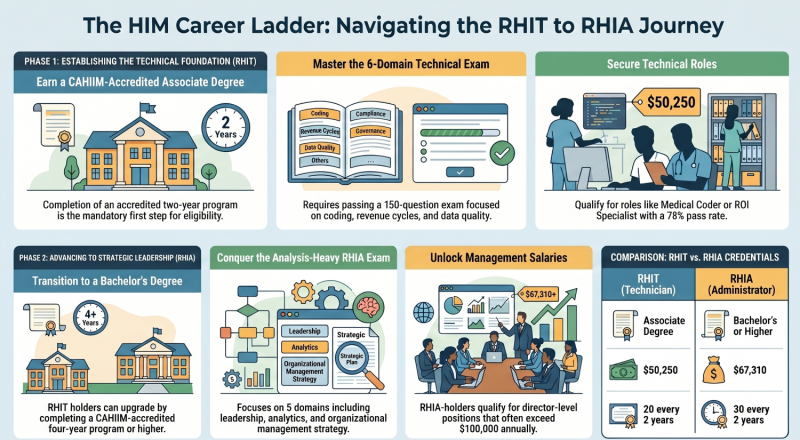
What Does the Career Ladder From RHIT to RHIA to HIM Director Look Like?
The RHIT-to-RHIA path is one of the clearest career ladders in healthcare. Each step increases both responsibility and earning potential.
Step 1: RHIT (Associate Degree Level)
You start with an associate degree and the RHIT credential. Typical roles include health information technician, medical coder, release-of-information specialist, and billing coordinator. You handle day-to-day HIM operations — maintaining records, assigning codes, processing information requests, and ensuring data quality.
At this stage, you are building foundational skills in coding systems (ICD-10-CM, CPT, HCPCS), electronic health record workflows, and compliance procedures. Many RHIT holders begin working toward a bachelor's degree while employed full-time.
Step 2: RHIA (Bachelor's Degree Level)
After completing a CAHIIM-accredited bachelor's program, you qualify for the RHIA exam. RHIA roles shift from execution to management — HIM department supervisor, compliance officer, coding manager, data analytics lead, or information governance specialist.
RHIA professionals are responsible for developing departmental policies, preparing budgets, overseeing compliance programs, managing staff, and participating in organizational leadership committees. The RHIA credential signals to employers that you can lead, not just perform.
Earning RHIA after RHIT also simplifies your recertification: AHIMA's credential hierarchy means the RHIA replaces the RHIT, so you only maintain one credential.
Step 3: HIM Director (RHIA + Experience)
With several years of RHIA experience, many professionals advance to Director of Health Information Management. HIM Directors oversee entire departments, report to C-suite executives, manage multi-million-dollar budgets, and drive organizational strategy around data governance, compliance, and technology adoption.
Some HIM Directors pursue additional AHIMA credentials such as CHDA (Certified Health Data Analyst) or CHPS (Certified in Healthcare Privacy and Security) to specialize further. Others complete master's degrees in HIM, health administration, or business to qualify for Vice President or Chief Health Information Officer roles.
Expert Insight: "The RHIT is your foundation — it proves you understand the technical side of health information. But if you want to lead a department, negotiate budgets, and sit at the strategic table, the RHIA is non-negotiable. I've watched dozens of RHIT holders transform their careers by finishing their bachelor's and earning the RHIA. The salary jump alone makes the investment worthwhile." — *Denise R., RHIA, CHDA, HIM Director at a 400-bed community hospital (15 years in HIM)*
Should You Get RHIT First or Go Straight to RHIA?
If you already have a bachelor's degree in HIM, go directly to RHIA — there is no requirement to earn RHIT first. RHIA is the higher credential and will qualify you for a wider range of positions immediately.
If you currently have an associate degree, earning RHIT first is the practical path. RHIT lets you enter the workforce while you complete your bachelor's degree. Once you finish your four-year program, you can sit for the RHIA exam without losing any career momentum.
There is one important exception. Students enrolled in a CAHIIM-accredited bachelor's program can apply for the RHIA exam during their final semester through AHIMA's early testing program. If you are close to graduation, check whether early testing is available to you.
For candidates still exploring entry-level AHIMA credentials, MedicoExam's CCA practice exams are a useful starting point. The Certified Coding Associate (CCA) is AHIMA's entry-level coding credential and does not require a degree — it can help you decide if HIM is the right career path before committing to a full degree program.
How Hard Are the RHIT and RHIA Exams?
Based on 2024 data, the RHIT exam has a first-time pass rate of 78%, while the RHIA exam has a first-time pass rate of 71%. The most recent 2025 AHIMA certification data shows the RHIT pass rate at 74% and the RHIA pass rate at 67%.
-
The RHIA exam is generally considered more difficult for three reasons:
-
Higher cognitive demand. RHIA questions contain a greater proportion of Analysis-level items, which require synthesizing information across multiple concepts to evaluate a solution or scenario.
-
Broader content scope. RHIA covers organizational management and leadership topics that go beyond the RHIT content outline — budget preparation, strategic planning, and departmental oversight.
-
Administrator perspective. Even in overlapping areas like revenue cycle or data governance, RHIA questions test from a supervisory and policy-development angle rather than an operational one.
Both exams share the same format: 150 multiple-choice questions (130 scored, 20 pretest) in 3.5 hours, delivered at Pearson VUE centers. The passing score for both is 300 on a 100–400 scale.
Exam Complexity Levels Explained
| Level | Name | What It Tests |
|---|---|---|
| RE | Recall | Ability to remember specific facts, terms, and procedures |
| AP | Application | Ability to apply knowledge to new situations and interpret data |
| AN | Analysis | Ability to synthesize information, evaluate solutions, and solve complex problems |
The majority of questions on both exams are at the Application level. However, RHIA includes a higher percentage of Analysis-level questions, which is why many candidates find it more challenging despite having the same number of questions and time limit.
How Do You Prepare for the RHIT or RHIA Exam?
Effective preparation for either exam combines structured content review, practice testing, and domain-weighted study allocation.
RHIT Study Strategy (6–8 Weeks)
| Week | Focus Area |
|---|---|
| 1–2 | Data Content/Structure/Info Governance (19–25%) and Revenue Cycle Management (19–25%) |
| 3–4 | Compliance (13–17%) and Access/Disclosure/Privacy/Security (14–18%) |
| 5–6 | Data Analytics (12–18%) and Informatics/Health IT (8–12%) |
| 7–8 | Full-length practice exams and weak-area review |
RHIA Study Strategy (8–12 Weeks)
| Week | Focus Area |
|---|---|
| 1–3 | Data Analytics and Informatics (23–26%) and Revenue Cycle Management (20–23%) |
| 4–6 | Data/Information Governance (17–20%) and Compliance with PHI (15–18%) |
| 7–9 | Organizational Management and Leadership (15–18%) |
| 10–12 | Full-length practice exams, case-study review, and weak-area remediation |
Simulation-based practice testing is critical for both exams. The three-tier complexity structure (Recall, Application, Analysis) means you need to practice not just knowing the material, but applying it to scenarios and analyzing multi-step problems.
For AHIMA coding and HIM exam preparation, MedicoExam's CCS practice tests cover many of the same coding and revenue cycle competencies tested on both the RHIT and RHIA exams. Using timed, full-length simulations helps you build the stamina and decision-making speed needed for the 3.5-hour exam window.
What Are the Recertification Requirements for RHIT and RHIA?
-
Both credentials require recertification every two years through continuing education. The requirements differ in volume:
-
RHIT: 20 CEUs per two-year cycle
-
RHIA: 30 CEUs per two-year cycle
At least 80% of CEUs must be earned within AHIMA's Health Information and Informatics Management (HIIM) domains. The remaining 20% can come from content relevant to your professional role but outside the HIIM domains.
Recertification Cost
| Fee Type | AHIMA Members | Non-Members |
|---|---|---|
| Single credential recertification | $100 | $249 |
| Each additional credential | $20 | $50 |
| Extension fee (per credential) | $50 | $50 |
| Reinstatement fee (per credential) | $368 | $368 |
If you hold both RHIT and RHIA, AHIMA's credential hierarchy means the RHIA replaces the RHIT. You only need to maintain the RHIA credential and pay one recertification fee.
Failure to complete recertification by the deadline leads to inactive status (6 months), then temporary revocation (6 months), and ultimately permanent revocation. Earning and logging your CEUs on schedule is essential.
Is RHIA Worth It if You Already Have RHIT?
-
Yes — for most professionals, upgrading from RHIT to RHIA is one of the highest-ROI moves in health information management. Here is the math:
-
Additional education cost: A bachelor's completion program (for those with an associate degree) typically costs $15,000–$40,000 depending on the institution
-
RHIA exam fee: $299 (non-member) or $229 (AHIMA member)
-
Salary increase: The BLS data shows a $17,060 median annual increase between RHIT-aligned and RHIA-aligned roles
-
Five-year salary gain: Approximately $85,300 in additional earnings
Even at the higher end of education costs, the five-year return on investment is strongly positive. And that calculation does not account for the HIM Director pathway, which can push annual earnings above $100,000.
Beyond salary, RHIA opens doors to roles that simply are not available to RHIT holders — compliance leadership, departmental management, information governance director, and C-suite advisory positions.
Frequently Asked Questions
1. Can I take the RHIA exam without first earning RHIT?
-
Yes. There is no requirement to hold RHIT before taking the RHIA exam. You need a bachelor's degree or higher from a CAHIIM-accredited HIM program to be eligible for RHIA directly.
2. How many questions are on the RHIT and RHIA exams?
-
Both exams contain 150 multiple-choice questions. Of those, 130 are scored and 20 are unscored pretest items used to validate questions for future exams. You have 3.5 hours to complete either exam.
3. What is the passing score for RHIT and RHIA?
-
Both exams require a minimum scaled score of 300 on a 100–400 point scale. The exact number of correct answers needed varies by exam form because AHIMA uses scaled scoring to account for difficulty differences between versions.
4. How much does the RHIT or RHIA exam cost?
-
Both exams cost $299 for non-members and $229 for AHIMA members. AHIMA professional membership costs $149 per year, so membership saves $70 on exam fees alone.
5. What is the pass rate for each exam?
-
According to 2024 AHIMA data, the RHIT first-time pass rate is 78% and the RHIA first-time pass rate is 71%. The most recent 2025 data shows RHIT at 74% and RHIA at 67%.
6. How long do I have to wait to retake the exam if I fail?
-
AHIMA requires a minimum 30-day waiting period before reapplying for the RHIT or RHIA exam. You must submit a new application and pay the full exam fee for each retake attempt.
7. Does RHIA replace RHIT?
-
Yes. In AHIMA's credential hierarchy, RHIA supersedes RHIT. Once you pass the RHIA exam, the RHIT credential is replaced and you only need to maintain recertification for RHIA (30 CEUs every two years).
8. Can I earn RHIA while working full-time with an RHIT?
-
Yes. Many RHIT holders complete a bachelor's degree through online CAHIIM-accredited programs while working full-time. AHIMA also offers an early testing option that allows students to take the RHIA exam during their final semester.
9. Are RHIT and RHIA recognized nationally?
-
Yes. Both are nationally recognized credentials issued by AHIMA, the premier professional association for health information management. They are accepted by hospitals, health systems, insurance companies, government agencies, and consulting firms across all 50 states.
10. What other AHIMA credentials complement RHIT or RHIA?
-
AHIMA offers several specialty credentials that pair well with RHIT or RHIA: CCS (Certified Coding Specialist) for advanced coding expertise, CHDA (Certified Health Data Analyst) for data analytics specialization, CHPS (Certified in Healthcare Privacy and Security) for privacy and security roles, and CDIP (Certified Documentation Integrity Practitioner) for clinical documentation improvement. Learn more about AHIMA coding credentials on MedicoExam's AHIMA page.
Start Your AHIMA Exam Prep Today
Whether you are targeting RHIT, RHIA, or another AHIMA credential, preparation makes the difference between passing and retaking. MedicoExam offers simulation-based practice tests designed to mirror the format, domain weighting, and complexity levels of official AHIMA exams.
-
AHIMA Practice Tests — Full catalog of AHIMA exam simulations
-
CCA Practice Exams — Entry-level coding credential prep
-
CCS Practice Exams — Advanced coding specialist prep
Start with a free practice session to see where you stand — then build a study plan around your domain-level performance data.
Written by the MedicoExam Content Team — Healthcare Education Specialists at MedicoExam.com
Last Updated: April 2026
Disclaimer: This article is for informational purposes only. MedicoExam is not affiliated with AHIMA. Exam content, fees, and policies are subject to change — always verify current details on the official AHIMA website. This article does not contain actual exam questions, recalled content, or proprietary AHIMA materials.
- AHIMA RHIT Question Bank |
- AHIMA RHIT Eligibility & Requirements |
- AHIMA Health Information Technician Practice Test |
- AHIMA RHIT Exam Cost |
- AHIMA RHIT Registration Process |
- AHIMA Health Information Technician Study Guide |
- AHIMA RHIT Recertification |
- AHIMA RHIT Certification Overview |
- AHIMA RHIA Question Bank |
- AHIMA RHIA Eligibility & Requirements |
- AHIMA Health Information Administrator Practice Test |
- AHIMA RHIA Exam Cost |
- AHIMA RHIA Registration Process |
- AHIMA Health Information Administrator Study Guide |
- AHIMA RHIA Recertification |
- AHIMA RHIA Certification Overview


