
From Student to Certified: 5 Healthcare Professionals Share Their Certification Exam Strategies
 Passing a healthcare certification exam is often the final, daunting hurdle between you and your new career. Textbooks and study guides are essential, but there is no substitute for the lived experience of professionals who have actually sat in the testing center and earned their credentials.
We spoke with five credentialed professionals — spanning medical coding, nursing, respiratory therapy, and advanced practice — to find out what strategies worked and what mistakes they wish they had avoided.
The AAPC Certified Professional Coder (CPC)
-
Professional Profile: Marcus T., CPC
-
Credentials: Certified Professional Coder (AAPC)
-
Years Certified: 4 years
-
Current Role: Outpatient Surgery Coder at a large health system
-
Specialty: General surgery and orthopedic procedure coding
What was your biggest hurdle with the CPC exam?
"Time management, without a doubt. You have 4 hours to answer 100 questions, which sounds generous until you realize you are reading complex operative reports for many of them. I failed my first attempt because I spent too long on the surgical cases early in the test and had to rush through the last 20 questions. That 2.4 minutes per question disappears fast when you are flipping through a thousand-page CPT manual."
Marcus's Top 3 Study Tips:
-
Tab Your Books Strategically — But Not Excessively. "Do not tab every single page of your CPT book. Tab the major section dividers, the index, the guidelines pages, and any appendices you reference frequently. If you over-tab, you will spend more time scanning your tabs than finding the codes. I used color-coded tabs: blue for Evaluation and Management, red for Surgery, green for Radiology, and yellow for the Index."
-
Master the Process of Elimination. "When you read a question, look at the four multiple-choice answers first — before you read the scenario. Usually, you can eliminate two options immediately because they are from the wrong anatomical section or code range. This saves you from reading the entire operative note from scratch and narrows your lookup to two possible codes."
-
Practice in 4-Hour Blocks Every Weekend. "You have to build testing stamina. Sitting at a desk for four straight hours with physical codebooks is mentally and physically exhausting. I took a full-length, timed CPC practice exam every Saturday morning for six weeks before my test date. By week four, the 4-hour format felt normal."
Biggest Mistake to Avoid: "Ignoring the medical terminology and anatomy sections. People get obsessed with memorizing codes and forget the foundation. If you don't know your anatomy — the difference between a fasciotomy and a fasciectomy, for example — you physically cannot select the correct code. Spend the first two weeks of your study plan purely on anatomy and terminology."
The AHIMA Certified Coding Specialist (CCS)
-
Professional Profile: Sarah M., CCS, RHIT
-
Credentials: Certified Coding Specialist (AHIMA), Registered Health Information Technician
-
Years Certified: 6 years
-
Current Role: Inpatient Coding Auditor at a 400-bed hospital
-
Specialty: Complex surgical DRG optimization
The CCS exam has a notoriously low pass rate (estimated at 40–50%). How did you beat the odds?
"The CCS is a beast because it tests both multiple-choice knowledge and actual clinical scenario coding. You cannot just memorize rules — you have to know how to apply them to messy, real-world charts with conflicting documentation and multiple comorbidities. I treated studying like a part-time job: two hours every weekday and four hours on Saturdays for ten straight weeks."
Sarah's Top 3 Study Tips:
-
Drill ICD-10-PCS Root Operations Until They Are Automatic. "The inpatient procedure codes are where most people lose their points. Spend an entire week studying the difference between root operations like Excision vs. Resection, Replacement vs. Supplement, Repair vs. Alteration. If you select the wrong root operation, every character after it will be wrong too. I made a chart with definitions and examples for all 31 root operations and reviewed it daily."
-
Practice Without Your Encoder. "At work, I use 3M CodeFinder, which does a lot of the heavy lifting with DRG assignment and sequencing suggestions. On the CCS exam, you have only your physical ICD-10-CM and ICD-10-PCS books. You must practice looking up codes manually, navigating the index, and reading Excludes notes. I disconnected from the encoder completely during my study period to force manual lookup."
-
Budget 2 Full Hours for the Scenario Section. "The coding scenarios take significantly longer than the multiple-choice questions. I paced my exam so I finished the MCQ section in about 90 minutes, then had a full 2 hours for the clinical scenarios, with 30 minutes for review. If you run out of time in the scenario section, you will fail — those questions carry heavy weight."
Biggest Mistake to Avoid: "Buying the wrong year's codebooks. AHIMA updates the CCS exam annually on May 1st. If you test after May 1st using last year's ICD-10-CM book, you will encounter code changes that make your answers wrong based on outdated guidelines. Always verify which book edition applies to your exam date."
The Registered Nurse (NCLEX-RN)
-
Professional Profile: David R., BSN, RN
-
Credentials: Registered Nurse (NCLEX-RN)
-
Years Certified: 3 years
-
Current Role: Emergency Department Nurse at a Level 1 Trauma Center
-
Specialty: Emergency and critical care nursing
How did you handle the anxiety of the adaptive testing format (CAT)?
"The Next Generation NCLEX shuts off anywhere between 85 and 150 questions based on your performance. My screen kept going past 85, and the panic started creeping in. At question 110, I physically closed my eyes, took a deep breath, and told myself: if the test is still asking me questions, it means I am still in the game. It has not decided I failed. That mental reset saved me."
David's Top 3 Study Tips:
-
Master 'Prioritization' Questions — They Are Everywhere. "The NCLEX loves 'who do you see first' and 'what do you do next' questions. Master the ABCs (Airway, Breathing, Circulation) and Maslow's Hierarchy of Needs. When in doubt, the patient with a compromised airway always comes first. That single framework will guide you through 30% of the test."
-
Read the Rationale for Every Practice Question — Even the Ones You Got Right. "You need to understand why the NCLEX considers an answer correct. Their logic is very specific. A practice question might have two answers that seem right, but the NCLEX will choose the one that addresses the most immediate physiological need. If you only review questions you got wrong, you are missing half the learning opportunity."
-
Study 50–75 Questions Per Day, Every Day, for Six Weeks. "Consistency beats cramming. I did a block of 75 practice questions every single day for six weeks before my test date. I alternated between pharmacology days, medical-surgical days, and maternal-child days. By the end of six weeks, the question format felt completely natural — like reading a conversation, not taking a test."
Biggest Mistake to Avoid: "Changing your answers. Your first instinct is usually right, especially on the NCLEX. Unless you vividly remember a specific fact that proves your first choice wrong, do not go back and change it. I tracked my answer changes during practice tests and found that I changed correct answers to incorrect ones more than 60% of the time."
The Registered Respiratory Therapist (RRT)
-
Professional Profile: Elena K., RRT
-
Credentials: Registered Respiratory Therapist (NBRC)
-
Years Certified: 5 years
-
Current Role: Pediatric ICU Respiratory Therapist at a children's hospital
-
Specialty: Neonatal and pediatric ventilator management
With the NBRC transitioning to a new single exam format in January 2027, what foundational advice do you have for students testing now?
"Whether you are taking the current TMC and CSE or the new 2027 Respiratory Therapy Examination, the core of respiratory therapy remains clinical judgment. The format is changing — 160 total questions in a single test with breadth and depth sections — but the fundamental skill being tested is the same: can you gather the right data, interpret it correctly, and make the safest decision for your patient?"
Elena's Top 3 Study Tips:
-
Always Gather Information Before You Intervene — Unless It Is Life-Threatening. "In any clinical scenario or simulation question, the correct first answer is almost always to assess the patient. Listen to breath sounds, check the SpO2, obtain an arterial blood gas. The only exception is an immediate life-threatening situation where you must act without delay. The NBRC rewards methodical, data-driven decision-making."
-
Memorize Normal Values Cold — Write Them Down the Second You Sit Down. "You cannot pass if you do not know the normal ranges for ABGs (pH 7.35–7.45, PaCO2 35–45, PaO2 80–100, HCO3 22–26), hemodynamics, and basic lab values. The moment you sit down at the testing station, before you touch the first question, write every normal value you know on your erasable whiteboard. That cheat sheet will save you time and stress all through the exam."
-
Identify the Patient's Pathophysiology from the First Sentence. "The NBRC gives you clues early. 'Barrel-chested 65-year-old with a 40-pack-year smoking history' is COPD. 'Young adult after a motorcycle accident with absent breath sounds on the left' is a pneumothorax. Let the patient description immediately guide your treatment algorithm. If you correctly identify the disease process, the treatment options narrow dramatically."
Biggest Mistake to Avoid: "Over-treating. In simulations and scenario questions, candidates often jump straight to intubation when the patient could be managed with less invasive support. Always follow the step-up approach: supplemental oxygen → non-invasive ventilation → invasive ventilation. The NBRC specifically penalizes aggressive interventions when less invasive options are appropriate. Start conservative and escalate based on the data."
The Family Nurse Practitioner (FNP-BC)
-
Professional Profile: Dr. Michelle C., DNP, FNP-BC
-
Credentials: Family Nurse Practitioner (ANCC), Doctor of Nursing Practice
-
Years Certified: 8 years
-
Current Role: Primary Care Clinic Director managing a team of 6 providers
-
Specialty: Chronic disease management and preventive care
Stepping up from an RN to a provider role is a massive cognitive shift. How did you adjust your thinking for the boards?
"As an RN, your job is to assess, monitor, and implement orders. As an NP, you are the one writing the orders. You have to fundamentally shift your brain from 'what should I monitor?' to 'what is the diagnosis, what is the gold-standard diagnostic test, and what is the exact first-line pharmacological treatment?' That shift in thinking is what the ANCC FNP-BC exam is really testing."
Michelle's Top 3 Study Tips:
-
Organize Your Study by Body System, Not by Random Topic. "Do not study randomly. Dedicate one full week purely to cardiovascular conditions, one week to endocrine (diabetes, thyroid, adrenal), one week to respiratory, and so on. For every major disease in each system, know three things: the primary clinical presentation, the gold-standard diagnostic test, and the first-line medication. If you can recite those three facts for the 50 most common diseases, you are in strong shape."
-
Know Your 'Red Flag' Symptoms — The ANCC Tests Provider Safety. "The ANCC exam is fundamentally testing whether you are a safe provider. You need to instantly recognize when a headache is just a tension headache versus when it is a thunderclap headache suggesting a subarachnoid hemorrhage that requires an immediate ER referral. The red-flag questions are pass/fail gatekeepers. Get them wrong and nothing else matters."
-
Do Not Neglect the Non-Clinical Domains. "People fail the FNP-BC because they only study clinical medicine. The exam also tests Medicare/Medicaid reimbursement rules, ethical principles, research hierarchy (levels of evidence), and scope of practice. These non-clinical domains make up a surprisingly large portion — approximately 20–25% — of the total test. I almost failed because I underestimated this section."
Biggest Mistake to Avoid: "Answering based on your clinical experience instead of national guidelines. The way your specific clinic treats a condition may differ from the textbook gold standard. On the ANCC exam, always answer based on the latest published guidelines — USPSTF for screening, JNC for hypertension, ADA for diabetes — not what your preceptor did last week. The exam is testing evidence-based practice, not individual provider preference."
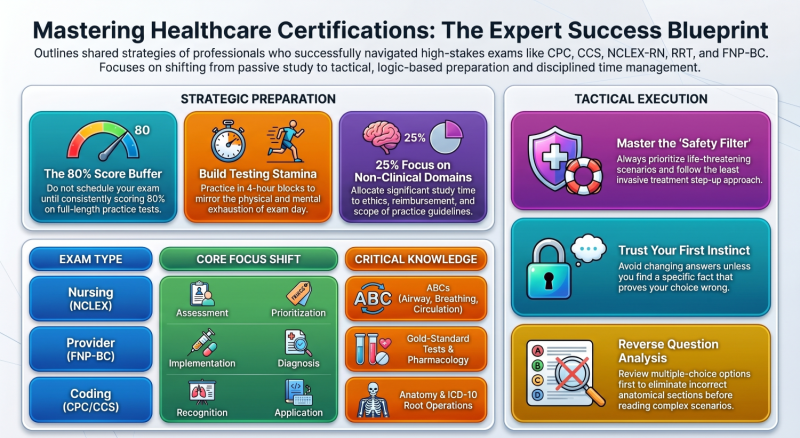
What Common Themes Emerge Across All Five Professionals?
Despite taking vastly different exams across different healthcare disciplines, all five professionals emphasized strikingly similar core strategies:
-
Simulated Practice Is Non-Negotiable. Every professional stressed the importance of taking full-length, timed practice exams under realistic conditions. Reading textbooks builds knowledge, but practice testing builds the ability to apply that knowledge under time pressure — which is what every certification exam actually measures.
-
Time Management Determines Pass or Fail. Marcus, Sarah, and Elena all identified time management as the factor that separates passers from failers. Building stamina through repeated, timed practice sessions is the only reliable way to develop the pacing instinct needed on exam day.
-
Content Knowledge Alone Is Insufficient. David and Michelle both emphasized that understanding the logic of the exam — how it evaluates your answers, what framework it uses to determine the "best" answer — is just as important as knowing the clinical content. Each certification body has a specific reasoning model that you must learn to mirror.
-
Strategic Study Beats Passive Reading. All five professionals organized their study by domain, not randomly. They used the official exam blueprint to prioritize high-weight topics and allocated study time proportionally. None of them relied on simply re-reading a textbook.
-
Learn From Failure — Yours and Others'. The biggest-mistake-to-avoid answers are arguably the most valuable advice in this article. Every professional identified a specific, common trap that derails candidates. Knowing what not to do is as powerful as knowing what to do.
"If I could give one piece of advice to every healthcare certification candidate, it would be this: do not schedule your real exam until you are consistently scoring 80% or higher on realistic, full-length practice tests. That 10-point buffer between your practice scores and the actual passing threshold accounts for test-day anxiety, fatigue, and unexpected questions." — Sarah M., CCS, RHIT
Ready to Start Practicing?
All five professionals in this article emphasized the same thing: practice testing is the single most important preparation strategy. Try MedicoExam's simulation-based tests to benchmark your knowledge, identify your weak spots, and walk into the testing center with the confidence of a certified professional.
Disclaimer: The profiles in this article are illustrative composites. MedicoExam does not provide exam recalls, leaked questions, or proprietary content from any certification body.
Written by the MedicoExam Content Team — Healthcare Education Specialists at MedicoExam.com
Last Updated: April 2026
- American Nurses Credentialing Center (ANCC) |
- American Health Information Management Association (AHIMA) |
- American Academy of Professional Coders (AAPC) |
- ANCC Certification Practice Exams |
- ANCC Test Prep |
- ANCC Sample Questions |
- ANCC Mock Exam |
- Healthcare Certification Prep |
- Medical Certification Practice |
- AHIMA Certification Practice Exams |
- AHIMA Test Prep |
- AHIMA Sample Questions |
- AHIMA Mock Exam |
- AAPC Certification Practice Exams |
- AAPC Test Prep |
- AAPC Sample Questions |
- AAPC Mock Exam |
- National Board for Respiratory Care (NBRC) |
- NBRC Certification Practice Exams |
- NBRC Test Prep |
- NBRC Sample Questions |
- NBRC Mock Exam |
- PMHNP-BC |
- AGACNP-BC |
- FNP-BC |
- AGPCNP-BC |
- AGCNS-BC |
- AMB-BC |
- CV-BC |
- GERO-BC |
- NI-BC |
- MEDSURG-BC |
- NE-BC |
- NEA-BC |
- CMGT-BC |
- NPD-BC |
- PMGT-BC |
- PED-BC |
- CCA |
- CCS |
- PMH-BC |
- CCS-P |
- RHIT |
- RHIA |
- CDIP |
- CHDA |
- CHPS |
- CPC |
- CPB |
- CRC |
- COC


