
ANCC CMGT-BC Nursing Case Management Certification Complete Guide
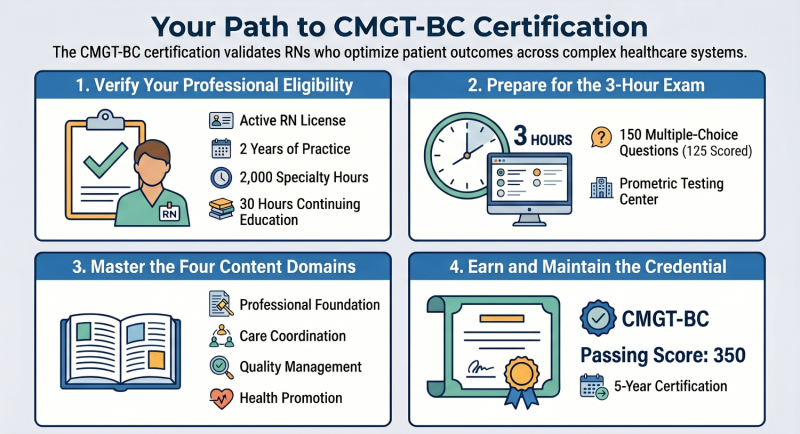
The ANCC CMGT-BC (Case Management Nurse – Board Certified) certification validates registered nurses who coordinate care, manage resources, support transitions, and improve patient outcomes across complex healthcare systems. The exam contains 150 questions—125 scored and 25 unscored pretest items—and is administered over 3 hours at Prometric testing centers. The credential is valid for 5 years and is designed for experienced RNs practicing in case management.
| Credential Awarded | CMGT-BC |
|---|---|
| Certifying Body | American Nurses Credentialing Center (ANCC) |
| Total Questions | 150 (125 scored + 25 pretest) |
| Time Limit | 3 hours |
| Passing Score | 350 / 500 scaled |
| Exam Fee | $395 non-member · $295 ANA member |
| Certification Validity | 5 years |
| Testing Format | Computer-based at Prometric centers |
| Scheduling Window | 120 days after application approval |
What Is the CMGT-BC Certification?
The CMGT-BC is a specialty nursing certification offered by the American Nurses Credentialing Center (ANCC), a subsidiary of the American Nurses Association. It confirms that an RN has the knowledge and clinical judgment required to coordinate care for patients with complex medical, psychosocial, financial, and transitional needs.
Case management nurses work in hospitals, health plans, accountable care organizations, home health agencies, rehabilitation facilities, long-term care settings, workers' compensation programs, and community-based care networks. Their responsibilities include care coordination, discharge planning, utilization review, patient advocacy, population health support, and interprofessional communication.
Who Is Eligible for the CMGT-BC Exam?
According to ANCC eligibility requirements, candidates must meet all of the following criteria:
-
Hold a current, active RN license in a U.S. state or territory, or the legally recognized equivalent in another country.
-
Have practiced the equivalent of 2 years full-time as a registered nurse.
-
Have completed at least 2,000 hours of clinical practice in nursing case management within the last 3 years.
-
Have completed 30 hours of continuing education in nursing case management within the last 3 years.
A BSN is not required. Eligibility is based on RN licensure, practice experience, specialty hours, and continuing education.
What Are the CMGT-BC Exam Content Domains?
The CMGT-BC exam is organized into four domains that reflect the major responsibilities of nursing case managers.
| Domain | Focus |
|---|---|
| Professional Foundation | Ethics, standards of practice, legal responsibilities, patient rights, documentation, and professional accountability. |
| Care Coordination | Assessment, planning, transitions of care, discharge planning, interdisciplinary collaboration, and patient advocacy. |
| Quality Management | Utilization review, risk management, outcome measurement, performance improvement, and cost-effective care. |
| Health Promotion | Patient education, self-management, prevention, chronic disease support, and community resources. |
How Does the CMGT-BC Exam Work on Test Day?
The CMGT-BC exam includes 150 multiple-choice questions. Of these, 125 are scored and 25 are unscored pretest items used to evaluate future questions. You will not know which items are pretest, so every question should be answered carefully. The time limit is 3 hours, which means pacing is important.
After ANCC approves your application, you receive a 120-day testing window. You schedule the exam through Prometric and take it at an approved testing center. Bring valid identification that matches your application information exactly.
How Should You Study for the CMGT-BC Exam?
Start with the official ANCC test content outline and map your study time to the four domains. Because the exam emphasizes practical nursing case management scenarios, preparation should include both content review and case-based practice questions.
-
Review case management standards, ethics, and scope of practice.
-
Practice discharge planning and transitional care scenarios.
-
Study utilization review, medical necessity, denial management, and appeals.
-
Understand chronic disease management and patient self-management education.
-
Use timed practice tests to build pacing and identify weak domains.
What Are Transitions of Care and Why Do They Matter?
Transitions of care occur when a patient moves from one setting or level of care to another, such as hospital to home, hospital to skilled nursing facility, emergency department to observation status, or acute care to rehabilitation. Case managers help ensure that information, medications, follow-up appointments, services, and patient education transfer safely.
Common transition-of-care responsibilities include assessing medical, psychosocial, and environmental needs before discharge; developing individualized discharge plans; coordinating with physicians, social workers, pharmacists, and home health agencies; educating patients and caregivers; and following up after discharge to reduce preventable readmissions.
What Is Utilization Review in Nursing Case Management?
Utilization review is the process of evaluating the medical necessity, appropriateness, and efficiency of healthcare services. It falls under the care coordination and quality management responsibilities of nursing case management.
-
Conduct concurrent reviews to verify that inpatient stays meet medical necessity criteria.
-
Process prior authorizations for procedures, medications, and post-acute services.
-
Manage denials and appeals when services do not meet criteria or when clinical information supports overturning a denial.
-
Monitor length of stay and identify opportunities for safe, timely discharge.
Exam questions may present scenarios where you must determine the appropriate level of care when a payer denies a requested service.
How Does Discharge Planning Connect to Case Management?
Discharge planning is a core function of nursing case management and appears across multiple CMGT-BC exam domains. Effective discharge planning involves:
-
Screening — Identify patients at risk for adverse outcomes post-discharge.
-
Evaluation — Assess post-discharge needs including home environment, caregiver availability, and insurance coverage.
-
Plan development — Create a written plan specifying medications, follow-up appointments, therapy services, and community referrals.
-
Implementation — Coordinate with receiving facilities and confirm all services are in place before discharge.
The nurse case manager serves as the central coordinator, ensuring nothing falls through the cracks during handoffs. Poor discharge planning is a leading contributor to preventable 30-day readmissions.
CMGT-BC vs. CCMC CCM: Which Credential Should You Choose?
Two certifications dominate the nursing case management landscape: the ANCC CMGT-BC and the CCMC Certified Case Manager (CCM). The table below highlights the key differences based on official and general credential information.
| Feature | CMGT-BC (ANCC) | CCM (CCMC) |
|---|---|---|
| Issuing body | American Nurses Credentialing Center | Commission for Case Manager Certification |
| Eligible professionals | RNs only | RNs, social workers, rehabilitation counselors, and other licensed health/human services professionals |
| Exam questions | 150 (125 scored + 25 pretest) | 180 (150 scored + 30 pretest) |
| Time limit | 3 hours | 3 hours |
| Focus | Nursing-specific case management | Multidisciplinary case management |
Choose the CMGT-BC if you are an RN who wants a credential rooted in nursing theory and clinical practice. Choose the CCM if you want a multidisciplinary credential recognized across healthcare, insurance, workers' compensation, and rehabilitation settings. Some nurses hold both credentials to maximize career flexibility. For a broader look at all ANCC specialty certifications, visit the MedicoExam ANCC hub.
How Do You Maintain and Renew the CMGT-BC?
The CMGT-BC certification is valid for 5 years. To renew, you must complete 75 contact hours of continuing nursing education in case management, plus fulfill one or more of the ANCC renewal categories, which may include professional service, academic credits, publications, presentations, or preceptorship hours.
-
You may submit a renewal application up to 1 year before your expiration date.
-
You must hold a current, active RN license at the time of renewal.
-
Renewal fees vary by membership status.
How Does the CMGT-BC Compare to Other ANCC Specialty Certifications?
The CMGT-BC is one of ANCC's RN-level specialty certifications. Unlike nurse practitioner credentials, it does not require a graduate degree or advanced practice licensure. It is most relevant for nurses working in utilization review, discharge planning, care coordination, population health, and transitional care. Compared with clinical bedside certifications, the CMGT-BC focuses more heavily on systems thinking, interprofessional coordination, payer requirements, and outcome management.
Frequently Asked Questions
Q1: How many questions are on the CMGT-BC exam?
A1: The CMGT-BC exam contains 150 multiple-choice questions. Of these, 125 are scored and 25 are unscored pretest questions.
Q2: How long is the CMGT-BC exam?
A2: You have 3 hours to complete the exam.
Q3: What score do I need to pass the CMGT-BC?
A3: ANCC certification exams use a scaled score system, and the passing score is 350 out of 500.
Q4: How much does the CMGT-BC exam cost?
A4: The standard fee is $395 for non-members and $295 for ANA members.
Q5: How much experience do I need for CMGT-BC eligibility?
A5: You need 2 years of full-time RN practice, 2,000 hours of clinical practice in nursing case management within the last 3 years, and 30 hours of continuing education in nursing case management within the last 3 years.
Q6: What happens if I fail the CMGT-BC exam?
A6: You may retest according to ANCC retesting policies. You can retake the exam up to three times within a 12-month period.
Q7: What is the difference between CMGT-BC and CCM?
A7: The CMGT-BC is issued by ANCC exclusively for registered nurses and focuses on nursing-specific case management. The CCM is issued by CCMC and is open to RNs, social workers, rehabilitation counselors, and other licensed health professionals. The CCM covers a broader, multidisciplinary approach to case management.
Q8: Do I need a BSN to sit for the CMGT-BC exam?
A8: No. ANCC does not require a BSN or any specific degree for the CMGT-BC. Eligibility is based on RN licensure, clinical experience, and continuing education hours.
Q9: Where can I take the CMGT-BC exam?
A9: The exam is administered at Prometric testing centers. After ANCC approves your application, you have a 120-day window to schedule and complete the exam at a location convenient to you.
Q10: What study materials does ANCC recommend for the CMGT-BC?
A10: ANCC recommends using the official test content outline and ANCC-approved study resources. Practice exams on MedicoExam help you prepare under timed, exam-like conditions.
Ready to Start Preparing?
Passing the CMGT-BC requires focused preparation across all four domains. MedicoExam's CMGT-BC practice tests offer simulation-based questions mirroring the ANCC format with timed sessions, detailed rationales, and domain-level performance tracking. Start practicing today.
Explore more ANCC guides on the MedicoExam Blog or browse all credentials at the ANCC hub.
Disclaimer: This article is for informational purposes only and does not contain exam recalls, leaked questions, or proprietary content. Verify current requirements and pricing with ANCC before applying.
Written by the MedicoExam Content Team — Healthcare Education Specialists at MedicoExam.com
Last Updated: April 2026
- ANCC CMGT-BC Question Bank |
- ANCC CMGT-BC Eligibility & Requirements |
- ANCC Nursing Case Management Practice Test |
- ANCC CMGT-BC Exam Cost |
- ANCC CMGT-BC Registration Process |
- ANCC Nursing Case Management Study Guide |
- ANCC CMGT-BC Recertification |
- ANCC CMGT-BC Certification Overview |
- ANCC Nursing Case Management Syllabus |
- ANCC CMGT-BC Preparation Time |
- ANCC CMGT-BC Passing Score |
- ANCC CMGT-BC Exam Format |
- ANCC Nursing Case Management Sample Questions |
- ANCC CMGT-BC Career Opportunities |
- ANCC CMGT-BC Exam Difficulty


