
ANCC GERO-BC Exam Study Plan: Gerontological Nursing Certification
 The ANCC Gerontological Nursing certification (GERO-BC) validates that registered nurses possess the clinical knowledge and judgment to care for older adults across acute, long-term, and community settings. The computer-based exam contains 150 questions — 125 scored and 25 unscored pretest items — and must be completed within 3 hours at a Prometric testing center. With 61.2 million Americans now aged 65 and older, representing 18% of the total population, board-certified gerontological nurses are in unprecedented demand. This guide breaks down every detail you need — eligibility requirements, content domains, study strategies, and exam-day logistics — so you can earn the GERO-BC credential on your first attempt.
| Full credential | Gerontological Nurse – Board Certified (GERO-BC) |
|---|---|
| Certifying body | American Nurses Credentialing Center (ANCC) |
| Exam length | 150 questions (125 scored + 25 pretest), 3 hours |
| Passing score | 350 on a scale of 0–500 |
| Cost | $395 (non-member), $295 (ANA member), $340 (GAPNA member) |
| Certification validity | 5 years |
| Testing format | Computer-based at Prometric centers, year-round |
| Scheduling window | 120 days after Authorization to Test (ATT) |
| Renewal requirement | 75 CE hours + 1 professional development activity |
Who Should Earn the GERO-BC Certification?
 The GERO-BC is designed for registered nurses who dedicate their practice to older adults in any care setting — hospitals, skilled nursing facilities, home health agencies, assisted living communities, rehabilitation units, hospice, or outpatient geriatrics. If your patient population is primarily adults age 65 and older, this certification formally validates your specialty expertise.
The credential is especially valuable for bedside nurses, charge nurses, case managers, care coordinators, long-term care clinicians, and nurse educators who want to demonstrate advanced gerontological competence to employers. Because many hospitals and Magnet-recognized organizations track specialty certification rates, the GERO-BC can also strengthen your professional portfolio for advancement, preceptor roles, or salary negotiations.
What Are the GERO-BC Eligibility Requirements?
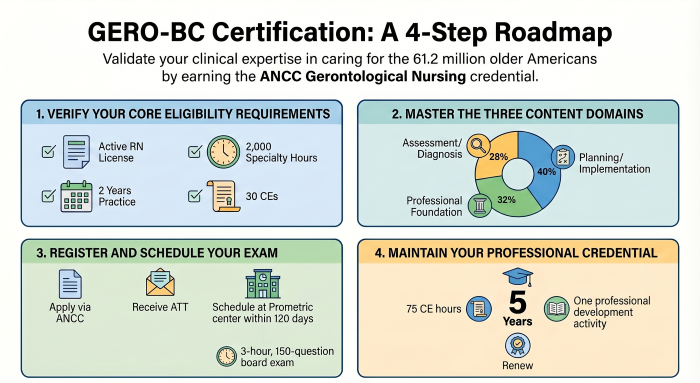
To sit for the GERO-BC exam, candidates must meet all four criteria established by ANCC:
- Active RN license — Hold a current, active registered nurse license in a U.S. state or territory, or hold the professional, legally recognized equivalent in another country.
- Two years of RN practice — Have practiced the equivalent of 2 years full-time as a registered nurse.
- 2,000 clinical hours in gerontological nursing — Accumulated within the last 3 years in the specialty area of gerontological nursing.
- 30 continuing education hours — Completed in gerontological nursing within the last 3 years.
There is no specific degree requirement beyond the RN license. Nurses with an associate degree, bachelor's degree, or graduate degree all qualify provided they meet the clinical hours and CE thresholds.
How Much Does the GERO-BC Exam Cost?
The GERO-BC exam costs $395 for non-members. ANA members pay $295, and Gerontological Advanced Practice Nurse Association (GAPNA) members pay $340. All prices include a $140 non-refundable administrative fee. Discount claims must be submitted within 5 business days of ANCC receiving your application — late claims are not honored. Many employers in long-term care and hospital systems reimburse certification fees, so check with your human resources department before paying out of pocket.
What Are the Three GERO-BC Content Domains?
The 125 scored questions are distributed across three domains. Understanding the weight of each domain is critical for allocating study time. The content outline below reflects the framework published by ANCC.
| Domain | Scored Questions | Percentage |
|---|---|---|
| I. Assessment and Diagnosis | 35 | 28% |
| II. Planning, Implementation, and Evaluation | 50 | 40% |
| III. Professional Foundation | 40 | 32% |
| Total | 125 | 100% |
Domain I: Assessment and Diagnosis (28%)
This domain tests your ability to perform comprehensive geriatric assessments and identify age-related changes. Key areas include:
- Assessment tools and techniques — Fall risk screens (e.g., Morse Fall Scale, Timed Up and Go), depression screening (e.g., Geriatric Depression Scale), pressure injury risk tools (e.g., Braden Scale), nutritional assessments, and cognitive screens such as the Mini-Cog.
- Social determinants of health — How housing instability, food insecurity, isolation, and transportation barriers affect older adult outcomes.
- Pharmacotherapy — Drug interactions, polypharmacy risks, and adverse drug reactions.
- Age- and disease-related factors — Recognizing how normal aging versus pathological changes affect clinical findings in cardiovascular, neurological, sensory, and musculoskeletal systems.
- Risk factor identification — Cognitive impairment screening, non-adherence patterns, and recognition of abuse and neglect.
Domain II: Planning, Implementation, and Evaluation (40%)
The largest domain focuses on care delivery. Questions assess your competency in:
- Evidence-based interventions — Selecting and evaluating nursing actions with expected outcomes grounded in current research.
- Medication management — Unique needs of older adults including dosage adjustments, route modifications, and the AGS Beers Criteria.
- Treatment modality contraindications — Drug-food, drug-drug, and drug-herbal supplement interactions.
- Safety interventions — Fall prevention is paramount.
- Care coordination across the continuum — Transitions of care, case management, discharge planning, community resources, and support systems.
- Therapeutic environment — Managing milieu factors, individual risk factors, and creating safe spaces for patients with dementia or delirium.
Domain III: Professional Foundation (32%)
This domain covers the ethical, legal, and systems-level knowledge base:
- Theoretical frameworks — Coping theories, developmental theories (e.g., Erikson's integrity vs. despair), and Maslow's hierarchy of needs as applied to older adults.
- Disease prevention and health promotion — Age-appropriate screenings, immunization schedules, self-management education, and community-level prevention programs.
- Adult learning and communication — Teaching strategies adapted for sensory impairments, low health literacy, and cultural preferences.
- Diversity, equity, and inclusion — Care considerations for subpopulations such as grandparent-headed families, veterans, homeless older adults, and individuals with behavioral health disorders.
- Legal and ethical considerations — Advance directives, advocacy, informed consent, scope and standards of practice, and end-of-life decision-making.
- Regulatory compliance and quality improvement — CMS regulations, Joint Commission standards, and quality metrics relevant to geriatric care settings.
- Technology-driven care — Electronic health records, telehealth, remote patient monitoring, and hospital-at-home models.
How Is the GERO-BC Exam Scored?
The GERO-BC uses a criterion-referenced scoring system with scores reported on a scale of 0 to 500. The passing score is 350. This passing standard is determined using the modified-Angoff method, meaning a panel of ANCC subject-matter experts evaluates each question to set the cut score — your result depends solely on your performance, not on how other test-takers score. There is no penalty for wrong answers, so you should answer every question.
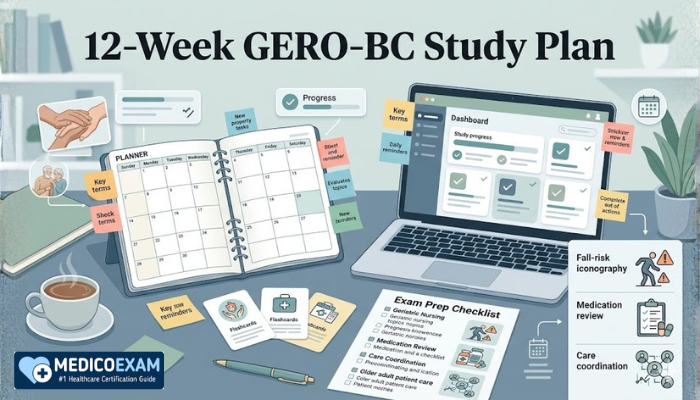
What Is the Best 12-Week GERO-BC Study Plan?
A structured study schedule maximizes retention and minimizes burnout. The following plan allocates time proportionally to domain weight.
Expert Insight: "The GERO-BC rewards nurses who think in systems — how a medication change affects fall risk, how a discharge plan prevents rehospitalization, how cultural context shapes an advance directive conversation. Study the connections between domains, not just the facts within them."
| Weeks | Focus Area | Activities |
|---|---|---|
| 1–2 | Baseline assessment and resources | Take a diagnostic practice test; identify strengths and weaknesses; gather study materials including ANCC content outline, a gerontological nursing textbook, and the AGS Beers Criteria. |
| 3–5 | Domain II: Planning, Implementation, and Evaluation (40%) | Study evidence-based interventions, Beers Criteria medications, fall prevention protocols, care coordination, and transitions of care; complete 100+ domain-specific practice questions. |
| 6–7 | Domain III: Professional Foundation (32%) | Review theoretical frameworks, legal/ethical principles, advance directives, CMS regulations, DEI concepts, and telehealth models; complete 80+ practice questions. |
| 8–9 | Domain I: Assessment and Diagnosis (28%) | Master geriatric assessment tools, pharmacotherapy interactions, age-related physiological changes, social determinants of health, and abuse/neglect recognition; complete 70+ practice questions. |
| 10 | Integration and weak-area review | Take a full-length timed practice exam; review incorrect answers and reinforce weak areas. |
| 11 | Clinical scenario practice | Work through scenario-based questions emphasizing clinical judgment, prioritization, and delegation. |
| 12 | Final review and exam logistics | Light review of high-yield topics; confirm Prometric appointment; prepare ID and plan your test-day routine. |
What Clinical Topics Should You Master for the GERO-BC?
Beyond the domain outline, certain high-yield clinical topics appear repeatedly across gerontological nursing certification exams. Prioritize these areas:
Geriatric Syndromes
Geriatric syndromes are multifactorial conditions common in older adults that do not fit neatly into a single disease category. The major syndromes to study include falls, delirium, dementia, incontinence, frailty, pressure injuries, malnutrition, and polypharmacy. The exam often tests how these syndromes interact with one another.
Falls Prevention
Falls are the leading cause of injury-related death among adults 65 and older. Know the evidence-based prevention bundle: mobility assessment, medication review, home safety modifications, vision correction, footwear assessment, and strength/balance interventions.
Dementia and Cognitive Impairment
Study the differences between delirium, dementia, and depression — a classic exam topic. Be prepared to apply non-pharmacological interventions for behavioral symptoms, understand person-centered care approaches, and recognize caregiver burden.
Polypharmacy
Many older adults in the United States take five or more medications. The AGS Beers Criteria, updated in 2023, is the primary reference for identifying potentially inappropriate medications in older adults. Expect questions on deprescribing strategies, adverse drug events, and the nurse's role in medication reconciliation.
End-of-Life Care
Gerontological nurses frequently support patients and families through end-of-life transitions. Study advance care planning, hospice eligibility criteria, palliative versus hospice care distinctions, symptom management, ethical principles, and communication techniques for serious illness conversations.
How Do You Register and Schedule the GERO-BC Exam?
Follow these steps to go from application to test day:
- Apply online at the official ANCC website — submit your application with proof of eligibility (RN license, clinical hours documentation, CE transcripts) and the exam fee.
- Receive your Authorization to Test (ATT) — ANCC sends a confirmation email after approving your application.
- Schedule at Prometric — visit the official Prometric ANCC scheduling page and select a testing center, date, and time within the 120-day scheduling window.
- Arrive on exam day — get to the testing center 30 minutes early with a valid government-issued photo ID and your confirmation details. Personal items are stored in provided lockers.
How Do You Renew the GERO-BC Certification?
The GERO-BC certification is valid for 5 years. To renew, you must hold an active RN license and complete 75 continuing education hours in gerontological nursing, plus fulfill at least one additional professional development category such as academic credits, presentations, publications, preceptorship, or 1,000 practice hours. At least 60 of the 75 CE hours must be formally approved continuing nursing education. Renewal applications can be submitted up to 1 year before the expiration date. The renewal fee is $350 for non-members, $250 for ANA members, and $295 for GAPNA members.
How Does the GERO-BC Compare to Other ANCC Specialty Certifications?
If you care for older adults but are unsure which ANCC credential fits best, this comparison may help:
| Feature | GERO-BC | MEDSURG-BC | PMH-BC |
|---|---|---|---|
| Focus population | Older adults (65+) | Adult medical-surgical patients | Psychiatric-mental health patients |
| Questions | 150 (125 scored + 25 pretest) | 150 (125 scored + 25 pretest) | 150 (125 scored + 25 pretest) |
| Time | 3 hours | 3 hours | 3 hours |
| Passing score | 350/500 | 350/500 | 350/500 |
| Clinical hours required | 2,000 in gerontological nursing | 2,000 in med-surg nursing | 2,000 in psych-MH nursing |
| CE hours required | 30 in specialty | 30 in specialty | 30 in specialty |
For nurses interested in advanced practice roles with older adults, the AGPCNP-BC (Adult-Gerontology Primary Care Nurse Practitioner) or AGACNP-BC (Adult-Gerontology Acute Care Nurse Practitioner) certifications may also be relevant. Explore all available ANCC certifications on the MedicoExam ANCC hub.
Frequently Asked Questions (FAQ)
1. How many questions are on the GERO-BC exam?
The GERO-BC exam has 150 total questions. Of these, 125 are scored and 25 are unscored pretest questions used for future exam development. You cannot tell which questions are pretest, so treat every question as if it counts.
2. What is the passing score for the GERO-BC?
The passing score is 350 on a scaled score range of 0 to 500. The passing standard is set using the modified-Angoff method by ANCC subject-matter experts.
3. How long is the GERO-BC exam?
You have 3 hours (180 minutes) to complete all 150 questions. That averages to about 1 minute and 12 seconds per question, so pace yourself and flag questions for review rather than spending too long on any single item.
4. What are the eligibility requirements for the GERO-BC?
You must hold an active RN license, have 2 years of full-time RN practice, accumulate 2,000 hours of clinical practice in gerontological nursing within the last 3 years, and complete 30 hours of continuing education in gerontological nursing within the last 3 years.
5. How much does the GERO-BC cost?
The exam fee is $395 for non-members, $295 for ANA members, and $340 for GAPNA members. All prices include a $140 non-refundable administrative fee.
6. Is the GERO-BC exam difficult?
The GERO-BC tests applied clinical judgment, not just memorization. Questions require you to analyze geriatric assessment findings, select evidence-based interventions, and apply legal and ethical principles. Most candidates who follow a structured study plan covering all three domains and complete timed practice questions report feeling well-prepared.
7. How often do I need to renew the GERO-BC?
The GERO-BC certification is valid for 5 years. Renewal requires 75 continuing education hours plus at least one additional professional development activity, along with an active RN license.
8. What study resources are recommended for the GERO-BC?
Key resources include the ANCC Test Content Outline, a gerontological nursing textbook, the AGS Beers Criteria 2023, and simulation-based practice exams such as those offered by MedicoExam.
9. Can I take the GERO-BC if I have an associate degree in nursing?
Yes. ANCC does not require a BSN or graduate degree for GERO-BC eligibility. You must hold an active RN license and meet the clinical hours and continuing education requirements.
10. What happens if I fail the GERO-BC exam?
If you do not pass, ANCC allows you to retest. Review the ANCC retesting policy for specific waiting periods and fees. Use your score report to identify weak domains and adjust your study plan before reattempting.
Ready to Start Practicing?
The best way to build exam-day confidence is to practice under realistic conditions. MedicoExam's GERO-BC practice exams simulate the actual ANCC testing experience with timed, scenario-based questions across all three content domains. Identify your weak areas, reinforce your clinical reasoning, and track your progress — all before you sit for the real exam.
Disclaimer: This article is for informational and educational purposes only. It does not contain exam recalls, leaked questions, or proprietary ANCC content. Always verify current eligibility requirements, fees, and policies on the official ANCC website. Certification requirements may change; confirm details before applying.
Written by the MedicoExam Content Team — Healthcare Education Specialists at MedicoExam.com
- ANCC GERO-BC Question Bank |
- ANCC GERO-BC Eligibility & Requirements |
- ANCC Gerontological Nursing Practice Test |
- ANCC GERO-BC Exam Cost |
- ANCC GERO-BC Registration Process |
- ANCC Gerontological Nursing Study Guide |
- ANCC GERO-BC Recertification |
- ANCC GERO-BC Certification Overview |
- ANCC Gerontological Nursing Syllabus |
- ANCC GERO-BC Preparation Time |
- ANCC GERO-BC Passing Score |
- ANCC GERO-BC Exam Format |
- ANCC Gerontological Nursing Sample Questions |
- ANCC GERO-BC Career Opportunities


