
ANCC NPD-BC Exam Guide 2026: Everything You Need to Know + FAQs
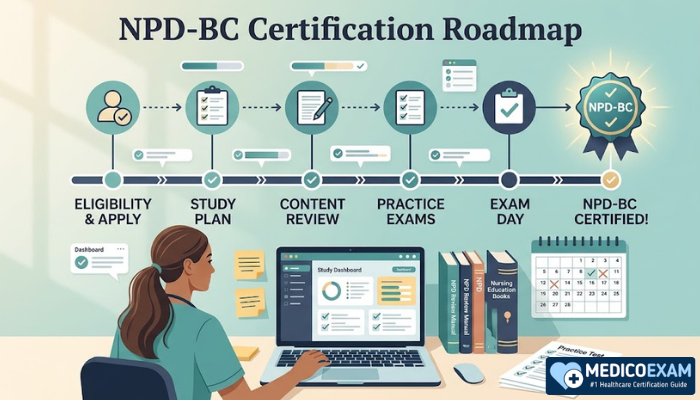 The ANCC Nursing Professional Development Board Certified (NPD-BC) credential is the nationally recognized certification for registered nurses who design education programs, manage staff competency, lead orientation initiatives, and drive evidence-based practice transitions. Awarded by the American Nurses Credentialing Center (ANCC), the NPD-BC exam consists of 150 questions (125 scored and 25 unscored pretest items) with a 3-hour time limit and costs $395 for non-ANA members or $295 for ANA members. As of December 31, 2025, 7,474 nurses hold active NPD-BC certification, and the first-time pass rate stands at 72%.
| Full credential | NPD-BC (Nursing Professional Development–Board Certified) |
| Certifying body | American Nurses Credentialing Center (ANCC) |
| Exam length | 150 questions (125 scored + 25 pretest) |
| Time allowed | 3 hours |
| Passing score | 350 on a scaled score of 0–500 |
| First-time pass rate | 72% (2025 ANCC Certification Data) |
| Total active certificants | 7,474 (as of 12/31/2025) |
| Exam fee | $395 non-member / $295 ANA member |
| Certification validity | 5 years |
| Testing format | Computer-based at Prometric centers, year-round |
| Accreditation | ABSNC and NCCA accredited |
What Is the NPD-BC Certification?
The NPD-BC certification validates that a registered nurse possesses the specialized knowledge and skills to function as a nursing professional development practitioner. NPD specialists sit at the intersection of clinical expertise and adult education — they design continuing education programs, manage new-nurse orientation and residency programs, oversee competency assessment, and lead quality improvement initiatives across healthcare organizations.
Unlike direct patient-care certifications, the NPD-BC recognizes nurses who shape the workforce itself. According to the ANCC certification page, the credential is a "competency-based examination that provides a valid and reliable assessment of the entry-level clinical knowledge and skills of registered nurses in the nursing professional development specialty." Common roles held by NPD-BC certified nurses include staff development specialist, clinical nurse educator, nurse residency coordinator, Magnet program coordinator, and continuing education administrator.
Who Is Eligible for the NPD-BC Exam?
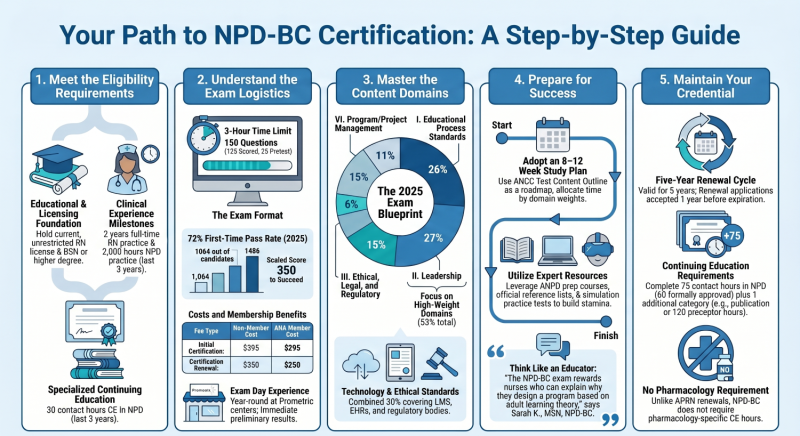
Candidates must meet all five eligibility requirements set by the ANCC before applying. There are no exceptions or waivers to these criteria:
-
Active RN license — Hold a current, unrestricted registered nurse license in a U.S. state or territory, or the legally recognized equivalent in another country.
-
Bachelor's degree in nursing (BSN) or higher — A bachelor's degree provides the educational foundation ANCC requires for specialty certification. ANCC accepts unofficial transcripts during the application review phase but requires a final, official transcript for certification.
-
2 years of full-time RN experience — Candidates must have practiced the equivalent of 2 years full-time as a registered nurse in any setting.
-
2,000 hours of NPD practice — A minimum of 2,000 hours of clinical practice in nursing professional development within the last 3 years is required. These hours reflect hands-on experience in educational design, orientation, competency management, or related NPD activities.
-
30 hours of continuing education in NPD — Candidates must have completed 30 contact hours of continuing education specifically in nursing professional development within the last 3 years.
Tip: Start tracking your NPD practice hours in a log from day one. Many candidates underestimate the documentation burden and scramble at application time.
What Are the NPD-BC Exam Content Domains?
The NPD-BC exam blueprint, officially called the Test Content Outline (effective February 26, 2025), divides the 125 scored questions across six content domains. Leadership and Educational Process Standards together account for more than half the exam.
| Domain | Content Area | Scored Questions | Percentage |
|---|---|---|---|
| I | Educational Process Standards | 32 | 26% |
| II | Leadership | 34 | 27% |
| III | Ethical, Legal, and Regulatory Standards | 19 | 15% |
| IV | Evidence-based Practice and Research | 7 | 6% |
| V | Technology | 19 | 15% |
| VI | Program/Project Management and Process Improvement | 14 | 11% |
| Total | 125 | 100% |
Domain I — Educational Process Standards (26%)
-
This domain tests your mastery of adult learning theories (behaviorism, cognitive constructivism, educational neuroscience), the education design process (assessment, planning, implementation, evaluation), competency management, types of educational activities (orientation, in-service, continuing education, interprofessional education), and the accreditation requirements for providing continuing education contact hours.
Domain II — Leadership (27%)
-
The largest domain covers leadership principles, organizational structures, change management, resource management, healthy work environments (physical and psychological safety, staff empowerment, work-life balance), diversity/equity/inclusion advocacy, communication and conflict resolution, group facilitation, professional standards, certification, credentialing, and mentoring processes.
Domain III — Ethical, Legal, and Regulatory Standards (15%)
-
Expect questions on the ANA Scope and Standards of Practice and Code of Ethics, organizational recognition programs (The Joint Commission, Magnet), risk management concepts (failure mode and effect analysis, root cause analysis, just culture), incident reporting, copyright law, intellectual property, and federal regulatory requirements.
Domain IV — Evidence-based Practice and Research (6%)
-
Though the smallest domain, questions on scholarly inquiry processes, study design, data collection and interpretation, and the translation and dissemination of research and evidence-based practice still appear on every exam form.
Domain V — Technology (15%)
-
This domain assesses knowledge of business tools, learning management systems, electronic health records, information technology security, simulation-based teaching strategies, virtual reality education, clinical technologies (smart pumps, device integration), and virtual meeting platforms.
Domain VI — Program/Project Management and Process Improvement (11%)
-
Questions focus on performance improvement methodologies, organizational performance indicators, project management processes for quality improvement and new technology implementation, and strategies for sustaining outcomes.
How Much Does the NPD-BC Exam Cost?
The NPD-BC exam costs $395 for non-members and $295 for ANA members. Both prices include a $140 non-refundable administrative fee. Membership discounts must be claimed within 5 business days of ANCC receiving your application — late claims will not be honored, and no refunds are issued.
| Fee Type | Non-Member | ANA Member |
|---|---|---|
| Initial certification | $395 | $295 |
| Renewal (every 5 years) | $350 | $250 |
ANA membership costs approximately $183 per year (varies by state). If you plan to certify and renew, the $100 certification discount alone nearly covers the first year of membership.
Additional fees may apply for special services such as rescheduling or international testing accommodations.
What Is the NPD-BC Pass Rate?
The NPD-BC first-time pass rate is 72%, based on 2025 ANCC Certification Data. Of 1,486 first-time test-takers, 1,064 passed the examination. This places NPD-BC in the middle range among ANCC specialty certifications — higher than Informatics Nursing (NI-BC) at 65% and Nurse Executive (NE-BC) at 63%, but lower than Adult-Gerontology Primary Care NP (AGPCNP-BC) at 85%.
The 72% pass rate means roughly 1 in 4 first-time candidates does not pass. A structured study plan covering all six content domains — with extra emphasis on Leadership (27%) and Educational Process Standards (26%) — is strongly recommended.
How Should You Study for the NPD-BC Exam?
A disciplined 8–12 week study plan is the most effective approach for most working NPD professionals. Here is a recommended framework:
-
Start with the official Test Content Outline. Download the ANCC NPD-BC Test Content Outline and use it as your study roadmap. Every scored question maps directly to one of the six domains.
-
Allocate study time proportionally. Spend roughly 27% of your study hours on Leadership and 26% on Educational Process Standards — these two domains alone account for 66 of 125 scored questions.
-
Use the ANCC reference list. ANCC publishes a recommended reference list on the NPD-BC certification page. Core texts typically include Nursing Professional Development: Scope and Standards of Practice and resources from the Association for Nursing Professional Development (ANPD).
-
Enroll in a certification preparation course. The ANPD offers certification preparation courses designed and taught by NPD-BC certified experts. Non-member pricing starts at $550.
-
Practice with question banks. Simulation-based practice tests help you build exam stamina and identify weak areas. MedicoExam's NPD-BC practice questions mirror the official exam format and cover all six content domains.
-
Join a study group. Connect with other NPD professionals preparing for the exam. Peer discussion reinforces learning and exposes you to different clinical perspectives.
-
Review your workplace practices. Many NPD-BC questions are scenario-based. Reflecting on real-world situations you handle daily — orientation planning, competency assessments, change management initiatives — builds exam readiness naturally.
Expert Insight: "The NPD-BC exam rewards nurses who think like educators and leaders, not just clinicians. If you can explain why you design a program a certain way — rooted in adult learning theory and evidence-based practice — you are well-prepared." — Sarah K., MSN, NPD-BC, Nursing Education Director
Why Is NPD-BC Certification Growing in Demand?
Nursing professional development has become a strategic priority for healthcare organizations, particularly in the post-pandemic era. The COVID-19 pandemic exposed critical gaps in workforce readiness, accelerated nurse turnover to historic levels, and forced rapid retraining across specialties. NPD-BC certified professionals are uniquely positioned to address these challenges.
According to a 2025 scoping review published in BMJ Open, "increasing professional development and mentorship opportunities" was one of five key strategies identified across 130 studies for improving nurse retention in the peri- and post-COVID-19 period. The review found that structured transition-to-practice programs, continuing education support, and career reinvention initiatives — all core NPD functions — directly reduce turnover intention.
The Bureau of Labor Statistics projects 16.8% job growth for nursing instructors and educators through 2034, far exceeding the 3% average for all occupations. Meanwhile, Salary.com reports that nursing professional development specialists earn an average salary of $126,948 per year, with a typical range of $114,946 to $140,517.
Organizations pursuing Magnet designation from the American Nurses Credentialing Center are especially likely to employ NPD-BC certified nurses. Magnet standards require demonstrated investment in professional development, making certified NPD specialists essential to the recognition process.
The total number of active NPD-BC certificants grew from 6,574 in 2024 to 7,474 in 2025 — an increase of approximately 14% in a single year, according to ANCC Certification Data. This upward trend reflects the profession's growing recognition of NPD as a distinct specialty.
How Do You Renew NPD-BC Certification?
NPD-BC certification is valid for 5 years from the date of initial certification. Renewal requires completing 75 continuing education contact hours in your certification specialty plus at least one additional professional development category, and submitting a renewal application through ANCC.
Renewal requirements at a glance:
-
75 CE contact hours in nursing professional development (at least 60 must be formally approved CE)
-
Plus one professional development category from the following eight options:
-
Additional 75 CE hours in your specialty
-
5 semester credits or 6 quarter credits of academic coursework
-
Presentations totaling 5 clock hours
-
Publication, research, or evidence-based practice project
-
120 preceptor hours
-
Professional service (committee, board membership)
-
1,000 practice hours in NPD
-
Re-take and pass the current exam
Renewal fees:
| Status | Fee |
|---|---|
| Non-member | $350 |
| ANA member | $250 |
Note: Unlike APRN certification renewals, NPD-BC renewal does not require pharmacology-specific CE hours. You can submit a renewal application up to 1 year before your expiration date. If your certification lapses, ANCC offers a reactivation pathway (with an additional $125 fee) for certifications expired less than 2 years.
How Does NPD-BC Compare to Other ANCC Specialty Certifications?
NPD-BC is one of 12 active ANCC specialty certifications. Here is how it compares on key metrics:
| Certification | Focus Area | Pass Rate | Total Certificants | Exam Fee |
|---|---|---|---|---|
| NPD-BC | Nursing Professional Development | 72% | 7,474 | $395 |
| NE-BC | Nurse Executive | 63% | 9,527 | $395 |
| NEA-BC | Nurse Executive, Advanced | 73% | 6,717 | $395 |
| MEDSURG-BC | Medical-Surgical Nursing | 71% | 33,250 | $395 |
| NI-BC | Informatics Nursing | 65% | 3,536 | $395 |
| PMH-BC | Psychiatric-Mental Health (RN) | 71% | 10,900 | $395 |
All ANCC specialty exams share the same format: 150 questions (125 scored + 25 pretest), 3-hour time limit, computer-based testing at Prometric centers, and 5-year certification validity. Explore all ANCC certifications on MedicoExam.
What Is the NPD-BC Exam Day Experience?
The NPD-BC exam is administered year-round at Prometric testing centers across the United States. After ANCC approves your application, you receive a 120-day scheduling window to select your exam date and location through Prometric.
What to expect on exam day:
-
Arrival: Arrive 30 minutes early with two forms of valid identification (one government-issued photo ID).
-
Security: Personal items, phones, and study materials are stored in a locker.
-
Exam format: All 150 questions are multiple-choice. Pretest questions are interspersed randomly and indistinguishable from scored items.
-
Scoring: A scaled passing score of 350 (on a 0–500 scale) is required. Preliminary pass/fail results appear on screen immediately.
-
If you do not pass: ANCC allows retesting after a 60-day waiting period with full exam fee.
Frequently Asked Questions (FAQ)
1. How many questions are on the NPD-BC exam?
The NPD-BC exam contains 150 total questions. Of these, 125 are scored and 25 are unscored pretest questions used for future exam development. Pretest questions are randomly distributed and indistinguishable from scored items, so candidates should answer every question.
2. What is the passing score for the NPD-BC exam?
The passing score for the NPD-BC exam is 350 on a scaled score ranging from 0 to 500. This scaled scoring system accounts for slight differences in exam difficulty across test forms.
3. Do I need a master's degree to sit for the NPD-BC exam?
No. The NPD-BC requires a bachelor's degree in nursing (BSN) or higher. A master's degree is not required, though many NPD practitioners hold graduate degrees. According to the ANCC, a BSN "provides the foundation to practice competently at the entry level."
4. How long is NPD-BC certification valid?
NPD-BC certification is valid for 5 years from the date of initial certification. Renewal requires 75 CE contact hours plus completion of at least one professional development category.
5. Can I take the NPD-BC exam if I work outside the United States?
Yes. Candidates holding the professional, legally recognized equivalent of a U.S. RN license in another country may apply. Additional requirements may apply for international applicants. Contact ANCC directly for details.
6. What is the NPD-BC exam pass rate?
The NPD-BC first-time pass rate is 72%, based on 2025 ANCC Certification Data. Of 1,486 first-time candidates, 1,064 passed the exam.
7. How many CE hours do I need to renew NPD-BC certification?
You must complete 75 continuing education contact hours in nursing professional development within your 5-year certification period, with at least 60 hours from formally approved providers. You must also complete at least one additional professional development category.
8. Does NPD-BC renewal require pharmacology CE hours?
No. Pharmacology CE requirements apply only to APRN certifications (NP and CNS). Since NPD-BC is an RN specialty certification, there is no specific pharmacology requirement for renewal.
9. What happens if my NPD-BC certification expires?
If your certification has been expired for less than 2 years, you may reactivate it by completing the mandatory 75 CE hours, fulfilling at least one professional development category, and paying the renewal fee plus a $125 reactivation fee. If expired for more than 2 years, you must retake and pass the certification exam.
10. How much do NPD-BC certified nurses earn?
Nursing professional development specialists earn an average salary of $126,948 per year, according to Salary.com. The Bureau of Labor Statistics reports that nursing instructors and teachers in hospital settings earn a mean annual wage of $106,620, while those in academic settings average $86,900.
Start Preparing for the NPD-BC Exam Today
Earning your NPD-BC certification demonstrates mastery of a specialty that is central to nurse workforce development, patient safety, and organizational excellence. With a 72% first-time pass rate, thorough preparation is essential.
MedicoExam's NPD-BC practice tests feature simulation-based questions aligned to all six content domains of the official ANCC exam blueprint. Practice under realistic exam conditions, review detailed answer rationales, and track your progress across Educational Process Standards, Leadership, Technology, and every other tested area. Explore all ANCC certification practice exams to find the right prep for your career path.
Disclaimer: This article is for informational purposes only and does not constitute professional or legal advice. Exam details, fees, and policies are subject to change. Always verify current requirements directly with the American Nurses Credentialing Center (ANCC) before applying. MedicoExam is not affiliated with or endorsed by ANCC. This content does not contain exam recalls, leaked questions, or proprietary test material.
Written by the MedicoExam Content Team — Healthcare Education Specialists at MedicoExam.com
Last Updated: April 2026
- ANCC NPD-BC Question Bank |
- ANCC NPD-BC Eligibility & Requirements |
- ANCC Nursing Professional Development Practice Test |
- ANCC NPD-BC Exam Cost |
- ANCC NPD-BC Registration Process |
- ANCC Nursing Professional Development Study Guide |
- ANCC NPD-BC Recertification |
- ANCC NPD-BC Certification Overview |
- ANCC Nursing Professional Development Syllabus |
- ANCC NPD-BC Preparation Time |
- ANCC NPD-BC Passing Score |
- ANCC NPD-BC Exam Format |
- ANCC Nursing Professional Development Sample Questions |
- ANCC NPD-BC Career Opportunities |
- ANCC NPD-BC Exam Difficulty


