
ANCC PED-BC Exam: Complete Guide, Domains & FAQ
 The ANCC Pediatric Nursing board certification examination (PED-BC) is a competency-based credential for registered nurses who specialize in caring for children and adolescents. The exam contains 150 questions — 125 scored and 25 unscored pretest items — and allows 3 hours for completion at a Prometric testing center. Candidates need a current RN license, 2 years of full-time RN practice, 2,000 hours of pediatric clinical experience within the last 3 years, and 30 continuing education hours in pediatric nursing. This guide covers every detail you need: exam domains, eligibility, costs, study strategy, PED-BC vs CPNP comparison, and frequently asked questions.
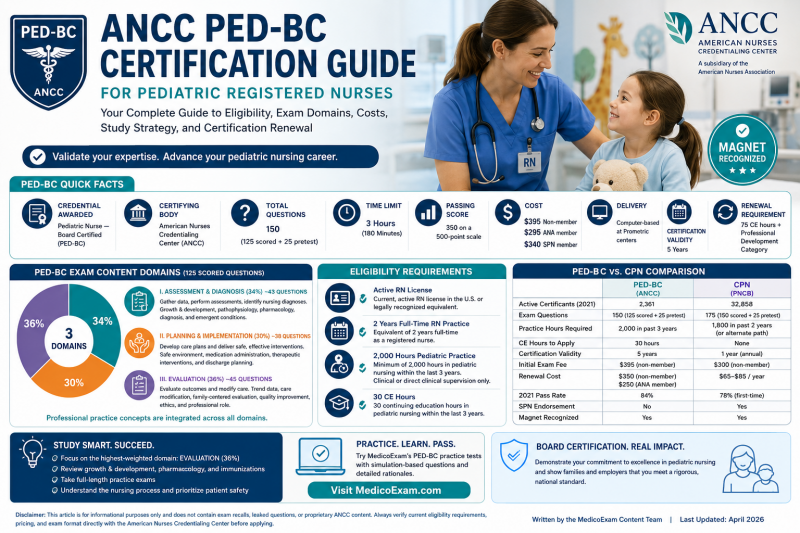
PED-BC Quick Facts
| Credential awarded | Pediatric Nurse — Board Certified (PED-BC) |
|---|---|
| Certifying body | American Nurses Credentialing Center (ANCC) |
| Total questions | 150 (125 scored + 25 pretest) |
| Time limit | 3 hours (180 minutes) |
| Passing score | 350 on a 500-point scale |
| Cost | $395 (non-member); $295 (ANA member); $340 (SPN member) |
| Delivery | Computer-based at Prometric centers |
| Certification validity | 5 years |
| Renewal requirement | 75 CE hours + professional development category |
What Is the ANCC PED-BC Certification?
The PED-BC is an RN-level specialty certification offered by the American Nurses Credentialing Center (ANCC), a subsidiary of the American Nurses Association (ANA). It validates entry-level clinical knowledge and skills for registered nurses who practice in the pediatric specialty after initial RN licensure.
The PED-BC is not a nurse practitioner credential. It is designed for bedside RNs, charge nurses, clinical educators, and other registered nurses in pediatric units, children's hospitals, outpatient clinics, school health, and community settings. The credential is accredited by the Accreditation Board for Specialty Nursing Certification (ABSNC) and the National Commission for Certifying Agencies (NCCA), and it is accepted for Magnet recognition status.
As of December 31, 2021, approximately 2,361 nurses actively held the PED-BC credential, according to pediatric-certification comparison data. Only 148 nurses tested for the PED-BC in 2021, making it one of ANCC's smaller specialty programs.
Who Is Eligible for the PED-BC Exam?
Candidates must meet all four eligibility requirements before applying. According to the official ANCC PED-BC certification information, the requirements are:
-
Active RN license — Hold a current, active RN license in a U.S. state or territory, or the legally recognized equivalent in another country.
-
Two years of full-time RN practice — Have practiced the equivalent of 2 years full-time as a registered nurse.
-
2,000 hours of pediatric clinical practice — A minimum of 2,000 hours in pediatric nursing within the last 3 years. ANCC accepts clinical or direct clinical supervision hours only — management, education, or consultation hours alone do not qualify.
-
30 continuing education hours — Complete 30 CE hours in pediatric nursing within the last 3 years.
ANCC does not require a BSN or higher degree for the PED-BC; an associate degree in nursing with a valid RN license satisfies the education threshold.
What Are the PED-BC Exam Content Domains?
The PED-BC exam is organized around the nursing process as applied to pediatric patients. The 125 scored questions are distributed across three primary content domains, according to the ANCC test content outline and exam prep providers:
| Domain | % of Exam | Scored Questions |
|---|---|---|
| I. Assessment and Diagnosis | 34% | ~43 |
| II. Planning and Implementation | 30% | ~38 |
| III. Evaluation | 36% | ~45 |
| Total | 100% | 125 |
Professional practice concepts — including ethics, legal considerations, leadership, evidence-based practice, and population health — are woven throughout all three domains rather than tested as a standalone section.
Domain I: Assessment and Diagnosis (34%)
This domain tests your ability to gather data, perform physical and psychosocial assessments, and identify nursing diagnoses. Key topics include:
-
Growth and development — Developmental stages and milestones (Erikson, Piaget, Freud), age-appropriate anatomy/physiology, and nutrition across the pediatric age continuum
-
Physical assessment — Evidence-based tools (Denver II, Braden-Q, pediatric pain scales, falls risk), vital sign norms by age, and system-specific examination techniques
-
Pathophysiology — Common childhood diseases, abnormal structure and function, and recognition of emergent conditions
-
Pharmacology — Immunization schedules, weight-based medication dosing, complementary therapies, and medication history
-
Diagnosis — Synthesizing data to identify patterns, prioritizing nursing diagnoses using NANDA-I, and triaging emergent situations such as abuse, neglect, and respiratory distress
Domain II: Planning and Implementation (30%)
This domain evaluates care planning, evidence-based interventions, and safe medication administration:
-
Care planning — Individualized, family-centered, age-appropriate plans using evidence-based guidelines, clinical pathways, and interdisciplinary coordination
-
Safe environment — Seizure precautions, infection prevention (CHG baths, hand hygiene), abduction/elopement protocols, and fall prevention
-
Medication administration — Administration rights, contraindications, weight-based dosing in kilograms, and maximum dose limits
-
Interventions — Therapeutic holding, kangaroo care, oral sucrose for pain, fluid resuscitation, and de-escalation techniques
-
Discharge planning — Referrals, case management, community resources, and medication reconciliation across transitions
Domain III: Evaluation (36%)
The largest domain focuses on outcome measurement and care modification:
-
Expected and unexpected responses — Evaluating effectiveness of the plan of care against measurable outcomes
-
Trending data — Interpreting vital sign trends, I&O, growth parameters on age-appropriate percentile charts, and lab values
-
Care modification — Revising the plan when outcomes are not met, documenting rationale, and collaborating with the patient, family, and interdisciplinary team
-
Family-centered evaluation — Assessing understanding through teach-back, evaluating education plans, and identifying barriers to adherence
-
Professional role — Quality improvement, risk management, delegation, documentation, ethical considerations (HIPAA, informed consent, advance directives), and population health
How Much Does the PED-BC Exam Cost?
The exam fee varies by membership status. According to the official ANCC PED-BC certification page:
| Candidate Type | Initial Exam Fee | Renewal Fee |
|---|---|---|
| Non-member | $395 | $350 |
| ANA member | $295 | as low as $250 |
| SPN member | $340 | $295 |
All fees include a $140 non-refundable administrative fee. Expedited 5-day processing costs an additional $200. If you do not pass, retesting is available after a 60-day wait at $270 for ANA members, according to third-party comparison data.
How Is the PED-BC Exam Structured and Scored?
The PED-BC is a computer-based test delivered at Prometric testing centers nationwide. Candidates receive an Authorization to Test (ATT) upon approval and have a 120-day scheduling window.
Scoring: The exam uses a scaled scoring system with a maximum score of 500. The minimum passing score is 350, as stated in the ANCC General Testing and Renewal Handbook. Only the 125 scored items count. The passing standard is set using the Modified Angoff Method. Results are reported as pass or fail immediately after testing, with diagnostic feedback provided for each content domain if you do not pass.
Test day: Arrive 30 minutes early with a valid government-issued photo ID. Personal items go in testing center lockers. No reference materials, calculators, or electronics are permitted.
What Is the PED-BC Pass Rate?
ANCC does not publish detailed annual pass rate tables for the PED-BC. However, approximately 71% of first-time test takers passed in 2023 (101 out of 142 candidates), based on third-party reporting. The 2021 overall pass rate was 84%, according to pediatric-certification comparison data.
The median annual wage for registered nurses was $93,600 in May 2024, according to the Bureau of Labor Statistics. The PED-BC credential demonstrates specialized competency that may support career advancement and salary negotiation.
“Board certification tells families and employers that you have voluntarily met a rigorous standard beyond basic licensure. In pediatric nursing, where developmental nuances drive every clinical decision, that distinction carries real weight.” — Dr. Lisa Martinez, DNP, RN, PED-BC, Pediatric Clinical Educator
How Do I Renew the PED-BC Certification?
The PED-BC credential is valid for 5 years. Renewal applications can be submitted up to 1 year before expiration. According to ANCC renewal requirements, you must:
-
Maintain an active RN license throughout the certification period.
-
Complete 75 CE hours relevant to pediatric nursing.
-
Complete at least one professional development category from eight options: additional CE hours, academic credits, presentations, EBP/QI/research/publication, preceptorship (120+ hours), volunteer service (2+ years), practice hours (1,000+), or retaking the exam.
-
All activities must be logged in your ANCC online account before starting the renewal application.
How Does the PED-BC Compare to the PNCB CPN?
The PED-BC (ANCC) and CPN are both RN-level pediatric certifications accepted for Magnet recognition. However, they differ significantly in volume, cost structure, and renewal cycles.
| Feature | PED-BC (ANCC) | CPN |
|---|---|---|
| Certifying body | ANCC | Pediatric Nursing Certification Board |
| Active certificants (2021) | 2,361 | 32,858 |
| Candidates tested (2021) | 148 | 3,088 |
| Exam questions | 150 (125 scored + 25 pretest) | 175 (150 scored + 25 pretest) |
| Time limit | 3 hours | 3 hours |
| Practice hours required | 2,000 in past 3 years | 1,800 in past 2 years (or alternate path) |
| CE hours required to apply | 30 hours | None |
| Accepted practice types | Clinical or direct clinical supervision only | Clinical, management, education, or consultation |
| Initial exam fee | $395 (non-member) | $300 |
| Certification validity | 5 years | 1 year (annual renewal) |
| Renewal cost | $350 (non-member) / $250 (ANA member) | $65–$85/year |
| 2021 pass rate | 84% | 78% (first-time) |
| SPN endorsement | No | Yes |
| Magnet accepted | Yes | Yes |
Key takeaway: The CPN is roughly 14 times more widely held than the PED-BC. It has a lower entry cost, broader practice-hour acceptance, and no CE prerequisite. However, the PED-BC offers 5-year certification validity (vs. annual renewal) and may appeal to nurses already in the ANCC ecosystem. Both are Magnet-recognized.
How Does the PED-BC Differ from the CPNP (Nurse Practitioner)?
The PED-BC and CPNP credentials are entirely different certification levels:
| Feature | PED-BC (ANCC) | CPNP-PC |
|---|---|---|
| Credential level | RN specialty | Advanced Practice (NP) |
| Minimum education | RN license (any degree) | Master's, post-graduate certificate, or DNP |
| Clinical requirement | 2,000 hrs pediatric RN practice | 500 faculty-supervised NP clinical hours |
| Scope of practice | Nursing assessment, care planning, patient education | Independent diagnosis, prescribing, treatment |
| Exam questions | 150 | 175 (150 scored + 25 pretest) |
| Exam focus | Nursing process in pediatrics | Advanced clinical practice in primary care pediatrics |
The PED-BC certifies competency as a pediatric registered nurse. The CPNP-PC certifies competency as a pediatric nurse practitioner with prescriptive authority. Nurses pursuing the NP pathway should explore the appropriate advanced-practice certification routes. ANCC previously offered the PPCNP-BC (Pediatric Primary Care NP) but retired it in 2018 due to low volume.
What Topics Should I Prioritize When Studying for the PED-BC?
Focus your preparation on the highest-weighted domain first: Evaluation accounts for 36% of scored questions — the single largest domain on the exam. Below is a strategic study framework:
High-yield content areas:
-
Growth and development — Erikson's psychosocial stages, Piaget's cognitive stages, and age-specific vital sign norms applied to clinical scenarios
-
Immunization schedules — CDC recommendations, contraindications, catch-up schedules, and parent counseling
-
Common childhood illnesses — Respiratory conditions (asthma, bronchiolitis, croup), GI disorders, infectious diseases, and behavioral/mental health
-
Pharmacology — Weight-based dosing in kilograms, maximum dose limits, adverse reactions, and medication reconciliation
-
Family-centered care — Therapeutic communication adapted to developmental stages, cultural factors, and teach-back methods
-
Safety and emergencies — Recognizing deterioration (bradycardia and hypotension are late signs of shock in children), abuse/neglect screening, safe sleep, and injury prevention
Study tips: Review the official ANCC Test Content Outline. Join a study group. Set a consistent schedule with extra time for weak areas. Take full-length timed practice exams. Focus on pharmacology — it is heavily tested.
Try MedicoExam's PED-BC practice tests for simulation-based questions that mirror the nursing process framework used on the real exam.
How Do I Register for the PED-BC Exam?
Registration follows four steps through ANCC's online portal:
-
Apply online — Complete the application with your RN license, membership details, CE records, and payment.
-
Receive your ATT — ANCC issues an Authorization to Test. You must schedule and complete the exam within 120 days.
-
Schedule at Prometric — Visit prometric.com/ancc, enter your ANCC ID, and select a center and date.
-
Test and receive results — Complete the 150-question exam within 3 hours. Results are immediate.
Frequently Asked Questions (FAQ)
1. How many questions are on the PED-BC exam?
-
The PED-BC exam contains 150 total questions. Of these, 125 are scored and 25 are unscored pretest items used for future exam development. Your score is based only on the 125 scored questions.
2. What score do I need to pass the PED-BC?
-
You need a scaled score of 350 out of 500 to pass. ANCC converts your raw score (number of correct answers out of 125) to a scaled score using a standardized conversion formula.
3. How long is the PED-BC certification valid?
-
The PED-BC credential is valid for 5 years from the date you pass the exam. Renewal requires 75 CE hours, at least one professional development category, and an active RN license.
4. Can I take the PED-BC without a BSN?
-
Yes. ANCC requires an active RN license but does not mandate a BSN or higher degree for the PED-BC. Nurses with an associate degree in nursing (ADN) who hold a valid RN license and meet the experience and CE requirements are eligible.
5. What is the difference between PED-BC and CPN?
-
The PED-BC is issued by ANCC and the CPN is another RN-level pediatric certification. Both are accepted for Magnet recognition. One renews every 5 years, while the other follows an annual renewal cycle.
6. Is the PED-BC the same as a pediatric nurse practitioner certification?
-
No. The PED-BC is an RN-level specialty certification. Pediatric nurse practitioner certification requires a graduate degree and faculty-supervised NP clinical hours. The PED-BC does not grant prescriptive authority.
7. What is the PED-BC pass rate?
-
Available data indicates approximately 71% of first-time test takers passed in 2023 and the overall pass rate was 84% in 2021. ANCC does not publish detailed annual pass rate tables for the PED-BC.
8. How much does the PED-BC exam cost?
-
The exam costs $395 for non-members, $295 for ANA members, and $340 for Society of Pediatric Nurses (SPN) members. All fees include a $140 non-refundable administrative fee.
9. Can I retake the PED-BC if I fail?
-
Yes. You must wait 60 days before retesting. Your score report will include diagnostic feedback for each content area to guide your study.
10. Do I need continuing education hours before applying for the PED-BC?
-
Yes. You must complete 30 hours of continuing education in pediatric nursing within the 3 years before your application.
Start Preparing for the PED-BC Today
Passing the PED-BC demonstrates validated expertise in pediatric nursing — from developmental assessment and immunization knowledge to family-centered care evaluation. Whether you work in a children's hospital, pediatric clinic, or school health setting, this credential strengthens your professional profile.
Build your confidence with MedicoExam's simulation-based PED-BC practice tests. Each question aligns with ANCC exam domains and provides detailed rationales so you learn while you practice. Explore additional ANCC resources on the MedicoExam ANCC hub, including guides for MEDSURG-BC, PMH-BC, GERO-BC, and PMHNP-BC.
Disclaimer: This article is for informational purposes only and does not contain exam recalls, leaked questions, or proprietary ANCC content. Always verify current eligibility requirements, pricing, and exam format directly with the American Nurses Credentialing Center before applying.
Written by the MedicoExam Content Team — Healthcare Education Specialists at MedicoExam.com
Last Updated: April 2026
- ANCC PED-BC Question Bank |
- ANCC PED-BC Eligibility & Requirements |
- ANCC Pediatric Nursing Practice Test |
- ANCC PED-BC Exam Cost |
- ANCC PED-BC Registration Process |
- ANCC Pediatric Nursing Study Guide |
- ANCC PED-BC Recertification |
- ANCC PED-BC Certification Overview |
- ANCC Pediatric Nursing Syllabus |
- ANCC PED-BC Preparation Time |
- ANCC PED-BC Passing Score |
- ANCC PED-BC Exam Format |
- ANCC Pediatric Nursing Sample Questions |
- ANCC PED-BC Career Opportunities |
- ANCC PED-BC Exam Difficulty


