
NHA CPhT Certification Exam 2026: 20 Questions Answered
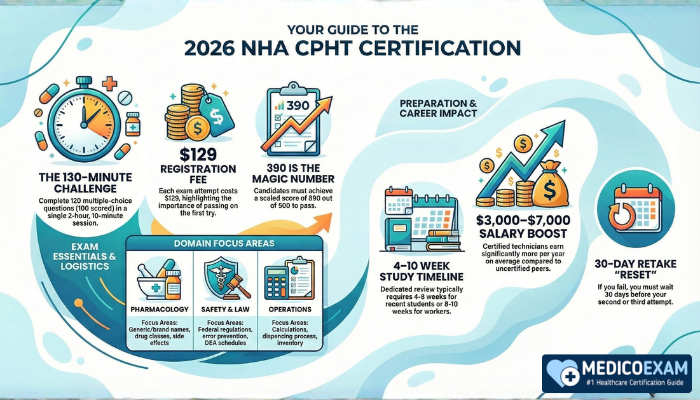
 Becoming a Certified Pharmacy Technician (CPhT) through the National Healthcareer Association (NHA) is one of the fastest routes to a stable, well-paying career in healthcare. The NHA ExCPT exam consists of 120 multiple-choice questions, must be completed in 2 hours and 10 minutes, costs $129 to register, and requires a scaled score of 390 out of 500 to pass (NHA). Certification boosts annual salary by an average of $3,000 to $7,000 per year.
If you are preparing for the test in 2026, you likely have questions about eligibility, format, scoring, study strategies, and career value. We have answered the 20 most frequently asked questions below to give you a complete, up-to-date picture.
Key Facts: NHA CPhT Exam (ExCPT)
-
Exam Cost: $129
-
Format: 120 multiple-choice questions (100 scored, 20 unscored pilot questions)
-
Duration: 2 hours and 10 minutes, completed in one continuous session (NHA)
-
Passing Score: Scaled score of 390 out of 500
-
Pass Rate: Approximately 63–64%
-
Certification Salary Boost: $3,000–$7,000 more per year on average
-
Certification Validity: 2 years, renewable through continuing education
Part 1: Eligibility and Application
1. What is the NHA CPhT exam?
-
The ExCPT is a national certification exam that validates your ability to work as a pharmacy technician in retail, hospital, and clinical settings.
2. Who administers the exam?
-
The exam is administered by the National Healthcareer Association (NHA), a widely recognized credentialing body in allied healthcare.
3. What are the eligibility requirements?
-
You must have a high school diploma (or equivalent) and have completed a training program or have relevant work experience.
4. Can I take the exam without experience?
-
Yes, if you complete an approved pharmacy technician training program.
5. How do I register?
-
You can register directly through the official NHA website.
Part 2: Exam Format and Content
6. How many questions are on the exam?
-
The exam includes 120 multiple-choice questions, of which 100 are scored.
7. How long is the exam?
-
You have 2 hours and 10 minutes to complete the test.
8. What topics are covered?
-
Topics include pharmacology, medication safety, pharmacy law, calculations, and inventory management.
9. Is the exam difficult?
-
With a pass rate of ~63–64%, the exam is moderately challenging and requires structured preparation.
10. Is there negative marking?
-
No. You are not penalized for incorrect answers.
Part 3: Scoring and Pass Rates
10. What is the passing score for the ExCPT?
-
The NHA uses a scaled scoring system ranging from 200 to 500. You must achieve a scaled score of 390 to pass (FlashGenius). The scaled scoring system accounts for variations in exam difficulty — a more difficult set of questions may require fewer correct answers to achieve a 390 than an easier set. Importantly, only the 100 scored questions contribute to your final score. The 20 pretest questions do not affect your pass/fail result.
11. What is the current pass rate?
-
The ExCPT exam has a pass rate of approximately 63–64% (Stepful). This means roughly 1 in 3 test-takers does not pass on their first attempt. The relatively low pass rate underscores the importance of thorough, structured preparation — particularly in the dispensing process domain, which accounts for nearly half the exam.
12. How soon will I get my results?
-
You receive immediate pass/fail feedback on the screen after completing the exam (Achievable). Your official score report typically posts to your NHA online account within a few business days. If you tested at a school or PSI center, you will see your preliminary result before leaving the facility.
13. What happens if I fail the exam?
-
If you do not pass on your first attempt, you must wait 30 days before retaking it. The NHA allows three attempts. If you fail the third time, you must wait 12 months before you can test again (Stepful). Each retake costs the standard $129 fee.
-
The 30-day waiting period is actually a valuable reset window. Use it to analyze which domains caused you to fall short and adjust your study strategy accordingly. Simply retaking the exam without changing your approach rarely produces a different result.
Part 4: Study Preparation
14. How long should I study for the CPhT exam?
-
If you recently completed a pharmacy technician training program, 4 to 6 weeks of dedicated review is usually sufficient. If you are using the work-experience pathway and have not been in a classroom setting recently, plan for 8 to 10 weeks of study to ensure you thoroughly cover topics outside your daily work routine.
A strong study plan follows a weekly structure:
| Week | Focus Area | Activity |
|---|---|---|
| 1–2 | Top 200 Drugs | Memorize generic/brand names, drug classes, common side effects |
| 3–4 | Dispensing Process | Prescription processing, labeling, compounding, calculations |
| 5–6 | Laws & Safety | Federal/state regulations, DEA schedules, error prevention |
| 7–8 | Full-Length Practice | Timed practice exams to build stamina and identify weak areas |
15. Do I need to memorize the top 200 drugs?
-
Yes. A substantial portion of the exam requires you to know generic and brand names, drug classifications, primary therapeutic uses, and common side effects for the top 200 most prescribed medications. This is non-negotiable. Flashcards — physical or digital — are the most effective memorization tool for drug names.
-
Focus your effort on the top 50 first. These include medications like lisinopril, atorvastatin, metformin, amlodipine, and omeprazole that appear across multiple exam domains. Once you can instantly recall the generic/brand pair and drug class for the top 50, expand to the full 200.
Part 5: Career Value and Salary Impact
20. Is the CPhT certification required by law?
- It depends on your state. A growing number of states now legally require pharmacy technicians to be certified to practice. Even in states where certification is not mandated, major employers — including large retail chains and hospital systems — strongly prefer or require the CPhT credential for hiring and promotions.
-
The trend is clearly moving toward universal certification requirements. Check your state's board of pharmacy website for current requirements.
Frequently Asked Questions
Q1. How many times can I retake the ExCPT?
-
You are allowed three attempts. After a third failure, you must wait 12 months before testing again. Each retake costs $129.
Q2. How long does the CPhT certification last?
-
The NHA CPhT certification is valid for 2 years. You must complete continuing education requirements to renew.
Q3. Can I take the ExCPT online from home?
- Yes. The NHA offers live remote proctoring for the ExCPT. You need a computer with a webcam, a stable internet connection, and a clean, quiet workspace.
Q4. Is the NHA CPhT accepted in all states?
-
The NHA CPhT is accepted in most states, though some states specify which certification body they recognize. Always verify with your state board of pharmacy before registering.
Q5. What is the best way to prepare for pharmacy math?
-
Practice days' supply calculations, unit conversions, and dilution problems daily. Use the on-screen calculator during practice tests to get comfortable with the tool you will have on exam day.
Ready to Pass the NHA CPhT Exam?
With a pass rate of just 63–64%, the ExCPT demands serious preparation. Do not risk paying the $129 retake fee. Try MedicoExam's simulation-based CPhT practice tests to experience the exact format, timing, and difficulty of the real exam before test day. Build your confidence by scoring above 80% on realistic practice tests before scheduling your official exam date.
Written by the MedicoExam Content Team — Healthcare Education Specialists at MedicoExam.com
Last Updated: April 2026
Disclaimer: This article is for informational purposes only. Always refer to the official NHA website for the most current exam policies.
- NHA CPhT Question Bank |
- NHA CPhT Eligibility & Requirements |
- NHA ExCPT Pharmacy Technician Practice Test |
- NHA CPhT Exam Cost |
- NHA CPhT Registration Process |
- NHA ExCPT Pharmacy Technician Study Guide |
- NHA CPhT Recertification |
- NHA CPhT Certification Overview |
- NHA ExCPT Pharmacy Technician Syllabus |
- NHA CPhT Preparation Time |
- NHA CPhT Passing Score |
- NHA CPhT Exam Format |
- NHA ExCPT Pharmacy Technician Sample Questions |
- NHA CPhT Career Opportunities |
- NHA CPhT Exam Difficulty


