
NHA CPT Exam: Certified Phlebotomy Technician Prep Made Simple
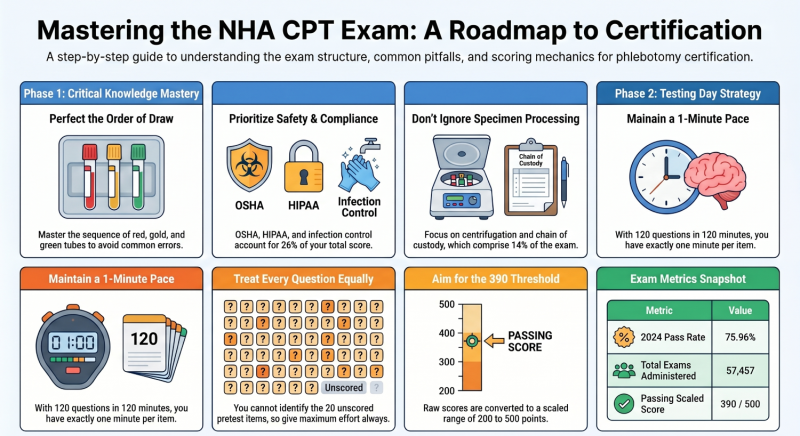
 The NHA Certified Phlebotomy Technician (CPT) exam is a 120-question, computer-based test that costs $129 and requires a scaled score of 390 out of 500 to pass. Of those 120 questions, 100 are scored and 20 are unscored pretest items used for future exam development. The first-time pass rate is 75.96%, according to NHA's 2024 annual pass rate report — meaning roughly one in four candidates does not pass on the initial attempt. This guide breaks down every domain, walks through the CLSI order of draw, explains eligibility requirements, and provides a 6-week study plan so you can join the 133,234 actively certified CPT holders in the United States.
NHA CPT Exam — Key Facts at a Glance
| Detail | Value |
|---|---|
| Full Name | Certified Phlebotomy Technician (CPT) |
| Certifying Body | National Healthcareer Association (NHA) |
| Total Questions | 120 (100 scored + 20 pretest) |
| Time Limit | 2 hours (120 minutes) |
| Exam Fee | $129 |
| Scoring Scale | 200–500 |
| Passing Score | 390 |
| First-Time Pass Rate | 75.96% (2024) |
| Active Certifications | 133,234 (as of Dec. 31, 2024) |
| Renewal Cycle | Every 2 years, 10 CE credits |
| Testing Options | School-sponsored, PSI testing center, or remote live proctoring |
Source: NHA — Certified Phlebotomy Technician (CPT) and NHA 2024 Annual Pass Rates
What Is the NHA CPT Certification?
The NHA CPT is a nationally recognized credential that validates a phlebotomy technician's competence in blood specimen collection, patient safety, and laboratory processing. Administered by the National Healthcareer Association — founded in 1989 and headquartered in Leawood, Kansas — the CPT is the second-most-administered NHA exam, with 57,457 candidates tested in 2024 alone. It is accepted by hospitals, diagnostic laboratories, outpatient care centers, and blood donation facilities across all 50 states.
Earning the CPT credential signals to employers that you meet a standardized competency threshold. According to the Bureau of Labor Statistics, many employers prefer or require national certification when hiring phlebotomists. If you're exploring other NHA certifications, the CPT pairs well with the CPCT/A (Certified Patient Care Technician/Assistant), which includes a 16% phlebotomy component.
Who Is Eligible for the NHA CPT Exam?
Candidates must satisfy one of two eligibility pathways established by NHA):
Pathway 1 — Training Program Graduate
-
Possess a high school diploma or GED (or be scheduled to earn one within 12 months)
-
Complete a phlebotomy technician training or education program within the last 5 years
-
Provide evidence of a minimum of 30 venipunctures and 10 capillary or finger sticks on live individuals
Pathway 2 — Work Experience
-
Possess a high school diploma or GED
-
1 year of supervised phlebotomy work experience within the last 3 years, or 2 years of supervised experience within the last 5 years
-
Provide evidence of a minimum of 30 venipunctures and 10 capillary or finger sticks on live individuals
Both pathways require documented proof of hands-on clinical procedures. NHA updated the capillary stick language in 2022 to clarify that finger sticks count toward the 10-stick requirement, addressing feedback from training programs where certain patient care sites primarily perform finger sticks rather than heel sticks.
What Are the 5 Domains on the NHA CPT Exam?
The NHA CPT exam covers five weighted domains based on a job analysis completed in 2024. Routine Blood Collections is the largest domain at 28%, while Special Collections is the smallest at 12%. Understanding the weight distribution is critical for prioritizing your study time.
| Domain | Scored Items | % of Exam | Focus Areas |
|---|---|---|---|
| 1. Safety & Compliance | 26 | 26% | OSHA, HIPAA, PPE, infection control, exposure control, sharps disposal, quality control |
| 2. Patient Preparation | 20 | 20% | Patient ID, consent, requisition review, site selection, fasting verification, communication |
| 3. Routine Blood Collections | 28 | 28% | Venipuncture, order of draw, equipment selection, tourniquet use, capillary collection, labeling |
| 4. Special Collections | 12 | 12% | Blood cultures, pediatric/geriatric draws, glucose tolerance tests, drug screening, blood donations |
| 5. Processing | 14 | 14% | Centrifugation, specimen handling/transport, chain of custody, critical value reporting, aliquoting |
| Total | 100 | 100% |
Source: NHA CPT Test Plan (2025)
Domain 1: Safety & Compliance (26%)
This is the second-largest domain and tests your knowledge of regulatory frameworks that govern phlebotomy practice. Key topics include:
-
OSHA and NIOSH workplace safety regulations
-
Bloodborne Pathogens Standard and exposure control plans
-
HIPAA patient privacy protections
-
Standard and transmission-based precautions (airborne, droplet, contact)
-
PPE usage — proper donning and doffing of gloves, gowns, masks, and eye protection
-
Sharps disposal and biohazard handling
-
Quality control for laboratory equipment and point-of-care (POC) testing
-
First aid for phlebotomy-related issues such as syncope, excessive bleeding, and falls
-
CLIA-waived test procedures and documentation requirements
Domain 2: Patient Preparation (20%)
This domain evaluates your ability to prepare patients before a draw. Key areas include:
-
Positive patient identification using two unique identifiers
-
Verifying implied, informed, or expressed consent
-
Reviewing requisition forms for completeness (demographics, diagnosis codes, test priority)
-
Confirming fasting status, medication compliance, and basal state
-
Interviewing patients for allergies, prior complications, and special considerations
-
Proper patient positioning for safety and vein access
-
Selecting the venipuncture site based on CLSI standards
-
Collecting non-blood specimens (urine, stool, sputum) when ordered
Domain 3: Routine Blood Collections (28%)
The largest domain focuses on the hands-on mechanics of specimen collection:
-
Selecting and assembling evacuated tube systems, syringes, and winged collection sets
-
Verifying equipment sterility and expiration dates
-
Tourniquet application and removal (no more than 1 minute)
-
Palpating and selecting the final venipuncture site
-
Antiseptic application and vein anchoring technique
-
Order of draw for venipuncture and capillary collection (see table below)
-
Recognizing and responding to complications — hematoma, petechiae, nerve pain, syncope
-
Engaging needle safety devices, applying bandages, and labeling all specimens
Domain 4: Special Collections (12%)
Although it carries the fewest questions, this domain covers high-stakes scenarios:
-
Blood culture collections — site preparation, bottle types, volume requirements
-
Pediatric and geriatric draws — volume calculations to prevent iatrogenic anemia
-
Glucose tolerance tests (gestational, lactose, 2-hour post-prandial)
-
Blood alcohol specimen preparation — non-alcohol antiseptic required
-
Drug screening collection and chain-of-custody procedures
-
Newborn screening (PKU, galactosemia) — heel-stick filter paper collection
-
Blood donation phlebotomy and hemoglobin/hematocrit screening
Domain 5: Processing (14%)
This domain covers everything that happens after the needle is withdrawn:
-
Centrifuging procedures and equipment operation
-
Aliquoting and preparing specimens for testing or transport
-
Maintaining specimen integrity — temperature, light sensitivity, and time requirements
-
Following chain of custody for forensic and legal specimens
-
Inputting and retrieving data from laboratory information systems
-
Recognizing and reporting critical values for POC and CLIA-waived tests
-
Coordinating with ordering providers to distribute results
What Is the CLSI Order of Draw?
The order of draw is one of the most heavily tested topics on the NHA CPT exam. Following the correct sequence — established by the Clinical and Laboratory Standards Institute (CLSI) — prevents additive carryover between tubes, which can compromise test results. The table below lists the standard venipuncture order of draw with tube colors, additives, and common tests.
| Draw Position | Tube Color | Additive | Common Tests |
|---|---|---|---|
| 1 | Yellow (SPS) / Blood culture bottles | Sodium polyanethol sulfonate (SPS) / nutrient broth | Blood cultures, microbiology |
| 2 | Clear / Red (discard tube) | None | Used only when light blue is first non-culture tube |
| 3 | Light Blue | Sodium citrate | PT, PTT, aPTT, coagulation studies |
| 4 | Red | None (glass) / clot activator (plastic) | Serum chemistry, serology, blood bank |
| 5 | Gold / Tiger-Top (SST) | Silica clot activator + thixotropic gel | BMP, CMP, lipid panel, thyroid panel |
| 6 | Light Green (PST) | Lithium heparin + gel | STAT chemistry (potassium, BMP) |
| 7 | Dark Green | Sodium or lithium heparin | Ammonia, STAT electrolytes |
| 8 | Lavender / Purple | EDTA (K₂ or K₃) | CBC, hemoglobin A1c, ESR, blood type |
| 9 | Pink | K₂ EDTA | Blood bank / type and screen |
| 10 | Gray | Sodium fluoride + potassium oxalate | Glucose (fasting/GTT), blood alcohol |
| 11 | Royal Blue | None or EDTA (color-coded stripe) | Trace elements, heavy metals, lead |
Source: Clinical and Laboratory Standards Institute (CLSI) GP41 and current phlebotomy training guidelines
Memory tip: Many students use the mnemonic "Stop, Look, Read — Good Stories Last, Please Go" to remember the tube sequence — SPS/cultures, Light blue, Red, Gold/SST, Green, Lavender, Pink, Gray.
Capillary order of draw differs from venipuncture. For capillary (dermal) punctures, the order is: (1) EDTA tubes first — to prevent platelet clumping, (2) other additive tubes, (3) non-additive tubes. Blood gas capillary tubes, if collected, are drawn first before EDTA.
How Hard Is the NHA CPT Exam — and Why Do 24% of Candidates Fail?
The NHA CPT exam has a first-time pass rate of 75.96%, based on 57,457 examinations administered in 2024 (NHA Annual Pass Rates). While this is the second-highest pass rate among NHA exams (behind CCMA at 81.38%), it still means roughly 1 in 4 candidates falls short.
Common reasons candidates fail include:
-
Order of draw confusion — Tube sequence errors are among the most frequently missed questions. The difference between red, gold, and green tubes must be automatic.
-
Safety & Compliance underestimation — At 26% of the exam, this domain carries almost as much weight as Routine Blood Collections. Candidates who focus exclusively on venipuncture technique and neglect OSHA, HIPAA, and infection control often lose critical points.
-
Pretest question anxiety — The 20 unscored pretest items are indistinguishable from scored questions, which means you must treat all 120 questions with equal seriousness.
-
Weak specimen processing knowledge — Processing (14%) is often overlooked, but questions on centrifugation, chain of custody, and critical value reporting are common.
-
Poor time management — With 120 questions in 120 minutes, you have exactly 1 minute per question. Spending too long on difficult items leaves easy points unanswered.
How Is the NHA CPT Exam Scored?
The NHA CPT exam uses a scaled scoring system. Your raw score — the number of correct answers out of the 100 scored items — is converted to a scale from 200 to 500. You need a scaled score of 390 to pass.
Key scoring facts:
-
There is no penalty for guessing. Unanswered questions receive zero points, so always select an answer.
-
Pretest items do not affect your score. The 20 unscored items are statistically evaluated for potential use on future exams.
-
Results are posted within 2 business days for exams taken online or at PSI testing centers.
-
You cannot determine which questions are pretest items, so approach every question with full effort.
What Does the NHA CPT Venipuncture Procedure Look Like?
Understanding the standard venipuncture procedure is essential for Domain 3 (Routine Blood Collections). The exam tests both the correct sequence and the rationale behind each step.
-
Review the requisition — Verify patient name, DOB, tests ordered, and priority (STAT vs. routine).
-
Gather supplies — Select correct tubes per the order of draw, needle gauge (typically 21G), evacuated tube holder, tourniquet, antiseptic wipes, gloves, gauze, and labels.
-
Identify the patient — Use two unique identifiers (name + DOB or medical record number). Compare against the requisition and patient wristband.
-
Obtain consent — Explain the procedure and receive implied, informed, or expressed consent.
-
Position the patient — Seat comfortably with the arm extended and supported. Use a supine position for patients at risk of syncope.
-
Apply the tourniquet — Place 3–4 inches above the puncture site. Do not leave on for more than 1 minute to avoid hemoconcentration.
-
Select and palpate the site — The median cubital vein is preferred, followed by the cephalic and basilic veins.
-
Cleanse the site — Apply 70% isopropyl alcohol in a circular motion from center outward. Allow 30 seconds to dry.
-
Anchor the vein and insert the needle — Insert at a 15–30° angle, bevel up.
-
Collect tubes in order of draw — Fill to the manufacturer's specified line.
-
Release the tourniquet before removing the last tube.
-
Remove the needle and activate the safety device — Apply gauze with pressure.
-
Invert tubes gently 5–10 times per manufacturer instructions. Do not shake.
-
Apply bandage after confirming bleeding has stopped.
-
Label specimens at the bedside — Never pre-label tubes. Include patient name, DOB, date/time, and phlebotomist initials.
-
Dispose of sharps in a puncture-resistant container. Never recap used needles.
6-Week NHA CPT Study Plan
This study plan allocates weekly hours proportional to each domain's weight on the exam. Budget 8–10 hours per week (roughly 1.5 hours per day) for six weeks.
| Week | Focus | Hours | Activities |
|---|---|---|---|
| 1 | Foundations + Safety & Compliance (26%) | 10 | Study OSHA, HIPAA, BBP standard, PPE, infection control. Memorize sharps disposal rules and exposure control steps. |
| 2 | Patient Preparation (20%) | 9 | Master patient ID procedures, consent types, requisition review, fasting requirements, and site selection criteria. |
| 3 | Routine Blood Collections — Part 1 (28%) | 10 | Learn venipuncture steps, equipment selection, tourniquet application, antiseptic use. Memorize order of draw. |
| 4 | Routine Blood Collections — Part 2 + Capillary | 10 | Drill order of draw with flashcards. Study capillary collection procedures, complication recognition, and labeling. |
| 5 | Special Collections (12%) + Processing (14%) | 9 | Cover blood cultures, pediatric draws, GTT, drug screening, centrifugation, chain of custody, and critical values. |
| 6 | Full-Length Practice Tests + Weak-Area Review | 10 | Take 2–3 timed 120-question practice exams. Review missed questions. Focus remaining time on weakest domain. |
Study tips that improve pass rates:
-
Active recall over passive reading — Use flashcards for tube colors, additives, and tests. Quiz yourself daily.
-
Simulate exam conditions — Practice under a 2-hour time limit with 120 questions to build stamina and pacing.
-
Prioritize high-weight domains — Safety & Compliance (26%) and Routine Blood Collections (28%) together account for 54% of scored questions.
-
Don't skip Processing — At 14%, this domain delivers 14 "easy" points if you study centrifuge procedures and specimen handling.
-
Use MedicoExam's CPT practice tests — Simulation-based practice exams mirror the actual NHA format and help you identify weak domains before test day.
"The students who pass on the first try are the ones who treat the safety and compliance questions as seriously as the hands-on collection procedure." — Andrea Wells, MLS(ASCP), Allied Health Instructor
How Much Do Certified Phlebotomy Technicians Earn?
Earning the NHA CPT credential positions you for competitive wages in a growing field. According to the Bureau of Labor Statistics (May 2024), phlebotomists earn a median annual salary of $43,660, with the top 10% earning $57,750 or more.
| Metric | Value |
|---|---|
| Median annual salary | $43,660 |
| Median hourly wage | $20.99 |
| 10th percentile | $34,860 |
| 90th percentile | $57,750 |
| Total U.S. employment | 139,700 |
| Projected job growth (2024–2034) | 6% (faster than average) |
| Annual job openings | ~18,400 |
Source: Bureau of Labor Statistics — Phlebotomists
Salary varies by work setting. BLS industry data shows that phlebotomists in outpatient care centers earn the highest average annual wage at $48,450, compared with $41,490 in hospitals and $40,480 in physician offices.
The 6% projected growth from 2024 to 2034 — faster than the average for all occupations — is driven by an aging population that requires more diagnostic blood work, chronic disease monitoring, and outpatient lab testing.
How Do You Register for the NHA CPT Exam?
Registration follows one of three pathways depending on your testing preference:
-
School-sponsored exam — If you completed a phlebotomy training program through an NHA-partnered school, your program coordinator will schedule your exam and provide a testing date.
-
PSI testing center — Create an account on the NHA website, verify eligibility, pay the $129 exam fee, and schedule at a PSI testing center near you.
-
Remote live proctoring — After paying the exam fee through NHA, schedule a remote exam session. You'll need a computer with a webcam, microphone, and reliable internet connection.
What to bring on exam day:
-
A valid, government-issued photo ID (driver's license, passport, or state ID)
-
Your NHA exam confirmation email or candidate ID number
-
No personal belongings, phones, or study materials are allowed in the testing room
Results are typically available within 2 business days. If you do not pass, NHA allows retesting after a waiting period (check NHA's candidate handbook for current retake rules).
How Does the NHA CPT Compare to Other Phlebotomy Certifications?
The NHA CPT is one of several nationally recognized phlebotomy certifications. Here is how it stacks up against the ASCP PBT and AMT RPT:
| Feature | NHA CPT | ASCP PBT | AMT RPT |
|---|---|---|---|
| Questions | 120 (100 scored) | 80 | 200 |
| Time Limit | 2 hours | 2 hours | 2 hours |
| Exam Fee | $129 | $135–$155 | $120–$155 |
| Pass Rate (approx.) | 76% | Not publicly reported | Not publicly reported |
| Renewal | 2 years, 10 CE credits | 3 years | 3 years |
| Best For | Broad clinical settings | Hospital laboratories | Flexible entry |
The ASCP PBT (Phlebotomy Technician) is often considered the gold standard for hospital laboratory positions, while the NHA CPT is the most common entry-level credential used by vocational schools and allied health training programs. The AMT RPT sits between the two — offering flexible eligibility routes and national recognition, but less name recognition than ASCP in major hospital systems.
How Do You Renew NHA CPT Certification?
NHA CPT certification is valid for 2 years from the date you pass the exam. To maintain active status, you must complete 10 continuing education (CE) credits and pay the renewal fee before expiration.
Key renewal details:
-
Renewal fee: $185
-
CE requirement: 10 CE credits within the 2-year certification period
-
Free CE courses: NHA provides free CE courses to currently certified holders through their online CE portal
-
Late renewal: If your certification lapses, NHA may require re-examination
Staying certified matters. As the healthcare industry increasingly mandates credentialed staff, lapsed certifications can limit job opportunities and delay promotions.
Frequently Asked Questions
Q1. How many questions are on the NHA CPT exam?
-
The NHA CPT exam contains 120 total questions: 100 scored items that determine your pass/fail result and 20 unscored pretest questions used by NHA for future exam development.
Q2. What is the passing score for the NHA CPT?
-
The passing score is 390 on a scaled score range of 200 to 500. Your raw score (number of correct answers on the 100 scored questions) is converted to that scale.
Q3. How much does the NHA CPT exam cost?
-
The NHA CPT exam costs $129. This fee covers one exam attempt through a school-sponsored setting, PSI testing center, or remote live proctoring.
Q4. What is the NHA CPT pass rate?
-
The first-time pass rate for the NHA CPT exam is 75.96%, based on 57,457 examinations administered during the 2024 calendar year, according to NHA's official annual pass rate report.
Q5. How many venipunctures do I need before taking the CPT exam?
-
You must document a minimum of 30 venipunctures and 10 capillary or finger sticks on live individuals. This requirement applies to both the education and work-experience pathways.
Q6. What is the order of draw for phlebotomy?
-
The CLSI order of draw for venipuncture is: blood culture bottles (yellow SPS), light blue (sodium citrate), red (no additive), gold/SST (clot activator + gel), green (heparin), lavender (EDTA), pink (EDTA blood bank), gray (fluoride/oxalate), then royal blue when required for trace elements. Capillary order of draw is different.
Q7. How long is the NHA CPT certification valid?
-
NHA CPT certification is valid for 2 years. Renewal requires 10 continuing education credits and a $185 renewal fee. NHA offers free CE courses for current credential holders.
Q8. Can I take the NHA CPT exam online?
-
Yes, NHA offers remote live proctoring as a testing option. You need a computer with a webcam and microphone, a stable internet connection, and a private testing environment.
Q9. How long should I study for the NHA CPT exam?
-
Most candidates benefit from 6 to 8 weeks of structured preparation, studying 8–10 hours per week. Candidates who completed a recent phlebotomy program may need less time, while career changers often need more.
Q10. What happens if I fail the NHA CPT exam?
-
If you do not achieve a scaled score of 390 or higher, you can retake the exam after completing a waiting period specified in NHA's candidate handbook. Use the score report to identify weak domains before retesting.
Start Preparing for the NHA CPT Exam Today
The NHA CPT exam is achievable with the right preparation strategy. With 5 clearly defined domains, a published test plan, and a 76% first-time pass rate, your odds improve dramatically when you study the highest-weight topics first and practice under timed conditions.
Ready to practice? MedicoExam's NHA CPT practice tests simulate the real exam format with 120 timed questions across all 5 domains. Each question includes answer explanations so you learn while you practice.
Explore more resources on MedicoExam.com.
Disclaimer: This guide is for informational purposes only and does not contain actual NHA exam questions or proprietary content. Always verify current policies and fees with the National Healthcareer Association.
Written by the MedicoExam Content Team — Healthcare Education Specialists at MedicoExam.com
Last Updated: April 2026
- NHA Phlebotomy Technician Practice Test |
- NHA CPT Question Bank |
- NHA CPT Eligibility & Requirements |
- NHA CPT Exam Cost |
- NHA CPT Registration Process |
- NHA Phlebotomy Technician Study Guide |
- NHA CPT Recertification |
- NHA CPT Certification Overview |
- NHA Phlebotomy Technician Syllabus |
- NHA CPT Preparation Time |
- NHA CPT Passing Score |
- NHA CPT Exam Format |
- NHA Phlebotomy Technician Sample Questions |
- NHA CPT Career Opportunities |
- NHA CPT Exam Difficulty


