
Struggling with the NCC C-OBE Exam? Start with This NCC C-OBE Practice Test
 Preparing for the NCC C-OBE exam can feel overwhelming. Between long shifts, emotional pressure, and the responsibility of mastering life-saving skills, many candidates struggle to find the right study rhythm. If you are searching for a smarter way to prepare, a well-structured NCC C-OBE practice test strategy can become your strongest ally.
This guide is written from the perspective of experienced educators and clinicians who understand the realities of obstetric emergency care. It will help you transform scattered studying into focused, confident preparation so you walk into the exam ready, calm, and in control.
What Is the NCC C-OBE Certification and Why It Matters
The NCC C-OBE certification validates a healthcare professional’s expertise in managing obstetric emergencies, including hemorrhage, hypertension, and maternal resuscitation. It demonstrates advanced clinical competence and commitment to maternal safety, making it valuable for career advancement and professional credibility worldwide.
Understanding the Credential
The Certified-Obstetric Emergencies (C-OBE) credential is awarded by the National Certification Corporation (NCC) to professionals who demonstrate proficiency in high-risk maternal and postpartum care.
Key exam details include:
-
Exam Name: NCC Obstetric Emergencies
-
Credential: NCC Certified-Obstetric Emergencies (C-OBE)
-
Exam Code: C-OBE
-
Delivery Mode: Computer-based testing
-
Duration: 120 minutes
-
Questions: 125
-
Passing Standard: Pass/Fail (~72%)
-
Exam Fee: $210
You can verify official guidelines through NCC’s certification overview and candidate guide.
Why Employers Value C-OBE Certification
Healthcare systems increasingly emphasize patient safety, risk management, and evidence-based practice.
C-OBE-certified professionals are often preferred for:
-
High-acuity maternity units
-
Leadership roles in obstetrics
-
Clinical education positions
-
Quality improvement teams
Certification reflects both clinical competence and professional accountability.
Career Impact
-
Holding this credential can support:
-
Promotion eligibility
-
Increased professional trust
-
Expanded scope of responsibility
-
Stronger resumes for global healthcare roles
In competitive job markets, C-OBE certification often distinguishes candidates who are prepared for real-world obstetric emergencies.
Understanding the NCC C-OBE Exam Format and Scoring
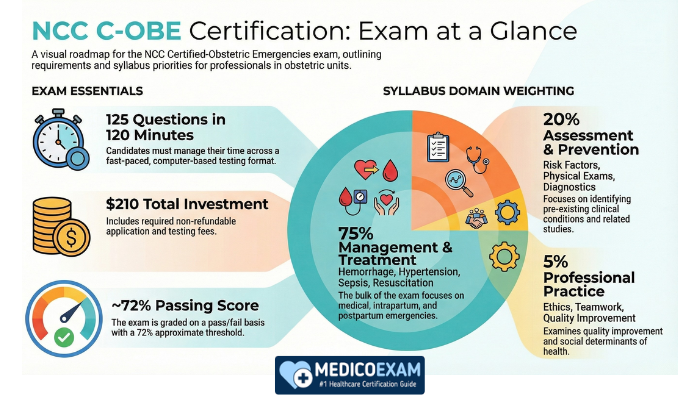 The NCC C-OBE exam consists of 125 multiple-choice questions completed in 120 minutes. It uses a pass/fail scoring system based on psychometric standards, with an approximate passing benchmark of 72%, though final results depend on exam scaling.
Exam Structure Overview
The exam tests both knowledge and clinical reasoning. It emphasizes practical decision-making rather than memorization.
| Domain | Percentage |
|---|---|
| Assessment and Prevention | 20% |
| Identification, Management, and Treatment | 75% |
| Professional Practice | 5% |
Question Style
Expect:
-
Scenario-based questions
-
Prioritization tasks
-
Risk assessment cases
-
Management pathway decisions
For example, you may be asked to determine the first intervention in postpartum hemorrhage or identify early signs of sepsis.
Scoring and Results
NCC uses criterion-referenced scoring. This means:
-
Your score is measured against standards, not other candidates
-
Passing thresholds may be adjusted periodically
-
Results typically reflect clinical competency
Understanding this structure helps you align practice tests with exam expectations.
Why Taking an NCC C-OBE Practice Test Improves Your Pass Rate
An NCC C-OBE practice test improves pass rates by familiarizing candidates with exam formats, identifying weak knowledge areas, enhancing time management, and reinforcing clinical reasoning through repeated scenario-based exposure.
1. Builds Exam Confidence
Repeated exposure to realistic questions reduces anxiety. When candidates recognize familiar patterns on exam day, cognitive load decreases, allowing clearer thinking.
2. Reveals Knowledge Gaps
Practice tests highlight:
-
Weak clinical domains
-
Misunderstood protocols
-
Inconsistent reasoning patterns
For example, many candidates overestimate their readiness in hypertensive crisis management until they face timed questions.
3. Improves Clinical Judgment
Quality practice exams simulate real-life dilemmas. Over time, you learn to:
-
Prioritize interventions
-
Interpret diagnostic clues
-
Avoid unnecessary steps
This directly transfers to bedside care.
4. Enhances Time Management
With 125 questions in 120 minutes, pacing matters. Practice exams train you to:
-
Allocate time wisely
-
Avoid overthinking
-
Recognize when to move on
5. Supports Targeted Learning
When paired with a structured and detailed C-OBE exam syllabus, practice tests become strategic learning tools rather than random drills.
You can explore structured preparation resources through comprehensive C-OBE practice test platforms designed to simulate real exam scenarios and strengthen clinical reasoning.
High-Yield Obstetric Emergencies (C-OBE) Topics You Must Master
High-yield C-OBE topics include postpartum hemorrhage, hypertensive disorders, maternal sepsis, embolism, cardiac arrest, and obstetric trauma. Mastery requires understanding early recognition, emergency protocols, and interdisciplinary coordination.
1. Assessment and Prevention (20%)
Key areas:
-
Pre-existing medical conditions
-
Risk stratification tools
-
Antenatal screening
-
Diagnostic imaging interpretation
Focus on recognizing high-risk patients early.
2. Medical Emergencies
Includes:
-
Cardiac conditions
-
Pulmonary embolism
-
Diabetic emergencies
-
Stroke in pregnancy
You must know symptom patterns and rapid-response steps.
3. Intrapartum and Postpartum Emergencies
Critical topics:
-
Shoulder dystocia
-
Uterine inversion
-
Amniotic fluid embolism
-
Uterine rupture
These scenarios require precise sequencing of actions.
4. Infection and Sepsis
High mortality risk makes this domain essential:
-
Early warning scores
-
Broad-spectrum antibiotic protocols
-
Fluid resuscitation
-
Source control
WHO and CDC guidelines are useful references:
5. Hypertension Disorders
Includes:
-
Preeclampsia
-
Eclampsia
-
HELLP syndrome
Candidates must understand medication protocols, monitoring, and escalation.
6. Obstetric Hemorrhage
The most heavily tested topic:
-
Uterine atony
-
Retained placenta
-
Coagulopathies
-
Massive transfusion protocols
ACOG resources provide valuable clinical insights:
7. Professional Practice (5%)
Covers:
-
Ethical dilemmas
-
Cultural competence
-
Team communication
-
Quality improvement
Even though weighted lower, these questions are often tricky.
How to Build an Effective C-OBE Study Guide and Practice Strategy
An effective C-OBE study strategy combines structured content review, targeted practice testing, clinical scenario analysis, performance tracking, and reflective learning, aligned with NCC exam domains and real-world obstetric workflows.
Step 1: Create a Personalized Study Map
Start with the official syllabus and build your framework:
-
Review exam domains
-
Allocate weekly goals
-
Identify weak areas
Step 2: Develop Your C-OBE Study Guide
Your personal guide should include:
-
Emergency algorithms
-
Medication dosages
-
Diagnostic criteria
-
Flowcharts for management
Avoid passive reading. Rewrite protocols in your own words.
Step 3: Integrate Practice Tests Early
Do not wait until “feeling ready.” Start early using realistic question banks,
Early testing builds adaptive learning.
Step 4: Use the Three-Pass Review Method
After each test:
-
Review incorrect answers
-
Analyze correct guesses
-
Reinforce weak concepts
Document patterns in mistakes.
Step 5: Apply Clinical Reflection
Relate questions to real experiences:
-
“Have I seen this scenario?”
-
“How was it managed?”
-
“What would I do differently?”
This deepens retention.
Step 6: Practice Under Exam Conditions
Simulate:
-
Timed sessions
-
No interruptions
-
Single sitting attempts
This builds endurance.
Step 7: Build an 8-Week Sample Plan
|
Week
|
Focus
|
|---|---|
|
1–2
|
Assessment & Prevention
|
|
3–4
|
Hemorrhage & Hypertension
|
|
5
|
Infection & Resuscitation
|
|
6
|
Mixed Practice
|
|
7
|
Full-Length Tests
|
|
8
|
Revision & Confidence
|
Common Preparation Mistakes
Avoid:
-
Memorizing without context
-
Skipping rationales
-
Over-relying on free tests
-
Ignoring weak domains
Many failures result from unbalanced preparation.
Frequently Asked Questions (FAQs)
1. How difficult is the NCC C-OBE exam?
-
The NCC C-OBE exam is considered moderately to highly challenging. It focuses on clinical reasoning rather than memorization. Candidates with strong emergency care experience and consistent practice testing generally perform better than those relying on passive study methods.
2. How long should I study for the C-OBE exam?
-
Most candidates prepare for 8 to 12 weeks, depending on experience and schedule. Full-time clinicians may need longer. Regular practice tests and focused review sessions are more effective than extended passive reading.
3. Are free NCC C-OBE practice tests reliable?
-
Free practice tests can be helpful for initial exposure, but quality and accuracy vary. They may not reflect current exam standards. Using validated, updated resources alongside official guidelines is generally more reliable.
4. Can I retake the C-OBE exam if I fail?
-
Retake policies depend on NCC’s current regulations. Therefore, it is important to review the most up-to-date requirements before planning another attempt. Typically, candidates must wait a defined period and submit a new application. In addition, certain eligibility criteria may need to be reconfirmed. For this reason, consulting NCC’s official candidate guide ensures you receive the most accurate and current information before proceeding.
5. Does C-OBE certification improve career prospects?
-
Yes, many employers value this credential for high-risk maternity care roles. In fact, it serves as a strong indicator of advanced clinical competence. Moreover, it reflects a clear commitment to patient safety and evidence-based practice. As a result, certified professionals are often viewed as well-prepared for leadership or specialist responsibilities in obstetric settings. Ultimately, earning this credential can strengthen both credibility and career advancement opportunities.
6. How many practice tests should I take before the exam?
-
Most successful candidates complete 4 to 6 full-length practice tests. By doing so, they gain repeated exposure to exam-style questions and realistic timing conditions. As a result, they can analyze performance patterns more effectively and identify recurring weaknesses. Furthermore, this structured approach allows them to strengthen weak areas while refining critical thinking skills. Over time, consistent practice also builds confidence and improves time management, which are essential for exam-day success.
7. What topics are most frequently tested?
-
Postpartum hemorrhage, hypertensive disorders, maternal resuscitation, and infection management are heavily represented on the exam. In fact, these topics consistently appear because they reflect high-risk clinical scenarios. Additionally, they directly align with the exam’s focus on early emergency recognition and rapid intervention. Therefore, mastering these areas is essential for improving both clinical judgment and exam performance. Ultimately, a strong understanding of these core topics significantly increases your chances of success.
8. Is clinical experience enough to pass the exam?
-
Clinical experience is valuable but not sufficient alone. The exam requires standardized knowledge and familiarity with evidence-based protocols. Structured study and practice testing remain essential.
9. How important are rationales in practice tests?
-
Rationales are critical. Specifically, they explain why an option is correct or incorrect, which helps refine your clinical reasoning. In other words, they turn each question into a learning opportunity rather than just a score. However, skipping rationales significantly limits retention and understanding. As a result, you may repeat the same mistakes on future practice tests or even on the actual exam.
10. Should I study alone or join a study group?
-
Both approaches can work. Independent study allows flexibility, while study groups provide discussion and accountability. Many candidates combine both for balanced preparation.
Conclusion: Turn Practice into Professional Confidence
Passing the NCC C-OBE exam is not just about earning a credential—it is about becoming a safer, more confident clinician during critical moments. A structured NCC C-OBE practice test strategy transforms preparation from stressful guesswork into purposeful learning.
- NCC Certification |
- NCC Certification Syllabus |
- NCC Certification Sample Questions |
- NCC Certification Practice Exam |
- NCC C-OBE Practice Exam |
- NCC C-OBE Mock Test |
- NCC C-OBE Online Test |
- NCC C-OBE Simulation |
- NCC Obstetric Emergencies Practice Exam |
- NCC Certified-Obstetric Emergencies (C-OBE) Preparation |
- NCC Obstetric Emergencies Practice Test |
- NCC C-OBE Sample Questions |
- NCC C-OBE Study Guide |
- NCC C-OBE Syllabus |
- NCC C-OBE Exam Topics |
- NCC C-OBE Exam Syllabus |
- NCC Obstetric Emergencies Syllabus |
- NCC C-OBE Exam Guide |
- NCC C-OBE Exam Questions |
- C-OBE Practice Questions |
- NCC Obstetric Emergencies Sample Questions |
- NCC Obstetric Emergencies |
- Obstetric Emergencies Exam |
- C-OBE |
- Healthcare Certification Exam |
- C-OBE Exam Format |
- C-OBE Passing Score |
- C-OBE Exam Difficulty


