The Registered Health Information Administrator exam, identified as RHIA, is a professional certification exam from the American Health Information Management Association. It evaluates applied capability in health information management, including data and information governance, compliance with access, use, and disclosure of health information, data analytics and informatics, revenue cycle management, and management and leadership.
This FAQ is intended for candidates pursuing roles such as health information administrator, health information manager, medical records manager, health information systems administrator, and patient data analyst. It explains exam structure, difficulty, preparation, renewal, and practical expectations in a clear format so candidates can review the scope of the RHIA before using official American Health Information Management Association guidance.
AHIMA RHIA — Frequently Asked Questions (FAQs)
This FAQ section summarizes key aspects of the AHIMA RHIA exam, including format, difficulty, and preparation. For official eligibility, policies, and updates, visit the AHIMA’s official exam page.
SECTION A: AHIMA RHIA Exam Overview & Legitimacy
This section explains what the credential is, who usually pursues it, and what the exam is designed to measure. It also clarifies renewal and recognition in practical workforce terms.

 A Registered Health Information Administrator (RHIA) credential, offered by AHIMA, signifies a professional's expertise in managing and securing patient health information. This certification validates critical skills in data integrity, privacy, and healthcare informatics, essential for modern healthcare operations. Professionals aiming to lead health information departments, ensure data accuracy, and maintain regulatory compliance should strongly consider pursuing this credential. This comprehensive article will delve into the RHIA certification's purpose, exam structure, syllabus, benefits, and effective preparation strategies, guiding aspiring candidates toward success and a future-proof career.
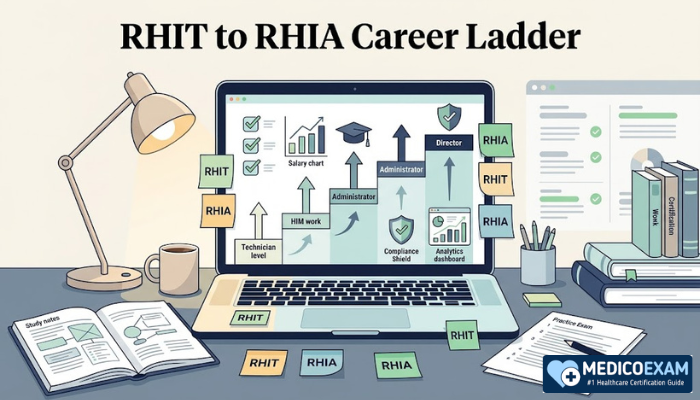 Choose RHIT if you hold an associate degree and want to start working in health information management quickly — it covers 6 exam domains and qualifies you for technical roles earning a median of $50,250 per year. Choose RHIA if you have a bachelor's degree or higher and want to move into management, compliance, or data analytics leadership — RHIA holders earn a median of $67,310 per year and qualify for director-level positions that exceed $100,000 annually.