
CEDC Exam Syllabus, Format and a Six-Week Practice Test Plan
The AAPC Certified Emergency Department Coder (CEDC) exam has 100 questions, a 240-minute time limit and a 70% passing score, and it costs $325 for one attempt or $399 for two. It tests emergency department coding: ICD-10-CM diagnoses, ED evaluation and management levels, critical care and trauma, ED procedures, and the split between facility and professional coding.
This guide walks through each of those areas, explains why emergency medicine catches out coders who are strong in other specialties, and lays out a six-week plan you can follow alongside your normal workload. If you want to test yourself while you read, start the CEDC practice test and use your first score as the baseline the plan below is built around.

What does the CEDC credential prove, and who should earn it?
The CEDC tells an employer that you can read an emergency department record and turn it into accurate, compliant codes without supervision. The ED is one of the hardest settings to code well. Records are written fast, by several clinicians, for patients whose problems are still being worked out. A single visit can include an evaluation and management service, critical care time, a laceration repair, a splint, an EKG interpretation and imaging, each with its own rules about what may be reported together.
The credential is aimed at medical coders who already work in, or want to move into, hospital emergency departments, emergency physician groups, outpatient coding teams and revenue cycle departments. It is a specialty credential from the American Academy of Professional Coders (AAPC), so most candidates arrive with general coding experience and want proof that they can handle the ED specifically.
It is also useful for people who already code emergency claims every day but have never had that skill measured. Teams that bill high ED volumes tend to route the complex charts (critical care, multiple procedures, trauma activations) to the coders they trust most, and a specialty credential is one of the few objective signals of that trust. AAPC publishes the current eligibility and membership requirements on its CEDC certification page, and that page is the one to check before you buy an exam, because requirements can change between exam cycles.
How is the CEDC exam structured, and what does it cost?
The structure is simple to state and demanding to sit. You answer 100 questions in 240 minutes and need 70% to pass. AAPC offers the exam either as an online, live remote-proctored session or in person at a Meazure Learning testing center, and you schedule it after buying the exam through the AAPC and Meazure Learning process.
| Exam detail | CEDC |
|---|---|
| Credential | AAPC Certified Emergency Department Coder (CEDC) |
| Certifying body | American Academy of Professional Coders (AAPC) |
| Number of questions | 100 |
| Time allowed | 240 minutes |
| Passing score | 70% |
| Exam fee (as of October 2026) | $325 for one attempt, $399 for two attempts |
| Delivery | Online live remote proctoring, or in person at a Meazure Learning test center |
| Credential validity | 2 years |
The two price points matter more than they first appear. The $399 option buys a second attempt for far less than a second full fee, so it is worth weighing against how confident you are on the day you book. A candidate whose practice scores are already well above the pass mark gains little from it. A candidate who is coming to ED coding from another specialty, or who has never sat a long proctored exam, is buying insurance that costs far less than a second full fee would.
The time limit works out to roughly two and a half minutes per question. That sounds generous until you remember that most CEDC questions are scenarios: a short ED note, followed by a choice between several code combinations that differ by one modifier, one code, or the order in which diagnoses are listed. Reading the scenario carefully is where the time goes, and a plan for pacing is covered later in this guide.
What does the CEDC syllabus cover?
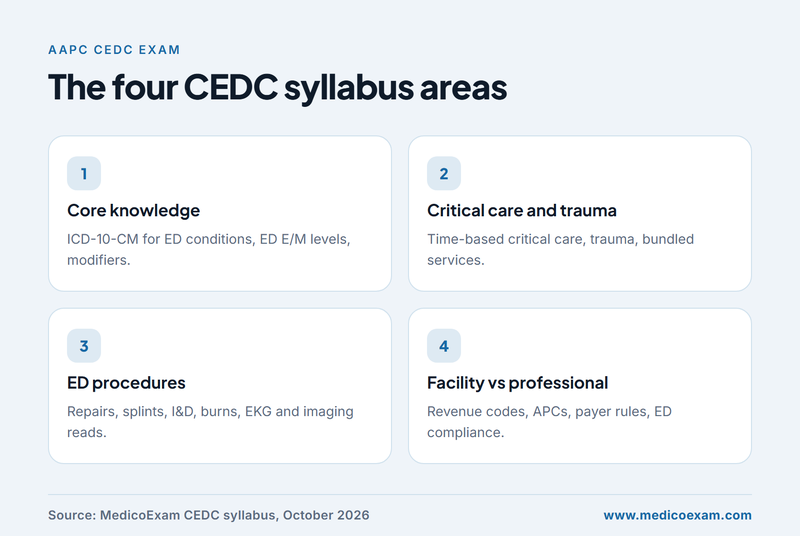
The CEDC syllabus groups the exam into four topic areas. They are not separate silos on the day. A single question can draw on diagnosis coding, E/M level, a procedure and a modifier at once, which is why studying them only one at a time leaves gaps. Learn each area, then practise mixed scenarios.
Core knowledge areas
The first area is the foundation the other three sit on. It covers ICD-10-CM diagnosis coding for the conditions an emergency department sees most: trauma, cardiac events, respiratory emergencies, strokes and acute injuries. It also covers E/M service selection for ED visits, meaning the levels of service and the documentation guidelines that decide which level a record supports, and the application of modifiers and payer-specific rules in emergency medicine.
For diagnoses, the skill being tested is choosing what the record actually supports. ED notes often end with a symptom rather than a confirmed condition, because the workup is not finished when the patient leaves. Outpatient guidelines tell you to code to the highest degree of certainty documented, so a note that says chest pain with a cardiac cause still being ruled out is coded as chest pain. Injury coding adds its own layer: the seventh character for the encounter, external cause codes where your payer or facility requires them, and the sequencing of multiple injuries.
For E/M, the emergency department codes run from 99281 to 99285. Since the 2023 revision of the CPT E/M guidelines, the level of an ED visit is chosen on medical decision making, and time is not used to select an ED level. That single rule eliminates a whole class of wrong answers: any option that justifies an ED level by minutes spent is reasoning the way office visits are coded, not the way ED visits are.
Critical care and trauma services
The second area covers critical care for life-threatening conditions, trauma activations and procedures, the services that are bundled in emergency medicine, and the documentation needed for time-based critical care coding. Critical care is the one place in ED coding where time drives the code, so the exam checks that you know where the time thresholds sit, what time may be counted toward them, and which services performed during that time are already included and cannot be billed on top.
Questions here tend to hinge on documentation. A note that describes a critically ill patient but records no total critical care time does not support critical care codes, however sick the patient was. Equally, time spent on separately billable procedures is not counted toward critical care. Expect at least one scenario where the right answer is a high-level ED visit rather than critical care, simply because the time statement is missing or falls short.
Diagnostic and therapeutic procedures
The third area covers the procedures an emergency department performs every shift: splinting, casting, wound repair and burn treatment; laceration repairs, foreign body removals, and incision and drainage; and the diagnostic tests and interpretations done in the ED, including EKGs, imaging and point-of-care testing.
Laceration repair is the classic test of careful reading. Repairs are classified as simple, intermediate or complex, and the lengths of repairs in the same classification and the same anatomic group are added together and reported as one code, while repairs in different classifications or groups are reported separately with the more complex repair listed first. A scenario with three wounds on two body areas is designed to see whether you add the right lengths together.
Interpretations bring the professional-versus-facility question into the procedure area. An emergency physician who reads and documents an interpretation of an EKG or an X-ray may be able to report the interpretation, but only when the record shows a separate, signed interpretation rather than a passing mention of the result. The exam rewards coders who look for that evidence before choosing a code.
Facility and professional coding requirements
The fourth area is the one that most often separates ED specialists from general coders: the difference between facility coding and professional services in the emergency department. It covers revenue codes, ambulatory payment classifications (APCs) and payer guidelines specific to emergency departments, plus compliance considerations for high-volume, multispecialty ED environments.
The physician and the hospital both bill for the same visit, under different rules. The professional claim reflects the clinician's work and is levelled under the CPT E/M guidelines. The facility claim reflects the hospital's resources and is levelled under the hospital's own criteria, which for Medicare must follow the general principles CMS sets for outpatient hospital visits. The same patient can therefore have a different level on each claim, and both can be correct. Questions in this area test whether you can keep the two frameworks apart.
Why does emergency department coding trip up experienced coders?
Most CEDC candidates are not new to coding, and that is exactly why some of them fail. Habits that are correct in an office or an inpatient setting produce wrong answers in the ED. Five of them come up again and again.
- Levelling by time. Office E/M visits can be levelled on total time; ED visits cannot. Coders who reach for minutes on an ED level are applying the wrong framework.
- Coding the suspected diagnosis. Inpatient coders are used to coding conditions documented as probable or suspected. In the outpatient ED setting, uncertain diagnoses are not coded as if confirmed; the symptom is coded instead.
- Overusing modifier 25. Modifier 25 marks a significant, separately identifiable E/M service on the same day as a procedure. It does not apply automatically whenever a procedure is performed, and the exam includes scenarios where the evaluation was simply the decision to perform a minor procedure.
- Missing bundled services. Critical care and many ED procedures include services that cannot be billed separately. Candidates who list every documented service pick the over-coded option.
- Merging facility and professional logic. Using hospital levelling criteria on the physician's claim, or the reverse, is one of the fastest ways to lose marks in the fourth syllabus area.
The useful thing about this list is that each habit has a quick check you can run on any question: what decides the level here, how certain is the diagnosis, is the E/M truly separate, what is already included, and whose claim is this. Running those checks becomes automatic after a few weeks of scenario practice, and that is what the study plan below is designed to build.
Does AAPC offer CEDC training, and where does a practice test fit?
Two kinds of preparation material exist, and it helps to keep them apart. AAPC, the body that awards the credential, runs its own CEDC exam preparation course, which is AAPC's official training for this exam. MedicoExam is not the certifying body, so nothing it sells is official AAPC material. Our practice test is an independent, exam-aligned question bank built around the same four syllabus areas.
The two do different jobs. A course teaches the rules. A practice test shows whether you can apply them under time pressure to scenarios you have not seen before, which is what the exam itself asks of you. MedicoExam's CEDC practice test includes more than 195 scenario-based questions, timed mock exams that mirror the 240-minute sitting, and a result history that shows which syllabus area each wrong answer came from. That last part is what turns practice into a study plan: you stop re-reading what you already know and spend your hours on the area that is costing you marks.
Whichever materials you use, make sure the code set editions match the year you will test. CPT, ICD-10-CM and HCPCS Level II change every year, and AAPC states on its exam pages which editions and which reference books are permitted in the exam. Studying from last year's codes is a quiet way to lose marks on questions you thought you knew.
A six-week CEDC study plan that fits around a full-time job
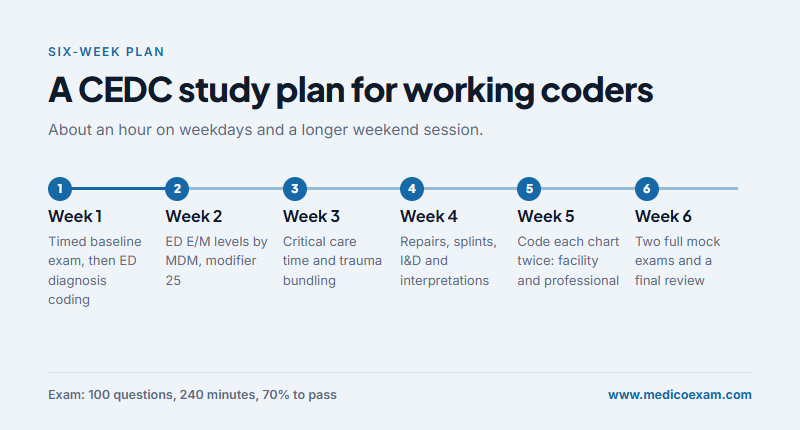
Six weeks is a realistic window for a working coder who already knows the code sets and needs to sharpen ED-specific judgment. Plan on about an hour on weekdays and a longer session at the weekend. Adjust the length, not the order: the order is what matters.
Week 1: baseline and ED diagnosis coding
Take one timed practice exam before you study anything. The score is not a prediction; it is a map. Sort your wrong answers by syllabus area, then spend the rest of the week on ICD-10-CM for emergency conditions: injury coding with seventh characters, symptom versus confirmed diagnosis, and sequencing when a patient arrives with more than one problem.
Week 2: ED E/M levels and modifiers
Work through the ED E/M levels using the medical decision making table until you can level a note without looking anything up. Then add modifiers, starting with modifier 25 and the modifiers that show distinct procedural services. For every practice question, write one sentence explaining why the modifier is or is not appropriate.
Week 3: critical care and trauma
Study the time rules for critical care, what counts toward the time, and what is bundled into it. Read trauma scenarios slowly and list every service in the note before you choose codes, then cross off what is included. This is the week to be strict with yourself about documentation: if the time or the medical necessity is not written down, it does not support the code.
Week 4: procedures and interpretations
Cover wound repair classification and length rules, splinting and casting, foreign body removal, incision and drainage, and burn care. Finish with interpretations of EKGs and imaging, focusing on what the record must show before an interpretation can be reported.
Week 5: facility versus professional coding
Take a set of ED records and code each one twice, once for the physician and once for the facility. Note where the levels differ and why. Add the revenue code, APC and payer-specific questions from the fourth syllabus area, and the compliance points that matter in a busy, multispecialty department.
Week 6: full mock exams and review
Sit two full-length timed mock exams, at least three days apart, in conditions as close to the real exam as you can arrange. Review every wrong answer and every lucky guess. In the last two days, stop learning new material and re-read your notes on the five habits that cost experienced coders marks.
How should you manage 240 minutes on exam day?
Pacing is a skill you can practise, and the CEDC rewards it. With 100 questions in 240 minutes, a steady pace leaves a buffer of around thirty minutes for review if you split the exam into quarters and check the clock at the end of each one. Falling behind in the first quarter is a signal to start flagging long scenarios rather than solving them on the spot.
Read the answer options before you read the whole scenario. The options tell you what the question is really about, whether that is a modifier, the order of diagnoses or the choice between an ED visit and critical care, and you can then read the note looking for the one fact that decides it. Many options differ by a single element, so eliminating the ones that break a rule you know is often faster than proving the right one directly.
Flag and move on when a question would take more than a few minutes. A hard question is worth exactly as much as an easy one, and coming back to it with fresh eyes at the end is more productive than wrestling with it while the clock runs. Before you submit, check every flagged question and make sure none is left unanswered.
What happens after you pass the CEDC exam?
The CEDC is valid for 2 years, and keeping it means meeting AAPC's continuing education requirements within each cycle. AAPC publishes the current number of continuing education units and the rules for specialty credentials on its certification pages, and those rules are worth reading as soon as you pass so that your first cycle does not end in a rush.
The habits that get you through the exam are also the ones that keep a credential useful. Code sets change every year, payer policies for emergency services change more often, and the ED is where a small coding error repeats across thousands of claims. Coders who keep practising scenarios after they pass, and who read the annual code updates with the ED in mind, are the ones a department relies on for its most complex charts.
If you are ready to measure where you stand today, take one timed attempt at a full practice exam and let the result decide which week of the plan you start in.
Frequently Asked Questions
How many questions are on the CEDC exam and how long do you get?
The CEDC exam has 100 questions and a time limit of 240 minutes, which works out to roughly two and a half minutes per question. Most questions are short emergency department scenarios, so reading time, not calculation, is what uses up the clock.
What score do you need to pass the CEDC exam?
You need a score of 70% to pass the AAPC Certified Emergency Department Coder exam. Because the exam has 100 questions, that means answering about 70 correctly, and every question carries the same weight regardless of how difficult the scenario is.
How much does the CEDC exam cost?
As of October 2026, AAPC charges $325 for one attempt at the CEDC exam or $399 for a package with two attempts. The second attempt costs much less than a second full fee, so it suits candidates who are new to emergency department coding or to long proctored exams.
Can I take the CEDC exam online?
Yes. You can sit the CEDC from home with a live remote proctor watching the session, or choose a Meazure Learning test center if you prefer an in-person room. Either way, the exam is purchased from AAPC first and the date is booked afterwards.
How long is the CEDC certification valid?
The CEDC credential is valid for 2 years. To keep it, you meet AAPC's continuing education requirements within each cycle. AAPC lists the current continuing education rules for specialty credentials on its certification pages, so check them soon after you pass.
- AAPC CEDC Question Bank |
- AAPC CEDC Eligibility & Requirements |
- AAPC Emergency Department Coder Practice Test |
- AAPC CEDC Exam Cost |
- AAPC CEDC Registration Process |
- AAPC Emergency Department Coder Study Guide |
- AAPC CEDC Recertification |
- AAPC CEDC Certification Overview |
- AAPC Emergency Department Coder Syllabus |
- AAPC CEDC Preparation Time |
- AAPC CEDC Passing Score |
- AAPC CEDC Exam Format |
- AAPC Emergency Department Coder Sample Questions |
- AAPC CEDC Career Opportunities


