
CMAA Exam: NHA Medical Administrative Assistant Certification Guide
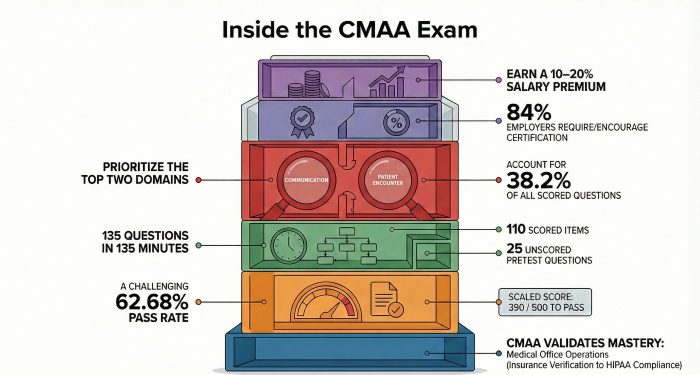
 The NHA Certified Medical Administrative Assistant (CMAA) exam contains 110 scored multiple-choice questions plus 25 unscored pretest items, and candidates have 2 hours and 15 minutes to complete it. The exam fee is $129 (USD), the passing scaled score is 390 out of 500, and the 2024 first-attempt pass rate was 62.68% — making it one of the most challenging NHA certifications. This guide breaks down every domain, walks you through a proven study plan, and answers the most common questions so you can pass the CMAA on your first try.
CMAA Exam at a Glance — Key Facts
|
Detail |
Data |
|---|---|
|
Full Name |
Certified Medical Administrative Assistant |
|
Certifying Body |
National Healthcareer Association (NHA) |
|
Total Questions |
135 (110 scored + 25 unscored pretest) |
|
Time Limit |
2 hours 15 minutes (135 minutes) |
|
Exam Fee |
$129 (USD) |
|
Question Format |
Multiple-choice |
|
Scoring Scale |
200–500 |
|
Passing Score |
390 / 500 |
|
2024 Pass Rate |
62.68% (9,390 candidates tested) |
|
Active Certifications |
17,616 (as of December 31, 2024) |
|
Renewal Cycle |
Every 2 years |
|
CE Credits Required |
10 per renewal cycle (free through NHA) |
|
Testing Options |
School-sponsored, PSI testing center, or live remote proctoring |
Sources:
What Is the NHA CMAA Certification?
The CMAA is a nationally recognized credential awarded by the National Healthcareer Association (NHA) — a certification body founded in 1989 and headquartered in Leawood, Kansas, that has issued over 1 million certifications to date. The CMAA validates that a medical administrative assistant can manage front-desk operations, schedule appointments, handle patient records, verify insurance, process basic billing, and maintain HIPAA compliance in a healthcare setting.
Unlike clinical NHA certifications such as the CCMA (injections, vital signs) or CPCT/A (phlebotomy, EKG), the CMAA focuses entirely on administrative operations. It is accredited by the National Commission for Certifying Agencies (NCCA). According to NHA's 2025 Industry Outlook, 84% of employers require or encourage certification for medical administrative assistants.
Who Is Eligible for the CMAA Exam?
Candidates must meet one of two eligibility pathways to sit for the CMAA exam. Both require a high school diploma or GED (or being scheduled to earn one within 12 months).
Pathway 1 — Education:
-
Complete an NHA-approved medical administrative assistant training or education program within the last 5 years.
Pathway 2 — Work Experience:
-
1 year of supervised work experience in a medical administrative assistant field within the last 3 years; or
-
2 years of supervised work experience in a medical administrative assistant field within the last 5 years.
High school health science students who are scheduled to earn their diploma within 12 months may also be eligible through a specialized certification pathway. Full eligibility details are available in the NHA Candidate Handbook).
What Are the 7 Domains on the CMAA Exam?
The CMAA exam is built on a 2021 job analysis and spans 7 domains. Each domain has a fixed number of scored items, so you know exactly where to focus your study time. The 25 pretest items are distributed across all domains but do not count toward your score.
|
Domain |
Scored Items |
% of Exam |
|---|---|---|
|
1. Foundational Knowledge |
10 |
9.1% |
|
2. Communication and Professionalism |
21 |
19.1% |
|
3. Medical Law, Ethics, and Compliance |
17 |
15.5% |
|
4. Scheduling |
16 |
14.5% |
|
5. Patient Encounter |
21 |
19.1% |
|
6. Billing and Revenue Cycle |
11 |
10.0% |
|
7. Medical Practice Administrative Procedures and Logistics |
14 |
12.7% |
|
Total Scored |
110 |
100% |
Source:
Two domains tie for the highest weight — Communication and Professionalism and Patient Encounter — at 21 items each. Together they account for 38.2% of your scored questions. If you are short on study time, prioritize these two domains first.
What Does Each CMAA Domain Cover?
Domain 1: Foundational Knowledge (10 Items)
-
Medical terminology: spelling, pronunciation, prefixes/roots/suffixes (e.g., hyper-, hypo-, cardi/o, -osis, -pathy). Know The Joint Commission's (TJC) "Do Not Use" abbreviation list.
-
Basic anatomy and physiology: major body systems, anatomical structures, and common diseases/conditions.
-
Healthcare delivery models: outpatient vs. inpatient, PCMH, ACOs, hospice, home health care.
-
EHR/EMR components: demographics, clinical records, medication records, diagnoses, lab reports, orders, and billing data.
Domain 2: Communication and Professionalism (21 Items)
-
Adapting verbal and nonverbal communication for language barriers, pediatric/geriatric patients, and varying health-literacy levels.
-
Conflict resolution and de-escalation strategies for difficult customer service interactions.
-
Professionalism: appearance, hygiene, demeanor, language, and tone.
-
Electronic communications and email etiquette, including EHR messaging templates.
-
Gender identity, expression, and use of pronouns.
Domain 3: Medical Law, Ethics, and Compliance (17 Items)
-
HIPAA: permitted use/disclosure of PHI, penalty tiers (unknowing through willful neglect-uncorrected), data safeguards (passwords, screen savers, mobile device policies).
-
Patient consent: expressed, implied, informed, and waived.
-
OSHA guidelines: Safety Data Sheets (SDS), Needlestick Safety and Prevention Act.
-
Mandatory reporting: child abuse, STDs/STIs, gunshot wounds, communicable diseases.
-
Basic medical law: patient abandonment, malpractice, negligence, Patient's Bill of Rights, fraud vs. abuse.
Domain 4: Scheduling (16 Items)
-
Scheduling methods: time-specified, wave, modified wave, double booking, open booking, and block scheduling.
-
Telehealth: determining appropriateness, platform familiarity, patient instructions.
-
Insurance verification: eligibility, in-network vs. out-of-network, referrals, and preauthorization.
-
Patient portal management: self-scheduling, notifications, pre-appointment screening.
Domain 5: Patient Encounter (21 Items)
-
Check-in: verifying identity (two patient identifiers), collecting demographics and insurance, completing intake forms (assignment of benefits, privacy practices, advance directives).
-
Insurance concepts: copayment vs. coinsurance, deductibles, ABN, EOB, ERA, and code set recognition (ICD-10-CM, CPT, HCPCS — recognition level, not memorization).
-
Check-out: post-visit summaries, follow-up scheduling, and addressing patient questions.
Domain 6: Billing and Revenue Cycle (11 Items)
-
Revenue cycle phases: registration → verification → charge capture → claims → adjudication → payment posting → denial management → appeals.
-
Fee-for-service vs. value-based payment models, charge reconciliation, payment collection.
-
Clearinghouse/claim scrubbing, aging reports, collections, and financial eligibility programs.
Domain 7: Medical Practice Administrative Procedures and Logistics (14 Items)
-
Records management: ensuring records are secure, complete, up-to-date, and signed off.
-
Opening/closing procedures: answering services, messages, equipment, supplies, reception area.
-
Financial procedures: petty cash management and end-of-day reconciliation.
-
Filing systems: alphabetical, color, and terminal digit filing.
-
Computer skills: email, word processing, spreadsheets, copiers, fax machines, scanners.
-
ADAAA compliance and downtime procedures.
How Does the Front-Office Workflow Connect to the CMAA Exam?
Understanding the full front-office workflow is essential because the CMAA exam tests it across multiple domains — particularly Domains 4, 5, 6, and 7. Here is the sequence you need to know:
-
Pre-Visit (Domain 4): Schedule the appointment in the EHR, verify insurance eligibility, send portal confirmations, and conduct pre-appointment screening (symptoms, vaccination status, insurance changes).
-
Check-In (Domain 5): Welcome the patient, verify identity with two patient identifiers, collect/update demographics and insurance, complete intake forms, and collect copayments.
-
During Visit (Domains 2 + 3): Relay communications between patients and providers, ensure HIPAA compliance when handling PHI, and support telehealth technology if applicable.
-
Check-Out (Domains 5 + 6): Provide post-visit summaries, schedule follow-ups, arrange referrals or diagnostic testing, and perform charge reconciliation.
-
End-of-Day (Domain 7): Financial reconciliation, file and secure records, disable answering service, restock supplies, and prepare for the next business day.
What Medical Terminology Do You Need for the CMAA?
Medical terminology appears primarily in Domain 1 but also surfaces throughout the exam when questions reference diagnoses, procedures, or body systems. Focus on these high-yield areas:
|
Category |
Examples |
|---|---|
|
Common Prefixes |
hyper- (excessive), hypo- (below), an- (without), tachy- (fast), brady- (slow), peri- (around) |
|
Common Roots |
cardi/o (heart), gastr/o (stomach), pulmon/o (lung), hepat/o (liver), neur/o (nerve), derm/o (skin) |
|
Common Suffixes |
-osis (condition), -itis (inflammation), -ectomy (surgical removal), -pathy (disease), -scopy (viewing) |
|
Abbreviation Do-Not-Use |
TJC "Do Not Use" list: U (units), IU (international units), Q.D./Q.O.D. (daily/every other day), trailing zeros, MS/MgSO4/MSO4 |
|
Common Office Abbreviations |
Rx (prescription), Dx (diagnosis), Tx (treatment), Hx (history), Sx (symptoms), f/u (follow-up) |
You do not need to memorize anatomy at a clinical depth, but you should know the functions of major body systems and be able to recognize common diseases and conditions referenced in a front-office context (e.g., hypertension, diabetes mellitus, COPD, CHF).
How Does Insurance Verification and Prior Authorization Work on the CMAA?
Insurance verification and prior authorization questions appear in both Domain 4 (Scheduling) and Domain 5 (Patient Encounter). The CMAA tests the following concepts:
Insurance Verification Steps:
-
Collect the patient's insurance card; verify policy number, group number, and subscriber information.
-
Confirm eligibility and active coverage via the payer's portal or phone.
-
Determine in-network vs. out-of-network status.
-
Identify financial responsibilities: copayment, coinsurance, deductible, out-of-pocket maximum.
-
Verify whether a referral or preauthorization is required.
Key Insurance Concepts:
-
Copayment vs. Coinsurance: Copayment = fixed dollar amount (e.g., $25/visit); coinsurance = percentage of allowed amount (e.g., 20% after deductible).
-
Plan types: HMO, PPO, EPO, POS (commercial); Medicare, Medicaid, Medigap, TRICARE (government).
-
Coordination of benefits (COB): birthday rule and dependent rules determine primary/secondary payer.
-
ABN: required for Medicare patients when a service may not meet medical necessity criteria.
-
EOB and ERA: insurer documents detailing payments, adjustments, and denials.
What Is the CMAA Pass Rate, and Why Is It Lower Than Other NHA Exams?
The CMAA had a 62.68% pass rate in 2024, based on 9,390 candidates tested. This is the second-lowest pass rate among all NHA examinations — only the ExCPT (Certified Pharmacy Technician) was lower at 62.22%.
|
NHA Exam |
2024 Pass Rate |
Candidates Tested |
|---|---|---|
|
CCMA |
81.38% |
78,681 |
|
CPT |
75.96% |
57,457 |
|
CBCS |
73.82% |
6,905 |
|
CPCT/A |
73.31% |
17,816 |
|
CET |
69.66% |
19,241 |
|
CEHRS |
68.81% |
1,834 |
|
CMAA |
62.68% |
9,390 |
|
ExCPT |
62.22% |
16,519 |
Source:
The CMAA's lower pass rate reflects the exam's breadth — 7 domains spanning terminology, law, scheduling, insurance, billing, and logistics. Candidates who skip medical terminology, anatomy basics, or insurance concepts often underperform. The pass rate dropped from 69.02% in 2023 to 62.68% in 2024 — a decline of over 6 percentage points.
How Much Does the CMAA Exam Cost, and What About Renewal?
The CMAA exam fee is $129 (USD), making it one of the most affordable NHA certifications (tied with the CBCS). Here is the full cost breakdown:
|
Cost Component |
Amount |
|---|---|
|
Exam fee |
$129 (USD) |
|
NHA study guide + practice test (optional) |
Varies |
|
Renewal fee (every 2 years) |
~$185 (first certification); $60 for each additional NHA certification |
|
CE credits for renewal |
Free through NHA's online CE library |
|
Late reinstatement fee (30 days–1 year past expiration) |
$277.50 renewal + $99 reinstatement = $376.50 |
NHA's continuing education courses are free for current certification holders, and the CE library is available online 24/7. You need 10 CE credits per renewal cycle regardless of how many NHA certifications you hold — 10 credits covers all of them.
Expert Insight: "The CMAA is one of the best return-on-investment certifications in healthcare. At $129 (USD) for the exam and free CE credits for renewal, the total cost over a two-year cycle is remarkably low compared to the salary premium certification provides." — Dr. Meredith Lawson, Healthcare Administration Program Director
How Much Do CMAA-Certified Professionals Earn?
According to the Bureau of Labor Statistics (BLS) May 2023 data, medical secretaries and administrative assistants earn a median annual salary of $40,640 ($19.54/hour). Entry-level professionals at the 10th percentile earn $31,900, while those at the 90th percentile earn $58,340. Total national employment is approximately 749,500.
|
Percentile |
Hourly Wage |
Annual Salary |
|---|---|---|
|
10th (entry-level) |
$15.34 |
$31,900 |
|
50th (median) |
$19.54 |
$40,640 |
|
90th (experienced) |
$28.05 |
$58,340 |
Top-paying states (mean annual wage): Washington ($53,420), California ($51,830), D.C. ($51,490), Massachusetts ($49,360), and Oregon ($48,710). The highest-paying industries include outpatient care centers ($46,930) and hospitals ($44,840).
Certified medical administrative assistants earn 10–20% more than uncertified peers. According to NHA, 93% of employers prefer certified allied health professionals, and 63% would increase pay for employees who earn a new certification.
The BLS projects 12% growth for medical assistants from 2024 to 2034, much faster than average, with approximately 112,300 openings projected each year.
What Is the Best 6-Week Study Plan for the CMAA?
With a 62.68% pass rate, you need a structured study plan. This 6-week plan allocates time proportionally to each domain's weight on the exam. Plan for 8–10 hours of study per week (approximately 50–60 total hours).
|
Week |
Focus Areas |
Key Tasks |
|---|---|---|
|
1 |
Domain 1: Foundational Knowledge |
Learn 50 common prefixes/roots/suffixes; memorize TJC "Do Not Use" list; review body systems and healthcare delivery models; create flashcards |
|
2 |
Domains 2 + 3: Communication, Law, Compliance |
Study communication techniques and de-escalation; deep-dive HIPAA (PHI types, penalty tiers); learn consent types; review OSHA and mandatory reporting |
|
3 |
Domain 4: Scheduling |
Master all scheduling methods (wave, block, double booking); study telehealth procedures; practice insurance verification workflows; learn portal management |
|
4 |
Domain 5: Patient Encounter |
Walk through complete check-in/check-out workflow; study all intake forms; learn copay vs. coinsurance, ABN, EOB, ERA; recognize code sets (ICD-10-CM, CPT, HCPCS) |
|
5 |
Domains 6 + 7: Billing, Revenue Cycle, Office Ops |
Map the full revenue cycle; study payment models; review aging reports and claim scrubbing; master opening/closing procedures, filing systems, and records management |
|
6 |
Full Review + Practice Exams |
Take 2 full-length timed practice exams (135 min each); review missed questions; revisit weak domains and terminology flashcards; rest before exam day |
Pro tip: NHA offers an interactive study guide and official CMAA practice test through your nhanow.com account. You can also use MedicoExam's CMAA practice tests for simulation-based preparation that mirrors the actual exam format.
How Does the CMAA Compare to the CEHRS?
Both the CMAA and the NHA CEHRS (Certified Electronic Health Records Specialist) are administrative NHA certifications, but they serve different roles. Here is a quick comparison:
|
Feature |
CMAA |
CEHRS |
|---|---|---|
|
Focus |
Broad front-office administration |
EHR systems and data management |
|
Scored Questions |
110 |
75 |
|
Pretest Questions |
25 |
25 |
|
Exam Time |
2 hours 15 minutes |
125 minutes |
|
Exam Fee |
$129 (USD) |
$129 |
|
2024 Pass Rate |
62.68% |
68.81% |
|
Active Certifications |
17,616 |
4,131 |
|
Key Skills |
Scheduling, insurance, billing basics, patient communication, HIPAA |
EHR software navigation, data integrity, interoperability, privacy compliance |
|
Best For |
Front-desk and general admin roles |
Health IT, EHR implementation, data management |
If you want a broad, general-purpose administrative credential, choose the CMAA. If you want to specialize in electronic health records and health information technology, choose the CEHRS. Many professionals stack both certifications for maximum versatility — and since NHA only requires 10 CE credits total to renew all your certifications, holding multiple NHA credentials is cost-effective.
For a detailed comparison, see our NHA CMAA vs CEHRS guide.
What Are the Career Paths for CMAA-Certified Professionals?
The CMAA opens doors to roles including medical receptionist, front-desk coordinator, patient services representative, scheduling coordinator, insurance verification specialist, and health information clerk — across physician offices, hospitals, urgent care centers, and specialty practices.
With experience, CMAA holders can advance to medical office manager (earning up to $110,680 per year, per Stepful salary data), practice administrator, or healthcare operations supervisor. Stacking additional NHA certifications — such as the CBCS for billing and coding or the CEHRS for EHR expertise — further expands career options.
How Do You Register and Take the CMAA Exam?
-
Create an NHA account at nhanow.com and submit your CMAA application. Select your organization if school/employer-sponsored.
-
Select date and location — pay the $129 (USD) fee. Choose school-sponsored, PSI testing center, or remote proctoring.
-
Prepare using NHA's study guide, official practice test, or MedicoExam's CMAA practice tests.
-
Take the exam. For remote proctoring: ensure stable internet, clean desk, working webcam/microphone, and quiet room. No notes, scratch paper, or calculators permitted.
-
Get results — posted to your NHA account within 2 business days for online exams.
Frequently Asked Questions (FAQ)
Q1. How many questions are on the CMAA exam?
-
The CMAA exam contains 135 total questions: 110 scored items and 25 unscored pretest items. The pretest questions are embedded throughout the exam and are indistinguishable from scored questions, so treat every question as if it counts.
Q2. What is the passing score for the CMAA?
-
The passing score is 390 on a scaled score range of 200 to 500. NHA uses scaled scoring, which adjusts for question difficulty across different exam forms, ensuring fairness regardless of which version you receive.
Q3. How long is the CMAA exam?
-
You have 2 hours and 15 minutes (135 minutes) to complete all 135 questions. That works out to approximately 1 minute per question, so pace yourself and flag difficult questions for review.
Q4. How much does the CMAA exam cost?
-
The CMAA exam fee is $129 (USD). Optional NHA study materials (interactive study guide and practice test) are available for an additional cost. Check with your school or employer — many sponsor the exam fee.
Q5. What is the CMAA pass rate?
-
The 2024 CMAA pass rate was 62.68%, based on 9,390 candidates tested. This was a notable drop from 69.02% in 2023, making the CMAA one of the more challenging NHA certifications.
Q6. How do I renew my CMAA certification?
-
Complete 10 continuing education (CE) credits within your 2-year certification period and pay the renewal fee (approximately $185 for your first certification, $60 for each additional NHA certification). NHA's CE courses are free for current certification holders through the online CE library.
Q7. Can I take the CMAA exam online?
-
Yes. NHA offers live remote proctoring, allowing you to take the exam from any location with a computer, webcam, microphone, and stable internet connection. You can also test at a PSI testing center or through your school.
Q8. What happens if I fail the CMAA exam?
-
You can retake the CMAA exam after a waiting period. NHA requires payment of the full exam fee $129 (USD) for each attempt. Use your score report to identify weak domains and focus your study efforts there before retaking.
Q9. Is the CMAA the same as the CCMA?
-
No. The CMAA (Certified Medical Administrative Assistant) focuses entirely on front-office and administrative skills. The CCMA (Certified Clinical Medical Assistant) tests both clinical duties (injections, vital signs, specimen collection) and administrative tasks. The CCMA exam has 120 questions (100 scored + 20 pretest), costs $155, and requires a broader clinical skill set.
Q10. Do I need the CMAA to work as a medical administrative assistant?
-
Certification is not legally required in most states, but 84% of employers require or encourage it. Earning the CMAA demonstrates competency, can increase your starting salary by 10–20%, and gives you a competitive edge in the job market.
Start Your CMAA Exam Prep Today
The CMAA exam rewards candidates who prepare systematically across all 7 domains — not just the ones they encounter in daily work. With a 62.68% pass rate, nearly 4 in 10 candidates fail on their first attempt. Do not be one of them.
MedicoExam's simulation-based CMAA practice tests mirror the actual exam format and cover every domain, helping you identify weaknesses before exam day. Combine them with NHA's official study guide and the 6-week plan above, and you will be positioned to pass with confidence.
Explore all NHA certifications on MedicoExam's NHA hub, or visit the MedicoExam homepage to browse practice tests for 50+ healthcare certification exams.
Written by the MedicoExam Content Team — Healthcare Education Specialists
Disclaimer: This guide is for informational purposes only. MedicoExam is not affiliated with or endorsed by the National Healthcareer Association (NHA). Exam content, fees, and policies are subject to change — always verify current information at nhanow.com. This article does not contain exam recalls, leaked questions, or proprietary NHA content.
- NHA CMAA Question Bank |
- NHA CMAA Eligibility & Requirements |
- NHA Medical Administrative Assistant Practice Test |
- NHA CMAA Exam Cost |
- NHA CMAA Registration Process |
- NHA Medical Administrative Assistant Study Guide |
- NHA CMAA Recertification |
- NHA CMAA Certification Overview |
- NHA Medical Administrative Assistant Syllabus |
- NHA CMAA Preparation Time |
- NHA CMAA Passing Score |
- NHA CMAA Exam Format |
- NHA Medical Administrative Assistant Sample Questions |
- NHA CMAA Career Opportunities


