
NHA CBCS vs AAPC CPC: Which Medical Coding Certification Is Better?
 The NHA CBCS and the AAPC CPC serve different career paths in the medical billing and coding field. The CBCS (Certified Billing & Coding Specialist) is an entry-level credential focused on revenue cycle workflows, payer requirements, coding guidelines, and billing and reimbursement fundamentals. Based on the current MedicoExam CBCS syllabus page, the CBCS exam costs $129, runs 180 minutes, and includes 125 total questions (100 scored + 25 pretest). The CPC (Certified Professional Coder) is a physician-office and outpatient coding credential from AAPC that currently costs $425 for one attempt or $499 for two attempts, includes 100 questions, and requires a passing score of 70%.
Choosing between them depends on whether you want a faster entry into billing and revenue cycle work or a coding-focused path with stronger employer recognition for dedicated outpatient coding roles. This guide compares the current CBCS syllabus and the current AAPC CPC exam details so you can choose the credential that best matches your goals.
Key Facts: CBCS vs CPC at a Glance
|
Feature |
||
|---|---|---|
|
Full Name |
Certified Billing & Coding Specialist |
Certified Professional Coder |
|
Issuing Body |
National Healthcareer Association (NHA) |
AAPC |
|
Exam Fee |
$129 |
$425 (1 attempt); $499 (2 attempts) |
|
Student Pricing |
Not listed on the MedicoExam CBCS syllabus page |
$400 (1 attempt); $475 (2 attempts) |
|
Total Questions |
125 (100 scored + 25 pretest) |
100 |
|
Time Limit |
180 minutes |
4 hours |
|
Passing Score |
390 on a 200–500 scale |
70% |
|
Delivery Options |
School testing site, PSI testing center, live remote proctoring |
Live remote proctoring or approved testing location |
|
Open Book |
Follow current NHA handbook/manual rules |
Yes — coding books permitted under AAPC exam rules |
|
Renewal Cycle |
Every 2 years |
Active annual membership + 36 CEUs every 2 years |
|
Career Focus |
Billing, reimbursement, payer workflows, revenue cycle support |
Physician-office and outpatient coding |
What Is the NHA CBCS Certification?
The CBCS (Certified Billing & Coding Specialist) is an NHA credential designed for candidates pursuing billing, coding, and revenue cycle support roles. The current MedicoExam CBCS syllabus aligns the exam to administrative and information management responsibilities such as coding application, claims processing, reimbursement compliance, insurance eligibility review, and billing workflows in settings such as hospitals, physician offices, and insurance companies.
According to the current CBCS syllabus page, the exam blueprint is organized into 4 topic areas:
-
The Revenue Cycle and Regulatory Compliance — 15 questions
-
Insurance Eligibility and Other Payer Requirements — 20 questions
-
Coding and Coding Guidelines — 32 questions
-
Billing and Reimbursement — 33 questions
That weighting matters. Nearly two-thirds of the scored CBCS exam is concentrated in coding/guidelines plus billing/reimbursement, so candidates need more than basic administrative knowledge. They need to understand how coded services move through payer rules into compliant reimbursement workflows.
What Is the AAPC CPC Certification?
The CPC (Certified Professional Coder) is AAPC’s flagship medical coding credential for physician-office and outpatient coding. It validates the ability to assign CPT, ICD-10-CM, and HCPCS Level II codes correctly while applying documentation rules, coding guidelines, compliance standards, and modifier logic in real-world outpatient scenarios.
AAPC’s current CPC exam information states that the exam has 100 questions, a 4-hour time limit, and a required passing score of 70%. AAPC also states that maintaining the credential requires active annual membership and 36 CEUs every two years.
How Do the Exam Formats Differ?
The CBCS and CPC exams measure different levels of specialization.
NHA CBCS Exam Format
The current CBCS syllabus page lists the CBCS exam as:
-
125 total questions
-
100 scored items and 25 pretest items
-
180 minutes
-
Passing score of 390 on a 200–500 scale
-
Delivery through school testing sites, PSI testing centers, or live remote proctoring
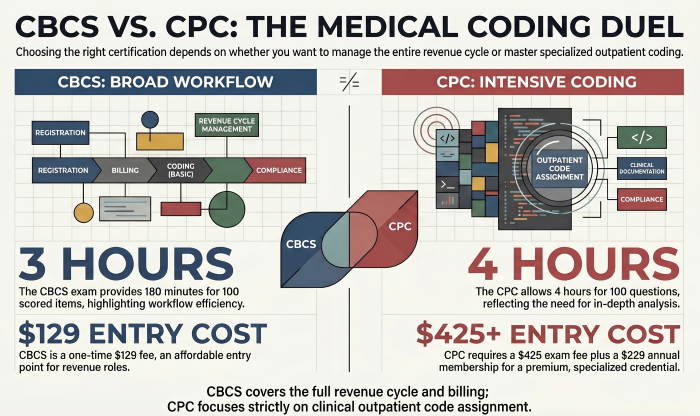
The CBCS is designed to assess broad competency across the revenue cycle, payer rules, coding fundamentals, and reimbursement workflows. It is a strong fit for candidates targeting entry-level billing and revenue cycle roles.
AAPC CPC Exam Format
AAPC’s current CPC exam information states that the CPC exam includes:
-
100 questions
-
4 hours
-
70% passing score
-
Testing online through live remote proctoring or at an approved testing location
AAPC also permits coding references during the exam. Current AAPC support guidance states that handwritten notes are acceptable in printed coding books if they relate to daily coding activities, and tabs are allowed as long as they function as page markers rather than added reference material.
The practical difference is simple: CBCS is broader and more workflow-oriented, while CPC is more coding-intensive and outpatient-focused.
How Much Does Each Certification Cost?
The current pricing gap between these certifications is substantial.
CBCS Cost
The MedicoExam CBCS syllabus page lists the CBCS exam price at $129.
CPC Cost
AAPC’s current support page lists:
-
$425 for 1 attempt
-
$499 for 2 attempts
-
$400 student pricing for 1 attempt
-
$475 student pricing for 2 attempts
In addition, AAPC’s current membership page lists annual membership at $229 for individuals and $164 for students. Since AAPC requires active membership to maintain the CPC, the real ongoing cost of the CPC path is materially higher than the CBCS path.
What Are the Salary Differences Between CBCS and CPC?
The CPC generally supports stronger salary upside because it is more directly tied to dedicated coding roles. The broader labor market benchmark is the U.S. Bureau of Labor Statistics category for medical records specialists, which had a median annual wage of $50,250 in May 2024 and projected 7% employment growth from 2024 to 2034.
In practice, the CBCS is usually the lower-cost entry point into billing and revenue cycle support, while the CPC is typically the stronger long-term credential for outpatient coding roles, specialty coding growth, and remote coding opportunities.
Which Certification Do Employers Prefer?
For billing, reimbursement, front-end revenue cycle, and payer workflow roles, the CBCS can be a practical entry credential because it maps directly to insurance eligibility, reimbursement, and revenue cycle topics on the exam blueprint.
For dedicated coding roles, employer preference usually leans strongly toward the CPC because it is built specifically around physician-office and outpatient coding work. AAPC positions the CPC as its core coding credential, and MedicoExam’s CPC preparation guide frames it as the most widely recognized outpatient coding certification in the U.S.
What Are the Career Paths for Each Certification?
CBCS Career Path
-
Medical billing specialist
-
Claims specialist
-
Insurance verification specialist
-
Revenue cycle support
-
Reimbursement and payment posting roles
CPC Career Path
-
Outpatient medical coder
-
Physician-office coder
-
Professional-fee coder
-
Ambulatory surgery coding roles
-
Remote outpatient coding roles
-
Later progression into auditing, compliance, or specialty coding
How Do Eligibility Requirements Compare?
CBCS Eligibility
-
The current comparison article source text states that CBCS candidates can qualify through either formal training or supervised work experience, while the official NHA CBCS page points candidates to the handbook and FAQ for current requirements and testing manual rules.
CPC Eligibility
-
AAPC does not position prior work experience as a hard prerequisite for sitting the CPC exam, but candidates without sufficient professional experience may hold the apprentice designation until they satisfy AAPC’s experience requirements.
How Do Renewal and Maintenance Requirements Compare?
CBCS Renewal
NHA’s current CBCS page states that certification is renewed every two years and requires:
-
10 CE credits
-
A recertification fee
-
Free NHA CE access for current certification holders
CPC Renewal
AAPC’s current CPC certification information states that maintaining the credential requires:
-
Active annual AAPC membership
-
36 CEUs every two years
This makes the CBCS easier and cheaper to maintain, while the CPC demands a larger long-term financial and continuing education commitment.
Can You Earn Both CBCS and CPC?
Yes. This can be an efficient pathway:
-
Start with CBCS to enter billing and revenue cycle work faster and at lower cost.
-
Build exposure to payer rules, claims, denials, reimbursement, and documentation patterns.
-
Move to CPC when you want coding-specific advancement in outpatient settings.
Which Certification Should You Choose?
Choose CBCS if:
-
You want a lower-cost entry point
-
You want to work in billing, reimbursement, or revenue cycle support
-
You want a certification aligned to payer requirements and billing workflows
-
You plan to build experience first, then move into advanced coding later
Choose CPC if:
-
You want to work specifically as a medical coder
-
You are targeting physician-office or outpatient coding roles
-
You want the stronger coding-focused credential
-
You are willing to invest more in exam cost, membership, and CEUs for better coding career mobility
Choose Both if:
-
You want to enter healthcare administration quickly
-
You want to earn while building toward a coding-centered role
-
You want a staged path from billing into coding
Frequently Asked Questions
1. Is the CBCS easier than the CPC?
-
Usually yes. The CBCS is broader and more workflow-oriented, while the CPC is more coding-intensive and built around outpatient coding judgment, manual navigation, and guideline application.
2. What changed in this updated comparison?
-
The biggest corrections are the CBCS exam structure and pricing. The current CBCS syllabus page lists 125 total questions, 180 minutes, and a $129 fee, which replaces the older 110-question, 110-minute, $117 figures used in the earlier draft.
3. Is the CPC exam open-book?
-
AAPC allows coding references during the exam. AAPC support guidance states that handwritten notes in printed coding books are allowed if they relate to daily coding activities, and tabs are allowed when used only as page markers.
4. Do I need AAPC membership for the CPC?
-
AAPC states that active annual membership is required to maintain the CPC credential. AAPC’s current membership pricing lists $229 for individuals and $164 for students.
5. Which credential is better for someone who wants remote work?
-
The CPC is generally the stronger choice for remote coding roles. The CBCS can support some remote billing and revenue cycle positions, but it is not as strong a coding-specific signal as the CPC.
Start Preparing for Your Medical Coding Certification Today
If you want a faster, lower-cost route into billing and revenue cycle support, the CBCS is the better starting point. If you want the stronger coding-specific credential for physician-office and outpatient roles, the CPC is the better long-term investment. Either way, choosing the right exam is easier when your study plan matches the actual current blueprint and exam rules.
Disclaimer: This article is for informational purposes only. Exam policies, handbook rules, pricing, and eligibility requirements can change. Always verify the latest details directly with NHA and AAPC before registering.
- American Academy of Professional Coders (AAPC) |
- Healthcare Certification Prep |
- Medical Certification Practice |
- AAPC Certification Practice Exams |
- AAPC Test Prep |
- AAPC Sample Questions |
- AAPC Mock Exam |
- NHA CBCS Question Bank |
- NHA CBCS Eligibility & Requirements |
- NHA Billing & Coding Specialist Practice Test |
- NHA CBCS Exam Cost |
- NHA CBCS Registration Process |
- NHA Billing & Coding Specialist Study Guide |
- NHA CBCS Recertification |
- NHA CBCS Certification Overview


