
Evidence-Based PMH-BC: Study Smarter, Not Harder
 The ANCC Psychiatric-Mental Health Nursing Certification (PMH-BC) credential signifies a robust commitment to specialized mental health care, validating a nurse's advanced knowledge and clinical skills. This certification is designed for registered nurses who provide comprehensive psychiatric and mental health services across various settings, impacting patient care significantly. This comprehensive guide outlines the certification's purpose, details the examination structure (PMH-BC exam code), outlines the core syllabus topics, and offers practical, step-by-step strategies for effective preparation to ensure you study smarter, not harder, for your ANCC PMH-BC exam prep. Here, we clarify who should pursue this credential and what essential steps are involved in earning this distinguished recognition.
Validating Psychiatric-Mental Health Expertise
The PMH-BC certification, offered by the American Nurses Credentialing Center (ANCC), is a nationally recognized mark of excellence for registered nurses working in psychiatric-mental health. Earning this credential confirms a nurse's specialized knowledge and clinical competence in areas critical to the care of individuals, families, and communities experiencing mental health challenges. It validates the nurse's ability to assess, diagnose, plan, implement, and evaluate care in complex psychiatric situations, promoting superior patient outcomes and elevating professional standards. This certification contributes significantly to professional identity and demonstrates a dedication to continuous learning and advanced practice within this vital nursing specialty.
Nurses who obtain the PMH-BC credential often find enhanced career opportunities and increased trust from patients and colleagues. It reinforces their role as expert clinicians capable of navigating intricate mental health landscapes. The PMH-BC credential meaning extends beyond personal achievement, signifying a commitment to evidence-based practice and high-quality care delivery in psychiatric-mental health nursing. For more details on the official ANCC certification page, aspiring candidates can consult the official ANCC PMH-BC certification page.
Gauging the ANCC PMH-BC Examination Structure
Understanding the structure and requirements of the ANCC PMH-BC examination is a crucial first step in any effective preparation strategy. The exam is meticulously designed to assess a candidate's mastery of the essential knowledge, skills, and abilities required for advanced psychiatric-mental health nursing practice. Familiarizing yourself with these details helps in tailoring your study plan to the specific demands of the assessment, ensuring focused and efficient learning. This section provides an overview of the key metrics associated with the examination.
Key Examination Metrics
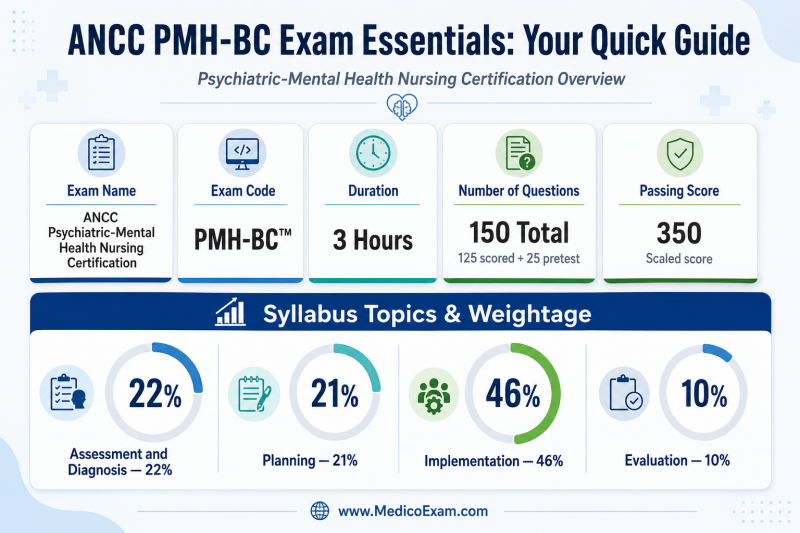
The ANCC Psychiatric-Mental Health Nursing Certification examination (PMH-BC) features a standardized format, ensuring a fair and consistent evaluation for all candidates. Key aspects include:
|
Exam Detail |
PMH-BC Information |
|---|---|
|
Exam Name |
ANCC Psychiatric-Mental Health Nursing Certification |
|
Exam Code |
PMH-BC |
|
Exam Price |
Non-member - $395; Members - $295. These fees are subject to change, so always verify current pricing on the official ANCC site. |
|
Duration |
Candidates are allotted 180 minutes (3 hours) to complete the exam. Effective time management during practice tests is vital. |
|
Number of Questions |
The exam consists of 150 questions. A portion of these may be pretest questions, which do not count towards your score but are indistinguishable from scored items. |
|
Passing Score |
To pass the ANCC Psychiatric-Mental Health Nursing Certification exam, candidates must achieve a scaled score of 350 out of a possible 500. This is not a raw percentage but a statistically adjusted score reflecting consistent competency across domains. |
Acquiring a comprehensive comprehensive PMH-BC preparation guide can significantly aid in navigating these exam specifics and structuring your study efforts.
Mastering the Foundational Knowledge Domains
The ANCC PMH-BC exam content outline is structured around several critical practice domains, each representing a distinct area of psychiatric-mental health nursing. A thorough understanding of these domains and their respective weightages is paramount for effective study planning. Candidates should allocate study time proportionally to the emphasis placed on each area in the examination. This methodical approach ensures comprehensive coverage and enhances readiness for the diverse range of questions.
The PMH-BC exam syllabus covers the following core areas:
|
Content Domain |
Exam Weight |
Focus Area |
|---|---|---|
|
Assessment and Diagnosis |
22% |
This domain focuses on the nurse's ability to conduct thorough psychiatric assessments, interpret findings, and formulate appropriate nursing diagnoses based on clinical data and diagnostic criteria. |
|
Planning |
21% |
Encompasses the development of individualized, patient-centered care plans, including goal setting, intervention selection, and collaboration with interdisciplinary teams. |
|
Implementation |
46% |
The largest domain, emphasizing the practical application of nursing interventions. This includes therapeutic communication, psychopharmacology, crisis intervention, milieu management, and patient education. |
|
Evaluation |
10% |
Focuses on monitoring patient progress, assessing the effectiveness of interventions, and making necessary adjustments to the care plan based on outcomes. |
For a deeper dive into each topic, reviewing the detailed PMH-BC exam content outline provided by ANCC is highly recommended. This document offers specific objectives and examples within each domain, serving as your ultimate roadmap for study.
Confirming Eligibility for PMH-BC Certification
Before embarking on intensive study, confirming your eligibility for the ANCC Psychiatric-Mental Health Nursing Certification is a vital prerequisite. The ANCC sets specific criteria to ensure that all certified nurses possess the necessary educational background and clinical experience to safely and competently practice in psychiatric-mental health. Meeting these requirements ensures that your investment in preparation is well-placed and that you are indeed on the right track toward earning your credential.
ANCC PMH-BC Eligibility Requirements Overview
To be eligible to take the ANCC PMH-BC exam, candidates must typically meet several key requirements:
-
Hold a current, active RN license in a state or territory of the United States or the legal equivalent in another country.
-
Possess a baccalaureate or higher degree in nursing from an accredited program.
-
Have practiced at least two years full-time as a registered nurse.
-
Have accumulated a minimum of 2,000 hours of clinical practice in psychiatric-mental health nursing within the last three years. This clinical practice must include direct patient care.
-
Have completed 30 hours of continuing education in psychiatric-mental health nursing within the last three years. These continuing education hours must be specific to the specialty and obtained through accredited providers.
It's crucial to consult the official ANCC website for the most current and detailed eligibility requirements, as these can sometimes be updated. Ensuring all criteria are met before applying will streamline your certification journey.
Developing an Effective PMH-BC Study Strategy
Preparing for the PMH-BC certification exam requires a structured and consistent approach. Simply studying harder isn't enough; studying smarter involves strategic planning, resource utilization, and self-assessment. A well-thought-out study guide and a disciplined schedule are cornerstones of success for the ANCC PMH-BC exam. This proactive approach helps candidates manage the extensive content effectively, building confidence and competence over time.
Crafting Your Personalized Study Plan
A tailored study plan is crucial for managing the breadth of the PMH-BC syllabus.
-
Assess Your Baseline: Begin with a diagnostic test or self-assessment to identify your strengths and weaknesses across the exam domains. This informs where to focus your efforts.
-
Allocate Time Wisely: Based on the exam content outline, dedicate more time to the "Implementation" domain (46%) and areas where your knowledge is weakest. Break down study sessions into manageable chunks, rather than attempting long, exhaustive periods.
-
Set SMART Goals: Establish Specific, Measurable, Achievable, Relevant, and Time-bound study goals for each week or month. This provides clear targets and motivation.
-
Integrate Diverse Methods: Combine reading textbooks, reviewing notes, watching educational videos, and participating in study groups. Varying your methods can enhance comprehension and retention.
-
Schedule Regular Reviews: Periodically revisit previously studied material to reinforce learning and transfer information from short-term to long-term memory.
Leveraging Quality Study Resources
The right study materials can make a significant difference in your preparation.
-
Official ANCC Resources: The ANCC often provides recommended reading lists, content outlines, and practice exams. These are indispensable as they directly reflect the exam's focus.
-
Textbooks and Reference Books: Utilize current psychiatric-mental health nursing textbooks and pharmacological references. Ensure they align with evidence-based practice and recent guidelines.
-
Online Courses and Review Programs: Many reputable organizations offer comprehensive review courses specifically designed for the ANCC Psychiatric-Mental Health Nursing Certification. These can provide structured learning and expert guidance.
-
Peer Study Groups: Collaborating with other candidates can offer different perspectives, clarify complex concepts, and provide mutual support. Teaching others is also an excellent way to solidify your own understanding.
-
Flashcards and Mnemonics: These tools are effective for memorizing key terms, diagnostic criteria, and pharmacological information.
Remember, the quality of your PMH-BC study materials significantly impacts your preparation quality. Choose resources that are up-to-date, comprehensive, and align with the ANCC's exam objectives.
Enhancing Readiness with Practice Assessments
Engaging with practice questions and mock exams is an indispensable component of successful ANCC PMH-BC exam preparation. It's not just about testing your knowledge; it's about familiarizing yourself with the exam format, question types, and time constraints. Regular practice builds confidence, refines test-taking strategies, and highlights remaining knowledge gaps, allowing for targeted review.
Integrating Practice into Your Routine
To maximize the benefits of practice questions and PMH-BC practice exam simulations:
-
Start Early: Don't wait until the last minute to begin practice testing. Integrate it throughout your study process to track progress and identify areas needing more attention.
-
Simulate Exam Conditions: When taking full-length practice exams, replicate the actual exam environment as closely as possible. This means no distractions, adherence to time limits (180 minutes for 150 questions), and taking it seriously.
-
Analyze Your Answers: Review not only the questions you got wrong but also those you answered correctly. Understand the rationale behind each correct answer and why other options were incorrect. This deep analysis reinforces learning.
-
Focus on Rationales: The "why" behind an answer is often more important than the answer itself. Understanding the clinical reasoning helps in applying knowledge to similar scenarios.
-
Track Progress: Keep a record of your scores and the types of questions you consistently miss. This data helps you refine your study plan and focus on specific content areas.
Utilizing PMH-BC practice questions is key to this process, allowing you to gauge your readiness and build proficiency with the types of questions you'll encounter on exam day.
Unlocking Career Growth with PMH-BC Certification
Achieving the ANCC Psychiatric-Mental Health Nursing Certification (PMH-BC) offers substantial benefits that extend far beyond simply passing an exam. This credential serves as a powerful testament to a nurse's specialized expertise, commitment to excellence, and dedication to advancing the field of mental health. It can significantly impact career trajectories, professional standing, and, ultimately, the quality of patient care delivered.
Professional Recognition and Growth
The PMH-BC certification is widely recognized by employers, healthcare systems, and the public as an indicator of advanced knowledge and skill in psychiatric-mental health nursing.
-
Enhanced Credibility: It sets you apart as a leader in your specialty, increasing your professional credibility and demonstrating a higher level of competence.
-
Career Advancement: Certified nurses often gain access to a broader range of career opportunities, including leadership roles, specialized positions, and academic appointments.
-
Increased Earning Potential: Many healthcare organizations offer salary differentials or bonuses for certified nurses, recognizing the added value they bring to their teams.
-
Peer Respect: Earning the PMH-BC fosters respect among colleagues and interdisciplinary team members, solidifying your position as a valuable resource in complex patient situations.
Commitment to Patient Care Excellence
Beyond individual career benefits, the PMH-BC certification directly contributes to improved patient outcomes and the overall quality of mental health care.
-
Specialized Knowledge: Certified nurses possess a deeper understanding of mental health conditions, evidence-based treatments, and therapeutic interventions, leading to more effective care.
-
Patient Trust: Patients and their families often feel more confident and trusting in the care provided by a certified specialist, knowing they are receiving expertise backed by rigorous standards.
-
Advocacy and Leadership: PMH-BC nurses are better equipped to advocate for their patients, influence healthcare policies, and lead initiatives that improve mental health services.
-
Lifelong Learning: The renewal requirements for the ANCC Psychiatric-Mental Health Nursing Certification encourage continuous professional development, ensuring certified nurses remain current with the latest advancements in the field.
These advantages underscore why the PMH-BC certification is a worthwhile pursuit for dedicated psychiatric-mental health nurses seeking to make a profound impact.
Maintaining Your ANCC PMH-BC Credential
Earning the ANCC PMH-BC certification is a significant accomplishment, but the journey doesn't end there. Maintaining your credential through regular renewal is essential to demonstrate ongoing competency and adherence to professional standards. The ANCC Psychiatric-Mental Health Nursing Certification renewal process is designed to ensure that certified nurses continue to engage in professional development, clinical practice, and activities that enhance their specialized knowledge.
Typically, ANCC certifications are valid for five years. Before the expiration date, certified nurses must complete a combination of professional development activities to qualify for renewal. These activities often include:
-
Continuing education hours specific to psychiatric-mental health nursing.
-
Professional practice hours in the specialty.
-
Participation in professional development activities such as presentations, publications, preceptorship, or academic coursework.
-
Completion of a professional portfolio.
It is crucial to keep meticulous records of all professional development and practice hours throughout your certification period. The ANCC website provides detailed guidelines and forms for renewal, which should be reviewed well in advance of your credential's expiration date. Planning ahead ensures a smooth renewal process and uninterrupted recognition of your specialized expertise.
In conclusion, the ANCC PMH-BC certification is more than just a credential; it is a testament to your expertise and dedication as a psychiatric-mental health nurse. By adopting an evidence-based approach to studying, leveraging quality resources, and consistently practicing, you can confidently prepare for and achieve this significant milestone. This certification not only validates your specialized skills but also opens doors to enhanced career opportunities and contributes meaningfully to the advancement of patient care in mental health.
To maximize your chances of success and gain comprehensive insights into the examination, explore our high-quality sample questions and detailed study resources. Begin your journey toward ANCC PMH-BC certification today and cement your role as a leader in psychiatric-mental health nursing.
Frequently Asked Questions
1. What is the PMH-BC certification?
The PMH-BC (Psychiatric-Mental Health Nursing Certification) is a credential awarded by the ANCC that validates a registered nurse's specialized knowledge and clinical competence in psychiatric-mental health nursing across the lifespan.
2. Who is the ANCC PMH-BC exam for?
The ANCC PMH-BC exam is for registered nurses who have a baccalaureate or higher degree in nursing, possess a current active RN license, and meet specific clinical practice and continuing education requirements in psychiatric-mental health nursing.
3. What is the passing score for the ANCC PMH-BC exam?
Candidates must achieve a scaled score of 350 out of a possible 500 to pass the ANCC PMH-BC examination. This is not a direct percentage but a statistically determined score reflecting proficiency.
4. How long is the ANCC PMH-BC certification valid?
The ANCC PMH-BC certification is typically valid for a period of five years. Certified nurses must complete specific professional development and practice requirements for renewal to maintain their credential.
5. Where can I find reliable study materials for the PMH-BC exam?
Reliable study materials can be found on the official ANCC website, through reputable nursing education providers, current psychiatric-mental health nursing textbooks, and specialized review courses designed for the PMH-BC certification.
- ANCC PMH-BC Question Bank |
- ANCC PMH-BC Eligibility & Requirements |
- ANCC Psychiatric-Mental Health Nursing Practice Test |
- ANCC PMH-BC Exam Cost |
- ANCC PMH-BC Registration Process |
- ANCC Psychiatric-Mental Health Nursing Study Guide |
- ANCC PMH-BC Recertification |
- ANCC PMH-BC Certification Overview |
- ANCC Psychiatric-Mental Health Nursing Syllabus |
- ANCC PMH-BC Preparation Time |
- ANCC PMH-BC Passing Score |
- ANCC PMH-BC Exam Format |
- ANCC Psychiatric-Mental Health Nursing Sample Questions |
- ANCC PMH-BC Career Opportunities


