
Medical Coding Career Path: From Entry-Level CCA to Advanced CCS
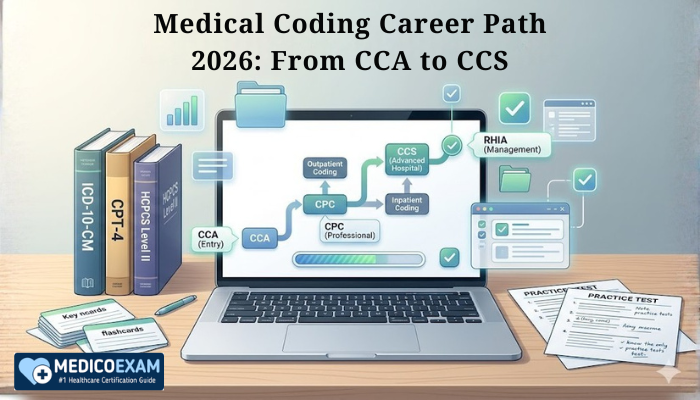 The medical coding profession offers one of the most clearly defined career ladders in all of healthcare. For 2026, the Bureau of Labor Statistics projects employment of health information technologists and medical registrars to grow 15% from 2024 to 2034 — much faster than the national average for all occupations (Bureau of Labor Statistics). The U.S. medical coding market is projected to reach $60.42 billion by 2035 (Nova One Advisor), and certified coders earn approximately 20.7% more than non-certified counterparts.
Whether you are evaluating your first credential or mapping a path to executive leadership, understanding each stage of the medical coding career ladder is the key to maximizing your earning potential and job satisfaction.
Key Facts: Medical Coding Careers 2026
-
Job Growth: 15% projected growth (2024–2034) — much faster than average
-
Annual Openings: Approximately 6,200 new openings projected per year
-
Median Salary (HIT/Medical Registrars): $67,310 per year
-
Remote Work: 60–70% of experienced coding jobs are now fully remote
-
Certification Premium: Certified coders earn ~20.7% more than non-certified peers.
-
Market Size: U.S. medical coding market projected at $60.42 billion by 2035 (Nova One Advisor)
What Does the Medical Coding Career Progression Look Like?
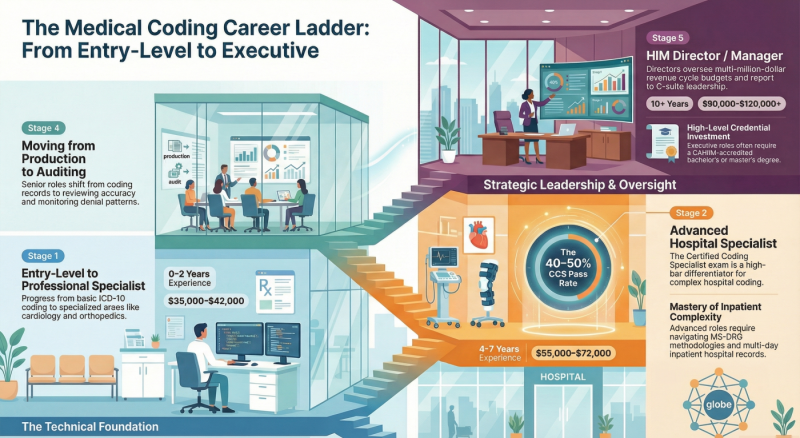
Your career in medical coding is not a single job — it is a clearly staged climb. Each rung brings new responsibilities, higher compensation, and more specialized expertise. The five-stage progression below maps the typical trajectory from first credential to executive leadership.
Stage 1: Entry-Level Coder (0–2 Years Experience)
Annual Salary Range: $35,000–$42,000 Primary Credential: AHIMA CCA (Certified Coding Associate) or AAPC CPC-A (Apprentice)
Your career begins after completing a medical coding training program or associate degree. Entry-level coders typically work in physician offices, small clinics, or outpatient billing departments. Day-to-day responsibilities include reviewing straightforward medical records, verifying provider documentation, and assigning standard ICD-10-CM and CPT codes for routine office visits, minor procedures, and diagnostic tests.
At this stage, the CCA credential from AHIMA is ideal — it validates foundational competency without requiring prior work experience. AAPC candidates who pass the CPC exam without two years of verifiable experience receive the CPC-A (Apprentice) designation, which can be upgraded once the experience requirement is met.
"Every senior coder I know started at the entry level. The CCA gave me instant credibility with employers even though I had zero work experience." — Illustrative quote, entry-level medical coder
Stage 2: Certified Professional Coder (2–5 Years Experience)
Annual Salary Range: $48,000–$62,000 Primary Credential: AAPC CPC (Certified Professional Coder)
After gaining real-world experience, you are ready to earn the industry's gold-standard outpatient credential. The CPC certification from the AAPC is the most widely recognized coding certification in the United States. CPC-certified coders earn between $60,000 and $75,000 on average (Cert Mage).
At this stage, many coders begin to specialize. Cardiology coding, orthopedics, emergency medicine, and surgical specialties each command premium salaries because employers need coders who deeply understand the nuances of specialty-specific documentation and coding guidelines. AAPC offers over 30 specialty credentials (such as CEMC for E/M coding, COSC for orthopedic surgery, and CCVTC for cardiovascular and thoracic surgery) that further differentiate you in the market.
Stage 3: Advanced Hospital Coding Specialist (4–7 Years Experience)
Annual Salary Range: $55,000–$72,000 Primary Credential: AHIMA CCS (Certified Coding Specialist)
The CCS credential is the gold standard for complex hospital inpatient coding. CCS-certified coders earn between $70,000 and $85,000 nationally (Cert Mage). The average annual pay for a CCS coder in Texas, for example, is $58,114, with top earners making over $81,500 (ZipRecruiter).
At this level, you are analyzing detailed hospital records for complex surgical procedures, multi-day inpatient stays, and MS-DRG (Diagnosis-Related Group) reimbursement methodologies. You must master ICD-10-PCS procedure codes, understand root operations (Excision vs. Resection, Replacement vs. Supplement), and navigate highly specific coding guidelines that directly affect hospital revenue.
The CCS exam itself has a notoriously low first-time pass rate — estimated at 40–50% (AMBCI). Earning this credential is a significant career differentiator.
Stage 4: Coding Supervisor / Auditor (5–10 Years Experience)
Annual Salary Range: $65,000–$85,000 Primary Credential: AAPC CPMA (Certified Professional Medical Auditor) or CDEO (Certified Documentation Expert Outpatient)
Supervisors and auditors move beyond chart-level coding into oversight, training, and compliance. Instead of coding records directly, you review the work of other coders for accuracy, train junior staff, monitor denial patterns, and prepare the organization for payer or government audits.
Coding auditors are particularly valued in the age of risk adjustment. Coders who earn the Certified Risk Adjustment Coder (CRC) credential frequently earn between $64,000 and $77,000 (Cert Mage). These roles often offer greater schedule flexibility and stronger remote-work opportunities than traditional production coding jobs.
Stage 5: HIM Director / Revenue Cycle Manager (10+ Years Experience)
Annual Salary Range: $90,000–$120,000+ Primary Credential: AHIMA RHIA (Registered Health Information Administrator)
At the executive level, you oversee entire health information management departments, manage multi-million-dollar revenue cycle budgets, and report directly to C-suite leadership on coding compliance, revenue integrity, CDI, audit outcomes, and EHR operations.
The RHIA requires a bachelor's or master's degree from a CAHIIM-accredited Health Information Management program (University of Wisconsin). It is a significant educational investment, but the career payoff is substantial.
How Much Do Medical Coders Earn at Each Stage?
| Career Stage | Years of Experience | Primary Credential | Average Annual Salary |
|---|---|---|---|
| Entry-Level Coder | 0–2 | CCA or CPC-A | $35,000–$42,000 |
| Certified Professional Coder | 2–5 | CPC | $48,000–$62,000 |
| Hospital Coding Specialist | 4–7 | CCS | $55,000–$72,000 |
| Coding Supervisor / Auditor | 5–10 | CPMA or CRC | $65,000–$85,000 |
| HIM Director / Rev Cycle Manager | 10+ | RHIA | $90,000–$120,000+ |
Sources: Bureau of Labor Statistics, official certification and industry salary references.
Which Certification Should You Get? CCA vs. CPC vs. CCS vs. RHIT vs. RHIA
Navigating the alphabet soup of medical coding credentials can be overwhelming. The table below compares the five major certifications to help you pick the right credential for your current stage.
| Credential | Issuing Body | Focus Area | Exam Cost | Exam Format | Difficulty | First-Time Pass Rate |
|---|---|---|---|---|---|---|
| CCA | AHIMA | Entry-level, all settings | $199–$299 | 105 questions, 2 hours | Moderate | ~74% |
| CPC | AAPC | Outpatient/physician coding | $399–$499 + $222 membership | 100 questions, 4 hours | High | ~50–60% |
| CCS | AHIMA | Complex inpatient hospital coding | $299–$399 | 115–125 questions, 4 hours | Very High | ~40–50% |
| RHIT | AHIMA | Technical HIM data management | ~$229 | 150 questions, 3 hours | Moderate-High | ~78% |
| RHIA | AHIMA | HIM leadership & administration | ~$229 | 150 questions, 3 hours | High | ~71% |
Sources: AHIMA certification information and AAPC certification information.
-
Choose CCA if you are a brand-new graduate with no coding work experience. It proves baseline competency and gets your foot in the door.
-
Choose CPC if your career target is physician-based outpatient coding. This is the most widely requested credential by employers in the ambulatory and professional fee coding space.
-
Choose CCS if you have 2+ years of coding experience and want to move into high-acuity hospital inpatient coding. The CCS unlocks the highest-paying coding specialist roles.
-
Choose RHIT if you are interested in the technical side of health information management — data quality, EHR systems, and coding supervision — and you hold an associate degree from a CAHIIM-accredited program.
-
Choose RHIA if your goal is HIM leadership, department management, or health data strategy. This credential requires a bachelor's degree from an accredited program.
For a detailed head-to-head comparison of the two most popular coding credentials, read our guide: AAPC CPC vs AHIMA CCS.
Where Do Medical Coders Actually Work?
The stereotypical image of coders in hospital basements is long gone. In 2026, the work settings are diverse and increasingly flexible:
-
Remote Work (60–70% of experienced roles): Remote coding is now the dominant work arrangement. Cloud-based EHR systems allow certified coders to review records for a hospital in New York while living in Florida or Texas.
-
Hospital Systems: Large health networks employ teams of CCS-certified coders for inpatient stays, surgeries, and emergency department visits. Hospital coders manage the most complex documentation — MS-DRGs, ICD-10-PCS, and reimbursement-sensitive diagnoses.
-
Physician Offices and Outpatient Clinics: Private practices and specialty clinics rely on CPC-certified coders for professional fee coding. Cardiology, orthopedics, and gastroenterology groups are among the highest-paying specialties.
-
Revenue Cycle Management (RCM) Companies: Third-party RCM firms hire coders on contract or full-time to manage coding, billing, and claims for multiple healthcare clients simultaneously.
-
Consulting Firms: High-level auditors and compliance specialists work for consulting firms that hospitals hire to optimize revenue cycles, prepare for payer audits, and reduce coding denials.
How Can You Maximize Your Medical Coding Salary?
If your goal is to push past $70,000, relying solely on tenure is not enough. The highest earners in medical coding strategically pursue high-demand niches.
Risk Adjustment (HCC) Coding is one of the most lucrative specialties. CRC-certified coders earn between $64,000 and $77,000 annually (Cert Mage). Medicare Advantage plan growth is the primary demand driver here.
Dual certification is a proven salary multiplier. Holding both a CPC and a CCS makes you versatile across outpatient and inpatient settings. Employers pay a premium for coders who can handle any chart type.
Specialty certifications in high-complexity areas — oncology coding, interventional radiology, cardiovascular surgery — command higher pay because fewer coders possess the expertise. As medicine becomes more subspecialized, this premium will continue to grow.
CDI and Analytics skills are increasingly valuable. Coders who combine coding expertise with clinical documentation improvement (CDI) or data analytics capabilities are positioned for the highest-growth career tracks in revenue integrity and healthcare operations.
What Is the Job Market Demand for Medical Coders in 2026?
The data is unambiguous: medical coding demand is strong and growing. According to the Bureau of Labor Statistics, employment of health information technologists and medical registrars is projected to grow 15% through 2034, with about 6,200 openings annually.
Key demand drivers for 2026 and beyond include:
-
Telemedicine expansion: Virtual visits require accurate coding for diagnosis, procedure, encounter type, and modifiers (CodingClarified)
-
AI augmentation (not replacement): AI tools assist with code suggestions but require human coders for complex chart review, auditing, and compliance oversight
-
Value-based care models: The shift from fee-for-service to value-based reimbursement increases the need for precise risk adjustment and quality measure coding
-
Aging population: The 65+ demographic is the fastest-growing segment, creating sustained demand for both inpatient and chronic disease coding
Frequently Asked Questions
Q1. How long does it take to become a medical coder?
- Most medical coding training programs take 4–12 months to complete. After training, you can sit for the CCA or CPC exam immediately. The entire timeline from enrollment to first certification is typically 6–15 months.
Q2. Can I start a medical coding career without a degree?
- Yes. The CCA requires completion of a coding training program or college coursework, but not a formal degree. The CPC requires either a coding program or an associate degree. Many successful coders start with certificate programs.
Q3. Is medical coding a good career in 2026?
- Yes. With 15% projected job growth, strong remote work availability, and a clear salary progression from $35,000 to $120,000+, medical coding remains one of the most accessible and rewarding healthcare careers.
Q4. What is the hardest medical coding certification?
- The AHIMA CCS is widely considered the hardest, with a first-time pass rate of only 40–50%. It tests complex hospital inpatient coding with scenario-based clinical cases.
Q5. Do medical coders work from home?
- Yes. An estimated 60–70% of experienced coding positions are now fully remote. Companies like Humana, Elevance Health, and Franciscan Health regularly hire remote coders (FlexJobs).
Q6. How much do CPC-certified coders make?
- CPC-certified coders earn between $48,000 and $75,000 annually, depending on experience, specialty, and geographic location (Cert Mage).
Q7. Should I get my CCA or CPC first?
- If you have no work experience, start with the CCA. If you have completed a comprehensive coding program and want to focus on outpatient physician coding, the CPC may be the better first choice. For a detailed comparison, see our CCA vs CCS guide.
Ready to Start Your Coding Career Path?
Whether you are aiming for your first CCA or preparing for the rigorous CCS, passing your certification exam is the gatekeeper to this lucrative career path. The most effective way to prepare is by simulating the actual testing environment. Try MedicoExam's simulation-based practice tests to benchmark your readiness, improve your time management, and build the confidence required to pass on your first attempt.
Disclaimer: This article is for informational purposes only. MedicoExam does not provide exam recalls, leaked questions, or proprietary content from any certification body. Always refer to the official AHIMA, AAPC, or credentialing body websites for current exam information.
Written by the MedicoExam Content Team — Healthcare Education Specialists at MedicoExam.com
- AHIMA CCA Question Bank |
- AHIMA CCA Eligibility & Requirements |
- AHIMA Coding Associate Practice Test |
- AHIMA CCA Exam Cost |
- AHIMA CCA Registration Process |
- AHIMA Coding Associate Study Guide |
- AHIMA CCA Recertification |
- AHIMA CCA Certification Overview |
- AHIMA CCS Question Bank |
- AHIMA CCS Eligibility & Requirements |
- AHIMA Coding Specialist Practice Test |
- AHIMA CCS Exam Cost |
- AHIMA CCS Registration Process |
- AHIMA Coding Specialist Study Guide |
- AHIMA CCS Recertification |
- AHIMA CCS Certification Overview


