
AAPC CPC vs AHIMA CCS: Which Medical Coding Certification Should You Get in 2026
 Choose the CPC if you want to code in physician offices and outpatient settings, especially as a newer coder. Choose the CCS if you have hospital inpatient coding experience and want the highest-paying credential in health information management. These two certifications come from different organizations—AAPC and AHIMA and target different healthcare settings. The CPC focuses on CPT-driven physician and outpatient coding, while the CCS validates mastery of ICD-10-PCS and complex hospital inpatient records. Understanding these differences is critical because choosing the wrong credential can delay your career by years.
Key Facts: CPC vs CCS 2026
| Fact | CPC | CCS |
|---|---|---|
| Issuing Organization | AAPC (American Academy of Professional Coders) | AHIMA (American Health Information Management Association) |
| Exam Cost | $425 (one attempt) or $499 (two attempts) + $222 membership | $299 (member) / $399 (non-member) |
| Number of Questions | 100 multiple-choice | 97–115 (multiple-choice + coding scenarios) |
| Time Limit | 4 hours | 4 hours |
| Passing Score | 70% (70 out of 100) | Scaled score of 300 out of 400 |
| First-Time Pass Rate | ~50–60% (estimated) | ~40–50% (estimated) |
| Primary Focus | Physician / Outpatient coding | Hospital Inpatient coding |
| Code Sets Tested | CPT, ICD-10-CM, HCPCS Level II | ICD-10-CM, ICD-10-PCS, CPT, HCPCS |
| Prerequisite Experience | None (apprentice designation without experience) | 1–2+ years recommended |
| Average Salary | $55,000–$67,000/year | $57,500–$85,000/year |
| Open Book | Yes (approved coding manuals) | Yes (approved coding manuals) |
| Renewal | Every 2 years (36 CEUs) | Every 2 years (20 CEUs) |
What Is the AAPC CPC Certification?
The Certified Professional Coder (CPC) credential, issued by the AAPC, is the most widely held medical coding certification in the United States. According to AAPC, over 200,000 professionals carry the CPC designation. The certification validates your ability to assign accurate CPT, ICD-10-CM, and HCPCS Level II codes for physician and outpatient services—including evaluation and management (E/M) visits, surgeries, diagnostic procedures, and medical supplies.
The CPC exam consists of 100 multiple-choice questions administered over a 4-hour time limit. You must score at least 70% (70 correct answers) to pass. The exam is open-book, meaning you can bring approved, current-year editions of the CPT Professional Edition, ICD-10-CM code book, and HCPCS Level II manual. Despite the open-book format, time management is one of the biggest challenges: you have only 2.4 minutes per question, and many surgical coding questions require looking up codes, reading guidelines, and applying modifiers.
The CPC exam costs $425 for a single attempt or $499 for a two-attempt bundle, plus a mandatory $222 annual AAPC membership fee. AAPC does not publish official pass rates, but estimates from training programs and industry surveys suggest a first-time pass rate of approximately 50–60%, with candidates who complete formal training programs passing at 65–75% versus 35–50% for self-study candidates.
A unique aspect of the CPC is the apprentice designation. If you pass the exam without two years of professional coding experience, you receive the CPC-A (Apprentice) credential. The "A" is removed once you submit proof of qualifying work experience or meet alternative education requirements. This makes the CPC accessible to candidates at all experience levels, unlike the CCS which strongly recommends prior experience.
The CPC covers 17 content areas spanning all major medical specialties. The heaviest-weighted sections include Evaluation and Management (14%), ICD-10-CM coding (15%), and Surgery subsections (approximately 25% combined). Mastering the E/M coding guidelines—particularly medical decision-making (MDM) levels—and surgical coding across the integumentary, musculoskeletal, cardiovascular, and digestive subsystems is essential for passing.
What Is the AHIMA CCS Certification?
The Certified Coding Specialist (CCS) credential, issued by AHIMA, is the industry's most respected certification for hospital-based medical coding. It validates mastery-level ability to code complex inpatient medical records, navigate the ICD-10-PCS procedural coding system, assign MS-DRG groupings, and ensure accurate hospital reimbursement. AHIMA recommends that CCS candidates have at least 1–2 years of hands-on coding experience or hold a prior certification such as the CCA or CPC.
The CCS exam costs $299 for AHIMA members and $399 for non-members. The exam consists of 97–115 questions administered over a 4-hour time limit. Unlike the CPC's all-multiple-choice format, the CCS includes scenario-based medical record coding cases where you must read complete or partial hospital records, abstract clinical data, and assign all relevant ICD-10-CM, ICD-10-PCS, CPT, and HCPCS codes with correct sequencing.
The CCS exam is weighted across four domains. Coding Applications (abstracting and assigning codes to full cases) makes up 45–50% of the exam—the heaviest single component. Coding Knowledge (terminology, anatomy, code sets) accounts for 20–25%, while Regulatory Guidelines and Reimbursement Methodologies each account for 10–15%. The emphasis on Coding Applications means that candidates who lack practical experience coding real medical records are at a severe disadvantage.
The first-time pass rate for the CCS is estimated at 40–50%, making it significantly harder than the CPC. The primary difficulty drivers are the ICD-10-PCS coding scenarios, which require building 7-character procedure codes from root operations, body parts, approaches, devices, and qualifiers under timed conditions. Candidates must also demonstrate mastery of DRG logic, clinical documentation interpretation, and coding compliance standards.
The CCS does not require AHIMA membership to take the exam or maintain the credential, though members receive discounted exam fees and continuing education pricing. Renewal requires 20 CEUs every two years.
How Do CPC and CCS Exam Formats Differ?
Both exams are 4 hours long and open-book, but their formats target fundamentally different coding skill sets.
| Format Feature | CPC | CCS |
|---|---|---|
| Question Count | 100 | 97–115 |
| Question Types | All multiple-choice | Multiple-choice + scenario-based coding |
| Time per Question | ~2.4 minutes | ~2.1–2.5 minutes |
| Primary Code Set | CPT (procedure focus) | ICD-10-PCS (procedure focus) |
| Scenario Coding | No | Yes (full medical record cases) |
| Modifier Testing | Extensive (CPT modifiers) | Moderate |
| DRG/Reimbursement | Minimal | Significant (MS-DRG grouping) |
| E/M Coding | Heavy (14% of exam) | Light |
| Clinical Simulations | No | Yes (inpatient records with incomplete documentation) |
| Coding Manual Navigation | Critical (CPT index, guidelines) | Critical (ICD-10-PCS tables) |
The CPC tests your ability to navigate the CPT manual efficiently. You receive clinical vignettes describing patient encounters and must select the correct CPT code(s), ICD-10-CM diagnosis code(s), and applicable modifiers. The emphasis is on outpatient procedures—office visits, outpatient surgeries, radiology, pathology, and medicine services.
The CCS tests your ability to code complete inpatient hospital records. You may receive a full chart including an operative report, discharge summary, laboratory results, and medication lists, and you must assign all principal and secondary diagnoses, all procedures, correct code sequencing, POA indicators, and verify DRG accuracy. This is a fundamentally different cognitive task than selecting answers from four multiple-choice options.
Which Certification Is Harder to Pass?
The CCS is harder than the CPC by virtually every available measure. The CCS first-time pass rate of approximately 40–50% is lower than the CPC's estimated 50–60%.
The difficulty difference comes down to three factors:
1. ICD-10-PCS vs CPT navigation. The CPC tests CPT, which follows a relatively intuitive numerical structure organized by body system and procedure type. The CCS tests ICD-10-PCS, a 7-character alphanumeric system with over 78,000 possible codes that must be constructed character by character using tables. Building ICD-10-PCS codes under time pressure is a skill that takes months of dedicated practice.
2. Scenario coding vs multiple-choice. Multiple-choice questions provide four options, one of which is correct. Scenario-based coding provides no options at all—you must generate the correct codes from scratch by reading and interpreting a medical record. This open-ended format eliminates the possibility of educated guessing.
3. Experience expectations. The CPC is designed to be passable by candidates who have completed a training program but may have no professional experience. The CCS assumes at least 1–2 years of real-world hospital coding competence. Candidates who attempt the CCS without this background account for a large share of the failures.
"Both credentials are valuable and respected — but for new coders, the AAPC CPC offers a smoother entry point, broader outpatient opportunities... Advance to the CCS when you're ready for complex inpatient coding."
How Do CPC and CCS Salaries Compare?
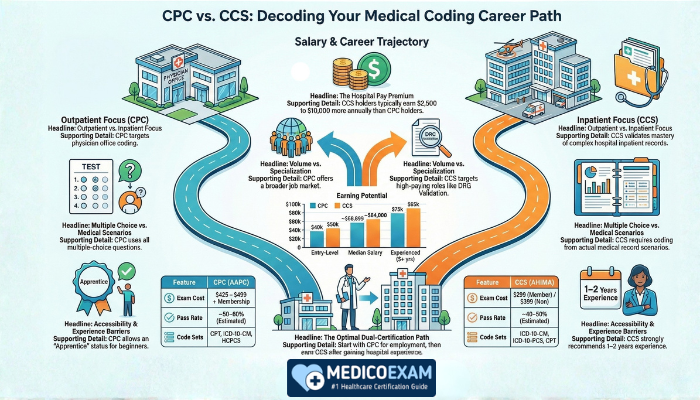
CCS-certified professionals generally earn higher salaries than CPC holders due to the complexity and specialization of hospital inpatient coding. CPC-certified coders earn between $60,000 and $75,000 per year, while CCS-certified coders earn between $70,000 and $85,000. The median salary for CPC holders is approximately $58,895 per year based on the AAPC 2025 Salary Survey. Meanwhile, CCS holders command a median of approximately $64,000.
| Salary Comparison | CPC | CCS |
|---|---|---|
| Entry-Level | $40,000–$50,000 | $50,000–$55,000 |
| Median Salary | $58,895 | ~$64,000 |
| Experienced (5+ years) | $60,000–$75,000 | $70,000–$85,000 |
| Top Earners | $75,000+ (with specialties) | $85,000+ (management/auditing) |
| Salary Premium vs Non-Certified | +20.7% | +25–35% |
According to the U.S. Bureau of Labor Statistics, the median annual salary for medical records and health information specialists overall is $50,250, but certified coders significantly outperform this median. AAPC data shows certified coders earn 20.7% more than non-certified coders, and professionals with three or more certifications average $81,227 per year.
The key salary differentiator is that CCS holders qualify for high-paying specialized hospital roles—DRG validation, clinical documentation improvement liaison, coding auditor, and HIM manager—that are rarely available to CPC-only holders. However, CPC holders who add specialty certifications (CPC-I for instructors, CPMA for auditing, COC for outpatient facility coding) can also reach the $75,000–$85,000 range.
Who Should Choose the CPC?
New coders entering the profession. The CPC has no formal experience requirement (you receive the CPC-A apprentice designation until you gain experience). This makes it the most accessible advanced coding credential available. If you are a recent graduate of a coding program, the CPC is the fastest path to employment.
Physician office and outpatient coders. If you plan to work in private physician practices, multi-specialty clinics, ambulatory surgery centers, or outpatient facilities, the CPC is the industry-standard credential. These settings rely heavily on CPT and E/M coding, which is exactly what the CPC validates.
Billing company professionals. Many third-party medical billing companies require or prefer the CPC for their coding staff. These companies primarily handle outpatient physician billing, making the CPC directly relevant to their daily workflow.
Coders who want the broadest job market. There are significantly more outpatient coding positions than inpatient positions in the United States. AAPC's network of 200,000+ members and employer recognition makes the CPC the most widely requested credential in job postings.
Professionals who want flexible career growth. AAPC offers over 30 specialty credentials that build on the CPC foundation, including Certified Outpatient Coder (COC), Certified Inpatient Coder (CIC), Certified Risk Adjustment Coder (CRC), and Certified Professional Medical Auditor (CPMA). This ecosystem allows you to specialize without switching certification bodies.
Who Should Choose the CCS?
Experienced hospital inpatient coders. If you already work in a hospital HIM department coding inpatient records, the CCS validates the advanced skills you use daily. It is the credential that hospital coding managers respect most and often require for senior positions.
Professionals targeting maximum salary. CCS holders have access to the highest-paying coding roles in the industry, including DRG validation specialist, coding compliance analyst, and HIM director. If salary maximization is your primary goal and you have or are willing to gain hospital experience, the CCS offers the strongest return on investment.
Remote inpatient coding candidates. Remote hospital coding positions—among the most desirable work-from-home jobs in healthcare—overwhelmingly require the CCS credential. Hospitals need assurance that remote coders can independently handle complex inpatient records without on-site supervision, and the CCS provides that assurance.
Candidates pursuing HIM leadership. The CCS is often a stepping stone to RHIT (Registered Health Information Technician) or RHIA (Registered Health Information Administrator) credentials. If your long-term career goal is HIM department management, the CCS demonstrates the advanced coding expertise that forms the foundation for leadership roles.
CDI and auditing professionals. Clinical Documentation Improvement (CDI) specialists and coding auditors frequently hold the CCS because their work requires verifying the accuracy of inpatient coding, DRG assignments, and physician documentation—all competencies validated by the CCS exam.
Should You Get Both CPC and CCS?
Yes—a dual-certification strategy is the highest-earning approach in medical coding. Many top-performing coders hold both credentials, which signals to employers that they can handle coding across all healthcare settings: physician offices, outpatient facilities, and hospital inpatient departments.
The optimal dual-certification path:
Step 1: Start with the CPC. The CPC has no experience prerequisite and offers a broader initial job market. Pass the CPC exam, secure your first coding position, and begin building your CPT and ICD-10-CM skills in an outpatient or physician office setting.
Step 2: Gain inpatient exposure. After 1–2 years, seek opportunities to transition into hospital-based coding or gain exposure to inpatient records through cross-training, continuing education, or a role that straddles both outpatient and inpatient coding.
Step 3: Earn the CCS. With real hospital coding experience under your belt, prepare for and pass the CCS exam. Your CPC foundation in CPT, ICD-10-CM, and coding compliance will transfer directly; you primarily need to master ICD-10-PCS and DRG logic.
Step 4: Command premium compensation. Dual CPC+CCS holders are rare and highly valued. They qualify for any coding position in any setting. Coders with two certifications average $71,130 per year—$8,441 more than single-certification holders and $15,409 more than non-certified coders.
Which Jobs Require CPC vs CCS?
The credential required depends primarily on the healthcare setting and the type of records being coded.
| Job Title | Typical Credential Required | Setting | Salary Range |
|---|---|---|---|
| Medical Coder (Physician Office) | CPC | Outpatient | $45,000–$60,000 |
| Outpatient Surgery Coder | CPC or COC | ASC / Hospital Outpatient | $50,000–$65,000 |
| E/M Coding Specialist | CPC | Multi-specialty clinics | $50,000–$65,000 |
| Inpatient Hospital Coder | CCS | Hospital HIM | $55,000–$75,000 |
| Remote Inpatient Coder | CCS | Remote (hospital contract) | $60,000–$80,000 |
| DRG Validation Specialist | CCS | Hospital | $65,000–$85,000 |
| Coding Auditor | CPC + CPMA or CCS | Hospital or consulting | $65,000–$85,000 |
| Coding Compliance Analyst | CCS or CPC + specialty | Hospital or payer | $60,000–$80,000 |
| CDI Specialist | CCS preferred + CDIP | Hospital | $70,000–$90,000 |
| HIM Manager/Director | CCS + RHIA preferred | Hospital | $80,000–$100,000+ |
In general, if a job posting mentions CPT, E/M coding, or outpatient services, it typically requires the CPC. If it mentions ICD-10-PCS, DRG, inpatient coding, or AHIMA credentials, it requires the CCS. Job postings that list "CPC or CCS" typically involve a mixed coding environment that handles both outpatient and inpatient records.
Frequently Asked Questions
1. Is the CCS harder than the CPC?
-
Yes. The CCS is widely considered more difficult than the CPC due to its scenario-based coding format, advanced ICD-10-PCS requirements, and lower first-time pass rate (approximately 40–50% vs 50–60% for the CPC). The CCS requires coding complete hospital records without multiple-choice options, while the CPC provides four answer choices for every question.
2. Can I take the CCS without taking the CPC first?
-
Yes. The CPC and CCS are issued by different organizations (AAPC and AHIMA, respectively). Neither credential is a prerequisite for the other. However, having CPC experience can provide a strong foundation in CPT and ICD-10-CM that transfers to CCS preparation.
3. Which certification pays more?
-
CCS holders generally earn higher average salaries ($57,500–$85,000) than CPC holders ($55,000–$75,000) because of the complexity of hospital inpatient coding work. However, CPC holders who add specialty certifications can match or exceed CCS salaries, and the CPC provides access to a broader initial job market.
4. Do I have to pay a membership fee for both?
-
AAPC requires an active annual membership ($222) to take the CPC exam and maintain the credential. AHIMA does not require membership to take the CCS or maintain it, though AHIMA members receive a $100 discount on the exam fee ($299 member vs $399 non-member) and reduced pricing on continuing education.
5. What is the CPC-A designation?
-
If you pass the CPC exam but have less than two years of professional coding experience, AAPC awards the CPC-A (Apprentice) designation. The "A" is removed once you submit proof of qualifying experience or complete alternative education requirements. The apprentice designation does not limit your scope of practice but may affect hiring decisions at some employers.
6. Does the CPC test ICD-10-PCS?
-
No. The CPC focuses exclusively on CPT for procedural coding, ICD-10-CM for diagnosis coding, and HCPCS Level II for supplies and durable medical equipment. ICD-10-PCS is tested only on inpatient-focused exams like the AHIMA CCS or the AAPC CIC (Certified Inpatient Coder).
7. Are both exams open-book?
-
Yes. Both the CPC and CCS allow you to bring approved, current-year coding manuals into the testing environment. For the CPC, you need CPT Professional Edition, ICD-10-CM, and HCPCS Level II. For the CCS, you need CPT Professional Edition, ICD-10-CM, and ICD-10-PCS. You may tab, highlight, and write notes directly on the pages of your books.
8. Can I work remotely with these certifications?
-
Yes, both credentials offer remote work opportunities. However, most employers require 1–3 years of on-site experience before approving remote work. The CCS opens doors to more remote positions because remote inpatient coding is one of the highest-demand remote healthcare roles. CPC holders can find remote work in outpatient coding, billing, and auditing.
9. Which credential has a larger job market?
-
The CPC has a larger overall job market because there are more outpatient and physician office coding positions than hospital inpatient coding positions in the United States. AAPC's network of 200,000+ certified professionals and widespread employer recognition make the CPC the most commonly requested credential in medical coding job postings.
10. How long does each exam take?
-
Both the CPC and CCS have a 4-hour time limit. For the CPC, this translates to 2.4 minutes per question across 100 multiple-choice items. For the CCS, the 4 hours must be divided between multiple-choice questions and scenario-based coding cases, requiring careful time allocation: roughly 90 minutes for multiple-choice, 120 minutes for scenarios, and 30–45 minutes for review.
Ready to Prepare for Your Coding Exam?
Whether you are aiming for the outpatient focus of the CPC or the inpatient mastery of the CCS, realistic practice is the key to passing on your first attempt. Try MedicoExam's simulation-based practice tests to master coding manual navigation, practice under timed conditions, and improve your accuracy with detailed answer rationales. MedicoExam offers targeted preparation for both AAPC CPC preparation and AHIMA CCS preparation.
Written by the MedicoExam Content Team — Healthcare Education Specialists at MedicoExam.com
Last Updated: April 2026
Disclaimer: This article is for informational purposes only. MedicoExam does not provide leaked questions, exam recalls, or proprietary content. Always refer to AAPC and AHIMA for the most current examination policies.
- American Academy of Professional Coders (AAPC) |
- Healthcare Certification Prep |
- Medical Certification Practice |
- AAPC Certification Practice Exams |
- AAPC Test Prep |
- AAPC Sample Questions |
- AAPC Mock Exam |
- AHIMA CCS Question Bank |
- AHIMA CCS Eligibility & Requirements |
- AHIMA Coding Specialist Practice Test |
- AHIMA CCS Exam Cost |
- AHIMA CCS Registration Process |
- AHIMA Coding Specialist Study Guide |
- AHIMA CCS Recertification |
- AHIMA CCS Certification Overview


