
NCC C-NPT Exam Guide: Neonatal Pediatric Transport Certification
 The Certified in Neonatal Pediatric Transport (C-NPT) credential from the National Certification Corporation (NCC) validates specialized knowledge for clinicians who stabilize and transport critically ill neonates and children. The exam costs $210, contains 125 multiple-choice questions with 3 answer options each, and must be completed in 2 hours. Endorsed by the Air & Surface Transport Nurses Association (ASTNA), the C-NPT is the only subspecialty certification purpose-built for the multidisciplinary neonatal and pediatric transport workforce — including registered nurses, neonatal nurse practitioners, respiratory therapists, paramedics, physicians, and physician assistants.
Preparing with a structured, scenario-based approach is essential for success. A high-quality C-NPT practice test can help you simulate real exam conditions, strengthen clinical decision-making, and boost confidence before test day.
| Detail | Information |
|---|---|
| Full name | Certified in Neonatal Pediatric Transport |
| Issuing body | National Certification Corporation (NCC) |
| Endorsing organization | Air & Surface Transport Nurses Association (ASTNA) |
| Questions | 125 (100 scored + 25 unscored pretest) |
| Answer choices per question | 3 (1 correct, 2 distractors) |
| Time limit | 2 hours |
| Exam fee | $210 (includes $50 non-refundable application fee) |
| Certification validity | 3 years |
| Renewal requirement | 15 CE contact hours + $50 fee |
| Testing format | PSI test centers or Live Remote Proctoring (LRP) |
What Is the C-NPT Certification?
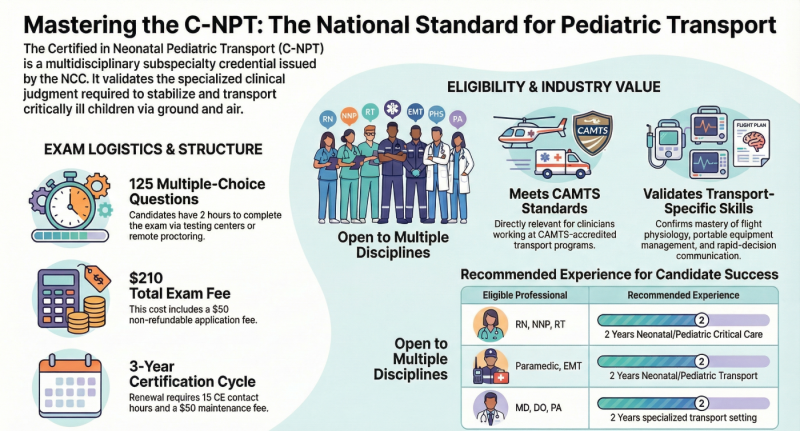
The C-NPT is a subspecialty certification that tests the knowledge and clinical judgment needed to care for critically ill neonatal and pediatric patients during interfacility ground and air transport. It is offered by the NCC, an NCCA-accredited credentialing body headquartered in Chicago, IL, that has certified over 250,000 healthcare professionals since 1975.
Approximately 68,000 critically ill neonates require interfacility transport each year in the United States alone, according to research published in the Journal of Pediatrics: Clinical Practice. These transports demand a unique skill set — one that blends critical-care expertise with an understanding of flight physiology, portable equipment management, and rapid-decision communication. The C-NPT credential confirms that a professional has mastered these competencies.
The certification meets requirements outlined in the Commission on Accreditation of Medical Transport Systems (CAMTS) Twelfth Edition Standards, making it directly relevant for clinicians working at CAMTS-accredited programs. CAMTS processes 60 to 65 neonatal pediatric transport applications annually, and transport teams often use C-NPT certification as one benchmark of clinical preparedness.
Who Is Eligible for the C-NPT Exam?
Eligibility is open to any licensed healthcare professional in the United States or Canada who provides stabilization and transport interventions to critically ill neonatal and pediatric patients. You need a current, active, and unencumbered license in one of the following eligible disciplines:
-
Registered Nurse (RN)
-
Neonatal Nurse Practitioner (NNP)
-
Respiratory Therapist (RT)
-
Paramedic or EMT/AEMT
-
Physician (MD/DO)
-
Physician Assistant (PA)
No minimum practice hours are formally required. However, the NCC candidate guide recommends at least 2 years of experience in neonatal or pediatric critical care and transport settings for the best chance of success. About 98% of civilian neonatal transports in the U.S. are performed by specialized teams, so real-world exposure to transport workflows can significantly strengthen readiness.
Unlike NCC's core RN certifications such as the RNC-OB or RNC-NIC, which require documented specialty practice hours, the C-NPT's multidisciplinary scope keeps the formal threshold low to accommodate the wide range of professional backgrounds on transport teams.
What Does the C-NPT Exam Cover?
The exam blueprint divides content into three weighted domains. Transport Core Knowledge dominates at 48% of scored questions, with the remaining 52% split evenly between neonatal-specific and pediatric-specific clinical scenarios. The full breakdown is below:
C-NPT Exam Content Outline
| Domain | Weight | Topics |
|---|---|---|
| Transport Core Knowledge | 48% | Regulation, legal and ethical issues; safety, communication, and environment; procedures and management of invasive devices; pharmacology; respiratory physiology; principles of mechanical ventilation; flight physiology; trauma/burns; resuscitation and stabilization |
| Neonatal Specific Knowledge | 26% | Development, anatomy and physiology; diseases and management of disease states; medications; procedures |
| Pediatric Specific Knowledge | 26% | Development, anatomy and physiology; diseases and management of disease states; medications; procedures |
The NCC lists 12 associated competencies that underpin these domains. Key competencies include identifying life-threatening states and initiating appropriate interventions, understanding the impact of transport physiology on both patients and crew members, and using equipment safely in the constrained transport environment.
Flight Physiology — A Core Knowledge Area
Transport-specific content like flight physiology sets the C-NPT apart from bedside-only certifications. Candidates must understand gas laws — Boyle's, Charles's, and Dalton's — and how altitude affects fluid dynamics, oxygen consumption, and spatial orientation. This knowledge is especially important for air transport clinicians who must anticipate changes in ventilator pressures, pneumothorax expansion risk, and medication delivery.
How Is the C-NPT Exam Structured?
The C-NPT contains 125 multiple-choice questions: 100 scored items and 25 unscored pretest items embedded randomly throughout the exam. You cannot distinguish pretest items from scored items, so you must answer every question. The time limit is 2 hours.
Each question has a stem followed by 3 answer options — 1 correct answer and 2 distractors — alphabetized by their first word. This 3-option format is standard across all NCC examinations and differs from the 4-option format used by most other nursing certification boards.
Scoring uses Item Response Theory (IRT) on a criterion-referenced, pass/fail model. NCC does not report a numeric score. Instead, candidates receive a pass or fail decision along with performance descriptors — Very Weak, Weak, Average, Strong, or Very Strong — for each content area.
How Do You Register for the C-NPT?
Registration is completed online at NCC official website. NCC does not accept applications by mail, fax, or email. Here is the step-by-step process:
-
Confirm eligibility — Verify that you hold a current, active, unencumbered license in a qualifying discipline.
-
Submit online application — Upload proof of licensure and complete the application agreement.
-
Pay the $210 exam fee — Accepted methods include Visa, MasterCard, American Express, and e-check (U.S. funds only). The fee includes a $50 non-refundable application fee.
-
Receive eligibility letter — Processing takes up to 2 weeks. Your eligibility letter provides instructions for scheduling.
-
Schedule within 30 days — You must book your exam appointment within the first 30 days of your 90-day eligibility window. Failure to schedule within 30 days may prevent you from testing within your window and require a $125 change fee.
-
Test at a PSI center or via LRP — Choose a PSI testing center or test from home/office using Live Remote Proctoring. If using LRP, test your computer setup before scheduling.
Key Fee Summary
| Fee | Amount |
|---|---|
| Exam fee (Test Center or LRP) | $210 |
| Non-refundable application fee (included) | $50 |
| Change request | $125 |
| Withdrawal refund | $105 back |
| Retest fee | $210 (full fee) |
| Incomplete application reprocessing | $30 |
What Is the C-NPT Retest Policy?
Candidates who do not pass must wait 45 days before retesting. A new application and the full $210 fee are required for each retest attempt. NCC allows a maximum of 2 attempts per calendar year for the same specialty exam. There is no lifetime limit on the number of attempts across different years.
If you experience an internet disconnection during Live Remote Proctoring that lasts fewer than 15 minutes and affects fewer than 10% of questions, you may be allowed to reschedule. Disconnections exceeding those thresholds require a 45-day wait and a new application.
How Do You Maintain C-NPT Certification?
C-NPT certification is valid for 3 years from the date of your score report. To renew, you must complete 15 continuing education (CE) contact hours in neonatal pediatric transport topics and submit a recertification application with a $50 renewal fee.
You may submit your renewal application up to 12 months early. NCC conducts random audits, so you should retain certificates that document the title, contact hours, provider, and learning objectives for every CE activity. Failure to renew before the deadline can result in lapse and reinstatement fees.
Compared to NCC's core certifications — such as the RNC-OB or RNC-MNN — which require 45 CE hours for renewal, the C-NPT's 15-hour requirement reflects its subspecialty status. Other NCC subspecialty credentials like the C-EFM, C-ELBW, and C-ONQS follow the same 15-hour renewal pattern.
How Should You Study for the C-NPT Exam?
A focused study plan should allocate roughly half of your preparation time to Transport Core Knowledge (48% of the exam) and split the remaining time between neonatal and pediatric clinical domains. The NCC candidate guide lists recommended resources and emphasizes broad transport competency rather than narrow bedside expertise.
Recommended Textbooks
-
Guidelines for Air and Ground Transport of Neonatal and Pediatric Patients — AAP (the go-to transport textbook)
-
Field Guide for Air and Ground Transport of Pediatric and Neonatal Patients — AAP, 2019
-
ASTNA Patient Transport Principles and Practices — Holleran et al., Mosby Elsevier, 2024
-
Handbook of Neonatal Intensive Care: An Interprofessional Approach — Gardner et al., Elsevier, 2021
-
Textbook of Neonatal Resuscitation — AHA/AAP, 2021
-
Neonatal and Pediatric Respiratory Care, 6th ed. — Walsh et al., Elsevier, 2022
Recommended Journals
-
Air Medical Journal
-
Advances in Neonatal Care
-
Pediatrics
-
Clinics in Perinatology
-
The Journal of Perinatal & Neonatal Nursing
Study Strategy Tips
-
Start with the blueprint. Map each subtopic to a study resource. Flight physiology, pharmacology, and mechanical ventilation appear in the largest domain and are commonly reported as high-yield.
-
Use practice questions. Simulation-based practice builds familiarity with the 3-option NCC format. MedicoExam's C-NPT practice tests mirror real exam conditions.
-
Review NRP and PALS. The Resuscitation and Stabilization section requires current knowledge of both algorithms — these are non-negotiable.
-
Cover surgical emergencies. Diaphragmatic hernia, gastroschisis, omphalocele, NEC, and TEF appear frequently in the neonatal domain.
-
Study trauma management. The pediatric domain includes accidental and non-accidental trauma, burns, submersion injuries, and toxic exposures — content areas less familiar to NICU-trained nurses.
Expert Insight: "The biggest challenge for many C-NPT candidates is the breadth of the exam. You're expected to handle a micro-preemie on a ventilator, a toddler in DKA, and a school-age trauma patient — sometimes on the same shift. Building a blueprint-based study plan keeps the content manageable."
How Does the C-NPT Compare to Other Transport Certifications?
The C-NPT occupies a unique niche among transport certifications. Here is how it compares to related credentials:
| Feature | C-NPT (NCC) | CFRN (BCEN) | CTRN (BCEN) |
|---|---|---|---|
| Focus | Neonatal & pediatric transport | Flight nursing (all ages) | Ground transport nursing (all ages) |
| Eligible disciplines | RN, NNP, RT, paramedic, MD, PA | RN only | RN only |
| Population | Neonatal and pediatric | All age groups | All age groups |
| Format | 125 Qs, 3 options, 2 hrs | 150 Qs, 4 options, 3 hrs | 150 Qs, 4 options, 3 hrs |
| Issuer | NCC | BCEN | BCEN |
The C-NPT's multidisciplinary eligibility — open to six different professional disciplines — makes it the most accessible transport certification. It is also the only certification that focuses exclusively on the neonatal and pediatric population during transport.
Why Does C-NPT Certification Matter for Your Career?
The C-NPT signals verified expertise in a high-stakes subspecialty. Research in the Journal of Pediatrics: Clinical Practice found that specialist neonatal transport teams had significantly fewer adverse clinical events (57%) compared to non-specialist teams (64%), with an adjusted odds ratio of 0.67 for severe deterioration or death. Certification alone does not create better outcomes, but it aligns with the specialized team model associated with safer transport.
From a practical standpoint, some transport programs require C-NPT certification at hire or within a defined period after onboarding. CAMTS-accredited programs increasingly value transport-specific advanced certifications for their RN staff. The credential can also strengthen promotion potential for clinicians who want to move into educator, team lead, or program coordinator roles.
Frequently Asked Questions
1. How many questions are on the C-NPT exam?
-
The C-NPT exam contains 125 total questions — 100 scored items and 25 unscored pretest items. Pretest questions are embedded randomly and do not count toward your pass/fail result.
2. How much does the C-NPT exam cost?
-
The C-NPT exam costs $210, which includes a $50 non-refundable application fee. The renewal fee is $50 every 3 years.
3. What is the pass rate for the C-NPT exam?
-
NCC does not publicly release pass rates for individual subspecialty exams. The exam uses criterion-referenced scoring with Item Response Theory (IRT), and results are reported as pass or fail with content-area performance descriptors.
4. Can paramedics and respiratory therapists take the C-NPT?
-
Yes. The C-NPT is multidisciplinary. Eligible professionals include registered nurses, neonatal nurse practitioners, respiratory therapists, paramedics, EMTs/AEMTs, physicians, and physician assistants — all with current U.S. or Canadian licensure.
5. How long is C-NPT certification valid?
-
C-NPT certification is valid for 3 years from the score report date. Renewal requires 15 CE contact hours in neonatal pediatric transport topics and a $50 fee.
6. Is clinical experience required for the C-NPT?
-
No minimum practice hours are formally required. However, NCC recommends at least 2 years of experience in neonatal or pediatric critical care and transport for the best chance of passing.
7. Can I take the C-NPT exam from home?
-
Yes. NCC offers Live Remote Proctoring (LRP), which allows you to test from home, your office, or any private location using your own computer. You must test your computer setup before scheduling.
8. What happens if I fail the C-NPT exam?
-
You must wait 45 days, submit a new application, and pay the full $210 fee. NCC allows a maximum of 2 attempts per calendar year for the same exam.
9. Does the C-NPT meet CAMTS requirements?
-
Yes. The C-NPT meets requirements outlined in the CAMTS Twelfth Edition Standards, making it directly relevant for clinicians at CAMTS-accredited transport programs.
10. How is the C-NPT different from the C-EFM or C-ELBW?
-
The C-EFM focuses on electronic fetal monitoring interpretation, while the C-ELBW focuses on care of extremely low birth weight neonates (<1,000 g). The C-NPT is the only NCC subspecialty credential centered on the transport environment and covers both neonatal and pediatric patients during interfacility transfer.
Start Preparing for the C-NPT Today
Passing the C-NPT requires targeted preparation across transport core knowledge, neonatal clinical issues, and pediatric clinical issues. MedicoExam's C-NPT practice tests use the 3-option NCC format and mirror real exam conditions — helping you identify weak areas before test day.
Disclaimer: This article is for informational purposes only. It does not contain actual exam questions, proprietary content, or leaked material. Always refer to the NCC official website and the current candidate guide for the most up-to-date policies.
Written by the MedicoExam Content Team — Healthcare Education Specialists at MedicoExam.com.
- NCC Neonatal Pediatric Transport Practice Test |
- NCC C-NPT Study Guide |
- NCC C-NPT Question Bank |
- NCC C-NPT Eligibility & Requirements |
- NCC C-NPT Exam Cost |
- NCC C-NPT Registration Process |
- NCC Neonatal Pediatric Transport Study Guide |
- NCC C-NPT Recertification |
- NCC C-NPT Certification Overview |
- NCC Neonatal Pediatric Transport Syllabus |
- NCC C-NPT Preparation Time |
- NCC C-NPT Passing Score |
- NCC C-NPT Exam Format |
- NCC Neonatal Pediatric Transport Sample Questions |
- NCC C-NPT Career Opportunities |
- NCC C-NPT Exam Difficulty


