
NCC RNC-LRN Exam Guide and FAQ: Low Risk Neonatal Nursing Certification
The RNC-LRN (Registered Nurse Certified in Low Risk Neonatal Nursing) is a core certification offered by the National Certification Corporation (NCC) for nurses caring for newborns in Level II nurseries, special care units, and step-down settings. The exam contains 175 multiple-choice questions (150 scored, 25 pretest), runs 3 hours, and costs $325. To qualify, you need an active RN license, 2 years of specialty experience, and at least 2,000 hours of low-risk neonatal care. As of 2024, there are 3,229 active RNC-LRN certificants in the United States and Canada — making it one of NCC's smaller but steadily growing credentials.
RNC-LRN Key Facts at a Glance
| Detail | Information |
|---|---|
| Full Name | Registered Nurse Certified in Low Risk Neonatal Intensive Care Nursing |
| Certifying Body | National Certification Corporation (NCC) |
| Accreditation | NCCA (National Commission for Certifying Agencies) |
| Questions | 175 total (150 scored + 25 unscored pretest) |
| Time Limit | 3 hours |
| Question Format | Multiple-choice, 3 answer options per item |
| Exam Fee | $325 (includes $50 non-refundable application fee) |
| Testing Options | PSI testing center or Live Remote Proctoring (LRP) |
| Certification Validity | 3 years |
| 2024 Pass Rate | 67% (377 candidates tested) |
| Total Active Certificants | 3,229 (as of 2024) |
What Is the RNC-LRN Certification?
The RNC-LRN is a competency-based credential that validates specialty knowledge for registered nurses who provide care to acutely and chronically ill neonatal patients and their families within Level II, chronic care, special care, or step-down units. Unlike the RNC-NIC (Neonatal Intensive Care) credential designed for Level III and IV NICU nurses, the RNC-LRN focuses on the care of low-risk and moderately ill newborns who do not require the most advanced interventions.
According to NCC's candidate guide, the examination emphasizes the newborn (birth to one month) and family components. Content covers assessment of all body systems and knowledge of normal findings versus deviations from normal. This makes the RNC-LRN the ideal certification for nurses working in well-baby nurseries, transitional care nurseries, and Level II special care settings where neonates are generally stable but may need additional monitoring, phototherapy, or gavage feedings.
NCC has certified more than 250,000 professionals since its founding in 1975, and all NCC certification programs are accredited by the NCCA (National Commission for Certifying Agencies), a division of the Institute for Credentialing Excellence.
Who Is Eligible for the RNC-LRN Exam?
All candidates must meet three eligibility criteria at the time of application, as outlined in the NCC Core RNC Registration Catalog:
-
Active RN License: Current, active, unencumbered licensure as a registered nurse in the United States or Canada. You must upload your license or a verification printout showing your name, license number, state or province, license type, and expiration date.
-
Two Years of Specialty Experience: A minimum of 24 months of practice as an RN in low-risk neonatal nursing, comprising at least 2,000 hours of practice time. Both the time requirement and the hours requirement must be met — this is not an either/or criterion.
-
Recent Employment: Employment in the low-risk neonatal specialty must have occurred at least sometime within the last 24 months. Your employment history for the past 5 years, including titles, specialty areas, and supervisor contacts, must be documented.
NCC uses Benner's novice-to-expert model as the basis for its two-year requirement, recognizing that competence — the third stage of skill development — is typically reached at two to three years of practice. Experience can include direct patient care, education, administrative work, or research in the specialty area.
What Does the RNC-LRN Exam Cover?
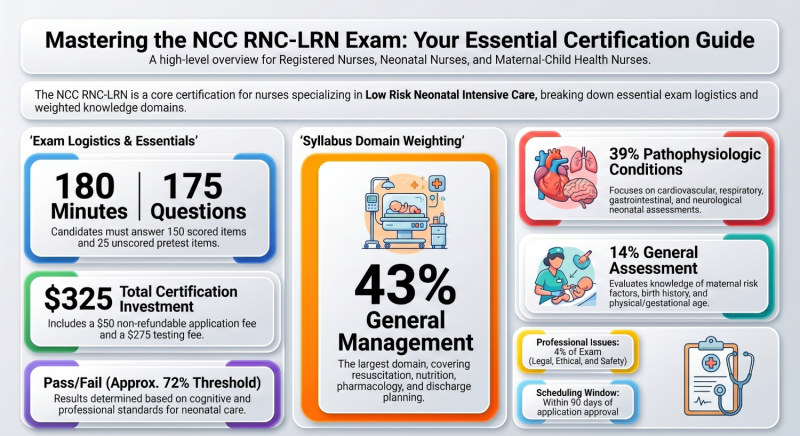
The RNC-LRN candidate guide organizes the exam into four content domains with the following percentage weights:
| Content Domain | % of Exam | Approximate Scored Items |
|---|---|---|
| General Assessment | 14% | ~23 questions |
| Assessment & Management of Pathophysiologic Conditions | 39% | ~56 questions |
| General Management | 43% | ~68 questions |
| Professional Issues | 4% | ~5 questions |
Domain 1: General Assessment (14%)
This domain tests your ability to gather and interpret foundational patient data. Topics include:
-
Maternal risk factors and birth history
-
Physical and gestational age assessment (Ballard scoring, for example)
-
Laboratory and diagnostic data interpretation
Domain 2: Assessment and Management of Pathophysiologic Conditions (39%)
The second-largest domain covers recognition and management of deviations from normal across body systems:
-
Cardiovascular — Adaptation to extrauterine life, patent ductus arteriosus, septal defects, coarctation of the aorta, abnormal rhythms
-
Respiratory — Respiratory distress syndrome, transient tachypnea of the newborn, meconium aspiration
-
Gastrointestinal and Genitourinary — Feeding intolerance, NEC screening, renal anomalies
-
Musculoskeletal and Integumentary — Birthmarks, fractures, hip dysplasia
-
Neurological — Seizures, hypoxic-ischemic events, tone abnormalities
-
Hematology and Hyperbilirubinemia — Jaundice management, phototherapy thresholds, Rh/ABO incompatibility
-
Genetic, Metabolic, and Endocrine — Newborn screening results, inborn errors of metabolism, thyroid disorders
Domain 3: General Management (43%)
The largest domain focuses on the hands-on care and management skills that define daily practice:
-
Resuscitation and Stabilization — NRP principles, initial stabilization
-
Nutrition and Feeding — Breastfeeding support, formula selection, gavage feeding
-
Pharmacology, Pharmacokinetics, and Pharmacodynamics — Common neonatal medications, dosing considerations
-
Fluid, Electrolytes, and Glucose Homeostasis — IV fluid management, hypoglycemia protocols
-
Oxygenation, Non-invasive Ventilation, and Acid-Base Balance — Nasal CPAP, pulse oximetry targets, ABG interpretation
-
Thermoregulation — Neutral thermal environment, skin-to-skin care
-
Neurodevelopmental Care — Developmental positioning, NIDCAP principles, sensory protection
-
Infection and Immunology — Sepsis workup, antibiotic stewardship, hepatitis B vaccination
-
Psychosocial Support, Grieving, Family Education, and Discharge Planning — Parent education, car seat testing, safe sleep counseling
Domain 4: Professional Issues (4%)
Although small, this domain is testable content that should not be overlooked:
-
Legal considerations in neonatal care
-
Ethical principles and decision-making
-
Patient safety and quality improvement initiatives
-
Evidence-based practice
How Is the RNC-LRN Exam Structured and Scored?
The RNC-LRN exam consists of 175 multiple-choice questions. Of these, 150 are scored and 25 are unscored pretest items embedded throughout the exam — you will not know which questions are pretest items. Each question has a stem (the question) and three answer options: one correct answer and two distractors. Answer options are alphabetized by their first word to randomize placement, and each candidate receives the exam in a different random order.
NCC examinations are criterion-referenced, meaning the passing standard is based on a predetermined ability criterion rather than a curved percentage. According to NCC's scoring methodology, Item Response Theory (Rasch Analysis) is used to calculate each candidate's ability level based on the number of correct answers. There is no penalty for wrong answers, so you should answer every question. There is no fixed passing percentage — the pass/fail cutoff is established by the NCC Board of Directors using the modified Angoff method, where content experts evaluate each item's criticality.
Your test report will indicate pass or fail status and provide word descriptors (very weak, weak, average, strong, very strong) for each content area. No numeric scores or percentages are given. If you believe there is a discrepancy, you can request a hand score within 60 days for a fee of $55.
What Are the RNC-LRN Pass Rates?
The NCC statistics page publishes five years of exam data. Here are the most recent figures for the RNC-LRN:
| Year | Candidates Tested | Pass Rate |
|---|---|---|
| 2020 | 230 | 82% |
| 2021 | 185 | 70% |
| 2022 | 248 | 76% |
| 2023 | 169 | 79% |
| 2024 | 377 | 67% |
The five-year average pass rate is approximately 75%. The 2024 cycle saw a notable jump in volume — 377 candidates, roughly double the 2023 cohort — but the pass rate dipped to 67%, the lowest in the five-year window. By comparison, the RNC-NIC pass rate in 2024 was 76% with 2,470 candidates, while RNC-MNN posted a 90% pass rate with 1,696 candidates. These numbers suggest the RNC-LRN, despite covering "low-risk" content, is by no means an easy exam.
Expert Insight: "Nurses sometimes assume that because the RNC-LRN covers low-risk neonates, it will be easier than the RNC-NIC. That's a misconception. You still need strong assessment skills and a deep understanding of when a neonate is transitioning from low-risk to high-risk — that clinical judgment is exactly what the exam tests." — Sarah M., MSN, RNC-LRN, Neonatal Clinical Educator
How Does the RNC-LRN Compare to the RNC-NIC?
Nurses who care for neonates often wonder whether to pursue the RNC-LRN or the RNC-NIC. The choice depends primarily on your practice setting. The RNC-NIC is designed for Level III and IV NICU nurses, while the RNC-LRN targets Level II NICU and special care nursery nurses.
| Feature | RNC-LRN | RNC-NIC |
|---|---|---|
| Target Setting | Level II NICU, special care, step-down, well-baby nursery | Level III and IV NICU |
| Patient Acuity | Low-risk to moderately ill neonates | Critically ill neonates |
| Exam Format | 175 Qs (150 scored), 3 hrs, $325 | 175 Qs (150 scored), 3 hrs, $325 |
| 2024 Pass Rate | 67% (377 tested) | 76% (2,470 tested) |
| Total Certificants | 3,229 | 21,761 |
| Content Emphasis | Transitional care, feeding, thermoregulation, discharge planning | Ventilator management, ECMO, high-acuity procedures |
| Ventilation Content | Non-invasive (CPAP, nasal cannula) | Invasive + non-invasive (HFOV, iNO, conventional ventilation) |
The RNC-NIC has roughly 6.7 times more active certificants than the RNC-LRN, reflecting the larger workforce in Level III/IV NICUs. However, as hospitals increasingly develop Level II units and newborn hospitalist programs, the RNC-LRN is gaining recognition. Both certifications share the same eligibility requirements, fee structure, and renewal process. A nurse working across both Level II and Level III settings should choose the certification that best matches the majority of their practice.
How Do You Apply for the RNC-LRN Exam?
The application process is completed entirely online through the NCC website:
-
Create an NCC Account — Register at NCCwebsite.org if you don't already have one.
-
Submit Your Application — Provide your RN license details, employment history for the past 5 years (including titles, specialty areas, and supervisor contact information), and documentation of 2,000 hours of specialty experience.
-
Pay the $325 Fee — This includes a $50 non-refundable application fee. Only online applications are accepted; mail, fax, and email submissions are not allowed.
-
Wait for Review — Applications are reviewed for eligibility and may take up to 14 days to process. You will receive email confirmation within 30 minutes of submission.
-
Receive Your Eligibility Letter — Once approved, your eligibility letter with scheduling instructions is sent by email.
-
Schedule Your Exam — You must schedule within the first 30 days of your eligibility window for a date within the 90-day testing window. Choose between a PSI testing center or Live Remote Proctoring from home.
What Should You Expect on Exam Day?
You have two testing options. At a PSI testing center, you will present a valid government-issued photo ID and be assigned a workstation in a proctored environment. With Live Remote Proctoring (LRP), you test from your own computer at home or another quiet, secure location. A live proctor monitors you via webcam to ensure exam integrity.
If you choose LRP, you must test your computer's compatibility before scheduling. Ensure a stable internet connection, a working webcam, and a distraction-free room. The exam clock starts once you begin and runs continuously for 3 hours.
Key exam-day reminders:
-
Answer every question. There is no penalty for wrong answers.
-
Manage your time. With 175 questions in 180 minutes, you have about 62 seconds per question.
-
Flag and review. Use the flag feature for uncertain questions and return to them if time permits.
-
Read all three options. NCC uses only 3 answer choices (not 4 like NCLEX), so each distractor is carefully crafted.
-
Preliminary results appear on screen immediately after you submit the exam. Official results are mailed within 15 business days and are also posted to your NCC online account.
How Do You Maintain and Renew RNC-LRN Certification?
RNC-LRN certification is valid for 3 years. To maintain your credential, you must complete the following during each certification cycle, as described in the NCC maintenance catalog:
-
Continuing Competency Assessment — At the start of each maintenance cycle, complete a competency assessment through NCC. This generates a personalized education plan.
-
Continuing Education — Earn CE contact hours in your certification core area as specified by your education plan. NCC recommends 45 CE hours over the 3-year cycle for the maximum maintenance fee discount.
-
Maintenance Application — Submit your maintenance application online through your NCC account and upload documentation of your CE activities.
-
Maintenance Fee — Fees are structured on a tiered system:
-
Base maintenance fee: $100
-
With 15 CE hours: $80
-
With 30 CE hours: $70
-
With 45 CE hours: $60
-
Alternate fee if competency assessment is not completed: $175
-
NCC randomly audits maintenance applications. If selected, you must upload electronic CE certificates. If you allow your certification to lapse, you can only regain RNC-LRN status through re-examination, meeting the then-current eligibility criteria and paying full fees.
How Should You Study for the RNC-LRN Exam?
A strategic study plan is essential, especially given the 67% pass rate in 2024. Here is a recommended approach:
-
Download the Candidate Guide. The official NCC candidate guide contains the complete content outline, competency statements, and recommended references. This is your exam blueprint — every study session should map back to it.
-
Focus on High-Weight Domains. General Management (45%) and Assessment and Management of Pathophysiologic Conditions (37%) together account for 82% of the exam. Prioritize topics like resuscitation and stabilization, nutrition and feeding, pharmacology, and hyperbilirubinemia.
-
Use Recommended References. NCC lists the following core texts in the 2026 candidate guide:
-
Core Curriculum for Neonatal Intensive Care (Verklan et al., Elsevier, 2021)
-
Tappero and Honeyfield's Physical Assessment of the Newborn (Witt et al., Springer, 2024)
-
Handbook of Neonatal Intensive Care (Gardner et al., Elsevier, 2021)
-
Williams Obstetrics (Cunningham et al., McGraw-Hill, 2022)
-
Breastfeeding: A Guide for the Medical Profession (Lawrence et al., Elsevier, 2021)
-
-
Take Practice Tests. NCC offers an official RNC-LRN practice test for $35. Third-party resources such as MedicoExam's simulation-based practice tests provide additional question banks aligned to the NCC content outline.
-
Join a Review Course. Several organizations offer NCC-aligned review courses, including Nurse Builders and MedEd Seminars. These courses are structured around the NCC exam content outline and competency statements.
-
Create a Study Schedule. Most successful candidates report studying for 8 to 12 weeks before the exam. Dedicate more time to weaker areas identified through practice testing and focus on clinical application questions, not just memorization.
What Are the Benefits of RNC-LRN Certification?
Earning the RNC-LRN credential offers tangible professional advantages:
-
Validated Expertise: The credential demonstrates specialty competence recognized by employers, patients, and peers across the U.S. and Canada.
-
Career Advancement: Many hospitals offer pay differentials, bonuses, or promotional pathways for nationally certified nurses. Certification is increasingly factored into Magnet designation requirements.
-
Professional Growth: The certification process deepens your clinical knowledge and sharpens your assessment skills — skills that directly improve patient outcomes in newborn care.
-
Marketability: With only 3,229 active certificants nationally, holding the RNC-LRN sets you apart in a competitive job market for neonatal nursing positions.
-
Contribution to Safe Care: Certification aligns with the growing emphasis on evidence-based practice and quality improvement in neonatal units, supporting better outcomes for newborns and families.
Frequently Asked Questions (FAQ)
1. How many questions are on the RNC-LRN exam?
-
The RNC-LRN exam has 175 multiple-choice questions. Of those, 150 are scored and 25 are unscored pretest items embedded throughout the exam. You have 3 hours to complete all 175 questions, and each question offers 3 answer options — one correct answer and two distractors.
2. What is the RNC-LRN pass rate?
-
According to NCC statistics, the 2024 RNC-LRN pass rate was 67%, with 377 candidates tested. The five-year average (2020–2024) is approximately 75%. Pass rates have varied between 67% and 82% over the last five years.
3. How much does the RNC-LRN exam cost?
-
The exam fee is $325, which includes a non-refundable $50 application fee. Additional costs may include the NCC practice test ($35), reference textbooks ($50–$100), and optional review courses. If you need a hand score of your results, there is an additional $55 fee.
4. What is the difference between RNC-LRN and RNC-NIC?
-
The RNC-LRN is designed for nurses working in Level II NICUs, special care, and step-down units caring for low-risk to moderately ill neonates. The RNC-NIC targets nurses in Level III and IV NICUs managing critically ill neonates requiring mechanical ventilation, ECMO, and other advanced interventions. Both exams share the same format (175 questions, 3 hours, $325) and eligibility requirements (2 years, 2,000 hours).
5. Can I take the RNC-LRN exam from home?
-
Yes. NCC offers Live Remote Proctoring (LRP), which allows you to take the exam from your home, office, or another secure and quiet location using your own computer. A live proctor monitors you via webcam. Alternatively, you can test at a PSI testing center. If choosing LRP, you must test your computer's compatibility before scheduling.
6. How long is the RNC-LRN certification valid?
-
RNC-LRN certification is valid for 3 years. To maintain it, you must complete a continuing competency assessment, earn CE hours in your specialty, submit a maintenance application, and pay a maintenance fee (ranging from $60 to $175 depending on CE hours completed). If your certification lapses, you must re-take the exam to regain it.
7. What happens if I fail the RNC-LRN exam?
-
You can retake the exam, but you must wait 45 days from your exam date before submitting a new application. You must submit a new application, meet current eligibility criteria, and pay the full $325 fee again. NCC allows a maximum of two attempts per calendar year. Use the waiting period to review content areas identified as weak on your score report.
8. Is the RNC-LRN exam difficult?
-
The 2024 pass rate of 67% — the lowest in the five-year window — indicates the exam is challenging. The content heavily tests clinical application and judgment, not just factual recall. General Management (45%) and Pathophysiologic Conditions (37%) together make up 82% of the exam and require deep understanding of neonatal physiology, pharmacology, and family-centered care.
9. What are the eligibility requirements for the RNC-LRN?
-
You need three things: (1) an active, unencumbered RN license in the U.S. or Canada, (2) a minimum of 2 years (24 months) and 2,000 hours of practice in low-risk neonatal nursing, and (3) employment in the specialty within the past 24 months. Experience can include direct patient care, education, administration, or research. Both the time and hours criteria must be met.
10. Does RNC-LRN certification qualify me for a pay increase?
-
Many hospitals and health systems offer certification pay differentials ranging from $1 to $3 per hour or annual bonuses of $1,000 to $5,000 for nationally certified nurses. Specific amounts vary by employer. Additionally, Magnet-designated hospitals actively encourage specialty certification, and holding the RNC-LRN can strengthen your candidacy for promotions or specialized roles in neonatal care.
Start Preparing for the RNC-LRN Today
Earning your RNC-LRN certification proves your mastery of low-risk neonatal nursing and elevates your professional standing. Whether you work in a Level II nursery, a transitional care unit, or a well-baby setting, the credential validates the specialized knowledge your patients and families depend on.
Ready to begin? MedicoExam's RNC-LRN practice tests simulate the actual NCC exam format — including 3-option multiple-choice questions aligned to the official content outline. Build confidence, identify weak areas, and walk into exam day fully prepared. Explore all NCC certification practice exams at MedicoExam.com.
Disclaimer: This article is for informational purposes only and does not guarantee exam success. It does not contain actual exam questions or proprietary NCC content. Always consult the official NCC website for the most current eligibility requirements, exam content outlines, and policies.
Written by the MedicoExam Content Team — Healthcare Education Specialists at MedicoExam.com
- NCC RNC-LRN Question Bank |
- NCC RNC-LRN Eligibility & Requirements |
- NCC Low Risk Neonatal Intensive Care Nursing Practice Test |
- NCC RNC-LRN Exam Cost |
- NCC RNC-LRN Registration Process |
- NCC Low Risk Neonatal Intensive Care Nursing Study Guide |
- NCC RNC-LRN Recertification |
- NCC RNC-LRN Certification Overview |
- NCC Low Risk Neonatal Intensive Care Nursing Syllabus |
- NCC RNC-LRN Preparation Time |
- NCC RNC-LRN Passing Score |
- NCC RNC-LRN Exam Format |
- NCC Low Risk Neonatal Intensive Care Nursing Sample Questions |
- NCC RNC-LRN Career Opportunities


