
RNC-MNN Certification: Complete Exam Guide + Study Plan for Success
RNC-MNN Key Facts at a Glance
| Detail | Information |
|---|---|
| Full Name | Registered Nurse Certified — Maternal Newborn Nursing |
| Certifying Body | National Certification Corporation (NCC) |
| Accreditation | NCCA (National Commission for Certifying Agencies) |
| Exam Length | 175 questions (150 scored + 25 unscored pretest items) |
| Answer Format | 3 answer options per question (1 correct, 2 distractors) |
| Time Limit | 3 hours |
| Exam Fee | $325 (includes $50 non-refundable application fee) |
| Testing Format | Computer-based at PSI test centers or Live Remote Proctoring (LRP) |
| Pass Rate (2024) | 90% (NCC Statistics) |
| Total Active Certificants | 13,406 (NCC Statistics) |
| Certification Validity | 3 years |
| Renewal | Continuing Competency Assessment (CCA) + CE hours + maintenance fee |
What Is the RNC-MNN Certification?
The RNC-MNN is a competency-based credential that validates a registered nurse's specialty knowledge in caring for the childbearing family from birth to six weeks postpartum. According to the NCC candidate guide, the exam tests both foundational knowledge and the application of that knowledge across hospital and community settings.
NCC is the only organization in the United States that offers a national certification specifically for maternal newborn nurses. Founded in 1975 and headquartered in Chicago, IL, NCC has certified over 228,700 professionals across its 12 active examination programs. The RNC-MNN credential is recognized by Magnet hospitals and many state boards of nursing as evidence of advanced specialty practice.
Who Is Eligible for the RNC-MNN Exam?
Eligibility requires an active RN license and documented specialty experience. According to the NCC eligibility page, candidates must meet all three of the following criteria:
-
Active RN license — Current, active, and unencumbered licensure as a registered nurse in the United States or Canada.
-
24 months of specialty experience — A minimum of 2,000 hours in maternal newborn nursing. Specialty experience can include direct patient care, education, administration, or research. This experience must have occurred at some point during your career.
-
Recent employment — Employment in the maternal newborn nursing specialty within the last 24 months.
Both the practice time (24 months) and the hours requirement (2,000 hours) must be met — this is not an either/or criterion. Your employer contact information is required during the online application for verification of hours.
How Does the RNC-MNN Differ from the RNC-OB?
The RNC-MNN and RNC-OB are distinct NCC certifications that cover different phases of the perinatal care continuum. Understanding the difference helps you choose the right credential for your practice setting.
| Feature | RNC-MNN (Maternal Newborn) | RNC-OB (Inpatient Obstetric) |
|---|---|---|
| Primary Focus | Postpartum mother and newborn (birth to 6 weeks) | Antepartum, intrapartum, and immediate postpartum |
| Clinical Setting | Mother-baby unit, well-baby nursery, community | Labor & delivery, antepartum, triage |
| Top Content Areas | Postpartum assessment (26%), postpartum complications (25%), newborn complications (22%) | Intrapartum management, fetal monitoring, obstetric emergencies |
| Exam Format | 175 Qs, 3 options, 3 hrs, $325 | 175 Qs, 3 options, 3 hrs, $325 |
| 2024 Pass Rate | 90% | 86% |
In short: RNC-OB is for nurses whose primary role centers on labor and delivery. RNC-MNN is for nurses who focus on the postpartum mother, normal newborn assessment, breastfeeding support, and discharge education. Some nurses who float between units pursue both certifications.
What Is on the RNC-MNN Exam?
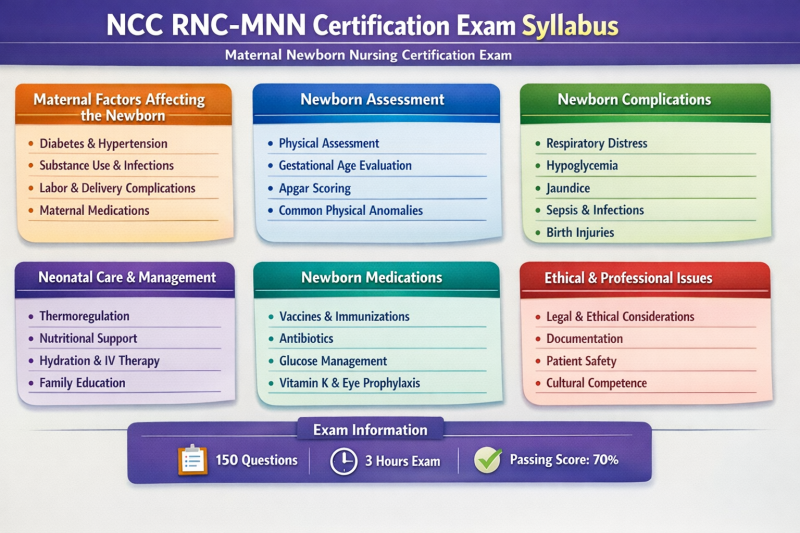
The RNC-MNN exam covers 5 content domains. According to the 2025 NCC Candidate Guide, the heaviest emphasis falls on maternal postpartum care and complications — together comprising 51% of scored questions.
Domain Breakdown
| Domain | Weight | Approximate Scored Questions |
|---|---|---|
| 1. Pregnancy, Birth Risk Factors & Complications | 7% | ~10–11 |
| 2. Maternal Postpartum Assessment, Management & Education | 26% | ~39 |
| 3. Newborn Assessment & Management | 20% | ~30 |
| 4. Maternal Postpartum Complications | 25% | ~37–38 |
| 5. Newborn Complications | 22% | ~33 |
Domain 1: Pregnancy, Birth Risk Factors & Complications (7%)
This smallest domain tests your understanding of antepartum and intrapartum factors that affect the postpartum/neonatal period. Topics include maternal health status, antepartum risk factors (diabetes, hypertension, infections), fetal assessment methods (biophysical profile, nonstress test, quad screen), complications of labor (shoulder dystocia, abruption, cord prolapse, meconium), methods of delivery, and delayed cord clamping.
Domain 2: Maternal Postpartum Assessment, Management & Education (26%)
The largest single domain covers the full scope of postpartum nursing care:
-
Physiologic changes and physical assessment — Reproductive, cardiopulmonary, genitourinary, gastrointestinal, hematological, endocrine, and neurological systems
-
Nursing care — Comprehensive postpartum care (vaginal and cesarean), common medications (insulin, analgesics, antimicrobials, antihypertensives, oxytocics, RhoGAM, SSRIs, MAT), and common problems (bladder distention, hemorrhoids, afterpains, breast engorgement, spinal headaches)
-
Psychosocial and ethical issues — Parent-infant interaction, family transition, barriers to bonding, intimate partner violence, adoption, surrogacy, perinatal grief, palliative care, and ethical principles
-
Lactation, newborn feeding & nutrition — Anatomy and physiology of lactation, positioning, latch, feeding cues, breastfeeding devices, expressing/storing breastmilk, formula types, and complications (mastitis, insufficient supply, nipple problems)
Domain 3: Newborn Assessment & Management (20%)
This domain focuses on the healthy newborn:
-
Transition to extrauterine life and thermoregulation
-
Physical and gestational age assessment (including late preterm)
-
Neurobehavioral and sensory assessment
-
Systems review with common variations
-
Newborn care and family education — cord care, circumcision, safe sleep, screening (CHD, hearing, metabolic, bilirubin), commonly used medications (vitamin K, eye prophylaxis, Hep B vaccine)
-
Resuscitation and stabilization (NRP), Apgar scoring
Domain 4: Maternal Postpartum Complications (25%)
The second-heaviest domain covers acute and life-threatening complications:
-
Hematologic — Hemorrhage (uterotonics, TXA), thrombophlebitis, DVT, DIC, shock
-
Cardiopulmonary — Preeclampsia/eclampsia/HELLP, postpartum cardiomyopathy, pulmonary embolus, stroke
-
Infection — Chorioamnionitis/Triple I, endometritis, wound infection, maternal sepsis
-
Diabetes
-
Psychological conditions and substance use disorders — Postpartum depression, anxiety, psychosis, OCD, bipolar/schizophrenia, substance withdrawal
Domain 5: Newborn Complications (22%)
This domain covers neonatal pathology:
-
Cardiovascular and respiratory — Congenital heart disease, apnea, TTN, pneumothorax, meconium aspiration
-
Neurological and gastrointestinal — Seizures, jitteriness, intracranial hemorrhage, neural tube defects, substance-exposed neonate
-
Hematologic — Hyperbilirubinemia, ABO incompatibility, hemolytic disease, G6PD, polycythemia
-
Infectious disease — Neonatal sepsis, viral/bacterial infections, anti-infectives
-
Genetic, metabolic & endocrine — Hypoglycemia, inborn errors of metabolism, infant of a diabetic mother
What Are the RNC-MNN Pass Rates?
The RNC-MNN consistently has one of the highest pass rates among all NCC certifications. According to NCC's published statistics, recent annual results are:
| Year | Candidates Tested | Pass Rate |
|---|---|---|
| 2020 | 1,233 | 92% |
| 2021 | 925 | 93% |
| 2022 | 1,335 | 90% |
| 2023 | 761 | 94% |
| 2024 | 1,696 | 90% |
The 5-year average pass rate is approximately 92%. As of 2024, there are 13,406 active RNC-MNN certificants across the United States and Canada. NCC uses the modified Angoff method for standard setting and criterion-referenced scoring — there is no set percentage passing level. Your ability level is calculated based on the number of questions answered correctly, with no penalty for wrong answers.
Expert Insight: "The RNC-MNN's consistently high pass rate reflects the fact that candidates typically have strong bedside experience before sitting for the exam. But don't let the numbers make you complacent — the 3-option question format means each distractor is carefully crafted to be plausible. Systematic content review paired with practice questions is still essential." — Sarah Mitchell, MSN, RNC-MNN, RNC-OB, Maternal-Child Nursing Educator
How Should You Study for the RNC-MNN? (8-Week Study Plan)
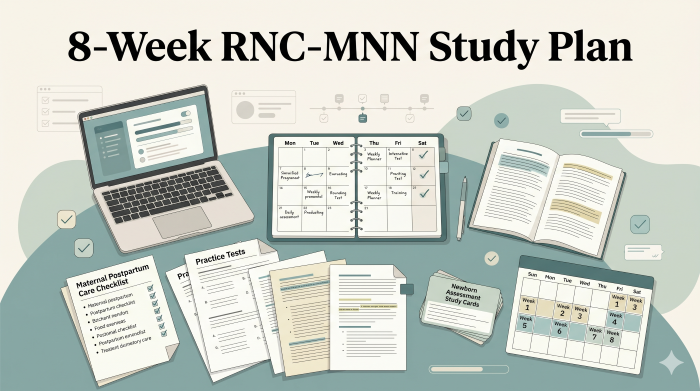
A structured study plan aligned to the exam content outline gives you the best chance of passing on your first attempt. Here is an 8-week framework based on the domain weights from the NCC candidate guide:
Weeks 1–2: Maternal Postpartum Assessment, Management & Education (26%)
-
Review physiologic changes in all body systems during the postpartum period
-
Study common postpartum medications — know indications, contraindications, and patient teaching for each
-
Master breastfeeding support: latch assessment, engorgement management, mastitis recognition, milk storage guidelines
-
Review psychosocial aspects: maternal role transition, bonding barriers, perinatal grief, ethical principles
Weeks 3–4: Maternal Postpartum Complications (25%)
-
Focus on postpartum hemorrhage: risk factors, assessment, uterotonics, tranexamic acid, quantitative blood loss
-
Study hypertensive disorders: preeclampsia/eclampsia management in the postpartum period, magnesium sulfate protocols
-
Review postpartum infections: endometritis, wound infections, sepsis indicators
-
Cover perinatal mood and anxiety disorders: screening tools, pharmacologic and nonpharmacologic interventions
Weeks 5–6: Newborn Complications (22%) & Assessment (20%)
-
Study newborn transition to extrauterine life and thermoregulation
-
Review gestational age assessment methods and physical examination findings
-
Cover hyperbilirubinemia: pathophysiology, risk factors, phototherapy, exchange transfusion criteria
-
Study neonatal cardiac and respiratory conditions: CHD recognition, TTN, meconium aspiration
-
Review NRP algorithm, Apgar scoring, and newborn resuscitation medications
Week 7: Pregnancy, Birth Risk Factors & Complications (7%) + Integration
-
Review antepartum risk factors and how they affect postpartum/neonatal care
-
Study intrapartum complications and their downstream effects
-
Take a full-length timed practice exam to simulate test-day conditions
-
Identify weak areas from your practice test results
Week 8: Final Review & Exam Readiness
-
Focus exclusively on your weak areas identified by practice testing
-
Review NCC sample questions from the candidate guide
-
Practice 3-option question elimination strategies
-
Confirm your test center or LRP appointment and ID requirements
Recommended Study Resources
The NCC candidate guide lists these official reference texts:
-
Baker, et al. — Core Curriculum for Maternal-Newborn Nursing (Elsevier, 2024)
-
Simpson, et al. — AWHONN's Perinatal Nursing, 5th ed (Wolters Kluwer, 2021)
-
Lowdermilk, et al. — Maternity and Women's Health Care, 12th ed (Mosby, 2024)
-
Davidson, et al. — Olds' Maternal-Newborn Nursing & Women's Health Care Across the Life Span (Pearson, 2024)
-
Witt, et al. — Physical Assessment of the Newborn (Springer, 2025)
Supplement your review with MedicoExam's NCC practice exams, which mirror the 3-option format and cover all five content domains.
How Do You Register and Schedule the RNC-MNN Exam?
Registration is completed online through the NCC website. Here is the step-by-step process:
-
Gather your documentation — RN license number, employer contact for hours verification, and personal information.
-
Submit the online application — Pay the $325 fee (includes the $50 non-refundable application fee). NCC will verify your eligibility.
-
Receive your eligibility letter — Sent via email once approved.
-
Schedule within 30 days — You must book your exam appointment within 30 days of receiving your eligibility letter.
-
Test within 90 days — Your testing appointment must fall within a 90-day window from eligibility notification.
-
Choose your testing method — PSI computer test centers (78% of candidates in 2024) or Live Remote Proctoring from your home or office (22% of candidates).
If you do not pass, you must wait 45 days before reapplying. A new application and full fee are required. Candidates may take the same NCC exam a maximum of two times per calendar year.
How Do You Maintain Your RNC-MNN Certification?
The RNC-MNN credential is valid for 3 years from the date on your official NCC score report. Maintenance requires three steps, as outlined by NCC:
-
Complete the Continuing Competency Assessment (CCA) — At the start of each renewal cycle, take the CCA to generate a personalized education plan. If you score below 7.5 in any competency category, you must earn continuing education in that area.
-
Earn required CE hours — Complete the CE hours specified by your CCA education plan. All CE must be completed after the CCA — hours earned before the CCA cannot count toward renewal.
-
Submit maintenance application and fee — Fees are based on a quarterly system (due dates: March 15, June 15, September 15, or December 15). The base maintenance fee is $100, with discounts available for completing NCC CE modules: $80 (15 hrs), $70 (30 hrs), or $60 (45 hrs).
NCC performs a 3% random audit of maintenance applications each year. If your certification lapses, you may reinstate within 12 months of your maintenance due date.
What Test-Day Strategies Work Best for 3-Option NCC Questions?
NCC exams use a unique 3-option format — each question has one stem and only 3 answer choices (not 4 like NCLEX or most nursing exams). This format changes your test-taking approach in important ways:
-
Random guessing gives you a 33% chance — With only 3 options, eliminating even one answer boosts your odds to 50%. There is no penalty for wrong answers, so never leave a question blank.
-
Answer options are alphabetized — NCC alphabetizes choices by first word, so do not rely on answer position as a cue. Focus entirely on content.
-
Questions test knowledge and application — Expect both recall questions and clinical scenario questions that require you to apply knowledge.
-
Lab values use conventional and international units — Questions containing laboratory data show results in conventional units with international units in parentheses.
-
Pace yourself — With 175 questions in 180 minutes, you have approximately 1 minute per question. Flag difficult questions and return to them after completing your first pass.
How Does the RNC-MNN Advance Your Nursing Career?
Earning your RNC-MNN delivers measurable career benefits. Magnet-designated hospitals actively seek nationally certified nurses, and NCC emphasizes that all NCC certifications are Magnet-approved specialty credentials. Many hospitals offer certification pay differentials — commonly $1,000–$3,000 annually — for nurses who hold national certification.
The RNC-MNN also strengthens your professional standing when pursuing roles in:
-
Mother-baby nursing — The most direct application for your certification
-
Lactation support — RNC-MNN demonstrates breastfeeding competency, complementing IBCLC preparation
-
Patient education — Demonstrates expertise in discharge teaching and family-centered care
-
Quality and safety — Pairs well with the C-ONQS subspecialty certification
-
Nursing leadership and education — Signals evidence-based practice commitment
Consider stacking your RNC-MNN with other NCC certifications such as C-EFM (Electronic Fetal Monitoring) or C-OBE (Obstetric Emergencies) to broaden your perinatal skill set.
Frequently Asked Questions
1. How many questions are on the RNC-MNN exam?
The RNC-MNN exam has 175 total questions: 150 scored items and 25 unscored pretest items embedded throughout the exam. You cannot distinguish pretest items from scored items. According to the NCC candidate guide, all questions use a 3-option multiple-choice format.
2. What is the RNC-MNN pass rate?
The RNC-MNN pass rate was 90% in 2024, based on 1,696 candidates tested. Over the past five years (2020–2024), the pass rate has ranged from 90% to 94%, with a 5-year average of approximately 92%, according to NCC exam statistics.
3. How much does the RNC-MNN exam cost?
The RNC-MNN exam costs $325, which includes a $50 non-refundable application fee and a $275 examination fee. If you need to retest, you must submit a new application and pay the full $325 fee again.
4. What is the difference between RNC-MNN and RNC-OB?
RNC-MNN focuses on postpartum care, newborn assessment, breastfeeding support, and discharge education — covering the period from birth to six weeks. RNC-OB focuses on inpatient obstetric care including antepartum, labor and delivery, fetal assessment, and obstetric emergencies. RNC-MNN is designed for mother-baby nurses; RNC-OB is designed for labor and delivery nurses.
5. Can I take the RNC-MNN exam from home?
Yes. NCC offers Live Remote Proctoring (LRP), allowing you to take the exam from your home or office using your own computer. In 2024, 22% of NCC candidates used LRP, according to NCC milestones data. You must test your computer before scheduling and comply with all LRP requirements.
6. How long do I have to schedule after my application is approved?
You must schedule your exam appointment within 30 days of receiving your eligibility letter. Your testing appointment must fall within a 90-day window from the eligibility notification date. If you fail to schedule within 30 days or test within the 90-day window without requesting a change, your application fee is forfeited.
7. Is there a penalty for wrong answers on the RNC-MNN?
No. There is no penalty for wrong answers on any NCC exam. Your ability level is calculated based on the number of correctly answered questions only. Always answer every question — even if you must guess, you have a 33% chance with 3 answer options.
8. What score do I need to pass the RNC-MNN?
NCC does not publish a numeric passing score or percentage cutoff. The exam uses criterion-referenced scoring with the modified Angoff standard-setting method. Pass/fail is determined by your ability level compared to a predetermined criterion, according to NCC's scoring explanation. Your score report shows word descriptors (very weak, weak, average, strong, very strong) for each content area.
9. How do I renew my RNC-MNN certification?
Complete the Continuing Competency Assessment (CCA) at the start of each 3-year renewal cycle, earn the CE hours specified by your personalized education plan, and submit your maintenance application with fees before your quarterly due date. The base maintenance fee is $100, with discounts for using NCC CE modules.
10. Can I take both the RNC-MNN and RNC-OB certifications?
Yes. Many perinatal nurses hold both the RNC-MNN and RNC-OB, especially those who float between labor and delivery and postpartum units. Each certification requires a separate application, fee, and eligibility verification. You must meet the 2,000-hour specialty experience requirement independently for each exam area.
Start Your RNC-MNN Exam Preparation Today
The RNC-MNN certification validates your expertise in caring for mothers and newborns during a critical period. With a 90% pass rate and a clear content outline, passing on your first attempt is entirely achievable with the right preparation.
Ready to begin? Try MedicoExam's RNC-MNN practice exams — simulation-based questions that mirror the NCC's unique 3-option format across all five content domains. Build confidence, identify knowledge gaps, and walk into your exam prepared.
Explore more NCC certification guides on the MedicoExam NCC hub, including resources for C-EFM, C-NPT, C-ELBW, and more.
Disclaimer: This article is for informational purposes only. It does not contain actual NCC exam questions, recalled content, or proprietary material. Always verify current eligibility requirements, fees, and policies on the official NCC website. Exam content outlines and policies are subject to change.
Written by the MedicoExam Content Team — Healthcare Education Specialists at MedicoExam.com
- NCC Maternal Newborn Nursing Sample Questions |
- NCC Maternal Newborn Nursing Practice Test |
- NCC RNC-MNN Preparation Time |
- NCC RNC-MNN Career Opportunities |
- NCC RNC-MNN Registration Process |
- NCC RNC-MNN Recertification |
- NCC RNC-MNN Exam Format |
- NCC RNC-MNN Certification Overview |
- NCC RNC-MNN Question Bank |
- NCC RNC-MNN Eligibility & Requirements |
- NCC RNC-MNN Exam Cost |
- NCC Maternal Newborn Nursing Study Guide |
- NCC Maternal Newborn Nursing Syllabus |
- NCC RNC-MNN Passing Score |
- NCC RNC-MNN Exam Difficulty


