
AMT MLS Certification Sample Questions

The AMT Medical Laboratory Scientist Certification Sample Question Set on this page is designed to familiarize you with the actual AMT MLS exam format and question types. These sample questions help you understand how questions are structured and what to expect on test day. While they provide a useful starting point, they represent only a limited preview of the real exam experience.
These sample questions are intended for evaluation and familiarization only. To understand exam style, pacing, and reasoning patterns more clearly, we recommend trying our online sample practice environment. If you are preparing for the AMT Medical Laboratory Scientist (MLS) and want to assess your readiness more rigorously, structured, timed, scenario-based practice is recommended. This approach aligns with the cognitive demands and professional expectations typically associated with Medical laboratory scientists, medical technologists, clinical laboratory professionals working in settings such as Clinical laboratories, hospitals, reference laboratories.
Try Sample Exam » | Access Full AMT MLS Practice Exam »
The demo introduces core concepts, while full-length premium simulations provide deeper, scenario-based coverage that more closely reflects the actual cognitive demands of the AMT Medical Laboratory Scientist exam, particularly in areas such as Clinical laboratory testing, specimen evaluation and processing, laboratory quality and safety. You can use these sample questions as a starting point, then progress to the AMT MLS Certification Practice Exam for stronger readiness. Our premium simulations are designed to mirror real exam conditions, helping you refine reasoning, pacing, and decision-making before your official exam attempt.
AMT MLS Sample Questions:
01. A chemistry analyzer is running two levels of control at the start of the shift. Level 1 is within range, but Level 2 exceeds the upper 2 SD limit for glucose on two consecutive runs with the same reagent pack. Patient samples have not yet been tested. Which action is most appropriate?
a) Release patient glucose results because only one control level is out of range
b) Troubleshoot the analytical system before reporting patient results
c) Average the two control values and proceed if the mean is acceptable
d) Report patient results, then repeat the abnormal control at the end of the shift
02. A patient on aminoglycoside therapy has a drug level drawn immediately before the next scheduled dose. This specimen is intended to measure which value?
a) Peak concentration
b) Loading dose
c) Therapeutic index
d) Trough concentration
03. A technologist compares the results of a troponin assay collected on time with one drawn much later in the clinical course. Which principle is most directly relevant?
a) Cardiac marker interpretation may depend on timing relative to the clinical event
b) Troponin is interpreted only by urine microscopy
c) Troponin testing determines donor eligibility
d) Marker timing is irrelevant if the sample is serum
04. A laboratory professional is asked why a hematocrit result may not perfectly match a calculated expectation when analytic interference is present. Which principle is most directly relevant?
a) Hematocrit determines ABO subgroup
b) Hematocrit discrepancies are resolved only with Gram stain
c) Hematology values should be assessed for internal consistency and possible artifact
d) Internal consistency is irrelevant if one value is automated
05. A patient has a prolonged prothrombin time with a normal activated partial thromboplastin time. Which interpretation is most appropriate?
a) The abnormality may primarily involve the extrinsic pathway
b) The abnormality confirms isolated intrinsic pathway deficiency
c) Both intrinsic and extrinsic pathways are definitely normal
d) The result pattern rules out all coagulation disorders
06. A patient has blood collected into multiple evacuated tubes during the same venipuncture. If the phlebotomist draws an EDTA tube before a serum tube, which problem is most likely?
a) EDTA carryover may interfere with testing in subsequently collected tubes
b) The serum tube will clot more quickly than expected
c) The patient will become more likely to develop hemolysis from tourniquet release
d) The specimen labels will no longer be valid
07. A patient’s serum osmolality is higher than the expected calculated value from routine electrolytes, glucose, and urea nitrogen. Which principle is most directly relevant?
a) ABO antibodies should be reviewed first
b) Comparison of measured and expected osmolality can reveal an osmolality gap
c) Platelet function testing is the next chemistry step
d) The discrepancy is resolved by urine sediment microscopy alone
08. Image description: Peripheral blood smear showing several leukocytes with bilobed nuclei and abundant coarse orange-red cytoplasmic granules.
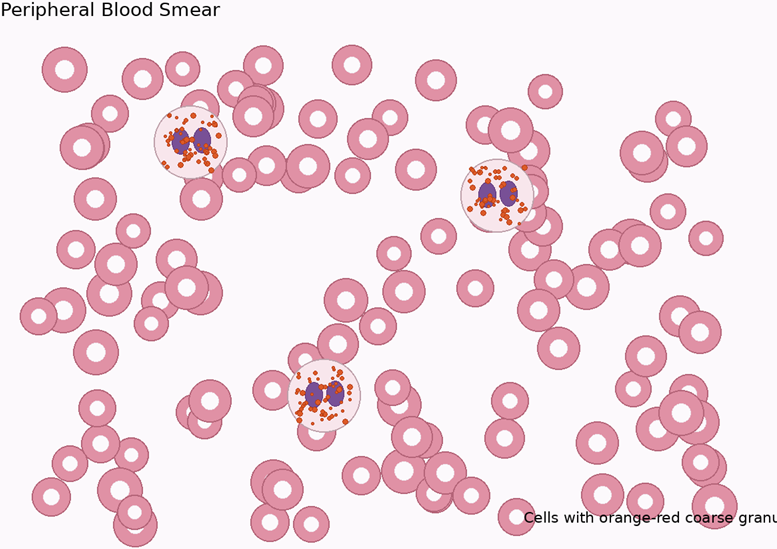
Which leukocyte type is most consistent with this image?
a) Basophils
b) Monocytes
c) Lymphocytes
d) Eosinophils
09. A peripheral smear review is ordered because the analyzer reports an abnormally high white blood cell count with instrument flagging. Which follow-up principle is most appropriate?
a) Microscopic examination should be used to correlate flagged automated findings
b) The flag should be ignored if the sample is not clotted
c) White blood cell flags are resolved by urine dipstick testing
d) Analyzer flags always indicate instrument failure and never true pathology
10. Image description: Four evacuated blood collection tubes are shown left to right in sequence: light blue, serum tube, green, and lavender.
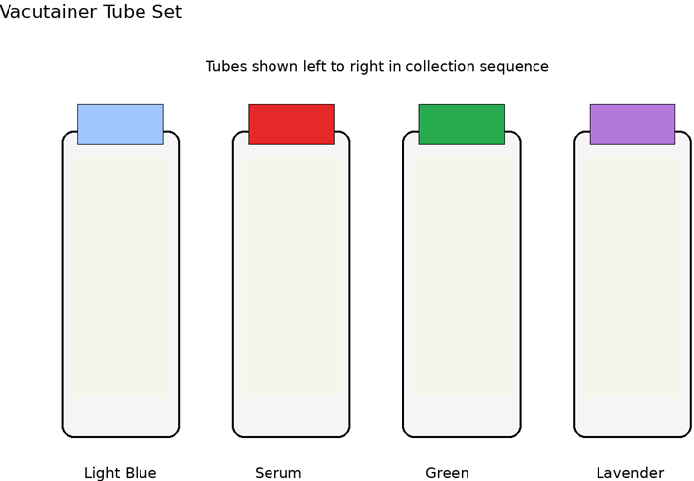
Which principle is most directly illustrated by this image?
a) Tube color determines patient blood type
b) All tubes can be collected in any sequence without consequence
c) Order of draw matters only for microbiology cultures
d) Proper order of draw helps reduce additive carryover between tubes
Answers:
|
Question: 01 Answer: b |
Question: 02 Answer: d |
Question: 03 Answer: a |
Question: 04 Answer: c |
Question: 05 Answer: a |
|
Question: 06 Answer: a |
Question: 07 Answer: b |
Question: 08 Answer: d |
Question: 09 Answer: a |
Question: 10 Answer: d |
For full-length, timed, scenario-based practice aligned with the official exam framework - and to build pacing, consistency, and confidence - explore our Premium AMT MLS Certification Practice Exam.
Note: These sample questions are not official exam questions and are intended only for familiarization and study purposes. If you find any typos or data entry errors in these AMT Medical Laboratory Scientist (MLS) sample questions, please let us know by emailing us at feedback@medicoexam.com


