
AMT PCT Certification Sample Questions
The AMT Patient Care Technician Certification Sample Question Set on this page is designed to familiarize you with the actual AMT PCT exam format and question types. These sample questions help you understand how questions are structured and what to expect on test day. While they provide a useful starting point, they represent only a limited preview of the real exam experience.
These sample questions are intended for evaluation and familiarization only. To understand exam style, pacing, and reasoning patterns more clearly, we recommend trying our online sample practice environment. If you are preparing for the AMT Patient Care Technician (PCT) and want to assess your readiness more rigorously, structured, timed, scenario-based practice is recommended. This approach aligns with the cognitive demands and professional expectations typically associated with Patient care technicians, medical assistants or nursing assistants, PCT instructors and related roles working in settings such as Patient care settings, clinical training environments, healthcare support settings and related settings.
Try Sample Exam » | Access Full AMT PCT Practice Exam »
The demo introduces core concepts, while full-length premium simulations provide deeper, scenario-based coverage that more closely reflects the actual cognitive demands of the AMT Patient Care Technician exam, particularly in areas such as Allied health foundations, personal patient assistance and care, clinical procedures and clinical patient environment. You can use these sample questions as a starting point, then progress to the AMT PCT Certification Practice Exam for stronger readiness. Our premium simulations are designed to mirror real exam conditions, helping you refine reasoning, pacing, and decision-making before your official exam attempt.
AMT PCT Sample Questions:
01. A Patient Care Technician is applying ECG electrodes to a patient with diaphoretic skin. The electrodes keep lifting, and the tracing shows intermittent artifact.
Which action is most appropriate?
a) Dry and prepare the skin according to procedure before applying new electrodes
b) Tape the loose electrodes tightly over wet skin without skin preparation
c) Ignore the loose electrodes because the machine can still print a tracing
d) Place electrodes over the patient’s gown to keep them dry
02. A competent adult patient refuses a scheduled bath and says, “I understand it is recommended, but I do not want it right now.” The family member at the bedside tells the Patient Care Technician, “Do it anyway. We do not want the staff to think we are neglecting him.”
Which action is most appropriate?
a) Complete the bath because the family requested it and hygiene is part of care
b) Respect the patient’s refusal, report it to the nurse, and document according to facility policy
c) Tell the patient that refusal is not allowed once care is scheduled
d) Ask the family member to hold the patient’s hands so the bath can be completed
03. A confused patient repeatedly tries to remove an IV line. A family member asks the Patient Care Technician to tie the patient’s wrists to the bedrails “just until the nurse has time.”
Which action is most appropriate?
a) Do not apply restraints independently; notify the nurse and follow facility policy for patient safety
b) Tie the wrists loosely because the family requested it
c) Use sheets as restraints because they are softer than wrist restraints
d) Place the bedrails up and ignore the IV pulling behavior
04. Image/Graphic Stimulus Description: A thermometer display reads 100.4°F. The previous recorded temperature was 98.2°F four hours earlier. The patient is flushed and reports chills.
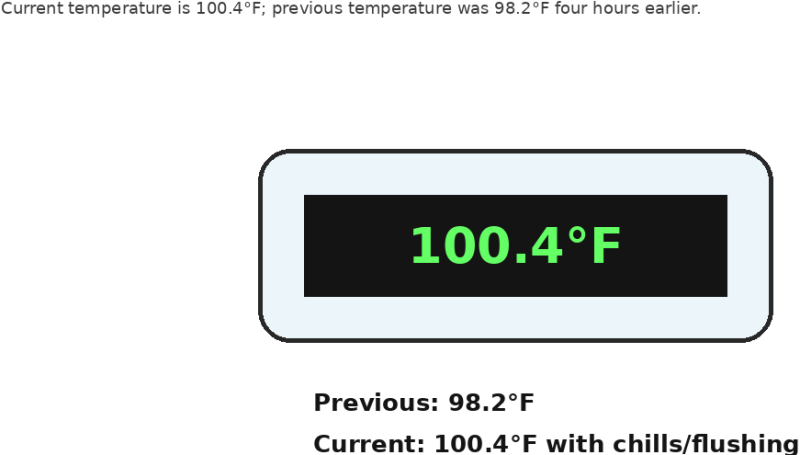
A Patient Care Technician observes the thermometer shown in the graphic and compares it with the earlier temperature.
Which action is most appropriate?
a) Record the temperature as unchanged from baseline
b) Report the elevated temperature and symptoms to the nurse
c) Ignore the reading because chills mean the patient feels cold
d) Give fever medication independently before telling the nurse
05. A Patient Care Technician enters a room and finds that a patient has vomited a large amount of dark, coffee-ground appearing material. The patient is pale and says, “I feel weak.”
Which action is most appropriate?
a) Stay with the patient and notify the nurse immediately, preserving the emesis for assessment if directed
b) Flush the emesis quickly so the room does not smell
c) Offer a full meal to replace lost nutrition
d) Document nausea only and continue routine rounds
06. A Patient Care Technician is assisting a patient recovering from prolonged hospitalization. The patient can brush teeth independently but asks the PCT to “just do it for me because it is faster.” The care plan encourages the patient to perform self-care tasks as tolerated.
Which action best supports restorative care?
a) Brush the patient’s teeth completely to save time during the morning routine
b) Encourage the patient to brush independently while offering setup help and rest periods as needed
c) Skip oral care because the patient is not motivated to participate
d) Tell the patient that help is never allowed if independence is possible
07. A Patient Care Technician is assisting a patient whose care plan requires nectar-thick liquids. The meal tray includes a carton of regular thin milk and a cup labeled nectar-thick juice. The patient asks for the milk because it looks more appealing.
Which action is most appropriate?
a) Offer only liquids that match the ordered consistency and report the tray concern if needed
b) Give the regular milk because the patient requested it
c) Mix the thin milk with water to make it safer
d) Tell the patient to drink the milk quickly while sitting upright
08. A Patient Care Technician is checking a room before a patient returns from a procedure. The suction canister is nearly full, the oxygen flowmeter is attached but not in use, and the call light cord is wrapped around the bed rail.
Which action should the PCT take?
a) Leave the room unchanged because the patient is not back yet
b) Turn on the oxygen flowmeter to the highest setting so it is ready for any patient need
c) Follow facility procedure to address the full suction canister, ensure equipment is ready, and place the call light safely within reach
d) Hide the call light cord behind the bed so it does not look cluttered
09. A Patient Care Technician is helping a patient with oral hygiene. The patient wears full dentures and says the gums feel sore after meals. The dentures have visible food debris, and the patient asks whether brushing the mouth is still needed when dentures are removed.
Which action is most appropriate?
a) Clean the dentures, provide oral care to the gums and tongue, and report gum soreness to the nurse
b) Clean only the dentures because gums do not need care when teeth are absent
c) Leave the dentures in place overnight so the gums do not shift
d) Use very hot water to clean the dentures so they become sterile
10. A Patient Care Technician notices that a dependent patient has repeated unexplained bruises on the arms and back. The patient becomes quiet when a particular visitor enters the room and later whispers, “Please do not leave me alone with them.”
Which action is most appropriate?
a) Wait for the patient to provide proof before reporting the concern
b) Ask the visitor directly whether they caused the bruises
c) Ignore the concern because bruises are common in dependent patients
d) Report the findings and patient statement through the appropriate chain of command immediately
Answers:
|
Question: 01 Answer: a |
Question: 02 Answer: b |
Question: 03 Answer: a |
Question: 04 Answer: b |
Question: 05 Answer: a |
|
Question: 06 Answer: b |
Question: 07 Answer: a |
Question: 08 Answer: c |
Question: 09 Answer: a |
Question: 10 Answer: d |
For full-length, timed, scenario-based practice aligned with the official exam framework - and to build pacing, consistency, and confidence - explore our Premium AMT PCT Certification Practice Exam.
Note: These sample questions are not official exam questions and are intended only for familiarization and study purposes. If you find any typos or data entry errors in these AMT Patient Care Technician (PCT) sample questions, please let us know by emailing us at feedback@medicoexam.com


