
AMT RDA Certification Sample Questions
The AMT Registered Dental Assistant Certification Sample Question Set on this page is designed to familiarize you with the actual AMT RDA exam format and question types. These sample questions help you understand how questions are structured and what to expect on test day. While they provide a useful starting point, they represent only a limited preview of the real exam experience.
These sample questions are intended for evaluation and familiarization only. To understand exam style, pacing, and reasoning patterns more clearly, we recommend trying our online sample practice environment. If you are preparing for the AMT Registered Dental Assistant (RDA) and want to assess your readiness more rigorously, structured, timed, scenario-based practice is recommended. This approach aligns with the cognitive demands and professional expectations typically associated with Registered Dental Assistant, dental assistant, chairside dental assistant and related roles working in settings such as dental offices, dental clinics, dental assisting education and training settings.
Try Sample Exam » | Access Full AMT RDA Practice Exam »
The demo introduces core concepts, while full-length premium simulations provide deeper, scenario-based coverage that more closely reflects the actual cognitive demands of the AMT Registered Dental Assistant exam, particularly in areas such as dental sciences and terminology, chairside clinical procedures, dental imaging and office assisting. You can use these sample questions as a starting point, then progress to the AMT RDA Certification Practice Exam for stronger readiness. Our premium simulations are designed to mirror real exam conditions, helping you refine reasoning, pacing, and decision-making before your official exam attempt.
AMT RDA Sample Questions:
01. A child is brought to the dental office for a routine visit. The parent asks why the dentist is monitoring both primary teeth and erupting permanent teeth. The assistant explains that the child is in a stage where primary teeth are being replaced gradually.
Which term best describes this stage?
a) Complete edentulism
b) Mixed dentition
c) Permanent dentition only
d) Attrition stage
02. A dentist asks the assistant to document that a restoration margin is on the mesial surface of the maxillary right canine. The assistant wants to verify the meaning of “mesial” before charting.
Which description best defines the mesial surface?
a) The tooth surface closest to the midline of the dental arch
b) The biting edge of an anterior tooth
c) The surface facing the cheek on posterior teeth
d) The area surrounding the root apex
03. A patient asks why periodontal disease can cause teeth to feel loose. The assistant explains that disease can damage tissues that support the tooth in the socket, including bone and ligament attachment.
Which structure provides the bony socket support around tooth roots?
a) Enamel
b) Incisal edge
c) Pulp chamber
d) Alveolar bone
04. Use the real tooth and periodontal-tissue image shown above for this item. The image labels enamel, dentin, pulp, gingiva, cementum, periodontal ligament, and alveolar bone.
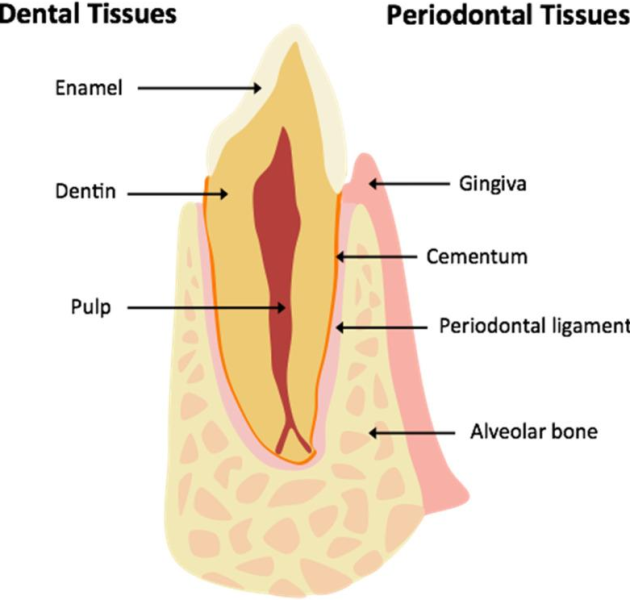
In the image, which labeled structure covers the root surface and provides attachment for periodontal ligament fibers?
a) Enamel
b) Cementum
c) Pulp
d) Gingiva
05. A patient is scheduled for an extraction of a mandibular molar. The assistant reviews the tray setup and notices that only restorative instruments have been placed on the tray.
Which action is most appropriate?
a) Replace the setup with the extraction tray and supplies required by office protocol
b) Keep the restorative tray because most dental procedures use the same instruments
c) Add a shade guide and curing light because all molar procedures need composite materials
d) Seat the patient and wait for the dentist to discover the tray mismatch
06. A traditional film radiograph is too dark. The assistant reviews the chart and finds that the exposure settings were appropriate, but the film remained in the developer longer than the recommended time.
Which explanation best fits the finding?
a) Overdevelopment can increase film density and make the image too dark
b) Overdevelopment usually creates a completely clear film with no image
c) Developer time changes tooth length but not image density
d) Long development time corrects all positioning errors automatically
07. While exposing radiographs, the assistant must remain in the room because the control panel is inside a protected area.
Which operator behavior is most appropriate?
a) Stand directly in the primary beam to watch the receptor
b) Hold the tube head steady with both hands during exposure
c) Stand behind the protective barrier or in the designated safe area during exposure
d) Stand beside the patient and hold the receptor for every image
08. Use the real tooth-anatomy image shown above for this item. The image labels enamel, dentin, pulp, periodontal ligament, cementum, gum, and bone.
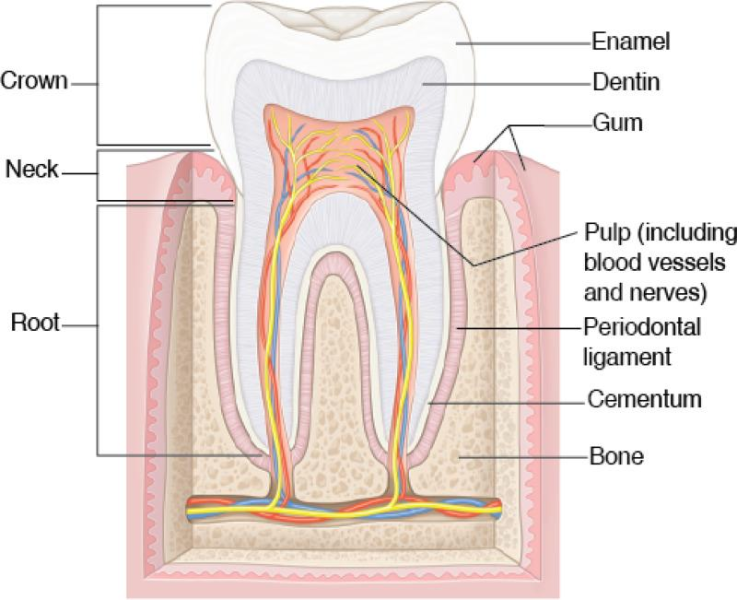
In the image, which labeled structure primarily anchors the tooth root to the surrounding alveolar bone by connecting cementum to bone?
a) Enamel
b) Dentin
c) Periodontal ligament
d) Pulp
09. A new patient calls the dental office and says that a crown came off the previous evening. The patient sounds anxious and asks whether the dentist can simply recement it without an examination. The schedule is nearly full, and the dentist is currently treating another patient.
Which response by the dental assistant best demonstrates proper telephone technique and etiquette?
a) Tell the patient that recementation is simple and promise that the dentist will complete it today
b) Advise the patient to use household glue temporarily if the tooth is not painful
c) Tell the patient to call back later because the dentist is unavailable
d) Ask the patient for relevant information, avoid making a diagnosis, and explain that the dentist will determine the needed care
10. A patient’s dental plan has approved a predetermination for part of a proposed bridge. The patient believes this means the plan will pay the entire fee and that no payment will be due at the time of service.
Which explanation is most appropriate for the dental assistant to provide within the assistant’s administrative role?
a) A predetermination generally estimates plan benefits and does not guarantee that all charges will be paid
b) A predetermination means the dental office must waive any remaining balance
c) A predetermination means the insurance carrier has already paid the claim
d) A predetermination eliminates the need to submit a claim after treatment is completed
Answers:
|
Question: 01 Answer: b |
Question: 02 Answer: a |
Question: 03 Answer: d |
Question: 04 Answer: b |
Question: 05 Answer: a |
|
Question: 06 Answer: a |
Question: 07 Answer: c |
Question: 08 Answer: c |
Question: 09 Answer: d |
Question: 10 Answer: a |
For full-length, timed, scenario-based practice aligned with the official exam framework - and to build pacing, consistency, and confidence - explore our Premium AMT RDA Certification Practice Exam.
Note: These sample questions are not official exam questions and are intended only for familiarization and study purposes. If you find any typos or data entry errors in these AMT Registered Dental Assistant (RDA) sample questions, please let us know by emailing us at feedback@medicoexam.com


