
AAPC CVBA Exam Success: Your Strategic Playbook
 The AAPC Certified Value-Based Administrator (CVBA) credential establishes proficiency in the rapidly evolving landscape of value-based healthcare. This certification is specifically designed for professionals aiming to demonstrate their expertise in managing and optimizing value-based care models, a critical skill set for the modern healthcare environment. Earning the CVBA signifies a deep understanding of the frameworks, data analytics, and collaborative strategies essential for improving patient outcomes while controlling costs. This comprehensive playbook offers a detailed guide, breaking down the exam's intricacies and outlining a strategic preparation pathway for successful certification.
Certifying Value-Based Administrator Expertise
Achieving the AAPC CVBA certification underscores a professional's capacity to navigate complex healthcare payment and delivery systems focused on value. This credential validates an individual's skills in core value-based care principles, including data-driven decision-making, risk adjustment methodologies, and effective performance measurement. Professionals holding the CVBA are equipped to drive initiatives that enhance quality, reduce waste, and foster robust partnerships between payers and providers. It positions individuals as key contributors to organizational success in a value-based ecosystem.
Understanding the AAPC CVBA Exam Structure
Preparing for the AAPC CVBA exam requires a clear understanding of its format and logistical details. The examination is structured to thoroughly assess a candidate's practical knowledge and application skills across various critical domains of value-based care administration. Familiarity with these specifics is the first step toward building an effective study strategy and managing expectations for exam day.
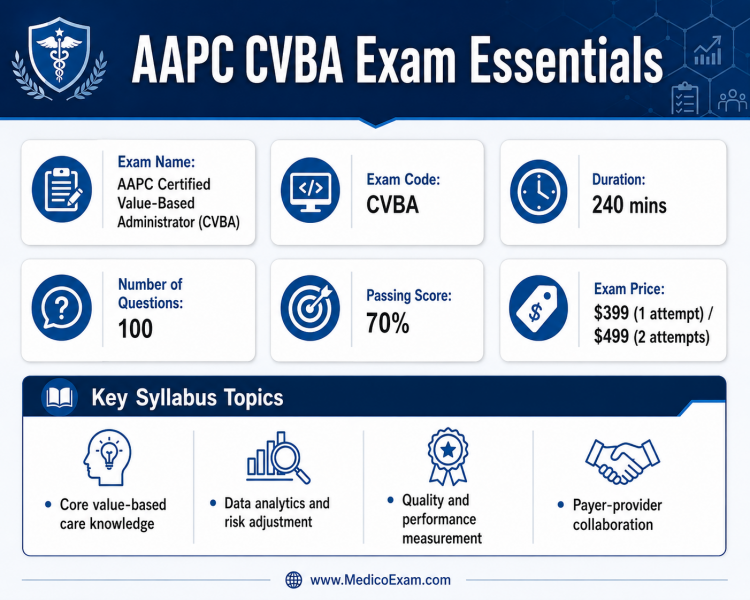
The AAPC CVBA exam details include:
| Exam Name | AAPC Certified Value-Based Administrator |
| Exam Code | CVBA |
| Duration | 240 minutes (4 hours) |
| Number of Questions | 100 multiple-choice questions |
| Passing Score | A minimum of 70% is required to pass |
| Exam Price | $399 for a single attempt, or $499 for two exam attempts |
These parameters define the testing environment, emphasizing the need for both comprehensive knowledge and efficient time management. Understanding the cost options allows candidates to choose the best path for their preparation and comfort level.
CVBA Syllabus Domains Explored
The AAPC CVBA exam covers a distinct set of domains, each vital to effective value-based care administration. Mastering these syllabus topics is fundamental to earning the certification, as they represent the core competencies expected of a Certified Value-Based Administrator. Candidates should allocate their study time proportionally, ensuring a robust grasp of each area.
The CVBA examination draws questions from the following key syllabus topics:
-
Core value-based care knowledge: This domain assesses foundational understanding of value-based care models, payment methodologies, and the transition from fee-for-service.
-
Data analytics and risk adjustment: Focuses on the ability to interpret healthcare data, understand risk stratification, and apply appropriate risk adjustment techniques to patient populations.
-
Quality and performance measurement: Covers the metrics and methodologies used to evaluate the effectiveness of care delivery, including HEDIS measures and other quality indicators.
-
Payer-provider collaboration: Explores strategies and best practices for fostering effective partnerships between healthcare providers and insurance payers to achieve shared value goals.
Each of these areas contributes significantly to the breadth of knowledge required for the role, demanding a strategic approach to study. Deepening your understanding across these domains is crucial for comprehensive preparation.
Developing Your Comprehensive Study Blueprint
A successful approach to the AAPC CVBA exam hinges on a well-structured and adaptable study blueprint. This plan should encompass not only what to study but also how to maximize your learning efficiency and retention. Starting with a clear strategy ensures that all critical areas are covered and that your preparation is both thorough and sustainable.
Building a Personalized CVBA Study Schedule
Creating a realistic and personalized study schedule is paramount. Begin by assessing your current knowledge level in each syllabus domain and identify areas that require more attention. Integrate regular study sessions into your routine, aiming for consistency rather than cramming. Use tools like calendars or study planners to map out your daily or weekly goals, breaking down large topics into manageable chunks. Remember to include short breaks to maintain focus and prevent burnout, ensuring your study path is sustainable.
Leveraging Official AAPC Resources
Official resources provided by AAPC are invaluable for your preparation. These materials often include study guides, workbooks, and other curriculum components that align directly with the exam content. Utilizing these resources ensures that your study is focused on the correct information and tested concepts. Additionally, visiting the official certification details page on the AAPC website can provide the most up-to-date information regarding exam updates and preparation tools.
Deep Dive into Core Curriculum Topics
Beyond understanding the general syllabus, successful candidates for the AAPC CVBA exam demonstrate a nuanced comprehension of each topic area. This requires not just memorization but a capacity to apply theoretical knowledge to practical scenarios typical in value-based care administration. Each domain builds upon the others, forming a holistic view of the certified administrator's responsibilities.
Foundational Value-Based Care Knowledge
This foundational domain requires candidates to grasp the fundamental concepts distinguishing value-based care from traditional fee-for-service models. Focus on understanding the various value-based payment models, such as Accountable Care Organizations (ACOs), bundled payments, and patient-centered medical homes (PCMHs). It’s crucial to recognize the underlying philosophies, regulatory landscape, and the financial incentives driving these models. Comprehending the evolution and objectives of value-based care is essential for building a strong base of knowledge.
Analytical Skills for Risk Adjustment and Data
The ability to work with healthcare data and understand risk adjustment is a cornerstone of the CVBA role. Candidates must learn how to interpret population health data, identify high-risk patient groups, and apply appropriate risk adjustment methodologies to ensure accurate reimbursement and resource allocation. This involves familiarity with various coding systems (e.g., ICD-10-CM) as they relate to risk scores and understanding the impact of chronic conditions on patient risk profiles. Strong analytical skills in this area directly impact organizational financial health and care effectiveness.
Measuring Quality and Performance Outcomes
Evaluating the quality and performance of healthcare services is critical in a value-based framework. This section of the syllabus requires understanding how quality metrics are defined, collected, and reported. Familiarity with national quality initiatives, performance indicators (e.g., HEDIS measures, patient satisfaction scores), and their role in reimbursement and public reporting is vital. Focus on how to interpret these measures to identify areas for improvement and demonstrate the value delivered by healthcare providers.
Enhancing Payer-Provider Collaboration
Effective collaboration between payers and providers is fundamental to the success of value-based care initiatives. This domain explores the strategies and communication models that foster strong partnerships, align incentives, and improve care coordination. Understanding the challenges and solutions in contract negotiation, data sharing agreements, and joint program development is key. The ability to facilitate these relationships ensures that both entities are working towards shared goals of improved patient outcomes and cost efficiency.
Optimizing Your Preparation with Effective Techniques
Beyond structured study, employing specific preparation techniques can significantly enhance your readiness for the AAPC CVBA exam. These methods are designed to solidify your understanding, identify knowledge gaps, and build confidence as exam day approaches. Engaging with the material actively is far more effective than passive reading.
Harnessing the Power of Practice Exams
Practice exams are an indispensable tool for CVBA candidates. They not only familiarize you with the exam format and question types but also help in identifying areas where further study is needed. Taking simulated tests under timed conditions can improve your pacing and reduce exam-day anxiety. Explore dedicated AAPC CVBA practice questions to gauge your readiness and refine your test-taking strategies. Analyzing incorrect answers to understand the reasoning behind them is crucial for learning.
Strategic Time Management for Exam Day
On the actual exam day, effective time management is as important as content knowledge. With 100 questions to answer in 240 minutes, you have approximately 2 minutes and 24 seconds per question. Develop a strategy during practice sessions for quickly answering questions you know and flagging those that require more thought. Avoid spending too much time on any single question. If you encounter a particularly challenging question, make an educated guess, mark it for review, and move on to ensure you complete the entire exam.
Ensuring Exam Day Readiness
The final phase of your AAPC CVBA preparation involves ensuring you are physically and mentally ready for the exam. This goes beyond academic knowledge and focuses on practical steps to minimize stress and optimize performance. A well-planned approach to exam day logistics can make a significant difference in your outcome.
Consider the following aspects to finalize your readiness:
-
Review Logistics: Confirm your exam appointment, location, and required identification well in advance. Plan your travel to arrive early, allowing for unexpected delays.
-
Gather Materials: Ensure you have all necessary approved materials for the exam, such as official code books (if permitted) and any other allowed references. Check the AAPC guidelines carefully.
-
Prioritize Rest: Get a good night's sleep before the exam. A well-rested mind performs significantly better than a fatigued one.
-
Nutrition: Eat a balanced meal before the exam to maintain energy and focus. Avoid heavy or sugary foods that might lead to an energy crash.
-
Mental Preparation: Practice relaxation techniques to manage pre-exam jitters. Visualize success and trust in the preparation you've undertaken.
These seemingly small details collectively contribute to a calm and focused mindset, which is crucial for recalling information and performing optimally under pressure.
Elevating Your Career with CVBA Certification
Beyond validating your skills, the AAPC CVBA certification serves as a powerful catalyst for career advancement within the healthcare industry. It signals to employers a specialized commitment to value-based care principles, a field that is continually growing and requiring expert leadership. This credential can unlock new opportunities, enhance earning potential, and position you as a critical asset in organizations transitioning to or operating within value-based models.
The demand for professionals who can effectively manage and administer value-based care programs is escalating. Healthcare organizations are actively seeking individuals with a proven understanding of risk adjustment, quality metrics, and payer-provider collaboration. Earning the CVBA demonstrates this specialized knowledge, distinguishing you in a competitive job market. It opens doors to roles such as Value-Based Care Coordinator, Clinical Quality Manager, Population Health Manager, or even consultancy positions, where your expertise can drive meaningful change and operational efficiency. Furthermore, the certification can foster increased confidence in your professional abilities, leading to greater leadership opportunities and a more significant impact within your organization. Professionals are encouraged to seek out comprehensive study resources to fully prepare for this valuable certification.
Conclusion
The AAPC CVBA certification offers a unique opportunity for healthcare professionals to solidify their expertise in the critical domain of value-based care. By understanding the exam structure, meticulously studying the syllabus, and employing strategic preparation techniques, candidates can confidently approach the examination. The journey to becoming an AAPC Certified Value-Based Administrator is a testament to one's dedication to advancing healthcare quality and efficiency.
Embark on your journey to CVBA certification with confidence and a clear strategy. Success is within reach for those committed to thorough preparation and leveraging the right resources. For further guidance and to explore quality preparation materials, visit MedicoExam's resources to bolster your study efforts.
Frequently Asked Questions
1. What does the AAPC CVBA certification validate?
The AAPC CVBA certification validates a professional's expertise in understanding and managing value-based care models, including data analytics, risk adjustment, quality measurement, and payer-provider collaboration.
2. Who should consider taking the AAPC CVBA exam?
The CVBA exam is ideal for healthcare professionals, administrators, coders, billers, and managers who work within or are transitioning to value-based care environments and seek to demonstrate specialized knowledge in this area.
3. How long is the AAPC CVBA exam?
The AAPC CVBA exam has a duration of 240 minutes, or 4 hours, allowing ample time for candidates to complete the 100 multiple-choice questions.
4. What is the passing score for the CVBA exam?
Candidates must achieve a minimum score of 70% to successfully pass the AAPC CVBA certification exam.
5. Are there any prerequisites for the AAPC CVBA exam?
While AAPC generally recommends prior experience in healthcare business or coding, there are typically no strict educational or experiential prerequisites listed for the CVBA exam, though a strong foundational understanding is crucial.
- AAPC CVBA Question Bank |
- AAPC CVBA Eligibility & Requirements |
- AAPC Value-Based Administrator Practice Test |
- AAPC CVBA Exam Cost |
- AAPC CVBA Registration Process |
- AAPC Value-Based Administrator Study Guide |
- AAPC CVBA Recertification |
- AAPC CVBA Certification Overview |
- AAPC Value-Based Administrator Syllabus |
- AAPC CVBA Preparation Time |
- AAPC CVBA Passing Score |
- AAPC CVBA Exam Format |
- AAPC Value-Based Administrator Sample Questions |
- AAPC CVBA Career Opportunities |
- AAPC CVBA Exam Difficulty


