
RMA Exam Guide: 210 Questions and 4 Weighted Areas
The AMT Registered Medical Assistant (RMA) exam has 210 questions, a 120-minute time limit and a passing score of 70 on a scale of 0-100. Its content falls into four areas, and clinical patient interaction is the heaviest at 33.8%. This guide shows how the exam is built and how to plan your study around it.
If you want to see where you stand before you read further, start the RMA practice test and treat your first score as a baseline. The rest of this article explains what that score should be compared against.
What does the RMA credential show, and who can sit the exam?
A medical assistant works in two worlds at once. In the morning that may mean checking a patient in, verifying insurance and keeping the schedule moving. An hour later it may mean taking vital signs, preparing a room or setting up an instrument tray. The Registered Medical Assistant credential from American Medical Technologists (AMT) is built around that mix. It tells an employer that you passed a standard exam covering both the front office and the clinical side of an outpatient practice.
AMT is the certifying body, and its own page for the credential is the place to confirm anything that can change. At the time of writing, AMT's Medical Assistant (RMA) page says that all applicants must pass the AMT examination for RMA to become certified. It also says that applicants must meet one of its eligibility routes before they can apply.
The page names five routes. They are the education route, the competency and work-based learning route, the work experience route, the military route and the instructor route. The conditions behind each route are shown on AMT's page and are updated by AMT, so read the current wording there rather than relying on a summary. The page also offers an RMA Eligibility Assistant for candidates who are not sure which route fits them.
Two practical points follow from this. First, eligibility is decided by AMT before you are cleared to schedule, so do it early. A candidate who has finished studying but is still waiting for approval has lost weeks that were meant for practice. Second, AMT says you submit a separate application for each certification, so an RMA application covers the RMA and nothing else.
How is the RMA exam structured: questions, time and scoring?
The RMA exam has 210 questions to be answered in 120 minutes. That works out to about 34 seconds per question if you spread the time evenly, which is quick. Most candidates will not spread it evenly. Short recall questions on terminology or instrument names take a few seconds, which leaves more time for scenario questions that ask you to choose the next correct step.
The passing score is 70 on a scale of 0-100, which is roughly 70%. The word scaled matters. A scaled score is a reported score, not a simple count of right answers, so you should not assume that 147 of 210 correct answers is the exact line. Plan to be comfortably above 70% on your practice papers rather than aiming for the minimum. A practice score of 72% leaves almost no margin for a bad day.
| Item | RMA exam detail |
|---|---|
| Certifying body | American Medical Technologists (AMT) |
| Questions | 210 |
| Time limit | 120 minutes |
| Passing score | 70 on a scale of 0-100 (approximately 70%) |
| Application fee | $150 USD, as listed by AMT in October 2026 |
| Delivery | Pearson VUE testing center, or at school when the school administers it |
Treat the table as a summary and confirm the figures against AMT's current candidate information before you book. The sheet we work from does not state how many of the 210 questions are scored and how many are unscored pretest items, so this guide does not give a number for that. If AMT's handbook states a split, use it when you work out how many questions you can afford to miss.
AMT's page says the exam is taken at a Pearson VUE testing center if you are testing on your own. If you are taking it at school, your instructor provides the exam date and time. That difference changes your preparation. A school sitting happens on a date you did not choose, so your study plan has to be fixed backward from it. A Pearson VUE booking gives you a free choice of date, which is a risk in itself, because an open date is easy to keep pushing back.
What does the RMA exam test, area by area?
The RMA content is split into four areas. The percentages below come from the MedicoExam RMA syllabus page, and they add up to 100%. AMT publishes its own content outline for the exam, which you can read as a PDF from AMT. If the two ever disagree, AMT's outline wins.
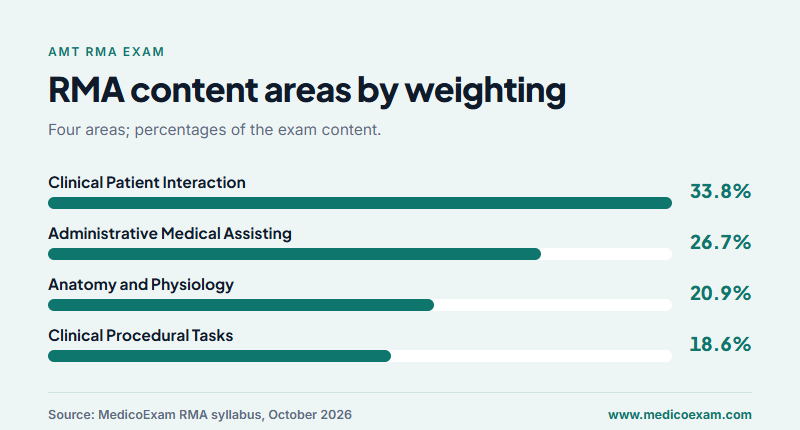
Clinical Patient Interaction: 33.8%
This is the largest area and it is the one most candidates underestimate because it looks like many small topics. It covers patient education, vital signs and measurements, physical examinations, clinical pharmacology, therapeutic modalities, laboratory procedures, electrocardiography (ECG), and first aid, CPR and emergency response. Notice how many separate subjects live in one area. A candidate who revises each one for an equal amount of time will under-study the whole.
Questions here usually test process rather than diagnosis. You may be asked what a medical assistant does first, what should be documented, or what a patient should be told within the assistant's role. This guide covers exam content only. It does not give clinical instruction, and nothing here replaces your training or your employer's protocols.
Administrative Medical Assisting: 26.7%
The second-largest area covers insurance, front-office and clerical tasks, medical law and ethics, and human relations. Candidates with a clinical background often lose marks here because they have not handled billing or scheduling vocabulary in a while. Candidates from the front desk have the opposite problem in the clinical areas, so this one is a good place to score steadily.
Because the area is worth more than a quarter of the exam, it deserves a fixed share of every week of study. Law and ethics questions tend to reward careful reading of what is being asked, such as who may receive information and what must be documented. Insurance questions reward knowing the terms precisely.
Anatomy and Physiology: 20.9%
This area covers the body systems and medical terminology. It is the most memorisation-heavy part of the exam, so spaced repetition suits it better than long sessions. Medical terminology is a skill you can build quickly, because word roots, prefixes and suffixes repeat across systems. Learn the building blocks once and a long list of terms becomes readable.
Anatomy also supports the clinical areas. A candidate who knows the systems finds vital signs, ECG and laboratory questions easier, because the questions assume that background without stating it.
Clinical Procedural Tasks: 18.6%
The smallest area covers aseptic technique, sterilization, instruments, laboratory procedures and minor surgery. Smallest does not mean easiest. Procedure questions often test sequence, and a sequence has to be learned as a sequence, not as a list of facts. Practise saying the steps in order, and check that you can explain why each step comes where it does.
Notice that laboratory procedures appear in both this area and in Clinical Patient Interaction. That overlap is a gift for revision, because one good review of laboratory topics supports two parts of the exam.
A worked example of weighting your time
Suppose you have eight weeks and about six hours a week, which is 48 hours. A flat split would give each area 12 hours. A weighted split follows the percentages instead: about 16 hours for Clinical Patient Interaction, 13 for Administrative Medical Assisting, 10 for Anatomy and Physiology and 9 for Clinical Procedural Tasks. Those numbers are only arithmetic on the published weightings, and you should then shift hours toward whichever area your baseline paper shows is weakest.
The same logic works at topic level. Inside Clinical Patient Interaction, ECG, vital signs and first aid are separate subjects, so a candidate who knows vital signs well can move those hours to pharmacology or emergency response. Write the subject list for each area on a single sheet and tick off a topic only after you have answered practice questions on it, not after you have read about it.
What does the RMA cost, and how do you apply and schedule it?
AMT lists the RMA application fee as $150 on its Medical Assistant page, and says the fee includes the application, the exam and the first annual fee. It adds that fees are non-refundable. Prices are shown in US dollars as of October 2026, and AMT can change them, so check the page when you apply.
The path has four steps, in the order AMT presents them. You check your eligibility, apply, prepare, and then take the exam once AMT sends notice that you are approved. After approval, a Pearson VUE candidate schedules their own exam, and a school candidate follows the date set by the instructor.
Because the fee is non-refundable, do not apply on the strength of hope. Apply when your practice results say you are close. If you are applying through a program, ask your instructor how far in advance the application should be filed, since approval takes time.
Renewal is the part this article cannot answer for you. AMT's Medical Assistant page, as rendered in October 2026, does not set out the renewal rule, and neither does the sheet we work from. Look for the requirements in AMT's candidate materials and on your AMT account before you plan the next few years of continuing education.
Which RMA area should you study first?
Start with a baseline, then study in the order of weight and weakness. A timed baseline paper tells you which of the four areas costs you the most marks. That matters more than the percentage alone, because a 20.9% area you already know well gives you fewer extra marks than an 18.6% area you keep getting wrong.
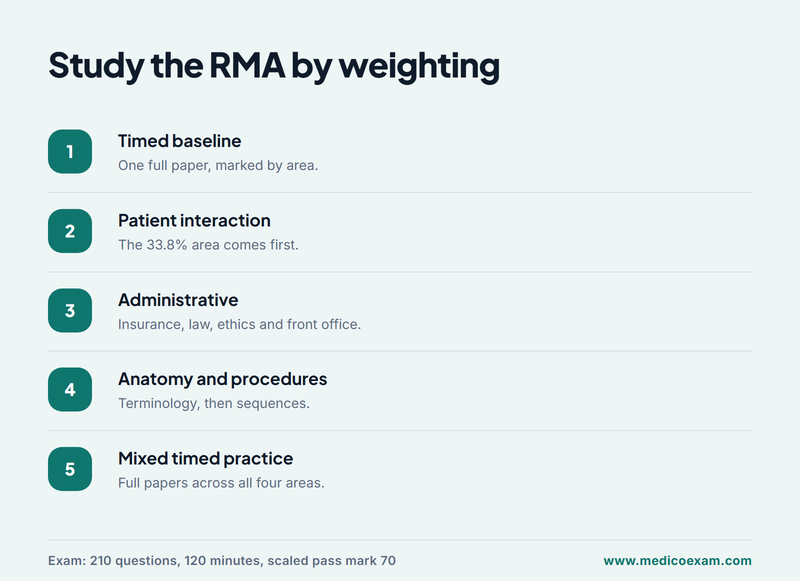
A sound order looks like this. Sit a full timed paper first and mark it by area. Then spend your first block on Clinical Patient Interaction, since at 33.8% it decides the largest part of your score. Move to Administrative Medical Assisting at 26.7%, then Anatomy and Physiology at 20.9%, and finally Clinical Procedural Tasks at 18.6%. Finish with mixed timed papers across all four areas.
Within each block, use the same loop. Read the topics listed in the content outline, answer practice questions on them, and write down every question you missed with the reason. The reason is the useful part. A knowledge gap needs reading, a misread question needs slower reading, and a timing problem needs practice with the clock.
For pace, set a rule for the first pass of the real exam. At about 34 seconds an average question, anything that will plainly take longer should be marked and left. Easy marks gathered first are worth more than one hard question solved at the cost of five others.
What study resources does AMT provide, and where does practice fit?
AMT's page lists its own study resources for the RMA: a practice exam, a fundamentals course, exam content, and reference material. The page also features a candidate handbook, the RMA exam content outline and the reference materials list. Start with the outline and the handbook, because they tell you what the exam covers and how it is run, and everything else should follow from them.
A third-party practice test, including ours, has a different job. It cannot tell you what AMT will ask. MedicoExam is not AMT and does not describe its practice questions as AMT's. What a practice test can do is give you timed repetition by area, so you find weak spots while there is still time to fix them. For a sample of what questions look like, see the RMA sample questions.
Choose practice that follows the weightings above. If a question set spends half its questions on anatomy and a tenth on patient interaction, it is training you for a different exam. Also be wary of memorising answers. Questions in the real exam will be worded differently, and a candidate who memorised wording instead of reasoning is stuck when the wording changes.
Which mistakes cost RMA candidates the most marks?
The first mistake is studying evenly. Four areas of different weight do not deserve equal time, and neither do topics inside an area. A candidate who spends a week on minor surgery and an afternoon on vital signs has inverted the weighting.
The second is skipping the administrative area because it feels easy, or the clinical areas because the candidate already works in one. Experience helps with the topics you meet every day and does nothing for the ones you never meet. A medical assistant who has never handled insurance terms in a practice can lose a quarter of the exam there.
The third is leaving timing untested. 210 questions in 120 minutes is a pace that has to be rehearsed. Sit at least two full papers under the clock before exam day, including the sitting posture and the breaks you intend to take.
The fourth is changing nothing after a poor score. A low result on one area is a signal to change your plan. Re-read the outline for that area, rebuild your notes and test again within a few days, while the gap is still fresh.
The fifth is trusting a summary over the source. This guide, like any third-party guide, can fall behind. Fees, routes and exam content can change, and AMT's pages are the ones that count. Before you apply, open AMT's page, read the current routes and fee, and confirm that what you have planned still matches.
A simple weekly routine
Early in the week, learn new material for one area and finish with a short set of practice questions on it. Midweek, return to last week's weak topics and answer fresh questions on them. At the weekend, take a timed mixed set of 50 to 70 questions across all four areas, mark it by area and write the next week's plan from the result.
This routine keeps new learning and review in balance. Candidates who only keep learning new topics forget the early ones, and candidates who only review never finish the content outline. A mixed set at the weekend also trains the skill the exam actually demands, which is switching between a billing question, an instrument question and a vital signs question without losing speed.
In the last week, stop adding new material. Spend the time on one or two full timed papers, a careful review of every error, and sleep. A rested candidate who knows 90% of the outline will outscore an exhausted candidate who crammed the last 10%.
How do you know you are ready to book the RMA exam?
Look for a pattern, not a single score. When your full-length, timed practice papers stay above 70% across at least two sittings, with no area far below the others, you have reasonable evidence of readiness. A single high score may be luck, and an average that hides a very weak area is a warning.
Also check your logistics. Make sure AMT has approved your application, you know whether you are testing at school or at Pearson VUE, and you have the identification and arrival time required. None of that is about knowledge, and all of it can still cost you the attempt.
The most useful next step is the one that gives you data. Sit a full timed paper, mark it by area, and begin the study order above at the area that cost you the most marks.
Frequently Asked Questions
How many questions are on the AMT RMA exam?
The AMT Registered Medical Assistant exam has 210 questions and a 120-minute time limit. That averages about 34 seconds per question. Short recall questions take less time and scenario questions take more, so rehearse the pace with timed practice before your sitting.
What is the RMA passing score?
To pass you need 70 on AMT's 0-100 scale, about 70%. A scaled result is not a straight tally of right answers, so do not count on a fixed number of correct responses. Target clear margin above 70% in timed practice.
What are the content areas of the RMA exam?
There are four areas: Clinical Patient Interaction at 33.8%, Administrative Medical Assisting at 26.7%, Anatomy and Physiology at 20.9%, and Clinical Procedural Tasks at 18.6%. AMT publishes its own content outline, which is the source to check for any difference.
How much does the RMA exam cost?
As of October 2026 AMT lists $150 USD for the RMA. That single payment covers application, exam and first annual fee, and AMT states it cannot be refunded. Fees change, so read AMT's Medical Assistant page for the current amount before you apply.
Where do you take the RMA exam?
According to AMT, candidates testing on their own schedule the exam at a Pearson VUE testing center. Candidates taking it at school receive the exam date and time from their instructor. In both cases AMT must approve your application first.
Who is eligible to take the RMA exam?
Applicants must meet one of AMT's eligibility routes: education, competency and work-based learning, work experience, military or instructor. AMT shows the conditions for each route on its Medical Assistant page, along with an eligibility assistant to help you choose.


