
COSC Exam Guide: 100 Questions, 240 Minutes, Four Areas
Sitting the AAPC Certified Orthopaedic Surgery Coder (COSC) exam asks 100 questions across 240 minutes, and you need 70% to pass. The questions draw on diagnosis, E/M, procedure and supply coding for bone, joint and spine care. Below you will find the structure, the four areas AAPC lists and a plan for getting ready.
Curious how ready you are today? Take the COSC practice test first and keep the result as a starting point to measure progress against.
What is the COSC credential, and who is it written for?
Orthopaedic coding rewards precision more than most specialties. A single operative report can describe a fracture reduction, a screw fixation, a cast and a follow-up plan, and each of those pieces is reported differently. The COSC credential from AAPC is meant to show an employer that you can read that kind of record and turn it into correct, defensible codes.
AAPC describes the credential as validating a medical coder's advanced expertise in orthopaedic surgery coding, with skill in applying diagnosis, procedure and supply code sets to musculoskeletal conditions and surgical procedures. It says the certification suits coders working in orthopaedic practices, ambulatory surgical centers, multispecialty groups and hospitals where musculoskeletal surgery is performed.
AAPC's page names four groups who should consider it: coders employed by orthopaedic practices, surgical centers or hospitals, billers and reimbursement staff who work orthopaedic surgery claims, auditors and compliance professionals, and experienced CPC-certified coders who want to specialise. That last group is the most common route in practice, because a general coding foundation makes the specialty material easier to absorb.
The experience statement on the same page is worth reading closely. AAPC asks for strong command of orthopaedic terminology, anatomy and pathophysiology, plus the ability to apply CPT for procedures, HCPCS Level II for supplies and similar items, and ICD-10-CM for diagnoses. It is a description of what the exam assumes you already know, not a list of forms to submit, so use it as a self-assessment before you pay for a voucher. You can read the current wording on AAPC's COSC certification page, which is where any change to the requirements will appear first.
How is the COSC exam structured: questions, time, fee and delivery?
Expect 100 questions, 240 minutes on the clock and a 70% threshold to pass. That works out at 2.4 minutes per question, a generous allowance compared with many certification exams. The time is there because the questions are scenario-heavy: you read an operative note or a clinical summary, find the key details and then choose the code or modifier that fits.
The fee, as of October 2026, is $325 for one attempt or $399 for two exam attempts. AAPC's own page shows the exam voucher as starting at $325, so confirm the current figure there before you buy. AAPC also lists an online self-paced preparation course starting at $660, which is a separate purchase and is not required to sit the exam.
AAPC offers two ways to sit: from home with a live proctor watching remotely, or in person at a test center. Voucher purchase comes first, and the dates and times you can pick depend on appointment availability through the testing provider, Meazure Learning, so book early if you have a deadline.
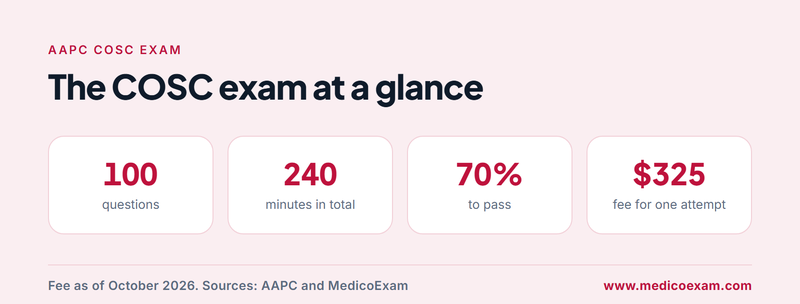
The table below collects the key facts in one place. Each figure also appears in the text above.
| Item | Detail |
|---|---|
| Credential | AAPC Certified Orthopaedic Surgery Coder (COSC) |
| Number of questions | 100 |
| Exam length | 240 minutes |
| Pass mark | 70% |
| Fee | $325 (one attempt) or $399 (two attempts), as of October 2026 |
| Where you sit | At home with a remote proctor, or in a test center |
| Keeping the credential | Annual AAPC membership and 36 CEUs per two-year cycle |
AAPC does not state a retake waiting period on the page we reviewed, and we do not guess one here. If you are weighing the two-attempt voucher against a single attempt, read AAPC's current exam policies first. The $74 difference in price buys a second chance without paying for a second voucher, which matters most to candidates who are sitting the exam while working full time.
What does the COSC exam actually test?
AAPC groups the exam content into four areas. They are core knowledge areas, surgical coding of the upper and lower extremities, spine and joint procedures, and casting, splinting and other orthopaedic services. AAPC does not publish percentage weights for them on the page we reviewed, so treat the four as a map rather than a ranking, and do not trust any source that quotes exact weights without citing AAPC.
Core knowledge areas
This area covers three skills that sit under everything else. The first is ICD-10-CM diagnosis coding for musculoskeletal injuries, deformities, degenerative diseases and traumatic conditions. The second is E/M coding for orthopaedic consultations, fracture care and post-operative management. The third is applying modifiers and payer rules that are specific to orthopaedic surgery.
Diagnosis coding here depends on details that are easy to skim past. Laterality, the site and type of fracture, whether a fracture is open or closed, and the seventh character that tells the payer whether the encounter is initial, subsequent or for a sequela all change the code. A coder who reads the note quickly and picks the nearest match will lose marks on questions built to test exactly that attention.
Surgical coding of the upper and lower extremities
AAPC lists procedures involving the shoulder, elbow, wrist, hand, hip, knee, ankle and foot. It also lists coding for fracture repairs, dislocations and reconstructive surgeries, and for arthroscopic and open surgical procedures of the extremities. This is the widest area by number of anatomical sites, so organise it by joint rather than trying to memorise code ranges in order.
For each joint, learn the questions the CPT code book forces you to answer. Was the procedure open, arthroscopic or percutaneous? Was a fracture treated with or without manipulation, and was fixation involved? Was the work on bone, on soft tissue or on both? A candidate who asks those three questions on every scenario will find the right section of the book far faster than one who searches by keyword.
Spine and joint procedures
This area includes spinal surgeries such as decompressions, fusions and disc procedures, total joint replacements, revisions and partial replacements, and arthroscopy, injections and surgical interventions for chronic joint conditions. Spinal coding is where the exam rewards patience, because one operation can involve several levels, an approach, a graft and instrumentation, each with its own reporting rule.
Read the operative note in order and build the claim in the same order: the approach, the levels, what was done at each level, then any add-on work. Add-on codes cannot be reported alone, and the exam will check whether you know which primary code a given add-on belongs with. Total joint work follows a similar logic, with the distinction between a primary replacement, a partial replacement and a revision deciding the code family.
Casting, splinting and other orthopaedic services
The last area covers the application and removal of casts, splints and strapping, injections and aspirations for joints, tendons and bursae, and coding for orthopaedic imaging, diagnostic testing and ancillary services. It looks like the lightest area, and it often hides the trickiest bundling questions, because cast and splint services interact with fracture care and with the global surgical package.
A rule to carry into the exam: before you add a code for a service, ask whether the primary procedure already includes it. Questions in this area are often built around a service that looks reportable but is bundled, or around a supply that is reported separately with an HCPCS Level II code. Knowing which is which is the difference between a clean claim and a denied one.
Which COSC topics are hardest for working coders?
Experience helps with the areas you touch every day and fails you on the ones you do not. A coder who handles office visits all day may be fluent in E/M and slower on spine fusions, while a hospital coder may be the reverse. The honest way to find your hard topics is to sit a timed paper and mark it by area, because your sense of what is difficult is often wrong.
Three topics catch many candidates. The first is modifier use, because several modifiers look similar and the exam asks you to pick the one that fits the documentation rather than the one that feels familiar. The second is the global surgical package, where you must decide which visits and services belong to the surgery and which can be reported separately. The third is multi-level spine and multi-site extremity work, where it is easy to count a code twice or miss an add-on.
Candidates who come from a clinical background tend to have the opposite problem. Anatomy and terminology come easily, but the reporting rules do not, and the exam asks for rules. If that is you, spend your time in the CPT guidelines at the start of each section, because those guidelines carry the instructions that decide most scenario questions. Candidates who come from billing often know the payer rules and need more time on anatomy, so build a one-page list of joints, bones and common procedures and review it daily.
What do real COSC scenarios look like?
The best way to prepare for scenario questions is to practise a method that works on any of them. The examples below are illustrations of that method, not exam questions, and they teach reasoning rather than medicine. Always confirm codes in the current code books, because code sets are updated and a memorised number can go out of date.
An arthroscopic knee procedure
A note describes an arthroscopic procedure on the right knee in which the surgeon removes damaged tissue from one compartment. Your steps are to identify the joint and the side, confirm the approach is arthroscopic, find the specific procedure performed and check the CPT guidelines for the arthroscopy section. Those guidelines state that a surgical arthroscopy includes a diagnostic arthroscopy, so you would not add a separate diagnostic code for the same joint. A code such as 29881 sits in this family, and the diagnosis and the laterality modifier complete the line.
A fracture treated in the clinic
A patient is seen for a closed fracture, the fracture is treated and a cast is applied. Your first question is what the fracture care code includes. For many fracture treatment codes the initial cast or splint application is part of the service, so adding a separate cast code would be wrong. The supplies used may still be reported with HCPCS Level II codes when the payer allows it. The diagnosis carries the fracture type, the side and the initial-encounter seventh character.
A multi-level spinal fusion
An operative note describes a fusion in the neck with a plate and a graft. Build the claim in order: the approach, the level or levels, the fusion code, then add-ons for additional levels, instrumentation or graft where the CPT book allows them. A code such as 22551 describes an anterior interbody fusion in the cervical spine below the C2 level, and its instructions tell you what is already included. The exam checks that you stop at what the book allows.
A global-period visit
A patient returns two weeks after a surgery for a wound check, and later for a new, unrelated problem. The first visit is generally part of the global package and is not reported separately. The second may be reportable with a modifier that tells the payer it was unrelated to the surgery. The exam asks you to separate the two, and the documentation, not your assumption, decides which is which.
Is there a practice test for the COSC, and how should you use it?
MedicoExam offers a COSC practice test built around the four areas AAPC lists, so you can take a timed paper and see which area costs you the most marks. We are an independent preparation site and are not affiliated with AAPC, so treat our questions as practice for the skill, not as a preview of the live exam. AAPC's COSC page promotes an online training course and an exam voucher but shows no practice exam, so we will not assume one exists.
Use a practice test in three passes. Take the first untimed to learn the style, with your code books open and every answer checked against the guidelines. Take the second timed and without help to measure where you stand. Take later ones as full mixed sets, and after every one, write down why each wrong answer was wrong. The note matters more than the score, because it tells you whether the gap is a missing fact, a misread scenario or a rushed choice.
On code books, AAPC asks candidates to choose print or ebook books when they redeem the voucher, from its approved list, so check the instructions at that point instead of assuming. Whatever format you use, practise with the same books you will use in the exam, tab the guidelines at the start of each CPT section and learn where the modifier list and the HCPCS Level II supply section sit. In a 240-minute exam, a minute saved on each lookup adds up.
How should you study for the COSC in six weeks?
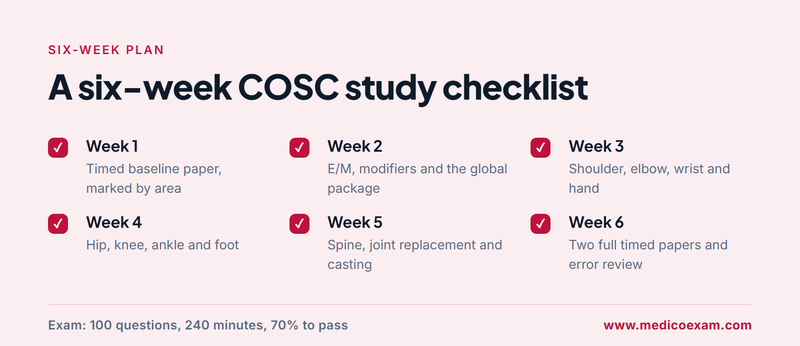
Six weeks is a realistic plan for a working coder who already codes regularly, at roughly an hour a day on weekdays plus a longer block on Saturday or Sunday. If you are new to musculoskeletal coding, add weeks rather than compressing the plan. The order below follows the four areas AAPC lists.
- Week 1: take a timed baseline paper, mark it by area, and review the ICD-10-CM musculoskeletal guidelines, especially fracture coding and the seventh characters.
- Week 2: work on E/M for orthopaedic consultations and post-operative care, then on modifiers and the global surgical package.
- Week 3: cover the shoulder, elbow, wrist and hand, with fracture and dislocation coding.
- Week 4: cover the hip, knee, ankle and foot, including arthroscopy and open procedures.
- Week 5: study the spine and joint replacements, then casting, splinting, injections and imaging.
- Week 6: take two full timed papers, review every error and stop adding new material.
Within each week, pair one new area with a short quiz on it. On a midweek day, revisit what you missed the week before. Then use the weekend for a timed mixed set that spans all four areas, scored area by area, and let those scores set next week's priorities.
The pattern balances new content against retention. Learning without review lets early topics fade, while review without new content leaves the syllabus unfinished. Mixed sets also build the habit the exam rewards: shifting from a diagnosis question to a spine scenario to a casting question at an even pace.
In the final week, add nothing new. Sit timed papers, go through each mistake and sleep properly; a rested candidate who has covered most of the syllabus will usually beat an exhausted one who crammed all of it. Book once two full-length timed papers in a row land above 70%, with no single area trailing badly.
What happens after you pass: renewal and next steps
To keep the COSC, AAPC requires an active annual membership and 36 CEUs in each two-year period, with 8 of those tied to orthopaedic surgery. That requirement is easier to meet if you plan for it, because orthopaedic-specific units are a smaller pool than general coding units. Check the current rules on AAPC's page before each renewal cycle, since they are set by AAPC and can change.
A COSC credential also changes what you can offer an employer. AAPC lists accurate reimbursement, lower compliance risk and a path to auditing and compliance roles among the reasons to earn it. We do not publish salary figures here, because any figure needs a source you can open, and the best evidence of value is the job postings in your own market.
Your next move should produce data. Complete one full timed paper, score it by area and start the plan above with the area where you lost the most. Once you can test across all four areas, come back to the COSC practice test and compare the result with your baseline. For anything that can change, such as fees, delivery and renewal rules, AAPC's COSC page is the final word.
Frequently Asked Questions
How many questions are on the COSC exam?
The AAPC Certified Orthopaedic Surgery Coder exam asks 100 questions and gives you 240 minutes. That allows about 2.4 minutes per question, which suits scenario questions where you read an operative note before choosing a code. Practise at that pace with timed papers before your sitting.
What is the COSC passing score?
The passing score is 70%. Aim for a clear margin above that in timed practice rather than a bare pass, because scenario questions vary in difficulty. Mark each practice paper by topic area so a strong area does not hide a weak one.
How much does the COSC exam cost?
As of October 2026, one attempt costs $325 and a voucher covering two attempts costs $399. AAPC's COSC page shows the voucher as starting at $325. Fees can change, so check AAPC's page for the current amount before you buy.
What does the COSC exam cover?
There are four areas: the core knowledge areas, extremity surgery, spine and joint procedures, and casting and splinting services. Between them they cover diagnosis, E/M, procedure and supply coding, plus modifiers, for musculoskeletal conditions and surgery.
Can you take the COSC exam online?
Yes. AAPC lets you test from home under live remote proctoring or in a test center. Buy the voucher, then pick a slot from those offered through the testing provider, Meazure Learning.
How do you renew the COSC credential?
Stay a current AAPC member and log 36 CEUs per two-year cycle; AAPC says 8 must be orthopaedic specific. Read AAPC's COSC page before each renewal cycle, because AAPC sets the rules and can change them.


