
ACRP CPI Practice Test and Exam Guide: Six Weighted Areas
The ACRP Certified Principal Investigator (CPI) exam has 125 questions (100 scored and 25 pretest), runs for 180 minutes and reports a scaled score, with 600 on a 200-800 scale needed to pass. It tests six areas of clinical research, led by ethical and safety considerations at 22% of the weighting.
The exam is built for people who have already led or co-led studies, so preparation is mostly about judgment, not memory. To see where you stand before you pay ACRP, take the CPI practice test first and use that result as your starting point.
| CPI exam fact | What the sources say |
|---|---|
| Questions | 125, of which 100 are scored and 25 are pretest items |
| Time limit | 180 minutes |
| Passing score | 600 on a scale of 200-800, approximately 67% |
| Fee, as of October 2026 | $435 to $600 depending on membership and registration date |
| Delivery | Computer-based at PSI test centers or live remote proctoring |
| Testing windows | Spring February 15 to May 15; fall July 15 to October 15 |
| Credential validity | 2 years |
Who can sit the CPI exam, and what does ACRP ask you to prove?
The CPI is a credential for clinical research professionals who have worked as a principal investigator or as a sub-investigator on more than one study. ACRP's CPI certification page sets a baseline of 3,000 hours of verifiable work experience, and it attaches an education requirement and an experience requirement to that baseline.
On education, ACRP accepts a doctorate-level degree such as DDS, MD, DO, MBBS, MBChB, PhD, PharmD or DNP. It also accepts a licensed physician's assistant, a nurse practitioner, or a sub-investigator who has served in a principal investigator role. If none of those describes you, the exam is not open to you yet, however well you would score.
On experience, you need proof of employment as a principal investigator or sub-investigator for at least two of the most recent five years. A regulatory authority document that verifies your role on the trial you submit is the kind of evidence ACRP lists. Work counts only if it relates to human subject research, rests on a paid contractual agreement between employer and employee, and ACRP can verify it through the employer.
Three things do not count: work done as part of a degree track or education program, experience older than ten years, and internships, paid or unpaid. The ten-year limit can leave a long career with fewer qualifying recent years than you expect, so count your own years before you plan a date.
ACRP may grant one waiver worth 1,500 hours of professional experience. You qualify if you hold an active ACRP certification, have a doctorate, or have completed a clinical research education program that matches the topics in the Exam Content Outline, carries valid third-party accreditation and gives knowledge equal to 1,500 hours of experience. With a waiver, the proof of employment drops to at least one of the most recent five years. ACRP decides on program approval itself and does not pre-approve a program outside a paid application, so do not assume yours will be accepted.
How is the CPI exam structured and scored?
The paper has 125 questions in 180 minutes. Of those, 100 are scored and 25 are pretest items, which are questions being trialled for future exams. The sources do not say whether pretest items are marked in any way, so answer every question as if it counts. You can sit the exam on a computer at a PSI test center or through live remote proctoring, and you choose the mode when you schedule.
Time works out at about 86 seconds per question if you spread it evenly. That is generous for a short factual item and tight for a long scenario, so the real skill is moving quickly through the first kind to protect your time for the second. A sensible habit is to check the clock after every 25 questions: five checkpoints, each about 36 minutes apart if you are on pace.
The passing score is 600 on a scaled range of 200 to 800, and the Master record puts that at approximately 67%. A scaled score is not a simple count of correct answers, so do not turn 67% into a hard target of 67 correct answers out of 100. Aim well above it in practice papers, and treat a result that only just clears the line as a warning, not a pass.
What do the six CPI exam areas cover, and how much is each worth?
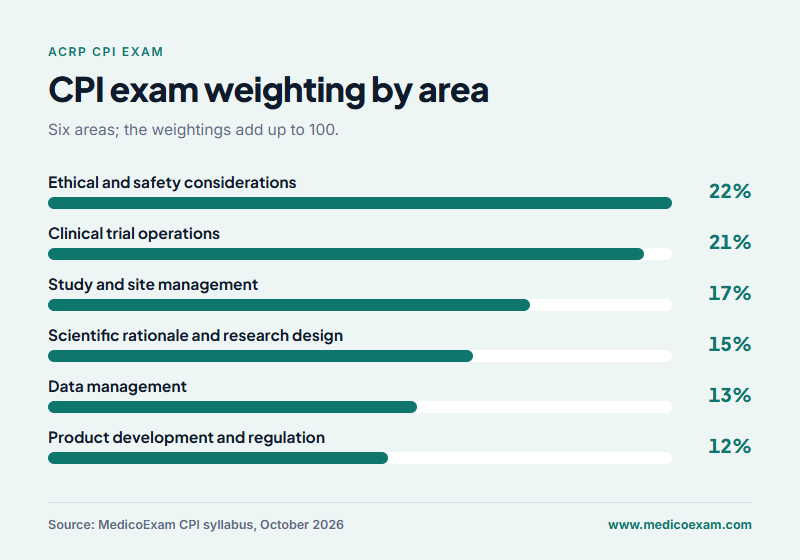
The syllabus has six areas with published weightings that add up to 100. Ethical and safety considerations carry the most at 22%, followed by clinical trial operations at 21%, study and site management at 17%, scientific rationale and research design at 15%, data management at 13% and product development and regulation at 12%. If you apply those weightings to the 100 scored items, ethics and safety would account for about 22 questions, though the sources do not publish question counts per area.
| CPI exam area | Weighting |
|---|---|
| Ethical and safety considerations | 22% |
| Clinical trial operations | 21% |
| Study and site management | 17% |
| Scientific rationale and principles of research design | 15% |
| Data management | 13% |
| Product development and regulation | 12% |
Ethical and safety considerations (22%)
This is the largest area and the one a principal investigator is expected to know best. The syllabus names two themes: human participant protection, and safety monitoring and reporting. Expect questions that describe a situation at a study site and ask what you, as the investigator, should do first or who must be told. Study the duties that attach to your role, not only the definitions.
Clinical trial operations (21%)
The second-largest area covers feasibility and study conduct, investigator responsibilities and quality assurance. Many candidates under-prepare here because they run trials every day and trust their routine. The exam asks for the standard approach, which can differ from how your own site does things, so read each scenario as a general case and not as a description of your workplace.
Study and site management (17%)
The syllabus lists investigational product management, equipment and supplies, clinical trial and site management, and operational participant oversight. This area rewards organised thinkers: who holds responsibility for what, how records of supplies are kept, and how oversight is delegated and still remains yours. If your site has a pharmacy or a coordinator who handles these tasks, ask them how the process is documented.
Scientific rationale and research design (15%)
Here the topics are study objectives and processes, including statistical principles and study end points, plus the design of a study, investigational products or devices, and treatment assignments. You do not need to be a statistician, but you should be able to read a design description and say what it is trying to show and what could weaken that.
Data management (13%)
This area covers clinical trial documentation, protected health information and data confidentiality, and data review and retention. Questions tend to test whether you know what must be documented, who may see which information, and how long records must be kept. Retention periods and privacy rules vary by region, so learn the rules that apply where you work and read the question for clues about which framework it assumes.
Product development and regulation (12%)
The smallest area covers the product development cycle, the function and reporting of an IRB, IEC or regulatory body, and data monitoring and inspection. It is the smallest, but it is also the one investigators who work mostly in academic settings tend to meet least often, so a short, focused review can lift your score faster here than extra hours on a stronger area.
When can you take the CPI exam, and what does it cost?
ACRP runs two testing windows a year. Spring testing runs from February 15 to May 15, and fall testing runs from July 15 to October 15. Registration has two price tiers inside each cycle, an early bird period and a regular period, and the dates differ by cycle.
| Registration | ACRP members | Nonmembers | Spring dates | Fall dates |
|---|---|---|---|---|
| Early bird | $435 | $485 | October 20 to December 31 | May 20 to July 15 |
| Regular | $460 | $600 | January 1 to April 30 | July 16 to September 30 |
These fees are as of October 2026, in US dollars, and ACRP can change them, so confirm the amount on its page before you pay. The saving from registering early is $25 for a member and $115 for a nonmember. The gap between member and nonmember pricing is $50 at the early bird rate and $140 at the regular rate, so a nonmember who plans to register late pays the most.
The calendar matters today. The fall window closed on October 15, so the next chance to test is spring, and the spring early bird period opened on October 20 and runs to December 31. If you plan to sit in spring, the cheapest route is to register in that window and use the months before February 15 for preparation.
How should you prepare for the CPI in the weeks before the exam?
ACRP's page and the sources used for this guide do not state a recommended number of study hours, so build the plan from the weightings instead. Start with a full timed paper to find your baseline, sort every wrong answer by the six areas, and give the most time to the area where you lose the most marks multiplied by the weighting. A weak 22% area costs you more than a weak 12% one.
An eight-week plan fits around the clinic and study duties of a working investigator. Treat the schedule below as a suggestion from this guide, not as an ACRP rule.
- Weeks 1 and 2: take a timed baseline paper, then read the Exam Content Outline and the syllabus topics for your two weakest areas.
- Weeks 3 to 5: rotate through all six areas, finishing each with a short set of scenario questions and writing one line on why each wrong answer was wrong.
- Weeks 6 and 7: sit two full timed papers under exam conditions and compare the scores by area.
- Final week: revisit your error log, check your exam logistics and rest before the day.
The error log is the most useful tool in the plan. For each missed question, write down the area, what you chose, what the better answer was and the rule behind it. After two weeks you will see patterns, such as choosing a technically correct action in the wrong order, and you can correct them instead of simply reading more.
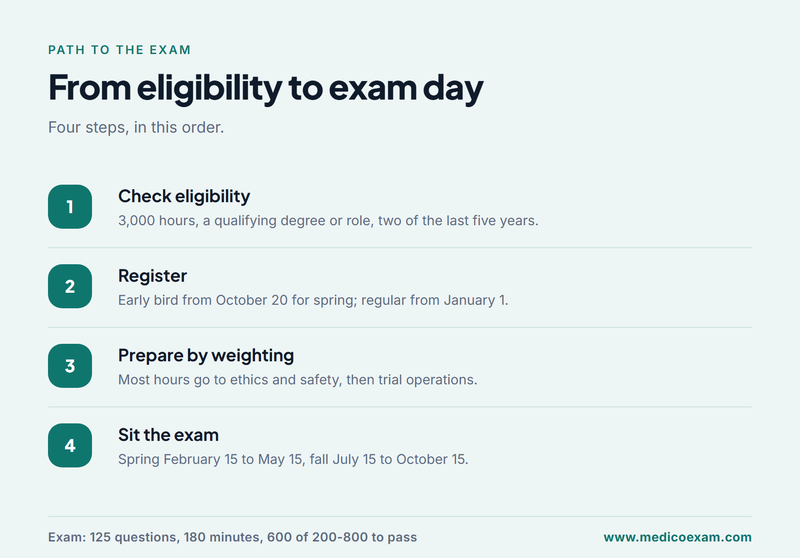
The path to the exam has four steps, and it helps to do them in this order: confirm you meet the eligibility rules, submit your application and register in the cheapest window you can reach, prepare by weighting, and sit the exam inside the testing window you booked.
How do you answer CPI scenario questions under time pressure?
Most questions describe a situation and ask for the best response, the first step or the person responsible. Start with the final sentence so the ask is clear, then read the scenario for the facts that bear on it. Many wrong options are reasonable in general but wrong for the role or the moment the question describes.
Eliminate options that skip a required step, ignore a duty that sits with the investigator, or act before the information is known. When two options remain, ask which one protects participants and keeps the study compliant at the same time. That test settles a surprising number of close calls in the ethics and operations areas, which together carry 43% of the weighting.
Do not let a single hard question cost you the next five. If a scenario is still unclear after about two minutes, flag it, give your best answer and move on. At your 25-question checkpoints, a deficit of more than ten minutes tells you to speed up on the short items, and leaving the final stretch for flagged questions ensures none are left blank.
Watch for answers that come from habit. Your site's routine is one valid way of working, yet the paper assumes a generic site. Where your instinct and the documented standard part ways, go with the standard and record the item in your error log.
Which mistakes cost CPI candidates the most marks?
The first mistake is treating experience as preparation. Running studies for years gives you fluency in your own processes, but the exam measures knowledge of the general standard across six areas, and a site routine that is faster than the standard, or slightly different from it, can steer you to a wrong answer. Use your first timed paper to find out how far your habits and the standard actually agree.
The second is spreading time evenly across the syllabus. Ethics and safety plus clinical trial operations make up 43% of the weighting, while product development and regulation is 12%. Equal hours for each area mean the heaviest part of the paper gets less attention than its share of the marks justifies. Weight your hours by the table above, then add extra time to any area where your error log shows repeated misses.
The third is reading for keywords instead of for the question. Scenario items often include details that make several options look attractive, such as a deadline, a senior colleague or a participant request. Ask what role the question puts you in and what that role must do before anything else, and use the other details only to confirm your choice.
The fourth is leaving logistics to the last week. Eligibility proof, such as a regulatory document that verifies your role, takes time to locate, and the registration tiers reward early action. Gather your employment evidence while you study, so that an application delay never forces you into a later window or a higher fee.
The fifth is relying on one source. A syllabus, a set of practice questions and a colleague's advice each show you part of the exam. Combine ACRP's Exam Content Outline, timed practice that reports results by area, and a review of your own error log, and you will see the gaps that any single source would hide.
How long does the CPI last, and how do you renew it?
The Master record gives the credential a validity of 2 years. The renewal rules for the CPI are on a section of ACRP's certification pages that this guide could not read in full, so no continuing education figure is given here. Look up the current requirements once you have passed, and put the end of your cycle in your calendar the day the result arrives.
Keep records as you go. Certificates of attendance, training logs and the dates of study milestones are easier to gather in a folder over two years than in the last month. Because ACRP may change its rules, rely on its page, not on a forum thread or an old article, for the final word.
Does ACRP publish a CPI practice exam, and where does MedicoExam fit?
ACRP is the certifying body and runs the real exam. It also lists exam preparation resources for its certifications, which is the right place to start for anything it endorses. MedicoExam has no affiliation with ACRP, and nothing in its question bank is presented as an ACRP product.
The MedicoExam practice exam for the CPI has 245+ exam-aligned questions in timed, scenario-based form, so you can find weak areas before you register. MedicoExam also publishes CPI sample questions and a syllabus page. Whichever set you pick, check that its questions make you choose a course of action instead of recalling a definition. Two complete timed papers in succession that clear the pass line comfortably are a fair sign that you can register with confidence.
A full timed attempt teaches more than another evening of reading, so book yourself into a full CPI practice test this week and let the area scores tell you what to study first.
Frequently Asked Questions
What is the CPI exam length in questions and minutes?
The ACRP CPI exam has 125 questions, of which 100 are scored and 25 are pretest items, and you get 180 minutes. That is about 86 seconds per question if you spread the time evenly, so move quickly through short items to leave time for the long scenarios.
What is the CPI passing score?
You pass with 600 on ACRP's scale of 200 to 800, which the exam sheet translates to roughly 67%. Because the result is scaled, it is not a plain count of right answers. Practice papers should land well above that figure before you register, not just on it.
How much does the CPI exam cost?
As of October 2026, early bird registration costs $435 for ACRP members and $485 for nonmembers. Regular registration costs $460 for members and $600 for nonmembers. Fees can change, so confirm the amount on ACRP's CPI page before you pay.
When can you take the CPI exam?
There are two sittings a year: a spring window from February 15 to May 15 and a fall window from July 15 to October 15. Registration happens ahead of each window, and the early bird price applies to the first stretch before the regular registration dates begin.
Who is eligible to sit the CPI exam?
You need 3,000 hours of verifiable research experience, a qualifying education route, and proof of work as a principal investigator or sub-investigator in at least two of the last five years. ACRP may waive 1,500 hours in some cases, which reduces the proof to one year.
What are the six CPI exam areas?
Ethics and safety lead at 22%, then trial operations at 21% and site management at 17%. Research design is 15%, data management 13% and product development and regulation 12%. The sources give weightings only, so the number of questions in each area is not published.
Can you take the CPI exam online?
Yes. The exam is delivered by computer at PSI test centers or through live remote proctoring. You choose the mode when you schedule, and the available dates depend on the mode and location you pick inside the testing window.
- ACRP CPI Question Bank |
- ACRP CPI Eligibility & Requirements |
- ACRP Principal Investigator Practice Test |
- ACRP CPI Exam Cost |
- ACRP CPI Registration Process |
- ACRP Principal Investigator Study Guide |
- ACRP CPI Recertification |
- ACRP CPI Certification Overview |
- ACRP Principal Investigator Syllabus |
- ACRP CPI Preparation Time |
- ACRP CPI Passing Score |
- ACRP CPI Exam Format |
- ACRP Principal Investigator Sample Questions |
- ACRP CPI Career Opportunities


