
CRHC Exam Guide: 100 Questions in 240 Minutes
The CRHC is AAPC's Certified Rheumatology Coder exam: 100 questions in 240 minutes, with a passing score of 70. It tests ICD-10-CM, E/M, infusion and injection, procedure and chronic disease coding for rheumatology. Start with the CRHC practice test, then work through the four syllabus areas below.
Where can you get CRHC practice questions, and does AAPC provide any?
On AAPC's CRHC page, AAPC offers two things: an online self-paced exam preparation course, listed as starting at $560, and an exam voucher, listed as starting at $325. The page does not show a practice exam, so do not assume one comes with the voucher. MedicoExam is an independent practice provider and is not AAPC: our practice test is our own question set, written against the published CRHC content areas, and it is not AAPC material.
To get it, open the CRHC practice test page, which holds the cart. If you only want to see the style of question first, the sample questions for this exam sit beside the syllabus page. Whatever source you use, check it against the content areas AAPC publishes, because a question bank is only useful if it matches what the exam covers.
How is the CRHC exam structured: questions, time, scoring and attempts?
Expect 100 questions to be answered within four hours (240 minutes), which is about 2.4 minutes for each one. The pass mark recorded for the exam is 70. AAPC lets you sit it from home under a live remote proctor, or in person at a testing center; the voucher comes first, and holding one unlocks the dates and times on offer.
Sitting once costs $325, and a bundle of two exam attempts costs $399 (October 2026 prices). The bundle adds only $74, so weigh it up before you buy if you doubt a first-time pass. Check the current fee and retake terms on the AAPC page before paying, because vendors change prices and conditions.
| Item | CRHC detail |
|---|---|
| Credential | AAPC Certified Rheumatology Coder (CRHC) |
| Validity | 2 years |
| Fee, October 2026 | $325 for one attempt; $399 for two exam attempts |
| Allowed time | 240 minutes (4 hours) |
| Number of questions | 100 |
| Pass mark | 70 |
| Delivery options | Remote proctoring from home, or a testing center |
Four hours for 100 questions is a generous allowance, and that changes how you should prepare. The limit is not there to rush you; it is there because many questions ask you to read a short scenario, find the documentation that matters and then choose the correct code or code combination. Practise reading carefully rather than racing, and use the full paper under timed conditions at least once so that sitting for four hours is not a surprise.
What does the CRHC exam actually test?
AAPC presents the CRHC as proof of advanced rheumatology coding skill: assigning diagnosis codes (ICD-10-CM), procedure codes (CPT) and drug and supply codes (HCPCS Level II) to rheumatology diagnoses, procedures and infusion therapies, within current guidelines and payer rules. The content falls into four areas, and the MedicoExam syllabus page lists them in the same order.
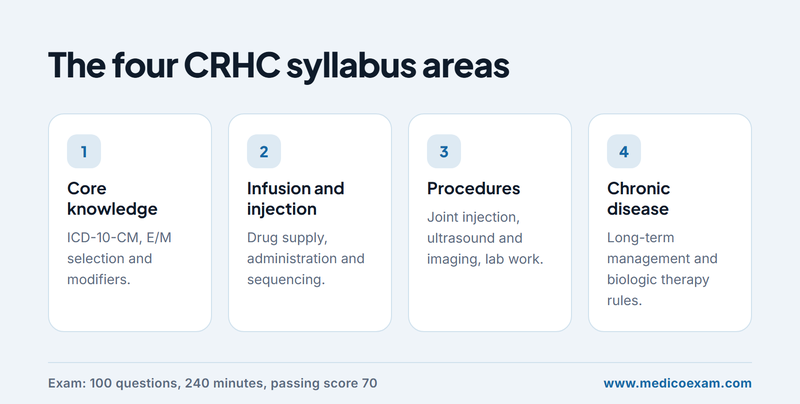
Core knowledge areas. This is the foundation. Expect ICD-10-CM diagnosis coding for autoimmune, connective tissue and musculoskeletal conditions, with AAPC naming rheumatoid arthritis, lupus, scleroderma, vasculitis and gout. It also covers E/M service selection for new, established and consultative rheumatology patients, and the correct use of modifiers with payer-specific guidelines. In this area you are coding what the record documents, so the skill being tested is reading the note accurately and applying the guideline, not remembering a diagnosis list.
Infusion and injection services. This area is the most distinctive part of rheumatology coding. AAPC lists coding for biologic and non-biologic drug administration, including intravenous infusions, subcutaneous injections and intra-articular injections, the documentation needed for drug supply under HCPCS Level II and for the administration procedure, and the sequencing rules when several drugs are given in one encounter. Questions here tend to hinge on a detail in the documentation, such as the route, the drug or the order of administration, so study the rules for each rather than memorising a single pattern.
Diagnostic and therapeutic procedures. AAPC names joint aspiration and injection coding, including small, intermediate and major joint procedures, coding for musculoskeletal ultrasound and imaging used in rheumatology, and the laboratory testing and therapeutic procedures commonly performed in rheumatology practices. The practical point is joint size. Learn how the joint categories are defined in the CPT guidance and practise assigning them from documented procedure notes.
Chronic disease management. The last area covers coding for the long-term management of rheumatoid arthritis, psoriatic arthritis, lupus and other systemic conditions, documentation and coding for medication monitoring and follow-up, and an understanding of payer guidelines for chronic care management and biologic therapy coverage. Here the questions are about continuity: how an ongoing condition is reported across repeated visits and what the record must show to support it.
AAPC's page lists these areas but does not show a percentage weighting for each, and we do not publish one either. Until AAPC states otherwise, assume the four areas count about equally, and decide where to spend your hours from your own scores.
Who can sit the CRHC and what experience does AAPC expect?
AAPC expects you to arrive already knowing rheumatology terminology, anatomy and pathophysiology, and able to apply the CPT, HCPCS Level II and ICD-10-CM code sets correctly. It states this as knowledge you should have, not as a fixed number of years of experience, and it recommends its CRHC exam preparation course if you are not ready yet.
AAPC's page describes the credential as suited to:
- certified coders working in rheumatology practices or multi-specialty groups with rheumatology departments
- hospital coders, revenue cycle professionals and coding auditors who specialise in infusion therapy or complex chronic disease management
- billing managers who oversee rheumatology services, specialty infusion centers or outpatient hospital departments
- medical coders who want to move into a specialty focused on autoimmune, musculoskeletal and chronic inflammatory conditions
If you are already a general coder, the exam asks you to apply what you know to a narrow setting. If you are newer to coding, the biggest gap is usually the combination of drug supply and administration coding, which does not appear in the same form in general practice coding. Be honest about which group you are in before you set your study time.
How should you study for the CRHC exam in an order that works?
Begin with a timed baseline: one full set of questions, marked by area, so you can see where you actually stand. Do not start by reading everything; start by finding the weak area, and then spend your time there. A baseline that exposes infusion sequencing as your weak spot tells you more than any general plan.
After the baseline, work area by area. Begin with the core knowledge area, because diagnosis coding and E/M selection run through every other area, then move to infusion and injection services, then procedures, then chronic disease management. For each area, read the relevant guideline, code ten documented scenarios yourself without looking at the answer, and then check your reasoning, not just your final code. A correct code reached for the wrong reason will fail you on the next variation.
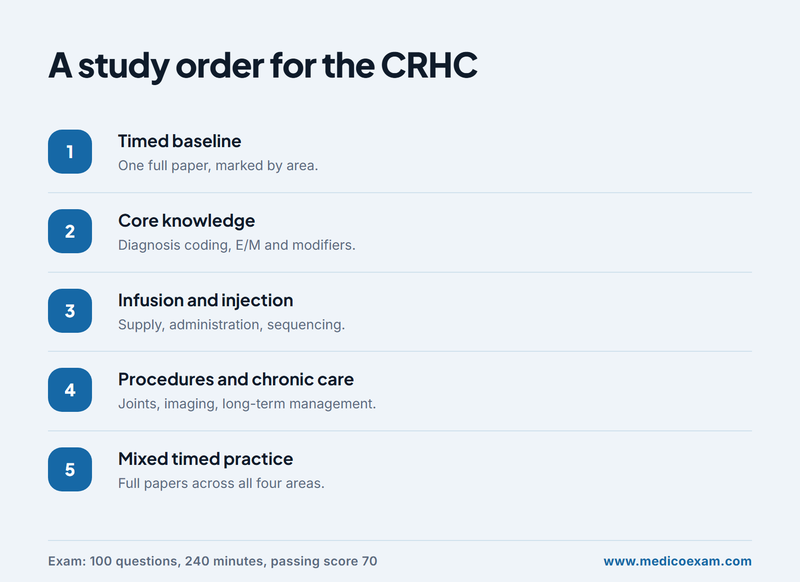
In the last stage, mix the areas. The real paper does not announce which area a question belongs to, so finish with full timed papers that jumble all four. Review every question you got wrong and every one you guessed, and write the rule you missed in one sentence. That list of rules becomes your final revision sheet.
How long this takes depends on your starting point, and we do not give a fixed number of weeks because no honest figure fits every candidate. A working rheumatology coder may need a short refresh of the rules, while a coder from another specialty needs time to learn the drug administration material from scratch. Set your plan from the baseline result, not from a generic schedule.
Which CRHC areas are hardest for coders from a general background?
AAPC does not publish difficulty ratings or pass rates by area, so this is our reading of the syllabus, not a statistic. For a general coder, the infusion and injection area is the likeliest place to lose marks, because it combines two coding systems in one scenario: HCPCS Level II for the drug supplied and CPT for the administration. A wrong sequence or a missed documentation element changes the answer.
Joint procedures are the second area to practise, because the code depends on the size of the joint and on whether imaging guidance was used and documented. Coders who come from a clinical background often find the diagnosis coding straightforward but need more work on the payer rules and compliance wording. Whichever way you lean, your baseline result is the better guide than a general expectation.
What do CRHC-style coding scenarios look like, and how do you reason through them?
AAPC does not publish its exam questions, so the scenarios below are our own illustrations of the kind of reasoning the syllabus areas call for. They name no code numbers on purpose: look every code up in the current code books, because that is what the exam expects you to do.
An infusion visit with more than one drug. A note records an intravenous biologic infusion followed by a subcutaneous injection of a second drug in the same encounter. Work in three steps. First, identify each drug and its route from the documentation. Second, report the drug supply with the HCPCS Level II code that matches the drug and its units. Third, report the administration service with the CPT code that fits the route and the documented start and stop information, and apply the sequencing rule for multiple administrations. The trap is to treat the visit as one service. The syllabus names sequencing for multiple drug administrations in a single encounter, so expect a question on the order.
A joint injection with imaging. A note documents an injection into a joint and mentions ultrasound. Ask which joint was treated and how the CPT guidance classes it as small, intermediate or major, then ask whether the ultrasound was used for guidance and whether the documentation supports reporting it. If the note does not support the imaging, you do not report it. The syllabus lists both joint procedures and musculoskeletal ultrasound, so a question may combine them.
A follow-up visit for a chronic condition. A patient with a long-standing autoimmune condition returns for a visit that includes review of a biologic medication. Decide what the note documents about the condition, then select the E/M service according to the current guidelines for the setting and visit type, and check whether a modifier applies to any service performed the same day. Chronic disease management is a named area, so expect the question to turn on what the record supports rather than on the diagnosis name alone.
After each scenario, write one sentence explaining why the correct answer is correct and why the closest wrong answer is wrong. That habit is the fastest way to turn practice into exam performance, because the wrong options on a coding exam are usually reasonable codes used in the wrong situation.
How can you judge whether a CRHC practice question set is any good?
A useful set matches the exam's content areas, uses realistic documentation and explains each answer. Check three things before you rely on one. First, do the questions cover all four areas AAPC lists, or do they pile up on diagnosis coding? Second, are the scenarios written like real notes, with the details a coder must find, or are they one-line prompts? Third, does the explanation tell you the rule behind the answer, or only the answer?
Be wary of any provider that quotes a pass rate without a source you can open, and of any set that calls itself official when it is not published by AAPC. A score on a practice set tells you where you stand on that set only. Use it to find weak areas, not to predict the result.
How should you prepare for exam day?
Buy your voucher early enough to see the available dates and times, because AAPC shows availability only after the voucher is purchased. Read the exam-day instructions on AAPC's certification pages for identification, permitted materials and, if you test from home, the technical checks for remote proctoring. The rules differ between remote and testing-center delivery, so check the one you chose.
In the last week, stop adding new material. Do one full timed paper under the same conditions you will have on the day, review the misses, and rest. On the day, use your time in two passes: answer the questions you can complete confidently, flag the ones that need a longer look, and return to them. With 240 minutes for 100 questions, you can afford a careful second pass, so use it.
What are the common mistakes candidates make on the CRHC?
- Coding from the diagnosis name instead of the documentation. The note decides the code. A condition that sounds like it belongs to one category may be documented in a way that points to another.
- Treating drug supply and administration as one thing. They are reported separately, and the questions test whether you know which documentation supports each.
- Ignoring modifiers. Modifiers are listed in the core knowledge area. A scenario with two services on the same day is often testing exactly this.
- Reading the question stem too fast. With 240 minutes available, speed is not your problem. Missing a word such as new, established or consultative is.
- Using out-of-date code books. Coding guidelines change, so study from the current edition and confirm with AAPC which references it expects.
Another mistake is to rely on one source. Use AAPC's own material for what the exam covers, your code books for the rules, and a practice set to test your recall under time. Each does a different job.
How do you keep the CRHC after you pass?
According to AAPC's CRHC page, you hold the CRHC by keeping your AAPC annual membership current and logging 36 CEUs in each two-year period, with 8 of them in rheumatology. Master lists a validity of 2 years, in line with that cycle.
Plan for this from the start. If you work in rheumatology, many of your normal learning activities will already count toward the rheumatology-specific CEUs. Read the renewal rules on the AAPC certification pages before you pay for the exam, so you know the ongoing cost of the credential and not just the first fee.
What is the quickest way to start preparing today?
Take the CRHC practice test as a timed baseline, mark your result by the four areas, and read the syllabus page to match each miss to a topic. Then follow the order above. If you decide the exam is not for you yet, AAPC's own preparation course is the other route it offers. Whichever route you choose, confirm the exam details on AAPC's page before you book, because the vendor's information always overrides ours.
This guide is about preparing for a coding certification exam. It does not give clinical or medical advice, and the conditions named here are mentioned only as coding topics.
Frequently Asked Questions
How many questions are on the CRHC exam?
Expect 100 questions, with 240 minutes allowed in total and a pass mark of 70. Working it out, that leaves about 2.4 minutes per question, enough to read each scenario with care. Check AAPC's CRHC page for the current format before you book your voucher.
How much does the CRHC exam cost?
Our records for October 2026 show $325 for a single attempt and $399 for two exam attempts. AAPC prices its self-paced preparation course separately, from $560. Fees can change, so read AAPC's CRHC page for the current figure before paying for a voucher.
Can I take the CRHC exam from home?
Yes, remote testing is one of the two options AAPC gives. A live proctor supervises you over the internet, and the alternative is travelling to a testing center. Buy the voucher first, since that is what reveals open dates and times, and read the technical and identification rules before the day.
What does the CRHC exam cover?
It covers four areas: core knowledge areas such as ICD-10-CM, E/M and modifiers; infusion and injection services; diagnostic and therapeutic procedures; and chronic disease management. Every area is tested from a coding point of view, applying the diagnosis, procedure and drug-supply code sets to rheumatology services.
How do I renew the CRHC credential?
AAPC asks for a current annual membership plus 36 CEUs per two-year period, 8 of them rheumatology specific. Those are the renewal rules it publishes on its CRHC page. Look at the page again before your renewal date in case anything has changed.
- AAPC CRHC Question Bank |
- AAPC CRHC Eligibility & Requirements |
- AAPC CRHC Registration Process |
- AAPC CRHC Recertification |
- AAPC CRHC Certification Overview |
- AAPC CRHC Preparation Time |
- AAPC CRHC Passing Score |
- AAPC CRHC Exam Format |
- AAPC CRHC Career Opportunities |
- AAPC CRHC Practice Test |
- AAPC CRHC Syllabus |
- AAPC CRHC Sample Questions


