
Is AMT CMLA Your First Lab Certification Move?
 The AMT Certified Medical Laboratory Assistant (CMLA) certification represents a foundational credential for individuals embarking on a career in medical laboratory settings. This American Medical Technologists (AMT) certification, identified by exam code CMLA, validates a candidate's essential skills and knowledge in critical pre-analytical, analytical, and post-analytical laboratory procedures. Designed for those seeking their first professional step into the lab environment, the CMLA credential demonstrates a commitment to quality and patient safety, offering a robust entry point into a vital healthcare role. This comprehensive article serves as a guide for prospective candidates, detailing the certification requirements, exam content, preparation strategies, and career impact to help you determine if the AMT CMLA is the appropriate initial certification for your professional journey.
Establishing Foundational Competence: What the AMT CMLA Offers
The AMT CMLA certification positions individuals to perform crucial support roles within various clinical laboratory environments, playing a direct part in the diagnostic process and ultimately, patient outcomes. This credential signifies a recognized level of competence in tasks vital to laboratory operations, patient care, and accurate diagnostic testing. It’s an essential step for those who aspire to work alongside medical technologists and clinical laboratory scientists, ensuring the smooth and efficient handling of specimens and data. Earning this certification can significantly enhance a professional’s marketability and demonstrate a commitment to best practices in the demanding field of laboratory medicine.
The certification focuses on practical skills and theoretical knowledge directly applicable to daily laboratory functions, from patient interaction to specimen processing. It ensures that certified professionals can contribute effectively from day one, adhering to safety protocols and quality standards that are paramount in healthcare. The CMLA credential builds a strong base for future career advancement, potentially leading to more specialized roles within the laboratory. This initial certification also instills confidence in employers regarding a candidate's readiness and ethical understanding of laboratory responsibilities, setting a high standard for entry-level professionals.
Navigating the Path to Credentialing: AMT CMLA Certification Requirements
Obtaining the AMT CMLA certification involves meeting specific eligibility criteria established by American Medical Technologists. These AMT CMLA certification requirements typically include a combination of education and/or experience, ensuring candidates possess a foundational understanding necessary for entry-level laboratory work. Prospective candidates should review the official AMT guidelines thoroughly to confirm their eligibility before initiating the application process. Meeting these prerequisites is the first critical step toward earning this valuable credential, demonstrating a readiness to uphold professional standards.
While the exact pathways can vary, AMT generally looks for candidates who have completed a formal training program for medical laboratory assistants or have accumulated a certain amount of supervised clinical experience. Many individuals pursue an associate's degree or a specialized certificate program in medical assisting or phlebotomy, which often include the clinical hours necessary to qualify. These pathways ensure that individuals seeking the CMLA certification have either received structured education or practical exposure to the laboratory setting, preparing them for the rigors of the exam and the profession. For detailed information on specific eligibility routes and the application process, consulting the official CMLA certification page is highly recommended.
Understanding the CMLA Assessment: Exam Structure and Key Details
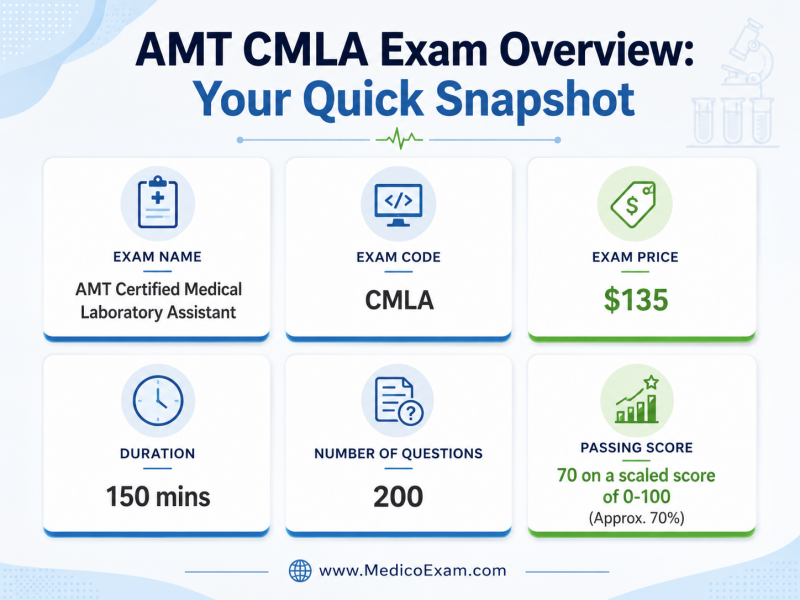
The AMT CMLA exam (Code: CMLA) is a standardized assessment designed to evaluate a candidate's readiness for the responsibilities of a Certified Medical Laboratory Assistant. Candidates should be familiar with the practical aspects of the examination to plan their preparation effectively. The exam structure ensures a comprehensive evaluation of critical knowledge domains, reflecting the multifaceted nature of the role within a clinical laboratory. Knowing these details upfront can significantly reduce test-day anxiety and allow for more focused study.
Key details of the CMLA assessment include:
| Exam Detail | Information |
|---|---|
| Exam Name | AMT Certified Medical Laboratory Assistant |
| Exam Code | CMLA |
| Exam Price | $135 |
| Duration | 150 minutes |
| Number of Questions | 200 |
| Passing Score | 70 (on a scaled score of 0-100), approximately 70% |
This structure ensures that the exam is thorough, covering a broad spectrum of the skills required for the AMT CMLA exam content outline. The duration allows ample time for candidates to read and respond to each of the 200 questions, while the scaled passing score reflects a standardized evaluation of competency across different exam versions and candidate groups.
Decoding the AMT CMLA Exam Content Outline
The AMT CMLA exam content outline provides a clear blueprint of the knowledge and skills assessed, crucial for any candidate preparing for the certification. This outline categorizes topics into key domains, each assigned a specific weight to indicate its relative importance on the exam. Understanding these domains helps candidates prioritize their study efforts and allocate time effectively across the curriculum. The content reflects the diverse responsibilities an AMT Certified Medical Laboratory Assistant will encounter in a real-world setting, emphasizing both theoretical understanding and practical application of critical procedures. For a detailed breakdown of the content and to download the full content outline, candidates are encouraged to visit the official AMT resources, such as the CMLA exam content outline.
Laboratory Safety and Quality Expertise
This domain accounts for a significant portion of the exam, comprising 22.5%, emphasizing the critical importance of safety protocols and quality assurance in the laboratory. Candidates must demonstrate a thorough understanding of hazard identification (e.g., chemical, biological, sharps), universal precautions, proper use of personal protective equipment (PPE), spill management, and appropriate waste disposal methods. Beyond immediate safety, this section also covers quality control (QC) procedures, instrument calibration checks, and basic proficiency testing concepts, which are fundamental for ensuring reliable and accurate test results. Mastery of these safety and quality concepts is non-negotiable for protecting both laboratory personnel and patients, and forms the bedrock of competent CMLA practice.
Pre-examination (Preanalytical) Considerations
Comprising 18.0% of the exam, this section covers all processes that occur before a sample is analyzed. This includes meticulous patient identification, proper collection techniques such as venipuncture and capillary collection, and explaining procedures clearly to minimize patient anxiety. Candidates must understand the correct order of draw for blood samples, appropriate labeling procedures, and the specific handling requirements for various types of specimens (e.g., temperature sensitivity, light protection). Errors in the pre-analytical phase are a common source of inaccurate results, highlighting the CMLA's vital role in ensuring specimen integrity from collection to initial processing. Proficiency in this area directly impacts diagnostic reliability.
Core Examination (Analytical) Procedures
As the largest portion of the exam at 41.5%, the analytical considerations domain assesses the candidate's understanding of basic laboratory testing principles and methodologies. While CMLAs typically do not perform complex analytical tests independently, they need to comprehend the underlying principles, common tests, and potential interferences that can affect results. This section might cover foundational concepts in hematology (e.g., CBC components, blood cell identification), chemistry (e.g., common analytes, basic instrumentation), microbiology (e.g., basic culture media, gram stain principles), and urinalysis (e.g., physical, chemical, microscopic analysis). The focus is on how CMLAs support the analytical phase by preparing samples, maintaining equipment, performing basic quality checks, and recognizing grossly abnormal specimens. This extensive coverage underlines the CMLA's integral role in supporting the actual testing process.
Patient Test Management, Communications, and Foundations
This domain, making up 18.0% of the exam, focuses on the administrative and communication aspects of the CMLA role. It includes understanding patient confidentiality (HIPAA regulations), navigating laboratory information systems (LIS) for order entry and result retrieval, and possessing a solid grasp of basic medical terminology. Effective communication with patients, colleagues, nurses, and physicians is crucial, requiring clarity, empathy, and professionalism when discussing procedures, specimen requirements, or basic test information. CMLAs are often the first point of contact for patients and play a crucial role in managing test orders and results, making strong communication and organizational skills indispensable. This section underscores the CMLA's contribution to overall patient experience and operational efficiency within the healthcare team.
Realizing Professional Growth: Benefits of AMT CMLA Certification
Earning the AMT CMLA certification opens doors to various career opportunities AMT CMLA professionals can pursue and provides numerous professional advantages for individuals entering the medical laboratory field. Beyond validating core competencies, the credential serves as a mark of professionalism and dedication, distinguishing certified individuals in a competitive job market. The benefits extend from enhanced employability to opportunities for career progression and increased earning potential, establishing a solid foundation for a long-term career.
Key advantages of holding the AMT CMLA credential include:
-
Enhanced Employability: Many healthcare employers prefer or explicitly require certified laboratory assistants, making the CMLA a strong asset on your resume for securing desirable positions across hospitals, clinics, and reference laboratories.
-
Increased Credibility: Certification signifies a commitment to professional standards, ethical practice, and a verified skill set, building trust with employers, patients, and inter-professional colleagues within the healthcare team.
-
Career Progression: The CMLA can be a strategic stepping stone, providing a solid knowledge base for pursuing higher-level certifications such as Medical Laboratory Technician (MLT) or Medical Technologist (MT), allowing for specialized roles and increased responsibilities.
-
Competitive Salary: AMT Certified Medical Laboratory Assistant salary expectations are often higher for certified professionals compared to non-certified counterparts, reflecting their recognized expertise and the value they bring to the laboratory.
-
Professional Recognition: Being part of a recognized professional body like AMT offers invaluable networking opportunities, access to ongoing educational resources, and a sense of community within the laboratory science field.
-
Job Security: With a growing and consistent demand for qualified healthcare professionals, especially in diagnostic support roles, certified laboratory assistants often enjoy greater job stability and promising long-term career prospects.
These benefits collectively underscore why the benefits of AMT CMLA certification make it a strategic investment for aspiring medical laboratory assistants, providing a solid foundation for a rewarding and impactful career in healthcare.
Role in Practice: What Does an AMT Certified Medical Laboratory Assistant Do?
An AMT Certified Medical Laboratory Assistant performs a wide range of essential tasks that support the diagnostic processes in clinical laboratories. This role is crucial for ensuring the accuracy and efficiency of laboratory testing, directly impacting patient care and treatment decisions. CMLAs work under the supervision of medical technologists or laboratory managers, meticulously handling specimens and performing basic laboratory procedures. The AMT Certified Medical Laboratory Assistant job description typically involves both direct patient interaction and extensive technical work behind the scenes, requiring attention to detail and adherence to strict protocols.
Typical responsibilities of an AMT CMLA include:
-
Patient Preparation and Specimen Collection: This involves correctly identifying patients, performing skilled venipuncture and capillary punctures, and providing clear, reassuring explanations of procedures to minimize patient anxiety and ensure cooperation.
-
Specimen Processing and Handling: CMLAs are responsible for centrifuging blood samples, aliquoting specimens into appropriate tubes, preparing blood smears for microscopic analysis, and ensuring accurate and detailed labeling for various downstream tests. This also includes proper storage and transportation of samples.
-
Laboratory Support and Maintenance: Key duties include performing routine maintenance and calibration checks on laboratory equipment, preparing chemical reagents, restocking supplies, and managing inventory to ensure continuous operation and readiness.
-
Quality Control Assistance: They assist in performing basic quality control checks on reagents and instruments and meticulously documenting results, which is vital for ensuring the reliability and validity of all laboratory tests.
-
Data Entry and Management: This involves precise entry of patient demographics and test orders into laboratory information systems (LIS) and managing patient records, always adhering to strict patient confidentiality guidelines (HIPAA).
-
Safety and Compliance: CMLAs must rigorously adhere to all laboratory safety protocols, including universal precautions, proper disposal of biohazardous waste and sharps, and maintaining a sterile and organized work environment to prevent contamination and accidents.
-
Effective Communication: Responsibilities include communicating clearly and professionally with patients, nurses, physicians, and other laboratory personnel regarding specimen requirements, basic test results, and any patient concerns or special instructions.
This diverse set of responsibilities highlights the indispensable nature of the CMLA role in supporting diagnostic services, maintaining the high standards of a medical laboratory, and contributing directly to patient well-being.
Preparing for Success: Effective AMT CMLA Exam Prep Strategies
Successful attainment of the AMT CMLA certification hinges on a well-structured and diligent preparation strategy. Given the comprehensive nature of the exam content, candidates need to engage with appropriate study materials and practice techniques. Effective preparation not only boosts confidence but also ensures a thorough understanding of the subject matter, leading to a higher probability of passing the AMT Certified Medical Laboratory Assistant exam. A strategic approach to studying involves combining official resources with supplemental tools and disciplined practice.
Utilizing AMT CMLA Study Guide Resources
A primary component of any preparation plan is a reliable AMT CMLA study guide. These guides typically align directly with the official exam content outline, offering in-depth coverage of each domain with detailed explanations, illustrations, and examples. They can help candidates focus on high-weightage topics, identify areas where additional study is needed, and serve as a comprehensive knowledge reference. When selecting a study guide, look for clarity, accuracy, and practice questions integrated within chapters to test comprehension immediately. Supplementing a general study guide with notes from any formal training programs or textbooks can also create a more personalized and effective learning resource, tailored to your specific learning style and background. Active reading, summarization, and flashcard creation from these guides are highly recommended.
Engaging with Practice Exam Questions
Beyond theoretical knowledge, familiarity with the exam format, question styles, and time constraints is crucial. Incorporating AMT CMLA practice exam questions into your study routine allows you to gauge your understanding, identify weak areas requiring further review, and significantly improve time management. Practice tests simulate the actual exam environment, helping to reduce test-day anxiety and build stamina for the 150-minute duration. They are an invaluable tool for applying learned concepts, reinforcing critical thinking skills required for the AMT Certified Medical Laboratory Assistant exam, and becoming accustomed to the question phrasing. Analyzing explanations for both correct and incorrect answers can deepen your comprehension and improve your performance significantly, turning mistakes into learning opportunities.
Exploring Best Prep Courses for CMLA
For some candidates, structured learning environments offered by dedicated preparation courses can be highly beneficial, especially if a formal training program was completed some time ago or if self-study proves challenging. The best AMT CMLA exam prep courses often provide expert instruction from experienced professionals, interactive learning modules, and access to a community of peers for collaborative study. These courses can break down complex topics into digestible segments, offer personalized feedback on progress, and ensure all aspects of the syllabus are covered comprehensively and strategically. Choosing a reputable prep course can streamline your study efforts and provide a guided pathway to certification success, offering accountability and structure. Many online platforms offer flexible learning options to accommodate different schedules and learning preferences.
Achieving Exam Success: Tips for Passing the AMT Certified Medical Laboratory Assistant Exam
Passing the AMT Certified Medical Laboratory Assistant exam requires more than just knowing the material; it also involves strategic test-taking skills and mental preparedness. Candidates who approach the exam with a clear plan and effective techniques significantly increase their chances of success. Focusing on comprehensive understanding, diligent practice, and maintaining a positive mindset are all vital components of an effective strategy for overcoming the CMLA assessment, ensuring you are at your best on exam day.
Consider the following tips for passing AMT Certified Medical Laboratory Assistant exam:
-
Understand the Content Outline: Thoroughly review the official AMT CMLA content outline to know exactly what topics will be covered and their respective weightages. This allows for targeted study.
-
Create a Study Schedule: Develop a realistic, disciplined study plan that allocates sufficient time to each domain, focusing more on high-weightage areas and personal weak points. Stick to it consistently.
-
Use Diverse Resources: Combine official AMT materials with reputable textbooks, online courses, and practice exams to gain a holistic understanding from various perspectives.
-
Practice Time Management: During practice exams, simulate the actual 150-minute duration to improve your pacing, avoid rushing, and ensure you can comfortably complete all 200 questions within the time limit.
-
Review Incorrect Answers: Don't just identify wrong answers; understand why they were wrong. Analyze the correct explanation to solidify your understanding of underlying concepts and avoid repeating errors.
-
Stay Healthy: Prioritize adequate sleep, balanced nutrition, and effective stress management techniques in the weeks leading up to the exam. A clear, well-rested mind performs optimally under pressure.
-
Read Questions Carefully: Pay close attention to keywords and qualifiers like "most likely," "least appropriate," "always," and "never" to avoid misinterpreting questions and selecting incorrect answers.
-
Prioritize Difficult Topics: Dedicate more study time to areas you find challenging, using different learning methods (e.g., visual aids, group study) to improve comprehension.
-
Simulate Exam Conditions: Practice in a quiet environment, free from distractions, mimicking the actual testing conditions to build focus and concentration.
By integrating these tips into your preparation, you can approach the AMT CMLA exam with confidence and significantly increase your likelihood of achieving a passing score on your first attempt.
Sustaining Your Credential: AMT CMLA Certification Renewal
Maintaining the AMT CMLA certification is an ongoing commitment to professional development and continued competence in the medical laboratory field. Certifications are not typically a one-time achievement; they require periodic renewal to ensure that professionals stay current with evolving practices, technologies, and regulations. Understanding the AMT CMLA certification renewal process is crucial for long-term career planning and sustaining your credential’s validity and value in the workforce.
AMT, like many certifying bodies, requires CMLAs to complete specific continuing education (CE) activities within a defined renewal cycle, typically every few years. These activities are designed to ensure that certified individuals continuously update their knowledge and skills, keeping pace with advancements in laboratory medicine, new diagnostic techniques, and changes in healthcare regulations. Accepted CE units can include participation in workshops, seminars, webinars, online courses, and professional conferences. Detailed documentation of these CE units, often alongside payment of a renewal fee, is required. Planning your continuing education throughout the renewal period helps avoid a last-minute rush and ensures your credential remains active, demonstrating your dedication to professional excellence.
Making the Decision: Is AMT CMLA the Right Starting Point for You?
Deciding whether the AMT CMLA certification is the ideal first move for your laboratory career involves evaluating your career aspirations, current qualifications, and the specific demands of the medical laboratory assistant role. This credential provides a solid entry point, but it's important to align it with your long-term professional goals to ensure it supports your desired career trajectory. Understanding the complete picture of what the CMLA entails, from its benefits of AMT CMLA certification to its rigorous requirements and ongoing professional development needs, helps in making an informed choice about your initial certification. Consider how this credential fits into your overall professional pathway.
Reflect deeply on your interest in direct patient interaction for specimen collection, your aptitude for meticulous laboratory procedures, and your unwavering commitment to safety, quality, and ethical practice. The CMLA is specifically designed for individuals who thrive in a supportive role, contributing directly to diagnostic processes and patient care. If your interests align with hands-on laboratory support, a patient-facing component, and a desire to build a robust career in healthcare, then the AMT CMLA could indeed be your strategic first step, validating the skills required for AMT Certified Medical Laboratory Assistant and setting you on a path to success.
Cultivating Your Career Path: Opportunities with AMT CMLA
The AMT CMLA certification significantly broadens career opportunities AMT CMLA professionals can pursue within the dynamic healthcare landscape. With a verified credential, graduates are well-prepared for entry-level and support roles in diverse settings, including bustling hospital laboratories, specialized clinics, independent reference laboratories, public health agencies, and private physician offices. The demand for skilled laboratory support staff remains consistently high and is projected to grow, driven by an increasing need for diagnostic testing due to technological advancements, an aging population, and the ongoing emphasis on preventive care. This certification acts as a professional passport, signaling to employers that you possess the necessary skills, knowledge, and dedication for the role.
Beyond immediate employment, the CMLA often serves as an invaluable foundational step for continued education and specialization within the broader field of laboratory sciences. Many CMLAs choose to pursue further certifications, such as becoming a Medical Laboratory Technician (MLT) or a Medical Technologist (MT), building upon their initial expertise and advancing into more complex analytical roles. This demonstrates the long-term value of the CMLA as an entry point into a dynamic and essential field, providing not just a job but a clear career trajectory and the potential for continuous professional growth within laboratory diagnostics.
Conclusion
The AMT Certified Medical Laboratory Assistant (CMLA) certification is an excellent starting point for individuals aspiring to a career in medical laboratories. It rigorously validates fundamental skills in safety, specimen handling, basic analytical support, and patient communication, preparing candidates for essential roles within diverse healthcare settings. This certification not only enhances employability and earning potential but also lays a robust foundation for future professional growth and specialization in the dynamic field of laboratory medicine. Understanding the requirements, exam structure, and preparation strategies outlined in this guide is key to successfully obtaining this valuable credential and launching a meaningful career.
For those ready to take the next step towards becoming an AMT Certified Medical Laboratory Assistant, thorough preparation is paramount. Explore comprehensive study materials and practice exams to solidify your knowledge and build confidence. Visit MedicoExam's expert preparation materials for top-tier resources designed to help you prepare effectively and confidently pursue your CMLA certification, ensuring you are well-equipped for success.
Frequently Asked Questions
1. What is the AMT CMLA certification?
The AMT CMLA (Certified Medical Laboratory Assistant) is a professional credential from American Medical Technologists (AMT) that validates an individual's competency in assisting medical technologists and clinical laboratory scientists with pre-analytical, analytical, and post-analytical laboratory procedures, ensuring accuracy and safety in diagnostic testing.
2. Who should consider getting the AMT CMLA?
Individuals starting their career in medical laboratory settings, those with formal training or some experience as a lab assistant, and anyone seeking to validate their foundational skills for entry-level lab roles that involve patient interaction, specimen processing, and laboratory support should consider the AMT CMLA.
3. What are the general eligibility requirements for the AMT CMLA exam?
Eligibility typically involves completing an approved medical laboratory assistant training program, an associate's degree in a related field, or possessing a certain amount of supervised work experience in a clinical laboratory setting. Specific criteria are detailed on the official AMT website.
4. How long is the AMT CMLA certification valid, and how do I renew it?
The AMT CMLA certification usually requires renewal every few years to ensure continued competence. Renewal typically involves completing a specified number of continuing education units (CEUs) and submitting a renewal application along with a fee to American Medical Technologists.
5. What kind of job roles can I get with an AMT CMLA certification?
An AMT CMLA certification qualifies individuals for essential support roles such as medical laboratory assistant, phlebotomist, specimen processor, laboratory support technician, or clinical assistant in various healthcare environments like hospitals, clinics, and independent diagnostic laboratories.
- AMT CMLA Question Bank |
- AMT CMLA Eligibility & Requirements |
- AMT Medical Laboratory Assistant Practice Test |
- AMT CMLA Exam Cost |
- AMT CMLA Registration Process |
- AMT Medical Laboratory Assistant Study Guide |
- AMT CMLA Recertification |
- AMT CMLA Certification Overview |
- AMT Medical Laboratory Assistant Syllabus |
- AMT CMLA Preparation Time |
- AMT CMLA Passing Score |
- AMT CMLA Exam Format |
- AMT Medical Laboratory Assistant Sample Questions |
- AMT CMLA Career Opportunities


