
CHONC Exam Guide: Format, Syllabus and a Practice Test Routine
To earn the AAPC Certified Hematology and Oncology Coder (CHONC) credential you answer 100 questions inside four hours and score at least 70%. The exam fee was $325 for one attempt and $399 for two exam attempts in October 2026. The paper checks whether you can code blood disorders, cancer care, chemotherapy and infusion work, radiation services and supportive care accurately from a provider's documentation.
This guide explains how the exam is built, what each syllabus area asks of you and where coders tend to lose points, then gives you a routine you can run alongside a full-time job. When you are ready to measure yourself, start the CHONC practice test and keep that first score; every later step in this guide is easier to judge against it.
What does the CHONC credential prove, and who is it for?
The CHONC shows an employer that you can turn a hematology or oncology record into correct, compliant codes without someone checking every line. Cancer care is documented in layers: a diagnosis that evolves, a treatment plan, drugs that are prepared and given in a set order, and visits that mix evaluation with treatment on the same day. A coder who understands how those layers fit together saves a practice from denials that would otherwise arrive weeks later.
The credential is issued by the American Academy of Professional Coders (AAPC) and sits in its specialty coding family. The syllabus describes the target audience as medical coders, hematology and oncology coders, and physician-practice coding and auditing staff. The settings it names are hematology and oncology physician practices, outpatient oncology clinics, cancer centers, and infusion or radiation oncology departments.
Two kinds of candidate tend to sit it. The first already holds a general coding credential and works in a mixed practice, and wants proof of specialty depth before moving to an oncology group. The second already codes oncology every day but has never had that skill tested by someone else. Either way, check the prerequisites and membership terms on AAPC's own CHONC certification page before you pay, because eligibility rules belong to AAPC and can change between exam cycles.
How is the CHONC exam structured, scored and priced?
The format is easy to state: 100 questions, four hours, and a pass mark of 70%. Four hours for 100 questions gives you 144 seconds each, which is generous for a multiple-choice paper but sensible once you remember that many questions describe a short encounter and ask you to choose the correct code, modifier or sequence. You can sit it under live remote supervision from your own room, or go to a testing center.
| Detail | What to know |
|---|---|
| Credential | AAPC Certified Hematology and Oncology Coder (CHONC) |
| Issued by | American Academy of Professional Coders (AAPC) |
| Length of paper | 100 questions in 240 minutes |
| Pass mark | 70% |
| Fee in October 2026 | $325 for one attempt; $399 for two exam attempts |
| Where you sit it | At home with a live remote proctor, or at a testing center |
| Time to use the voucher | One year from purchase |
| How long the credential lasts | 2 years |
Two details in that table deserve planning. A voucher expires a year after you buy it, and AAPC lets you book only one sitting at a time. The $399 two-attempt option therefore does not give you two exams back to back; it is a safety net you draw on after the first result. Since the extra attempt adds only $74 to the price, it is a reasonable purchase if this is your first long proctored paper or your first specialty credential.
No separate figure for scored versus unscored items is published here, so treat every question as counting. Fees are set by AAPC and can change; confirm the amount at checkout.
What does the CHONC syllabus cover?
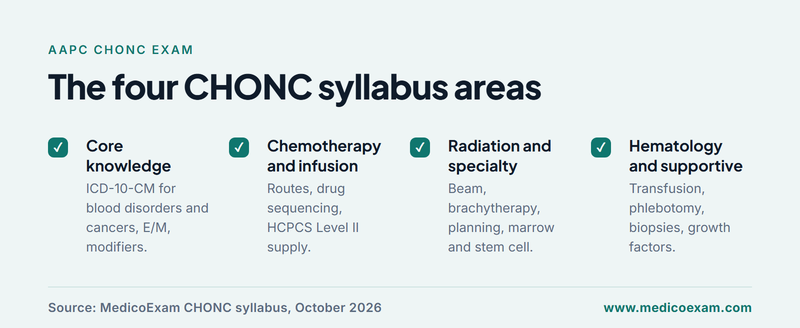
The syllabus groups the exam into four areas: core knowledge, chemotherapy and infusion services, radiation and specialty oncology services, and hematology and supportive care services. Together they describe the full path of a patient through an oncology or hematology practice, from the first consultation to supportive care between treatments. AAPC's certification page lists the same four areas but, as of October 2026, gives no question count or weighting for them, so this guide does not guess one.
Core knowledge areas
This area covers the diagnosis side of the record and the visit side of the claim. On the diagnosis side, the syllabus lists ICD-10-CM coding for hematologic disorders, including anemia, clotting disorders, hemophilia, leukemia, lymphoma and myeloma, and for oncologic conditions, including solid tumors, metastatic cancers and neoplasms of uncertain behavior. In ICD-10-CM, neoplasms have their own chapter and their own table, so a large part of preparation is learning to read the documentation and pick the right row and column rather than searching for a code by name.
On the visit side, the syllabus lists evaluation and management coding for oncology consultations, follow-up visits and chronic disease management, plus the correct use of modifiers, global periods and payer-specific oncology billing guidelines. The practical skill here is separating the work of the visit from the work of a procedure or drug administration that happened at the same encounter, and knowing when a modifier is justified by the record and when it is not.
Chemotherapy and infusion services
This area is where oncology coding becomes distinctive. The syllabus lists coding for chemotherapy administration by the intravenous, subcutaneous and oral routes, sequencing and coding for multiple drug infusions, hydration and therapeutic injections, and the documentation needed to report the drug itself with HCPCS Level II codes alongside the administration procedure.
Two ideas carry most of the questions. The first is that the drug and its administration are reported separately, so you need to find both in the note. The second is that when several infusions and injections happen in one visit, the order and the start and stop times in the record decide which service is the primary one and which are reported as additional. Without those times in the record, the coding answer is often to query the provider, and exam questions sometimes test whether you recognise that.
Radiation and specialty oncology services
The syllabus names external beam radiation, brachytherapy and stereotactic procedures, coding for oncology-related imaging, radiation planning and treatment delivery, and specialized services such as bone marrow biopsies and stem cell procedures. Even if you work in a medical oncology practice that never bills radiation, this area still appears on the exam, so allow study time for the vocabulary and for the difference between planning, delivery and the professional and technical components of a service.
Hematology and supportive care services
The last area covers transfusions, therapeutic phlebotomy and blood product administration, biopsy and aspiration procedures for bone marrow and lymph nodes, and supportive therapies such as colony-stimulating factors, iron infusions and antiemetics. These are everyday services in an infusion center, which makes them easy to under-study: coders who see them daily assume they know the rules, then meet a question that depends on a documentation detail they have never had to check.
Which parts of the CHONC are hardest for candidates?
Most candidates find the hardest material is the one furthest from their daily work. A coder in a hematology-only practice may be comfortable with transfusions and blood disorders and unsure about radiation terminology. A coder in a cancer center that bills infusion all day may be fluent in drug administration and rusty on the E/M rules that govern a new-patient consultation. Because the exam spans all four areas, your weakest area sets the ceiling on your score.
Four habits cost the most points in specialty coding exams of this kind. Coding from the diagnosis that sounds worst rather than the one the provider documented is the first. Missing a sequencing rule when several drugs are given in one session is the second. Reporting a service that the record shows was planned but not completed is the third. Forgetting that payer-specific rules can change what is billable, even when the code itself is correct, is the fourth.
To locate your own gaps, sit one timed practice paper and group every wrong answer under its syllabus area rather than its question number. Errors tend to cluster in one or two areas. Give those areas the first half of your study time, and use the second half to rotate through everything else.
Reading the record is its own skill, and the exam rewards it. Before you look at any answer option, find the provider's final diagnostic statement, the list of services performed, and any times, routes or sites that are written down. Those three items answer most questions on their own. When one of them is missing, the question is often testing whether you know that a code cannot be assigned from an assumption, and that asking the provider for clarification is the compliant response.
Keep your code books tidy as well. Tab the neoplasm table, the chemotherapy administration guidelines and the modifier list, and write the page numbers of your own reference sheet on the first page of each book. AAPC asks you to choose print or ebook code books when you redeem your exam voucher, and it publishes a list of approved books, so make sure yours are the editions on that list rather than assuming last year's will do. Time lost to hunting for a table is time you do not get back, and a few minutes of tabbing during preparation removes that risk.
What real-world scenarios should you practise for the CHONC?
The syllabus describes an exam of applied judgment, not recall alone, so practise with situations instead of lists. Each of the situations below is a short coding task that touches several parts of the syllabus at once. Work through them with a code set open, writing down the documentation fact that decided each answer.
- A new patient with a suspected blood disorder. Decide how the visit is coded when the diagnosis is not yet confirmed, and which diagnosis codes are allowed in an outpatient setting when the provider documents only a sign or symptom.
- A follow-up visit with infusion on the same day. Separate the evaluation from the drug administration, then decide whether a modifier is supported by the record.
- Three drugs given in sequence. Use the start and stop times to identify the initial service and the additional ones, and report each drug supply with its own HCPCS code.
- A bone marrow biopsy with aspiration. Check which services were documented, who interpreted the specimen and whether the facility or the professional claim carries each part.
- A radiation treatment course. Separate planning from delivery and identify which components belong on which claim.
- A supportive-care visit. Code a growth factor injection, an iron infusion or an antiemetic given to manage the side effects of treatment, and link it to the right diagnosis.
These are exam-preparation exercises about how to report a service. They are not clinical advice, and nothing in this guide tells anyone how a patient should be treated. Your task as a coder is to report accurately what the provider documented, and to ask for clarification when the record does not support a code.
How should you prepare for the CHONC, and for how long?
There is no single correct length of preparation, and the figure that matters is your starting point. Candidates who already code oncology daily may need a few weeks of focused review; candidates coming from another specialty usually need longer, because chemotherapy and infusion rules are unfamiliar. A timed practice attempt in the first days gives you the honest answer, and the plan below scales to either end.
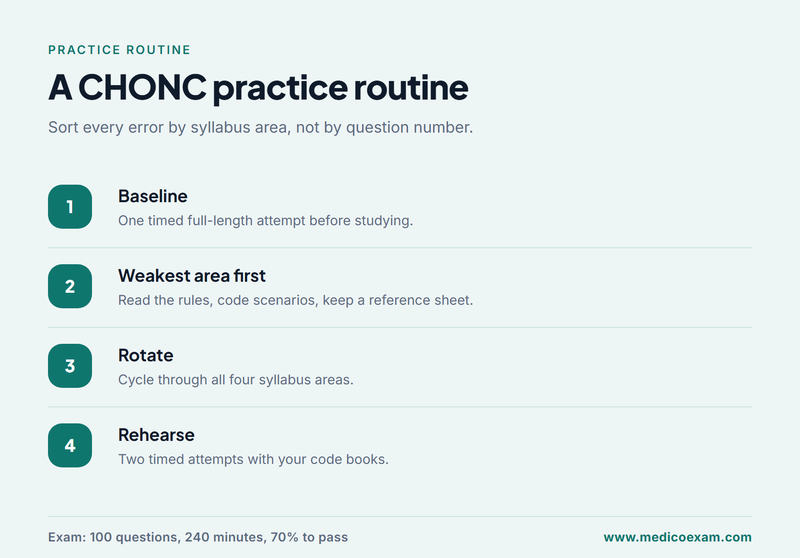
Start with a baseline. Sit a full-length timed practice exam before you study anything, and record your score by syllabus area. Next, work through the four areas in the order of your own weakness, not the order of the syllabus. For each area, read the guidelines, then code real-looking scenarios, then check your answers and write one sentence about each error describing the rule you missed.
Build one reference sheet as you go. It should hold the documentation facts that change a code, such as start and stop times for infusions, the site and route of administration, and whether a service was completed. Reviewing that sheet the evening before the exam is more useful than rereading a chapter. AAPC also sells a CHONC exam preparation course if you prefer a structured syllabus walk-through to self-directed study.
In the last two weeks, switch from learning to rehearsing. Take two timed full-length attempts under exam conditions, with the same code books you plan to use on the day, and review every error. If the second attempt is not clearly better than the first, spend the remaining days on the area that still produces most of your mistakes instead of starting new material.
Is there a practice test or question bank for the CHONC?
Yes. MedicoExam publishes a CHONC practice exam, a set of free sample questions and a syllabus guide for this credential. The practice exam is MedicoExam's own preparation material, and it is not produced or endorsed by AAPC. AAPC sells its own preparation material, including its CHONC exam preparation course, and that is the right place to look if you want material written by the certifying body itself.
Use practice questions for diagnosis, not for memorising answers. A question you got right for the wrong reason is a warning, so for every item ask which documentation detail decided the answer and what the nearest wrong option would have been. When you can explain why each distractor is wrong, you are learning the rule instead of the question.
Be wary of any practice material that promises a fixed pass rate or that shows the same questions you will see on exam day. Neither claim can be true of a proctored exam, and relying on it is the quickest way to arrive under-prepared.
How should you pace yourself during the exam?
Rehearse your pacing before the day. Divide the paper into four blocks of 25 questions and glance at the clock after each block, which gives you a checkpoint every hour. If a checkpoint finds you behind, flag the long scenarios and keep moving, instead of solving each one in full on the first pass.
Read the answer options before the scenario. The options show you what is really being asked, such as a modifier, a drug sequence or a diagnosis order, and you can then read the note hunting for the one fact that decides it. When options differ by a single element, striking out the ones that contradict a guideline you already know usually beats proving the correct one from scratch.
Take advantage of the remote or testing-center environment you chose. If you sit the exam from home, test your equipment and room beforehand so that setup problems do not eat into your focus. If you choose a testing center, plan the journey so that you arrive calm rather than rushed. Before you submit, confirm that no question has been left unanswered.
What happens after you pass the CHONC exam?
Passing earns a credential that lasts 2 years. Holding on to it needs an active yearly AAPC membership and 36 CEUs over each two-year period, at least 8 of them in hematology and oncology, according to AAPC's CHONC page in October 2026. Read them in the week you pass, while the exam is fresh, and you will not be hunting for credits at the last minute.
Oncology coding changes quickly. New drugs arrive, code sets are updated every year and payers revise their policies, so the habits that got you through the exam are the same ones that keep the credential useful afterwards. Keep a short log of the questions that surprised you in practice, and revisit it each time the annual code updates are released.
Not sure how much preparation you need? Let a single timed practice paper answer that, then set your schedule from the result. The CHONC syllabus guide lists the same four areas used here, so you can tick them off as you go.
Frequently Asked Questions
How many questions are on the CHONC exam?
The paper holds 100 questions and gives you 240 minutes, roughly 144 seconds for each one. Many items describe a short hematology or oncology encounter and ask for a code, modifier or sequence, so careful reading matters more than speed.
What is the passing score for the CHONC?
The pass mark is 70%. On a 100-question paper that means about 70 correct answers. AAPC owns the scoring rules, so check its certification page for the current wording before you book your sitting.
What is the CHONC exam fee?
In October 2026 the fee was $325 for one attempt, or $399 for two exam attempts. Vouchers last one year from purchase, and you may book only one sitting at a time. Confirm the amount at checkout, since AAPC can change it.
Can I sit the CHONC exam from home?
Yes. You can take it from your own room with a live remote proctor, or go to a testing center instead. Buy the exam first and book the date afterwards, then pick the setting that suits your connection, your space and your travel.
How long does the CHONC credential last?
Two years. Renewal, per AAPC's CHONC page in October 2026, means 36 continuing education units across each cycle, 8 in hematology and oncology, plus a paid-up annual membership. AAPC can change these rules, so check its CHONC page after you pass.
- AAPC CHONC Question Bank |
- AAPC CHONC Eligibility & Requirements |
- AAPC Hematology and Oncology Coder Practice Test |
- AAPC CHONC Exam Cost |
- AAPC CHONC Registration Process |
- AAPC Hematology and Oncology Coder Study Guide |
- AAPC CHONC Recertification |
- AAPC CHONC Certification Overview |
- AAPC Hematology and Oncology Coder Syllabus |
- AAPC CHONC Preparation Time |
- AAPC CHONC Passing Score |
- AAPC CHONC Exam Format |
- AAPC Hematology and Oncology Coder Sample Questions |
- AAPC CHONC Career Opportunities


