
CPMA Exam Syllabus: How the 100 Questions Are Split
Passing the AAPC Certified Professional Medical Auditor (CPMA) exam takes 70% of 100 questions answered inside 240 minutes, and the fee is $425 for one attempt or $499 for two exam attempts. It tests whether you can audit a medical record: check the documentation, apply the coding rules, follow the compliance requirements, sample records sensibly and report what you find.
The question counts below come from the seven syllabus areas, and they are not even. One area carries 36 of the 100 questions and another carries 2, so your study hours should not be even either. To see where you stand before you plan anything, start the CPMA practice test and use the result as your baseline.

What does the CPMA credential show, and who is it for?
A coder decides which code a record supports. An auditor decides whether that decision was right, whether the record supported it, and whether the same mistake is happening elsewhere. The CPMA is aimed at people who do that second job, or who want to move into it from coding, billing or compliance work. It tells an employer that you can review records against documented rules and explain your findings to the people responsible for them.
AAPC describes the CPMA as a core credential for auditing across specialties and settings, aimed at coders, billers, auditors and compliance professionals. It also calls the exam difficult and high-level, and expects candidates to have CPMA training or experience auditing physician services, including evaluation and management. The credential runs for 2 years. To renew it, AAPC's CPMA page (October 2026) asks for a current annual membership plus 40 CEUs in each two-year period. These rules belong to AAPC and can change, so read them on the official CPMA page before you register.
Auditing draws on three different skills at once. You read clinical documentation without being a clinician, you apply code sets and payer rules like a coder, and you write and speak like a reviewer who must justify a finding. Candidates who come from coding usually have the second skill and need work on the first and third. Candidates from compliance or quality roles are often the reverse. Knowing which group you are in is the first useful thing a baseline practice exam tells you.
How is the CPMA exam structured and scored?
The exam is delivered electronically. You can take it online at home or at a Meazure Learning testing center, and in both cases you buy the exam first and schedule a date afterwards. It has 100 questions and 240 minutes, which is 144 seconds per question on average, and you need 70% to pass. That means roughly 70 correct answers, with every question carrying the same weight.
Fees, as of October 2026, are $425 for one attempt and $499 for two exam attempts. The two-attempt option costs $74 more than a single attempt, so it is worth considering if this is your first long proctored exam or if you are changing specialty. Fees can change, and the vendor page is the final word on them.
A large share of the questions are scenarios. You are given a short record extract, a billed code or a described audit situation and asked what is correct, what is missing or what should happen next. These take longer than definition questions, so the time per question is less generous than 144 seconds sounds once you subtract the minutes you will spend on the longer ones.
How many questions does each CPMA syllabus area carry?
The MedicoExam CPMA syllabus lists seven areas, and their question counts add up to exactly 100. Medical record auditing abstraction is the largest at 36 questions, followed by compliance and regulatory guidelines at 21, medical record standards and documentation guidelines at 17, and coding and reimbursement concepts at 13. Scope and statistical sampling has 7, communication of results has 4, and quality assurance and risk analysis has 2.
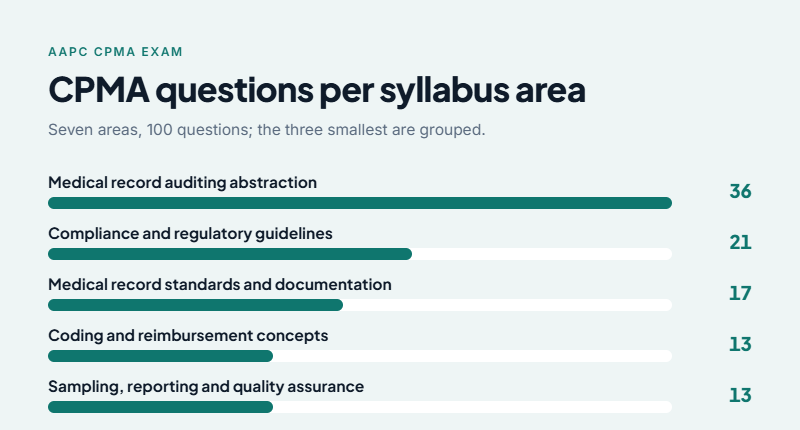
Two areas together, abstraction and compliance, account for 57 of the 100 questions. Add medical record standards and the first three areas cover 74. If you hold a firm working knowledge of those three and a basic grasp of the rest, you have a realistic route to 70, which is why the study order further down starts at the top of this list rather than at the start of the syllabus.
The small areas are not safe to ignore. Quality assurance and risk analysis has only 2 questions, but sampling has 7 and communication has 4, and those 13 questions are exactly the ones candidates from a coding background have rarely practised. A candidate who skips them can still pass, but has to find the missing marks somewhere harder.
What does the medical record auditing abstraction area test?
This is the biggest area at 36 questions, and the syllabus lists seven fields in it: evaluation and management, surgery, physical therapy, radiology, psychiatry, hematology and oncology, and infusion services. In each field you are asked to audit a record, which means finding what was documented, matching it to what was billed and deciding whether the two agree.
Evaluation and management is the field to master first because it appears in every specialty and its documentation rules are the ones auditors apply most often. Practise finding what supports a level of service under the current CPT E/M guidelines: the level of medical decision making, or the total time recorded on the date of the encounter when time is used. The history and examination must be medically appropriate, but they no longer set the level. An auditor has to be able to point to the line in the note that supports each element.
For the procedure and service fields, learn what each one needs to be billable. A surgical record needs the procedure described well enough to select the code and to check for modifiers. A radiology record separates the interpretation from the technical component. Infusion services depend on documented start and stop times and on the order of the drugs given, and therapy services depend on timed units. In every case the audit question is the same: does the record prove what was billed?
You are never asked for clinical judgment in these questions. You are not deciding what treatment was right for a patient. You are checking whether the documentation and the code match, and whether the record would stand up if a payer reviewed it.
Which compliance and regulatory topics are on the exam?
Compliance and regulatory guidelines carry 21 questions, and the syllabus names the topics directly: the compliance plan, fraud and abuse, the Civil Monetary Penalties Law, the Federal False Claims Act, the Stark Law, types of audits, the OIG regulations and Work Plan, the National Correct Coding Initiative, CMS guidelines for evaluation and management documentation, OIG-imposed Corporate Integrity Agreements, and recovery audits and other government programs.
Do not try to memorise this as a list of laws. Learn what each one is for and when an auditor meets it. The False Claims Act matters because it concerns submitting claims that are false, including through reckless disregard, so an auditor who finds a repeated error has a duty to raise it rather than let it continue. The Stark Law concerns referrals between physicians and entities they have a financial relationship with. The National Correct Coding Initiative exists to stop code pairs that should not be billed together, which is why modifier use is part of both this area and the coding area.
Learn the compliance plan as a structure. A plan has standards, an officer, training, monitoring and auditing, ways to report problems, and a response when problems are found. Questions about auditing within a compliance programme are usually asking where an audit fits in that cycle and who receives the result. The difference between a prospective audit, done before a claim goes out, and a retrospective audit, done after payment, is a common test of whether you understand that cycle.
The best preparation for this area is to read the primary sources that the syllabus names. The AAPC exam preparation course for the CPMA is the vendor's own training for this exam, and its outline is a useful cross-check against any practice material you use.
What do the documentation and coding areas cover?
Medical record standards and documentation guidelines carry 17 questions. The topics are the medical record itself, HIPAA privacy and release of medical record information, covered entities, the HIPAA privacy regulations, JCAHO documentation standards, record retention, the advance beneficiary notice, legal requirements of the medical record, and analysing the operative report.
The privacy questions turn on a simple habit: before you disclose anything, ask who is asking, what they are asking for and under which rule. Retention questions ask how long a record must be kept, and the answer depends on the rule that applies, so learn which source answers which kind of record. The advance beneficiary notice is a patient notice about services that may not be paid by Medicare, and an auditor checks whether it was given when it was required. The operative report has its own checklist of required elements, which makes it a favourite for audit scenarios.
Coding and reimbursement concepts carry 13 questions: CPT coding concepts, modifier usage, diagnosis coding and medical necessity, evaluation and management documentation guidelines, and coding guidelines versus payer guidelines. The last item deserves special attention. A code set's guideline and a payer's policy can differ, and an auditor has to know which one governs the question in front of them. When a question names a payer, read the payer's rule into your answer, and when it does not, fall back on the published code set guideline.
Medical necessity is the link between the diagnosis and the service. A correctly coded procedure can still fail an audit if the diagnosis on the claim does not support it. Practise asking the question in both directions: does the diagnosis justify the service, and does the service match the diagnosis?
How do sampling, quality assurance and reporting appear on the exam?
Scope and statistical sampling has 7 questions, covering audit scope and statistical sampling. Audit scope is the decision of what to review: which providers, which codes, which period. Sampling is the decision of how many records to pull and how to choose them. You will not be asked to do advanced statistics, but you should know why a random sample differs from a convenience sample, why the sample must be big enough to mean something, and why an error rate from a sample can be projected only when the sample was drawn properly.
Quality assurance and risk analysis has 2 questions, on the resources required for different types of audit and on identifying support for audit decisions. Think of it as the question of how you would defend your own work: what references you used, and what evidence in the record supports each finding.
Communication of results and findings has 4 questions, covering validation of audit results, analysis and reporting of findings, communicating the results and corrective action. The pattern here is a sequence. You validate what you found, you analyse it for patterns, you report it clearly to the right people, and you recommend a fix. Questions often describe a finding and ask which step comes next or who should be told. Answer with the person who can act on it, and avoid wording that blames an individual when the data shows a process problem.
Which CPMA area is hardest for coders and for non-coders?
For working coders, the hardest areas are usually the ones that have nothing to do with choosing a code: sampling, compliance law and reporting. A coder spends the day deciding what a record means, whereas an auditor spends it deciding whether someone else was right. The change of viewpoint takes practice, and the exam rewards it.
For candidates from a compliance or administrative background, the hardest area is usually abstraction. Reading a surgical or oncology record and spotting what is missing takes a coder's eye for documentation. If this describes you, spend more of your time on the 36-question area and on the coding concepts that sit behind it, and less on the laws you already know.
A practical way to find your own weak area is to sit a timed practice exam and sort each wrong answer into one of the seven areas. After one attempt you will usually see that most lost marks come from two areas. Those two are your first week of study.
What study order works for the CPMA exam?
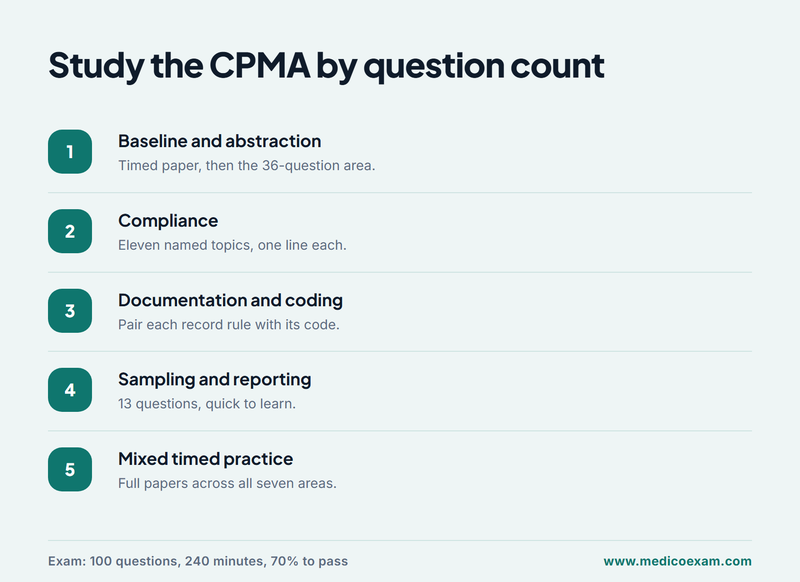
Order your study by question count, not by the order in the syllabus. A sensible sequence for a working professional is five stages, each ending with practice questions in that area before you move on.
Stage 1: baseline and the largest area
Sit a clock-limited paper before you open any book, so that your plan rests on evidence. Then spend the longest stage on medical record auditing abstraction, starting with evaluation and management and moving through the other six fields. Audit real or sample records against the rules and write down the line that supports each decision.
Stage 2: compliance and regulatory
Work through the eleven named topics. For each one, write a single sentence on what it prevents and a second on when an auditor would meet it. If you can do this without notes, you can handle a scenario question about it.
Stage 3: documentation standards and coding concepts
Cover medical record standards and coding concepts together, because they overlap in practice. Pair each documentation rule with the coding decision it affects, and practise the difference between a code set guideline and a payer rule.
Stage 4: sampling, quality assurance and reporting
These three areas hold 13 questions and take little time to learn, which makes them the best marks per hour in the syllabus. Learn the vocabulary of sampling, practise describing a finding in two clear sentences and rehearse the order of steps after an error is found.
Stage 5: mixed timed practice
In the last stretch, sit full-length timed exams that mix all seven areas. Go back over each missed question and each correct guess. Stop learning new material in the last two days and reread your own notes instead.
How long this takes depends on your starting point, and no two candidates need the same time, so the honest answer is that your baseline score decides it. A candidate who already passes the largest areas in a baseline needs weeks less than one who starts below half.
How should you spend the 240 minutes on exam day?
With 100 questions and 240 minutes, split the exam into four blocks of 25 questions and check the clock after each. If you reach the end of a block more than ten minutes late, start flagging long scenarios and returning to them later. This keeps a few minutes in hand for a final review of flagged questions.
On scenario questions, read the question line first so you know what you are hunting for in the record extract. Auditing questions often include details that are true but irrelevant, and reading with a target stops those details pulling you towards a wrong answer. When two options look right, look for the rule that rules one out: a missing signature, a missing time, a wrong modifier or a service the record does not support.
Before you submit, make sure every flagged question has an answer selected. When you eliminate two options, choose between the rest on the rule that separates them rather than on instinct, and move on once you have chosen, because the point is to preserve your pace.
Is there a CPMA practice test from AAPC, and what should you use?
AAPC is the certifying body and publishes its own training and preparation material for the CPMA, including the preparation course linked above. MedicoExam is not AAPC and does not describe its own question bank as official. What the MedicoExam practice test offers is timed practice across the seven syllabus areas so you can find your weak spots before you pay for the real exam.
Whatever you practise with, check that it follows the question split above. A practice set that spends half its questions on definitions teaches you the wrong skill, because the real exam is weighted towards audit scenarios in abstraction and compliance. When your scores on a full-length mixed attempt stay at or above 70% across two sittings, you have good evidence you are ready.
Your first mock score is the most useful number you will get, so sit a complete, clock-limited paper now and begin the study order at the stage it points to.
Frequently Asked Questions
What is the question count and time limit for the CPMA?
The CPMA exam has 100 questions and a 240-minute time limit, which averages 144 seconds per question. Many questions are audit scenarios built on a short record extract, so reading and judging the extract uses more of the clock than the answer options do.
What is the CPMA passing score?
You need 70% to pass the AAPC Certified Professional Medical Auditor exam. With 100 questions that means about 70 correct answers, and every question carries the same weight whether the topic is abstraction, compliance or sampling.
How much does the CPMA exam cost?
As of October 2026, the CPMA exam costs $425 for one attempt or $499 for two exam attempts. The two-attempt option adds $74 to the single-attempt price, which suits people new to auditing or to long proctored exams. Check AAPC for changes.
Which CPMA syllabus area has the most questions?
Medical record auditing abstraction has the most, with 36 of the 100 questions. It covers seven fields, from evaluation and management through to infusion services. Compliance and regulatory guidelines is second with 21 questions.
Can I take the CPMA exam online?
Yes. The CPMA is an electronic exam, so a home sitting is allowed, and a Meazure Learning testing center is the alternative. Buy the exam from AAPC, then book a date, and decide which setting suits you before you schedule.
How long is the CPMA certification valid?
Two years. AAPC's renewal rule for the CPMA, as listed in October 2026, is 40 continuing education units per two-year cycle together with an active annual membership. Those requirements can change, so look them up on the official CPMA page soon after you pass.
- AAPC CPMA Question Bank |
- AAPC CPMA Eligibility & Requirements |
- AAPC Professional Medical Auditor Practice Test |
- AAPC CPMA Exam Cost |
- AAPC CPMA Registration Process |
- AAPC Professional Medical Auditor Study Guide |
- AAPC CPMA Recertification |
- AAPC CPMA Certification Overview |
- AAPC Professional Medical Auditor Syllabus |
- AAPC CPMA Preparation Time |
- AAPC CPMA Passing Score |
- AAPC CPMA Exam Format |
- AAPC Professional Medical Auditor Sample Questions |
- AAPC CPMA Career Opportunities


