
Elevate Your Career with CHDA AHIMA Certification
The AHIMA Certified Health Data Analyst (CHDA) certification, designated by exam code CHDA from AHIMA, stands as a pivotal credential for professionals committed to leveraging healthcare data for improved outcomes. This esteemed certification validates an individual's advanced proficiency in health data analytics, including data acquisition, analysis, interpretation, and governance within the complex healthcare landscape. Professionals seeking to transform raw health data into actionable insights for strategic decision-making, quality improvement, and patient care enhancement are the ideal candidates. This article delves into the transformative power of the CHDA certification, exploring its requirements, benefits, career implications, and effective preparation strategies to guide aspiring health data analysts toward this impactful career milestone.
Validating Health Data Expertise with CHDA Certification
The demand for skilled health data analysts is rapidly expanding as healthcare systems increasingly rely on data to navigate complex challenges, optimize operations, and enhance patient care. The CHDA AHIMA Certification positions professionals at the forefront of this evolution, signaling to employers a deep understanding of health data analysis methodologies and their application in a clinical or administrative context. Earning this credential confirms an individual's ability to manipulate, interpret, and present complex health data, fostering evidence-based practices that drive real-world improvements. It's more than just a certificate; it’s an affirmation of specialized knowledge and a commitment to data integrity and ethical practice in healthcare. Professionals keen on solidifying their expertise and exploring the official certification pathway can find comprehensive details on the AHIMA website.
Decoding the AHIMA CHDA Exam Blueprint
Achieving the AHIMA Certified Health Data Analyst (CHDA) certification requires candidates to successfully pass a rigorous examination designed to assess their competencies across critical domains of health data analytics. Understanding the exam's structure is a foundational step in preparation, providing a clear roadmap for study efforts and time management. The exam ensures that certified professionals possess a well-rounded skill set essential for the multifaceted role of a health data analyst.
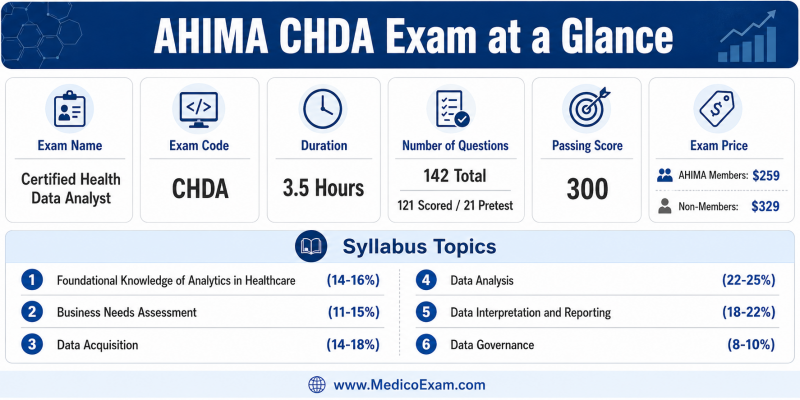
The CHDA exam structure is as follows:
-
Exam Name: AHIMA Certified Health Data Analyst
-
Exam Code: CHDA
-
Duration: 210 minutes
-
Number of Questions: 142 total (comprising 121 scored items and 21 pretest items)
-
Passing Score: 300 (on a scale of 100-400)
-
Exam Price: AHIMA Members: $259 (USD)
-
AHIMA Non-members: $329 (USD)
These details highlight the comprehensive nature of the assessment, requiring candidates to demonstrate both theoretical knowledge and practical application skills within a timed environment. Strategic preparation, including practice questions and thorough content review, is crucial for navigating this format effectively.
Essential Knowledge Domains for CHDA Candidates
The AHIMA CHDA exam assesses a broad spectrum of knowledge crucial for effective health data analysis. Candidates must master several key domains that cover the entire lifecycle of data, from its foundational principles to its governance and interpretation. A deep understanding of each domain is vital for success, as each contributes significantly to the overall score. For an even more detailed content outline, candidates are encouraged to consult the official AHIMA content outline.
The syllabus topics and their respective weightages are:
| Syllabus Topic | Weightage | Description |
|---|---|---|
| Foundational Knowledge of Analytics in Healthcare | 14-16% | This section covers fundamental concepts of data analytics specifically within the healthcare context, including terminology, methodologies, and the role of data in clinical and administrative decision-making. |
| Business Needs Assessment | 11-15% | Candidates are tested on their ability to identify and articulate an organization's analytical needs, translating business questions into data-driven problems that analytics can solve. |
| Data Acquisition | 14-18% | Focuses on the processes and challenges associated with collecting, integrating, and preparing data from various healthcare sources, ensuring data quality and readiness for analysis. |
| Data Analysis | 22-25% | This is the largest domain, encompassing various analytical techniques, statistical methods, and tools used to extract insights from health data, including descriptive, predictive, and prescriptive analytics. |
| Data Interpretation and Reporting | 18-22% | Examines how to interpret analytical findings, draw meaningful conclusions, and effectively communicate these insights to diverse stakeholders through clear and actionable reports and visualizations. |
| Data Governance | 8-10% | Covers the principles and practices for managing data availability, usability, integrity, and security, ensuring compliance with regulatory standards and organizational policies. |
Each domain represents a critical pillar of health data analysis, and a balanced study approach across all areas is recommended.
Strategic Advantages of Achieving CHDA Status
The CHDA AHIMA certification serves as a powerful differentiator in a competitive job market, offering a multitude of benefits that extend beyond mere credentialing. For health information professionals and data analysts, it represents an investment in career longevity and accelerated growth. This credential not only enhances an individual's skill set but also significantly boosts their earning potential and professional recognition.
Key advantages include:
-
Enhanced Career Opportunities: Certified individuals are often preferred for advanced roles in health data analytics, research, and healthcare management.
-
Increased Earning Potential: The AHIMA Certified Health Data Analyst salary is typically higher than that of uncertified professionals, reflecting the specialized skills and proven expertise.
-
Industry Recognition and Credibility: The CHDA designation is nationally recognized, signifying a commitment to the highest standards of health data analysis and ethical practice.
-
Validation of Expertise: It formally validates an individual’s proficiency in complex data acquisition, analysis, interpretation, and reporting unique to the healthcare sector.
-
Networking Opportunities: Becoming part of the CHDA community opens doors to a network of like-minded professionals, fostering collaboration and knowledge exchange.
These benefits collectively contribute to a robust professional profile, making the CHDA an indispensable asset for anyone serious about a career in health data analytics.
Mapping Your AHIMA Certified Health Data Analyst Career Path
The AHIMA Certified Health Data Analyst career path is dynamic and replete with opportunities, reflecting the growing demand for data-driven insights in healthcare. Professionals with the CHDA credential are uniquely positioned to excel in various roles, moving beyond traditional health information management to influential positions that shape healthcare strategy and operations. The certification validates an analytical mindset crucial for navigating complex health datasets and deriving meaningful conclusions.
Typical career trajectories and roles for CHDA holders include:
-
Senior Health Data Analyst: Leading analytical projects, developing complex data models, and providing expert guidance on data utilization.
-
Clinical Data Manager: Overseeing data collection processes in clinical trials, ensuring data accuracy and compliance.
-
Business Intelligence Analyst (Healthcare): Translating data into strategic business intelligence, often focusing on operational efficiency and financial performance.
-
Health Information Manager: Integrating data analytics into traditional health information management functions, focusing on data quality and accessibility.
-
Research Analyst: Contributing to public health initiatives or medical research by analyzing large datasets to identify trends and inform policy.
These roles emphasize the blend of technical prowess and domain-specific knowledge that the CHDA certification cultivates. For those ready to advance their professional journey, exploring comprehensive CHDA exam resources can be an excellent next step.
Preparing Effectively for the CHDA AHIMA Certification Exam
Successful preparation for the CHDA AHIMA certification exam demands a structured and comprehensive approach. Given the breadth of the syllabus and the depth of analytical skills required, candidates must adopt strategies that maximize learning and retention. Effective AHIMA CHDA exam prep goes beyond rote memorization, emphasizing understanding core concepts and their practical application.
Consider these key preparation strategies:
-
Thorough Syllabus Review: Begin by meticulously going through each domain of the official AHIMA CHDA study guide to identify areas of strength and weakness.
-
Utilize Quality Study Materials: Invest in reputable textbooks, online courses, and study guides specifically tailored for the CHDA exam. Focus on materials that offer comprehensive explanations and real-world examples.
-
Practice with Scenario-Based Questions: Health data analysis often involves critical thinking to solve real-world problems. Seek out AHIMA CHDA practice questions that mimic the exam format and challenge your analytical skills.
-
Time Management: Develop a realistic study schedule that allocates sufficient time to each domain, paying extra attention to areas where you need more reinforcement.
-
Form Study Groups: Collaborating with peers can provide different perspectives, clarify difficult concepts, and offer motivation during the study process.
-
Regular Self-Assessment: Regularly test your knowledge with mock exams to gauge your readiness and identify any remaining knowledge gaps before the actual exam.
Ethical preparation is paramount. Relying on "dumps" or unauthorized materials can not only lead to failure but also compromise the integrity of the certification process. Focus on genuine learning to build lasting expertise.
Understanding CHDA AHIMA Certification Requirements and Recertification
To be eligible for the AHIMA CHDA certification, candidates must meet specific criteria designed to ensure they possess a foundational understanding of health information management and data analytics. These CHDA AHIMA certification requirements are put in place to maintain the integrity and credibility of the credential, ensuring that certified professionals are well-prepared for the responsibilities of a health data analyst.
General eligibility pathways typically include a combination of education and experience:
-
Holding a bachelor's degree (or higher) with specific coursework in health information management, data science, or a related field, combined with a certain amount of professional experience in health data analysis.
-
Alternatively, possession of another AHIMA credential (like RHIA or RHIT) coupled with relevant work experience in the health data domain can also qualify candidates.
It is essential to consult the official AHIMA website for the most current and detailed eligibility criteria, as these can be updated periodically.
Beyond initial certification, maintaining the credential requires adherence to AHIMA CHDA recertification requirements. This typically involves earning a specified number of continuing education units (CEUs) within a defined cycle. Recertification ensures that CHDA professionals remain current with evolving industry standards, technological advancements, and best practices in health data analytics. By requiring ongoing learning, AHIMA upholds the value and relevance of the CHDA credential in a rapidly changing healthcare environment.
Evaluating the CHDA AHIMA Certification Difficulty
Prospective candidates often inquire about the CHDA AHIMA certification difficulty. The assessment is recognized as challenging, reflecting the advanced analytical skills and specialized healthcare knowledge it aims to validate. It's not simply a test of memorization but an evaluation of one's ability to apply complex data analytics principles to real-world healthcare scenarios.
Several factors contribute to its perceived difficulty:
-
Comprehensive Syllabus: The exam covers six broad domains, each requiring a deep understanding of concepts from foundational analytics to intricate data governance.
-
Application-Based Questions: Many questions are scenario-based, demanding critical thinking and the application of knowledge rather than just recalling facts. This can be challenging for those accustomed to more direct knowledge-recall exams.
-
Technical Acumen: A certain level of comfort with statistical methods, data modeling, and various analytical tools is expected, which might be a hurdle for individuals with less technical backgrounds.
-
Healthcare Context: All analytical tasks are framed within the unique complexities of the healthcare environment, requiring an understanding of clinical, administrative, and regulatory contexts.
-
Time Constraint: The 210-minute duration for 142 questions means candidates must manage their time effectively, avoiding getting stuck on difficult problems.
Despite these challenges, the exam is eminently passable with dedicated study, proper preparation using best AHIMA CHDA study materials, and a strategic approach. It is designed to distinguish truly competent health data analysts, making the effort worthwhile for career advancement.
Financial Investment: AHIMA CHDA Exam Cost and Value
Understanding the financial commitment associated with the AHIMA CHDA exam cost is a practical consideration for all aspiring candidates. The examination fees reflect the rigor of the certification process and the value it brings to a professional's career. While there is an upfront investment, the long-term career benefits often far outweigh the initial outlay.
The current exam prices are structured to provide a benefit to AHIMA members:
| Candidate Type | Exam Price |
|---|---|
| For AHIMA Members | $259 (USD) |
| For AHIMA Non-members | $329 (USD) |
This difference highlights the value of AHIMA membership, which offers additional resources and professional development opportunities beyond just exam fee discounts. Beyond the exam fee, candidates should also budget for study materials, practice tests, and potentially preparatory courses. However, viewing these expenses as an investment in professional growth reveals their true value. The CHDA certification can lead to higher salaries, more senior roles, and enhanced job security, demonstrating a significant return on investment over time. It equips professionals with the capabilities to make a tangible impact, translating data into better health outcomes and operational efficiencies.
Leveraging Health Data Analytics for Impact
The AHIMA Certified Health Data Analyst (CHDA) credential empowers professionals to move beyond basic data management and actively shape the future of healthcare through advanced analytics. This involves not just compiling data, but skillfully interpreting it to inform crucial decisions, identify trends, and predict outcomes that benefit patients and organizations alike. The ability to translate complex numerical patterns into clear, actionable strategies is a hallmark of CHDA-certified individuals.
CHDA-certified professionals leverage their skills to:
-
Improve Patient Outcomes: By analyzing clinical data, they can identify risk factors, optimize treatment protocols, and support personalized medicine initiatives.
-
Enhance Operational Efficiency: Through data-driven insights, they help healthcare facilities streamline processes, reduce waste, and manage resources more effectively.
-
Ensure Regulatory Compliance: They play a critical role in monitoring data quality and integrity, ensuring that all health data practices adhere to legal and ethical standards such as HIPAA.
-
Drive Strategic Planning: By providing robust analytical reports on market trends, population health, and service utilization, they support leadership in making informed strategic decisions.
-
Advance Public Health Initiatives: Their work can contribute to understanding disease outbreaks, evaluating public health interventions, and informing community health programs.
The certification fosters a comprehensive understanding of the ethical considerations, privacy regulations, and security protocols inherent in handling sensitive health information. This holistic approach ensures that data analysis is not only technically sound but also responsible and impactful.
Conclusion
The AHIMA CHDA certification is more than a professional credential; it's a testament to a health data analyst's expertise, dedication, and potential to drive transformative change within the healthcare industry. By validating advanced skills in data acquisition, analysis, interpretation, and governance, the CHDA empowers professionals to unlock the hidden value in health information, fostering better patient care, operational efficiency, and strategic foresight. Investing in this certification means investing in a future where data intelligence is paramount, positioning you as an indispensable asset in the evolving digital health landscape.
Ready to advance your career and become a leader in health data analytics? The journey to becoming an AHIMA Certified Health Data Analyst is challenging yet immensely rewarding. Explore expert study materials and resources to begin your preparation with confidence and build the foundational knowledge required for this impactful certification.
Frequently Asked Questions
1. What does the AHIMA CHDA certification validate?
The AHIMA CHDA certification validates advanced proficiency in health data analytics, covering essential skills in data acquisition, analysis, interpretation, and governance within the unique context of healthcare.
2. Who should consider pursuing the CHDA certification?
Professionals involved in health information management, data science, research, or clinical roles who seek to specialize in healthcare data analysis and leverage data for strategic decision-making should consider the CHDA certification.
3. What are the key benefits of becoming CHDA certified?
Key benefits include enhanced career opportunities, increased earning potential, industry recognition, validation of specialized expertise in health data, and access to a professional network of data analysts.
4. How often must CHDA certified professionals recertify?
CHDA certified professionals must meet recertification requirements, typically involving earning a specific number of continuing education units (CEUs) within a defined cycle, to ensure ongoing competency and updated knowledge.
5. Is the AHIMA CHDA exam considered difficult?
Yes, the AHIMA CHDA exam is considered challenging due to its comprehensive syllabus, application-based questions, and the requirement to apply complex analytical skills within a healthcare context. However, with focused preparation, it is achievable.
- AHIMA CHDA Question Bank |
- AHIMA CHDA Eligibility & Requirements |
- AHIMA Health Data Analyst Practice Test |
- AHIMA CHDA Exam Cost |
- AHIMA CHDA Registration Process |
- AHIMA Health Data Analyst Study Guide |
- AHIMA CHDA Recertification |
- AHIMA CHDA Certification Overview |
- AHIMA Health Data Analyst Syllabus |
- AHIMA CHDA Preparation Time |
- AHIMA CHDA Passing Score |
- AHIMA CHDA Exam Format |
- AHIMA Health Data Analyst Sample Questions |
- AHIMA CHDA Career Opportunities |
- AHIMA CHDA Exam Difficulty


