
Future-Proof Your Role: Why RHIA Can't Wait
 A Registered Health Information Administrator (RHIA) credential, offered by AHIMA, signifies a professional's expertise in managing and securing patient health information. This certification validates critical skills in data integrity, privacy, and healthcare informatics, essential for modern healthcare operations. Professionals aiming to lead health information departments, ensure data accuracy, and maintain regulatory compliance should strongly consider pursuing this credential. This comprehensive article will delve into the RHIA certification's purpose, exam structure, syllabus, benefits, and effective preparation strategies, guiding aspiring candidates toward success and a future-proof career.
Assessing Competence: The RHIA Credential Defined
The AHIMA RHIA credential identifies individuals proficient in managing health information systems and patient data across various healthcare settings. A Registered Health Information Administrator is a specialist who bridges clinical, operational, and administrative functions, ensuring the accuracy, accessibility, and security of health records. This role is paramount in an evolving healthcare landscape where data-driven decisions and stringent privacy regulations govern patient care and organizational efficiency. RHIAs apply their knowledge to optimize workflow, analyze data for improved outcomes, and uphold ethical standards in information governance, making them indispensable assets within any healthcare organization.
Exam Essentials: Understanding the RHIA Assessment Structure
The AHIMA Registered Health Information Administrator (RHIA) exam evaluates a candidate's mastery across several critical domains. It is a rigorous assessment designed to ensure only highly competent professionals earn the credential. Understanding the exam's structure is a crucial first step in effective preparation.
Key Examination Details:
| Exam Detail | Information |
|---|---|
| Exam Name | AHIMA Registered Health Information Administrator |
| Exam Code | RHIA |
| Exam Price | AHIMA members - $229 (USD); AHIMA non-members - $299 (USD) |
| Duration | 210 minutes |
| Number of Questions | 150 total (comprising 130 scored items and 20 pretest items) |
| Passing Score | A scaled score of 300 (on a scale of 100-400) |
This structure ensures a comprehensive evaluation of the candidate's knowledge and practical application skills required to excel as a Registered Health Information Administrator.
Mastering the Core: Exploring RHIA Exam Domains
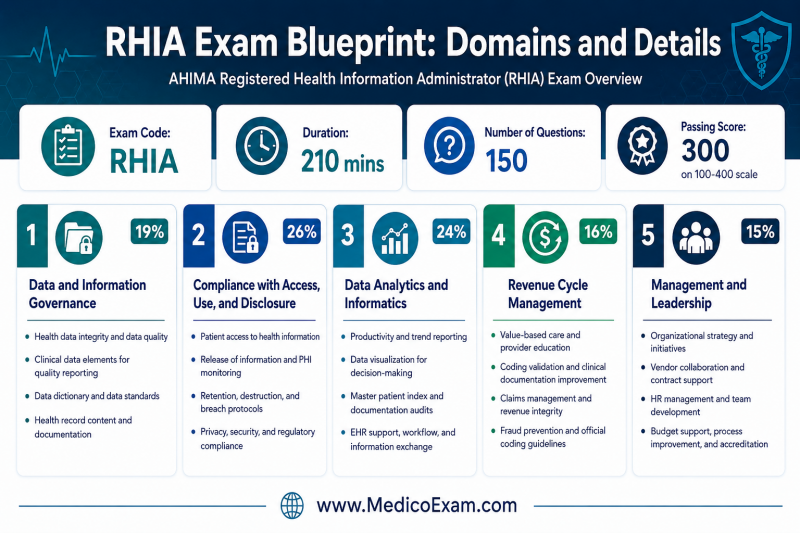
The AHIMA RHIA certification exam covers a broad spectrum of health information management functions, grouped into five distinct domains. Each domain carries a specific weight, indicating its importance and the approximate number of questions candidates can expect. A thorough understanding of these domains is vital for targeted study. For a complete breakdown, candidates should consult the detailed content outline from AHIMA.
RHIA Certification Exam Syllabus Domains and Weights:
-
Data and Information Governance (17-20%): Focuses on the policies, standards, and procedures for managing health information throughout its lifecycle.
-
Compliance with Access, Use, and Disclosure of Health Information (15-18%): Covers legal and ethical requirements related to patient data privacy, security, and release.
-
Data Analytics and Informatics (23-26%): Emphasizes the use of data for decision-making, quality improvement, and supporting clinical and administrative processes.
-
Revenue Cycle Management (20-23%): Explores the financial aspects of healthcare, including coding, billing, and reimbursement processes.
-
Management and Leadership (23-26%): Addresses principles of organizational management, human resources, strategic planning, and professional development within HIM departments.
These domains collectively represent the multifaceted expertise expected of an RHIA professional, from technical data management to strategic leadership.
Professional Impact: Advantages of AHIMA RHIA Certification
Earning the AHIMA RHIA certification is more than just adding letters after your name; it’s an investment in your professional future and a clear signal of your specialized expertise in health information management. The benefits extend across various aspects of a career, enhancing both individual trajectory and organizational effectiveness.
Accelerating Career Opportunities
The RHIA credential opens doors to a diverse range of roles within hospitals, clinics, government agencies, and technology vendors. It provides a competitive edge in a rapidly growing field, demonstrating a candidate's commitment to excellence and up-to-date knowledge in health information practices. Professionals with RHIA certification are sought after for their ability to manage complex data systems, ensure compliance, and contribute to strategic decision-making, leading to opportunities in leadership and specialized project management.
Boosting Earning Potential and Recognition
Registered Health Information Administrators often command higher salaries compared to non-certified peers due to their validated skills and expertise. The certification signifies a higher level of professional achievement and dedication, leading to increased trust and recognition from employers and colleagues. This enhanced credibility can translate into greater responsibilities, promotion prospects, and a stronger voice in healthcare policy and operational discussions.
Navigating Eligibility: RHIA Credential Requirements
To sit for the AHIMA RHIA certification exam, candidates must meet specific eligibility criteria established by AHIMA. These requirements ensure that only individuals with the necessary educational foundation and professional understanding are assessed for the credential. Meeting these prerequisites is a mandatory step before commencing your exam preparation.
AHIMA RHIA Eligibility Pathways:
There are several pathways to eligibility, typically involving a combination of academic achievement and/or prior certification. Candidates must generally hold a baccalaureate degree or master's degree from a program accredited by the Commission on Accreditation for Health Informatics and Information Management Education (CAHIIM) or an equivalent program. For the most current and detailed information on specific educational and experiential prerequisites, candidates should always refer to the official AHIMA guidelines. Ensuring you meet these AHIMA RHIA eligibility requirements before applying for the exam is crucial to avoid delays in your certification journey.
Strategic Preparation: Crafting Your RHIA Study Plan
Effective preparation is the cornerstone of success for the AHIMA RHIA certification exam. A well-structured study plan integrates various resources and techniques to cover the comprehensive syllabus and build confidence. Many resources are available to help candidates master the necessary concepts and skills.
Essential Study Resources
To pass the RHIA certification exam, candidates should begin by developing a robust study plan. Key components of a successful strategy include utilizing an official RHIA study guide and an AHIMA RHIA exam review book. These resources often provide in-depth coverage of each domain, practice questions, and detailed explanations. Online courses for RHIA certification can offer structured learning paths, expert instruction, and interactive content, which can be invaluable for understanding complex topics. The best RHIA study materials are those that align closely with the AHIMA RHIA exam blueprint and cater to your individual learning style.
Practice for Success
Beyond theoretical knowledge, practical application is critical. Incorporating AHIMA RHIA practice test questions into your routine is highly recommended. These practice tests help candidates become familiar with the exam format, question types, and time constraints. Regularly simulating exam conditions can significantly reduce test-day anxiety and identify areas requiring further review. Exploring comprehensive preparation resources can provide access to diverse practice tools and study aids tailored for Registered Health Information Administrator exam prep. Focus on understanding the rationale behind correct answers rather than just memorizing them.
Career Trajectory: RHIA Role and Compensation
Attaining the RHIA certification not only validates your expertise but also significantly influences your career trajectory and potential earning capacity within the healthcare industry. The Registered Health Information Administrator job salary reflects the specialized knowledge and critical responsibilities associated with the role.
Role Evolution and Demand
RHIAs are in high demand across various healthcare settings. Their expertise is crucial for managing electronic health records, ensuring data integrity, navigating complex regulatory landscapes, and contributing to healthcare analytics. As technology advances and regulations like HIPAA evolve, the RHIA's role becomes increasingly vital, leading to sustained demand for certified professionals. Career opportunities with RHIA certification can range from Health Information Manager, Director of Clinical Documentation, Data Integrity Analyst, to Privacy Officer.
Understanding Salary Expectations
The Registered Health Information Administrator job salary can vary based on several factors, including experience level, geographic location, type of healthcare organization, and additional specializations. Entry-level RHIAs can expect a competitive starting salary, which typically increases with years of experience and assuming more senior or specialized roles. The investment in RHIA certification often translates into a strong return, supporting long-term career growth and financial stability in a critical sector of healthcare.
The RHIA credential offers a robust foundation for a rewarding career in health information management. It equips professionals with the knowledge and skills to navigate the complexities of healthcare data, compliance, and leadership, positioning them for enduring success. With the industry’s increasing reliance on accurate and secure health information, becoming an RHIA is not just a certification; it's a strategic move to future-proof your career and contribute meaningfully to patient care and organizational excellence.
To truly excel as a Registered Health Information Administrator, a structured approach to learning and a commitment to continuous professional development are essential. Equip yourself with the best resources, engage in rigorous practice, and embrace the journey toward becoming a certified leader in health information. Explore diverse study materials to begin your RHIA journey and unlock a world of professional opportunities.
Frequently Asked Questions
1. What is the AHIMA RHIA certification?
The AHIMA RHIA (Registered Health Information Administrator) certification validates a professional's expertise in managing and securing health information across various healthcare settings, covering data integrity, privacy, and compliance.
2. What are the eligibility requirements for the RHIA exam?
Eligibility typically requires a baccalaureate or master's degree from a CAHIIM-accredited program. Specific criteria can vary, so it's essential to check the official AHIMA website for the most current requirements.
3. How much does the RHIA exam cost?
The RHIA exam costs $229 (USD) for AHIMA members and $299 (USD) for AHIMA non-members.
4. What are the key domains covered in the RHIA exam?
The RHIA exam covers five main domains: Data and Information Governance; Compliance with Access, Use, and Disclosure of Health Information; Data Analytics and Informatics; Revenue Cycle Management; and Management and Leadership.
5. What career opportunities does RHIA certification open up?
RHIA certification qualifies professionals for roles such as Health Information Manager, Director of Clinical Documentation, Data Integrity Analyst, Privacy Officer, and other leadership positions within healthcare organizations.
- AHIMA RHIA Question Bank |
- AHIMA RHIA Eligibility & Requirements |
- AHIMA Health Information Administrator Practice Test |
- AHIMA RHIA Exam Cost |
- AHIMA RHIA Registration Process |
- AHIMA Health Information Administrator Study Guide |
- AHIMA RHIA Recertification |
- AHIMA RHIA Certification Overview |
- AHIMA Health Information Administrator Syllabus |
- AHIMA RHIA Preparation Time |
- AHIMA RHIA Passing Score |
- AHIMA RHIA Exam Format |
- AHIMA Health Information Administrator Sample Questions |
- AHIMA RHIA Career Opportunities |
- AHIMA RHIA Exam Difficulty


