How to Pass the AHIMA CCS Exam: Step-by-Step Study Plan & Expert Strategies
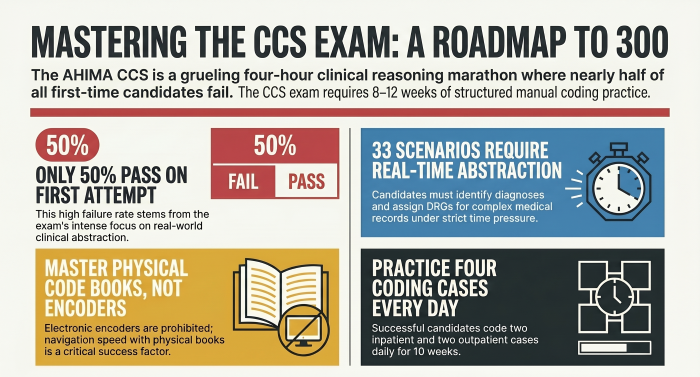
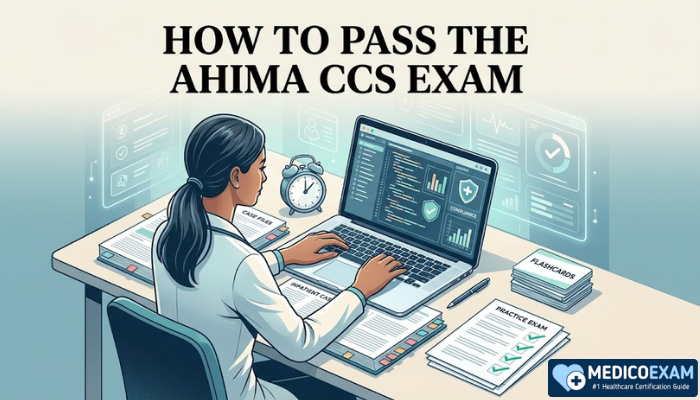 The AHIMA Certified Coding Specialist (CCS) exam has one of the lowest pass rates among healthcare certifications: approximately 50% of first-time test takers fail. With 107 total questions — including 33 medical coding scenarios requiring real-time abstraction — this is not an exam you can cram for. Successful candidates invest 8–12 weeks of structured preparation, practice 2 inpatient and 2 outpatient coding cases per day, and master the CCS content domains before sitting for the test. This guide gives you the exact study plan, domain strategy, and time management framework to pass on your first attempt.
Key Facts Box
-
Total Questions: 107 (97 scored, 10 pretest) — 64 multiple-choice items + 33 medical coding scenarios
-
Exam Duration: 4 hours
-
Passing Score: 300 (scaled)
-
First-Time Pass Rate: Approximately 50% (industry estimate)
-
Code Books Required: Candidates must bring approved ICD-10-CM, ICD-10-PCS, and CPT code books to the test center
-
2026 Code Book Update: Exams on or after May 1, 2026 require 2026 code books
-
Recommended Study Time: 8–12 weeks (10–15 hours per week)
-
Daily Practice Target: 2 inpatient + 2 outpatient coding cases per day
What Makes the CCS Exam So Challenging?
The CCS exam is not a typical multiple-choice test. It is specifically designed to assess whether you can perform complex medical coding tasks independently in real-world clinical settings. Three factors make it uniquely difficult:
-
The Scenario-Based Coding Section. Of the 97 scored items, 33 are medical coding scenarios that replicate actual medical records. You must read clinical documentation, abstract relevant data, identify the principal diagnosis, assign ICD-10-CM/PCS and CPT codes, apply sequencing rules, and assign DRG classifications — all under time pressure. This section is where most candidates fail.
-
The Breadth of Code Sets. The exam requires fluency across three major code sets simultaneously: ICD-10-CM for diagnoses, ICD-10-PCS for inpatient procedures, and CPT/HCPCS Level II for outpatient services. You must navigate your physical code books efficiently on exam day since electronic encoders are not permitted. Many candidates underestimate how much slower manual code book navigation is compared to using an encoder — this alone accounts for significant time pressure during the scenario section.
-
The Regulatory Knowledge. Beyond coding mechanics, the exam tests compliance frameworks: HIPAA, OIG audit standards, NCCI edits, medical necessity requirements, Medicare LCD/NCDs, and payer-specific reimbursement rules.
The exam spans a full 4 hours, and the AHIMA updated to the 2026 codebook requirements starting May 1, 2026 — meaning all candidates testing on or after that date must bring 2026 edition code books.
“The CCS exam isn't about memorizing codes — it's about clinical reasoning under pressure. If you can't abstract a principal diagnosis from messy documentation and assign the correct DRG in under 5 minutes, you'll struggle — even if you know the rules.”
CCS Exam Domain Weight Table
Understanding how the exam is weighted lets you allocate study time proportionally. The AHIMA CCS Exam Content Outline distributes questions across five domains:
| Domain | Weight | Key Topics |
|---|---|---|
| Domain 1: Coding Knowledge & Skills | 39–41% | Assign diagnosis/procedure codes, identify principal diagnosis, apply coding conventions, apply POA guidelines, demonstrate knowledge of NCCI edits, DRG/APC reimbursement, abstract data, identify MCC/CC conditions |
| Domain 2: Coding Documentation | 18–22% | Review health records for code assignment, identify documentation discrepancies, evaluate record completeness |
| Domain 3: Provider Queries | 9–11% | Determine compliant query opportunities, analyze documentation for query needs |
| Domain 4: Regulatory Guidelines | 9–11% | HIPAA compliance, NCCI edits, LCD/NCDs, payer logic, audit frameworks |
| Domain 5: Information Technologies | 9–11% | EHR types, encoder/grouper software, computer-assisted coding (CAC) impact |
Official source: AHIMA CCS Exam Content Outline
Note: Some third-party study guides group the domains differently. The official AHIMA content outline above reflects the current 5-domain breakdown.
10-Week CCS Study Plan
This week-by-week study plan assumes 10–15 hours per week. Adjust the timeline if you have more or less available study time.
| Week | Focus Area | Specific Activities | Daily Practice |
|---|---|---|---|
| Week 1 | Diagnostic Baseline & Orientation | Take a CCS practice exam to identify weak domains. Review the AHIMA Content Outline. Organize code books with tabs and markers. | Familiarize with code book navigation — 1 hour/day |
| Week 2 | ICD-10-CM Foundations | Official Coding Guidelines (Chapters 1–10). Focus on conventions, sequencing rules, excludes notes, combination codes. | 2 outpatient cases/day + 20 MCQ |
| Week 3 | ICD-10-CM Advanced | Official Coding Guidelines (Chapters 11–21). Focus on obstetrics, neoplasms, diabetes, and injury codes. | 2 outpatient cases/day + 20 MCQ |
| Week 4 | ICD-10-PCS Foundations | PCS structure, root operations, body systems, approaches, devices, qualifiers. | 2 inpatient cases/day + 15 MCQ |
| Week 5 | ICD-10-PCS Advanced | Surgical root operations, medical/surgical-related procedures, obstetric procedures. | 2 inpatient + 1 outpatient case/day |
| Week 6 | CPT/HCPCS Level II | E/M coding levels, surgical sections, modifier application, radiology, pathology, medicine, and HCPCS Level II. | 2 outpatient cases/day + 20 MCQ |
| Week 7 | Reimbursement & DRG/APC | MS-DRG assignment, APR-DRG, APC grouping, MCC/CC impact, POA indicator application. | 2 inpatient + 2 outpatient cases/day |
| Week 8 | Regulatory & Compliance | HIPAA, NCCI edits, medical necessity, LCD/NCDs, OIG compliance, provider query standards, fraud and abuse. | 2 mixed cases/day + 25 MCQ |
| Week 9 | Full-Length Practice Exams | Take 2–3 full-length timed CCS practice exams. Analyze errors by domain. Review weak areas intensively. | Full timed exam + error analysis |
| Week 10 | Final Review & Test Prep | Review only flagged weak areas. Practice code book navigation speed. Prepare test-day logistics. | 2 mixed cases/day (speed focus) |
What Are the Hardest CCS Topics?
Candidates consistently report the following topics as the most challenging on the CCS exam. Invest extra time in each:
-
Sepsis Coding. Sepsis coding is notoriously complex and appears frequently on the CCS exam. You must understand the difference between sepsis, severe sepsis, and septic shock. Know when to sequence R65.2-, when organ dysfunction supports severe sepsis, and how provider documentation affects code assignment.
-
Diabetes Coding. ICD-10-CM diabetes codes (E08–E13 categories) require precise identification of type, complications, and body system involvement. A single diabetic patient may require 3–5 codes to capture manifestations correctly.
-
Neoplasm Coding. Neoplasm coding requires navigating the Neoplasm Table in the ICD-10-CM Index, distinguishing primary vs. secondary sites, and understanding when to use codes for neoplasm-related pain, treatment complications, or personal history.
-
Surgical Procedures (ICD-10-PCS). The 7-character PCS structure challenges even experienced coders. Focus on distinguishing root operations — especially excision vs. resection, replacement vs. supplement, drainage vs. extirpation.
-
MS-DRG Assignment. Understanding how diagnoses and procedures affect DRG grouping is critical for the scenario section. Know how MCC and CC status changes reimbursement and why POA indicators matter.
How Should I Manage My Time During the CCS Exam?
The 4-hour exam requires deliberate pacing. Use this time management strategy:
| Exam Section | Time Allocation | Strategy |
|---|---|---|
| Multiple-Choice Questions (64 items) | 90 minutes | Average 1.4 minutes per question. Answer confidently known items first. Flag uncertain questions and return after completing all MCQ. Do not spend more than 3 minutes on any single question. |
| Medical Coding Scenarios (33 items) | 120 minutes | Average 3.6 minutes per scenario. Read the clinical documentation completely before coding. Identify principal diagnosis first, then secondary diagnoses, then procedures. Use code books systematically. |
| Review Time | 30–45 minutes | Return to flagged MCQ items. Verify scenario code sequencing. Check for missed modifiers and POA indicators. Do not second-guess well-reasoned first answers. |
Critical tip: Start with the multiple-choice section to build momentum and confidence. Move to coding scenarios when you are warmed up. The scenario section is the most time-intensive — protect your 120 minutes for it.
What Study Tools Should You Use for CCS Preparation?
The right study tools can make or break your preparation. Here is a comparison of the most effective CCS prep resources:
| Study Tool | Best For | Key Features | Cost Range |
|---|---|---|---|
| AHIMA CCS Exam Preparation Book | All candidates (essential) | Aligned with official content outline; practice questions across all domains; scenario-based coding cases | $50–$80 |
| ICD-10-CM, ICD-10-PCS, CPT Code Books | Exam day and daily practice | Required at testing center; build navigation speed by using physical books daily | $100–$250 (set) |
| Encoder software | Building real-world coding speed | Coding pathways, decision logic, and DRG grouping support for training use | Institutional access |
| MedicoExam Practice Tests | Exam simulation and gap analysis | Simulation-based CCS practice questions in a timed, exam-realistic format | Visit MedicoExam.com |
| AHIMA Practice Exam | Pre-exam diagnostic | Near-perfect replica of actual exam; same structure and time constraints; identifies weak domains | $50–$75 |
| Case Coding Labs (Inpatient/Outpatient) | Scenario section mastery | Practice abstracting data from complete medical records; mirrors the 33-scenario exam section | Varies |
| Flashcards / spaced repetition tools | Memorization and guideline review | Custom decks for code conventions, POA guidelines, DRG terms, and NCCI edits | Free to low cost |
Non-negotiable resources: At minimum, you need the AHIMA CCS Prep Book, current-year code books, and a practice exam platform. Everything else is supplementary but valuable.
If your training program or employer provides access to encoder tools, use them for learning coding logic and pathways — but remember that you will not have encoder access on exam day. Your physical code-book speed matters more.
What Daily Practice Habits Build CCS Exam Readiness?
-
Code 2 inpatient cases + 2 outpatient cases per day. This totals 4 cases daily — approximately 30–45 minutes. Inpatient cases build ICD-10-PCS, DRG assignment, and POA skills. Outpatient cases build CPT, HCPCS, and first-listed diagnosis logic.
-
Complete 15–25 multiple-choice questions daily. Use these to reinforce coding conventions, regulatory knowledge, and terminology. Review every answer explanation — even for questions you answered correctly.
-
Practice code book navigation for 15 minutes daily. On exam day, you will not have an electronic encoder. Your speed with physical code books directly affects your scenario section performance.
-
Use spaced repetition for guidelines and rules. Create flashcards for the official ICD-10-CM coding guidelines, common POA scenarios, NCCI edit pairs, and DRG grouping logic.
-
Simulate exam conditions weekly. Starting in Week 7, take at least one timed practice section per week under realistic conditions: code books only, no internet, no encoder, strict time limits.
How Should I Prepare for Test Day?
The week before:
-
Take one final full-length timed practice exam. If you score below 70%, strongly consider postponing your exam date.
-
Verify your code books are the correct edition (2026 code books required for exams on or after May 1, 2026).
-
Tab and mark your code books with sticky notes for fast navigation.
-
Confirm your test center location, parking, and check-in time.
The night before:
-
Pack your code books, valid photo ID, confirmation letter, and allowed supplies.
-
Do not study new material. Review only a brief summary of high-yield topics.
-
Get 7–8 hours of sleep. Fatigue is the enemy of a 4-hour exam.
On exam day:
-
Arrive 30 minutes early. Use the extra time to settle in, arrange your code books, and calm pre-test anxiety.
-
Manage your energy. The first 90 minutes should feel efficient. The middle 120 minutes demand peak concentration. The final 30–45 minutes are for review.
-
If you hit a scenario you cannot solve, flag it and move on. Spending 10 minutes on one scenario is a trap that costs you points on easier questions later.
Frequently Asked Questions (FAQ)
1. What is the CCS exam pass rate?
-
The CCS exam is widely considered one of the more challenging coding credentials. Many industry sources place the first-time pass rate at around 50%, though AHIMA does not publish this figure as a current official pass-rate metric.
2. How many questions are on the CCS exam?
-
The exam contains 107 total items: 97 scored and 10 unscored pretest questions. The 97 scored items break down into 64 multiple-choice questions and 33 medical coding scenarios.
3. What code books do I need for the CCS exam in 2026?
-
You need ICD-10-CM, ICD-10-PCS, and CPT code books. For exams on or after May 1, 2026, you must bring 2026 editions from AHIMA’s approved list.
4. Can I use an electronic encoder during the CCS exam?
-
No. Candidates must use physical code books only. Electronic devices, encoders, and online resources are not allowed during the exam.
5. How long should I study for the CCS exam?
-
Plan for 8–12 weeks of structured preparation at 10–15 hours per week.
6. What is the passing score for the CCS exam?
-
The passing score is 300 on a scaled scoring system.
7. How many times can I retake the CCS exam?
-
You can retake the exam, but you must follow AHIMA’s current retake policy and submit a new application and fee for each attempt.
8. Is the CCS worth it compared to the CPC?
-
Both certifications are valuable, but they serve different markets. The CCS validates inpatient and outpatient coding expertise with stronger hospital coding emphasis, while the CPC focuses more on physician and outpatient coding. For a side-by-side comparison, see this MedicoExam CPC vs CCS comparison.
Pass the CCS Exam on Your First Attempt
With a ~50% first-time pass rate, preparation is everything. Follow the 10-week study plan, code 4 cases daily, master your physical code books, and take multiple full-length practice exams before you schedule your test.
Try MedicoExam’s simulation-based CCS practice tests to build scenario coding speed, identify weak domains, and simulate real exam conditions. You can also explore more study resources here.
Written by the MedicoExam Content Team — Healthcare Education Specialists at MedicoExam.com
Last Updated: April 2026
Disclaimer: This article is for informational purposes only. MedicoExam does not provide actual CCS exam questions, exam recalls, or proprietary AHIMA content. All practice questions are original and designed to reflect the style, difficulty, and content areas of the official exam.
- AHIMA CCS Question Bank |
- AHIMA CCS Eligibility & Requirements |
- AHIMA Coding Specialist Practice Test |
- AHIMA CCS Exam Cost |
- AHIMA CCS Registration Process |
- AHIMA Coding Specialist Study Guide |
- AHIMA CCS Recertification |
- AHIMA CCS Certification Overview |
- AHIMA Coding Specialist Syllabus |
- AHIMA CCS Preparation Time |
- AHIMA CCS Passing Score |
- AHIMA CCS Exam Format |
- AHIMA Coding Specialist Sample Questions |
- AHIMA CCS Career Opportunities |
- AHIMA CCS Exam Difficulty


