AHIMA CCS Exam Format

Explore 5 resources related to AHIMA CCS Exam Format on MedicoExam. These resources help certification candidates understand key aspects of exam preparation, including exam structure, study strategies, and expectations for scenario-based or applied assessments. Reviewing these materials can help improve readiness and confidence before attempting the certification exam.

AHIMA CCA vs CCS: Which Medical Coding Credential Is Right for You?

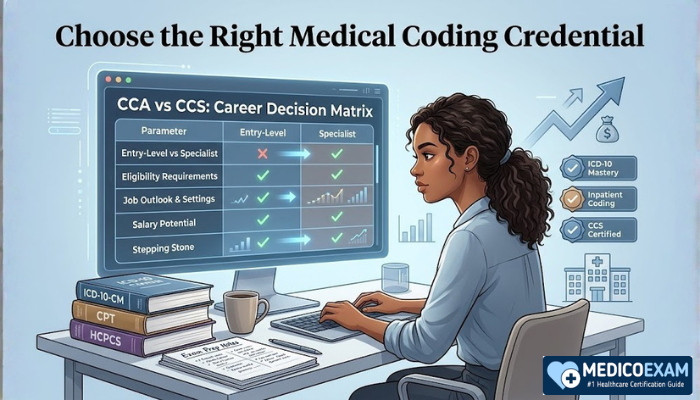
Medical coding student choosing between CCA and CCS certification with laptop, notes, and decision matrix graphic

Choose the CCA if you are an entry-level coder with no professional experience. Choose the CCS if you have 2 or more years of hands-on coding experience and want to specialize in complex hospital inpatient coding. The CCA validates foundational competency across both inpatient and outpatient settings, while the CCS is a mastery-level credential recognized as the gold standard for hospital-based medical coding. The CCS exam has a first-time pass rate estimated at just 40–50%, compared to approximately 70% or higher for the CCA, reflecting a significant gap in difficulty (AMBCI).

How to Pass the AHIMA CCS Exam: Step-by-Step Study Plan & Expert Strategies

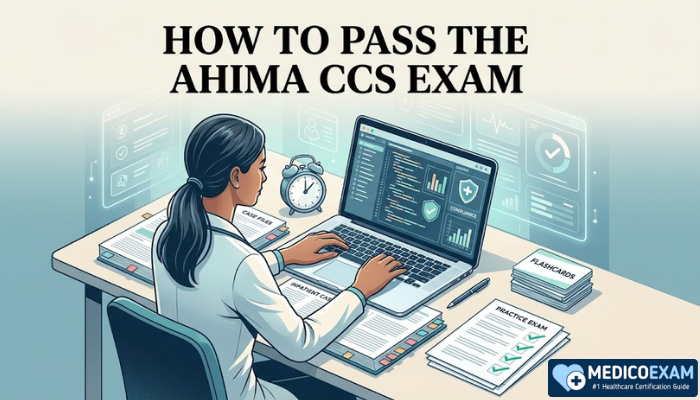
How to pass the AHIMA CCS exam image with a focused medical coding student, coding manuals, laptop, and practice test materials.The AHIMA Certified Coding Specialist (CCS) exam has one of the lowest pass rates among healthcare certifications: approximately 50% of first-time test takers fail. With 107 total questions — including 33 medical coding scenarios requiring real-time abstraction — this is not an exam you can cram for. Successful candidates invest 8–12 weeks of structured preparation, practice 2 inpatient and 2 outpatient coding cases per day, and master the CCS content domains before sitting for the test. This guide gives you the exact study plan, domain strategy, and time management framework to pass on your first attempt.

Key Facts Box

  • Total Questions: 107 (97 scored, 10 pretest) — 64 multiple-choice items + 33 medical coding scenarios

  • Exam Duration: 4 hours

  • Passing Score: 300 (scaled)

  • First-Time Pass Rate: Approximately 50% (industry estimate)

  • Code Books Required: Candidates must bring approved ICD-10-CM, ICD-10-PCS, and CPT code books to the test center

  • 2026 Code Book Update: Exams on or after May 1, 2026 require 2026 code books

  • Recommended Study Time: 8–12 weeks (10–15 hours per week)

  • Daily Practice Target: 2 inpatient + 2 outpatient coding cases per day

AHIMA CCS Exam FAQs & Preparation Guide

AHIMA CCS exam frequently asked questions (FAQs) for AHIMA Certified Coding Specialist (CCS) preparation

The AHIMA Certified Coding Specialist (CCS) certification is a professional credential offered by the American Health Information Management Association (AHIMA) that evaluates competencies in medical coding across various coding systems such as ICD-10-CM, CPT, and HCPCS Level II. Candidates pursuing this certification typically work as Medical Coding Specialists or Health Information Managers in settings like hospitals, outpatient clinics, and health insurance companies.

This FAQ covers essential details about the AHIMA CCS exam, including exam structure, preparation strategies, scoring, and key facts to help you prepare for success.

AHIMA CCS — Frequently Asked Questions (FAQs)

This FAQ section summarizes key aspects of the AHIMA CCS exam, including format, difficulty, and preparation. For official eligibility, policies, and updates, visit the AHIMA’s official exam page.

SECTION A: AHIMA CCS Exam Overview & Legitimacy

This section covers key details about the AHIMA CCS exam, including its purpose, who should take it, and the legitimacy of the certification.

AHIMA CCS Certification Sample Questions

AHIMA CCS sample questions for AHIMA Certified Coding Specialist (CCS) preparation

The AHIMA Certified Coding Specialist Certification Sample Question Set on this page is designed to familiarize you with the actual AHIMA CCS exam format and question types. These sample questions help you understand how questions are structured and what to expect on test day. While they provide a useful starting point, they represent only a limited preview of the real exam experience.

These sample questions are intended for evaluation and familiarization only. To understand exam style, pacing, and reasoning patterns more clearly, we recommend trying our online sample practice environment. If you are preparing for the AHIMA Certified Coding Specialist (CCS) and want to assess your readiness more rigorously, structured, timed, scenario-based practice is recommended. This approach aligns with the cognitive demands and professional expectations typically associated with Medical coders, Health information management professionals, Coding auditors and related roles working in settings such as Hospitals, Health systems, Coding service organizations and related settings.

Try Sample Exam »    |    Access Full AHIMA CCS Practice Exam »

AHIMA CCS Certification Exam Syllabus

AHIMA CCS syllabus for AHIMA Certified Coding Specialist (CCS) preparation

Welcome to the official MedicoExam syllabus guide for the AHIMA Certified Coding Specialist certification. This page delivers a clear, structured overview of the AHIMA CCS exam, including key exam details, syllabus topics, and preparation references to support effective study planning. The AHIMA Certified Coding Specialist (CCS) is intended for professionals pursuing roles aligned with Medical Coding, with assessment centered on applied competencies such as ICD coding proficiency, Clinical documentation interpretation, Coding compliance and auditing within real-world settings like Hospitals, Health systems, Coding service organizations and related settings.

The syllabus outline below reflects the core domains and expectations defined by the official AHIMA certification framework and aligns with the cognitive and professional standards assessed in the AHIMA CCS exam. Candidates can use this guide alongside official vendor resources and structured practice to align their preparation with current exam standards and professional expectations for Medical coders, Health information management professionals, Coding auditors and related roles

Syndicate content