
How to Pass the CUC Urology Coder Exam: A Four-Area Study Plan
Passing the CUC means answering 100 questions in 240 minutes and reaching a score of 70 on AAPC's Certified Urology Coder exam. The questions all concern urology claims: diagnosis, procedure and supply codes. Build your preparation around its four content areas, and use the CUC practice test to find the one that needs the most work.

Does a CUC practice exam exist, and who sells one?
Looking at AAPC's CUC page, two products appear: an exam voucher that starts at $325 and a self-paced online course that starts at $660. No practice exam or question bank is shown there, which means buying a voucher does not bring one with it. MedicoExam is a separate company from AAPC. The practice test on our site is a question set we wrote ourselves from AAPC's published content areas, and it carries no AAPC authorship or endorsement.
The cart for our set sits on the CUC practice test page linked in the opening paragraph. A short sample of questions is available next to the syllabus page for anyone who wants a preview first. Judge any set, ours included, by one test: does it spread questions across all four content areas AAPC names, or does it lean on whichever topic is simplest to write? Lopsided practice produces a score that flatters you and then fails you on the day.
What are the exam's format, scoring and fees?
One hundred questions share a four-hour clock, which gives you roughly 2.4 minutes for each. The passing score recorded in our data is 70. Candidates choose between a live remote proctor, from a home computer, and a physical testing center. A voucher must be bought before AAPC will display open dates and times.
In our October 2026 records the price is $399 and covers two attempts. AAPC advertises a single voucher from $325, so the extra attempt costs about $74. Our syllabus page adds that attempts are scheduled one at a time, with the second opening up after the first result comes back. Fees and retake conditions are set by AAPC and can change, so confirm both on its page before paying.
| Item | CUC detail |
|---|---|
| Credential | AAPC Certified Urology Coder (CUC) |
| Category | Specialty coding, medical coding |
| Number of questions | 100 |
| Allowed time | 240 minutes (4 hours) |
| Passing score | 70 |
| Fee, October 2026 | $399 for two exam attempts; AAPC lists a voucher from $325 |
| Credential validity | 2 years |
| Delivery | Online with a live remote proctor, or at a testing center |
The generous clock tells you something about the paper. Questions are rarely a quick recall of a code; they usually describe an encounter, and you must dig out the facts that decide the answer before selecting a code or a pair of codes. Reading is the slow part. Rehearse that pace once with a complete timed set, so the length of the sitting does not catch you off guard.
Which four areas does the CUC test?
According to AAPC's description, holders of the CUC are able to assign ICD-10-CM, CPT and HCPCS Level II codes to urologic conditions and procedures while following current guidelines, payer policy and federal rules. The published scope breaks into four groups. Our syllabus page carries the same four, in AAPC's order.
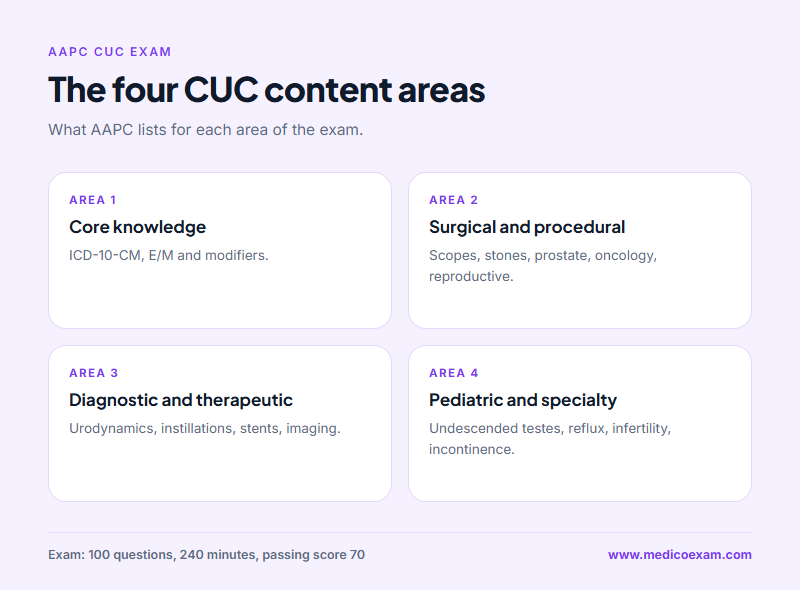
Core knowledge areas. Everything else stands on this group. AAPC lists diagnosis coding for conditions both ordinary and complex, citing kidney stones, incontinence, infertility, prostate disorders and urologic cancers. Added to that are E/M services in outpatient, inpatient and consultative settings, plus modifiers and payer rules that keep billing compliant. What is measured is note-reading: finding what the provider documented and applying the correct guideline to it.
Surgical and procedural coding. AAPC names the longest list here: cystoscopy, ureteroscopy, lithotripsy and transurethral resection; prostate operations such as TURP and prostatectomy; cancer surgery including nephrectomy, bladder tumor resection and orchiectomy; and reproductive procedures, vasectomy and hysteroscopic treatments among them. Operative reports decide these answers. What changes a code is the approach used, the work actually performed and anything else done in the same session.
Diagnostic and therapeutic services. This group takes in urodynamics, bladder instillations, catheterizations, stent placement, imaging, biopsy and other urology-specific testing, along with office-based and minimally invasive interventions. Because so much of it happens in the clinic and not the operating room, questions lean on practice-setting reporting: which components may be billed together and which supplies can be added.
Pediatric and specialty urology. The final group lists childhood conditions such as undescended testes, vesicoureteral reflux and congenital anomalies, infertility work-ups, treatments for erectile dysfunction, and incontinence assessment and management. Although the subject matter is clinical, the exam is not a clinical test. It asks which codes the documentation supports and never whether a treatment was the right one.
Percentage weights for the four groups are not given on AAPC's page, and we will not make any up. Unless AAPC publishes figures, assume the groups count about equally and let your own scores decide where the hours go.
Are you ready for the CUC, or should you wait?
Before sitting, AAPC wants candidates to hold working knowledge of urology vocabulary, anatomy and disease processes, and to use the CPT, HCPCS Level II and ICD-10-CM sets properly. No minimum number of years is stated. Anyone short of that level is pointed toward AAPC's own CUC course. For the rest of the credential family, see the AAPC certifications overview.
AAPC names these groups as the natural audience:
- coders already certified who work in urology practices or in multi-specialty groups with a urology department
- hospital coders, revenue cycle staff and auditors focused on surgical or outpatient procedure coding
- billing managers overseeing urology services, ambulatory surgery centers or specialty surgical clinics
- coders aiming to step into a specialty that leads on to auditing and compliance roles
A coder who handles urology claims every day usually needs to prove breadth, since a single practice meets only part of the list. A generalist faces a different gap, mostly in operative coding, where one report can describe several procedures and the question becomes which ones stand alone. Decide which of the two you are before choosing how much time to set aside.
How do the three code sets work together on a urology claim?
A urology claim usually draws on all three code sets the exam names. ICD-10-CM supplies the diagnosis, the reason the patient needed the service. CPT describes what was performed, whether that was an office visit or an operation. HCPCS Level II covers items CPT does not, such as certain supplies and drugs. The coder's task is to make the three tell one consistent story that the documentation backs up.
Consistency is what payers check, and it is what exam questions probe. A diagnosis that does not justify the procedure, a supply reported without the service that used it, or a modifier that contradicts the note will each be marked wrong. When you practise, finish every case by reading your three code choices together and asking whether a reviewer who had only the record would reach the same combination.
Medicare and other payer rules sit on top of this. AAPC lists payer-specific guidelines, bundling rules and modifier use among the skills the CUC proves, which tells you the exam is not a pure code-lookup exercise. Expect to apply a rule to a fact pattern, for instance deciding whether two services performed in one session may be reported separately or whether one is already included in the other.
Which skills beyond code lookup does the exam reward?
Reading speed and accuracy matter more than memory. Operative reports are long, and the lines that decide a code are often a short phrase about the approach, the extent of the work or a second step. Practise underlining those phrases in sample notes before you pick any code, so that your attention is on facts and not on guessing which section of the code book to open.
E/M selection is a second skill. For office and other visits, the level now rests on the complexity of medical decision making or on total time, and not on how much history or examination was recorded. Be ready to judge a visit note against those two routes. In urology this often arises on the day a procedure is also done, which brings the modifier question back in.
Third, learn to work from the answer choices backward when you are stuck. In a multiple-choice coding paper, two options are usually plausible and the others can be dropped quickly. Compare the two survivors against the documentation line by line, and choose the one the note fully supports. This is quicker than rebuilding the code from nothing, and it is safe because you still verify the final choice against the books.
Where do generalist coders struggle most?
AAPC releases no pass rates and no difficulty scores per area, so this is a judgment drawn from the published scope and not a statistic. Surgical and procedural coding looks like the weakest spot for a generalist. A cystoscopy may be purely diagnostic or may carry a further step, and a transurethral resection can be reported differently depending on what was removed and by what method. Candidates stumble by reading the title of an operative report rather than the body.
Diagnostic and therapeutic services come next. Urodynamics has several parts, and catheter and stent work may be billed alone or folded into a larger service. People from a clinical background tend to find diagnosis assignment comfortable yet need extra hours on bundling, modifiers and payer wording. A first timed paper will reveal which of these applies to you better than any guess.
What do urology coding scenarios look like in practice?
Because AAPC keeps its questions private, the three cases here are invented to show the style of thinking the four areas demand. Code numbers are left out deliberately; the real exam wants you to look codes up in current books, and so should you.
A scope examination that grows. The report describes a look inside the bladder, and then a tissue sample taken in the same session. Start by naming the base procedure from the report. Next, work out whether the sample was a distinct service or part of the base procedure under CPT guidance. Then choose the diagnosis the record supports and decide if a modifier is needed. The common error is to report both without ever asking whether the rules combine them.
A clinic visit plus a procedure. An established patient comes in about an ongoing problem and receives a bladder instillation at the same appointment. The question is whether the evaluation stood apart as significant and separately identifiable. If the note shows it did, an E/M service with a modifier may be reportable; if the note shows only the procedure, it may not. Such items test documentation and modifiers together, both of which sit in AAPC's first content area.
A child with a diagnosis and a later operation. A boy is evaluated for an undescended testis and has corrective surgery afterward. Separate the pieces: which entry supports the diagnosis, which supports the procedure, and whether the setting alters how the service is reported. Pediatric items often turn on a side or a documented detail that separates two similar codes, so finish the note before choosing.
When you finish each case, write a single sentence on why the right answer is right and why its nearest rival is wrong. Wrong options in coding exams are typically valid codes applied to the wrong situation, so this habit trains the exact skill the paper rewards.
What is a sensible order for CUC study?
Open with a timed baseline, a full paper marked by content area. Resist the urge to read first and test later. A baseline that shows surgical bundling dragging your score tells you far more than a generic plan could, and it lets you shorten the parts you already know.
Then go area by area. Core knowledge goes first because diagnoses, E/M levels and modifiers appear in every other group. Surgical and procedural coding follows, then diagnostic and therapeutic services, and pediatric and specialty urology closes the sequence. Inside each area, read the governing guideline, code ten documented cases without peeking, and compare not just your final code but how you reached it. A right answer reached by a wrong route will break the next time the case changes shape.
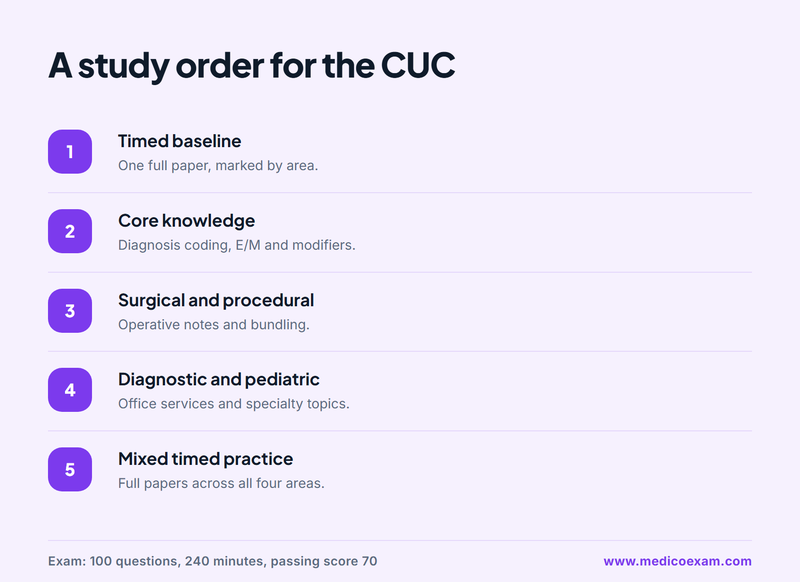
Finish with mixed practice. The live paper never labels the group a question belongs to, so complete several full timed sets in which all four are shuffled together. Go back over every miss and every lucky guess, and write down the missing rule in a line. Those lines, collected, become your revision sheet for the last days.
We name no number of weeks, since the right figure depends on the starting point. A working urology coder may need only a quick pass through the rules; someone from another specialty must build the operative and bundling knowledge from zero. Let the baseline set the schedule.
How can you check the quality of a CUC question set?
Good material has three traits. Its questions reach every area on AAPC's list instead of crowding into diagnosis coding. Its scenarios read like genuine documentation, with details you must locate, not one-line prompts. And each explanation states the rule, not merely the key. If a set fails any of the three, treat its scores with caution.
Distrust a provider quoting a pass rate with no source you can open, or one calling its questions official when AAPC did not write them. Your score on any set describes that set alone. Its use is to expose weak areas, not to forecast the real result.
How should the last week and the exam day go?
Book the voucher early, because dates and times only appear once it has been purchased. Study AAPC's instructions on identification, permitted items and, for home testing, the equipment checks that remote proctoring requires. Remote and testing-center rules differ, so read the set matching your choice.
During the final week, add nothing new. Do one complete timed paper in exam conditions, go through the misses and sleep well. On the day, take two passes through the paper: answer what you can settle quickly, flag the harder items and return to them. With four hours available, a second pass is realistic. The slips below cost candidates the most points.
- Coding from the diagnosis label. Documentation chooses the code. A condition with a well-known name can be recorded in a way that leads to a different answer.
- Billing every service named in a note. Some work is included in a larger procedure, and many questions probe whether you can tell.
- Treating modifiers as an afterthought. AAPC lists them under core knowledge, so the code may be right while the modifier makes the answer.
- Neglecting pediatric and specialty urology. It is one of four named groups and deserves equal revision time.
- Trusting memory over the books. Verify each code against the current edition and never lean on a number you only half recall.
What happens after you pass?
Our records show a validity of two years. AAPC's CUC page sets out the upkeep: keep the yearly AAPC membership active and log 36 continuing education units in every two-year period. These are the renewal terms that page publishes, so look at it once more before your own renewal falls due.
AAPC describes the credential as respected by urologists, surgical centers and healthcare organizations, and as a route into specialty coding, auditing and compliance in urology practices. We quote no salary and no pass rate, since AAPC gives neither on this page and we do not publish figures a reader cannot check. Take the baseline paper, follow the order set out above, and book the voucher once your timed scores stay comfortably over 70.
Frequently Asked Questions
How many questions are on the CUC exam?
Expect 100 questions on the CUC, a four-hour (240 minute) limit and a passing score of 70 in our records. Divided evenly, you get roughly two and a half minutes for each item. AAPC's CUC page is the place to confirm the format before you commit to a voucher.
How much does the CUC exam cost?
Our records for October 2026 show $399 for two exam attempts, and AAPC's page lists a voucher as starting at $325. AAPC prices its self-paced course separately, from $660. Fees change, so read AAPC's CUC page for the current figure before paying.
Can I take the CUC exam from home?
Yes. AAPC offers online delivery with a live remote proctor, or a testing center if you prefer. Dates and times become visible only after the voucher is bought. Whichever delivery you pick, read AAPC's identification and equipment rules ahead of exam day.
What does the CUC exam cover?
Four groups make up the content: core knowledge (ICD-10-CM, E/M and modifiers), surgical and procedural coding, diagnostic and therapeutic services, and pediatric and specialty urology. Every group is examined as coding work on urology records, never as clinical judgment.
How do I renew the CUC credential?
AAPC asks you to keep your annual membership current and to earn 36 continuing education units every two years. That is the renewal rule AAPC publishes on its CUC page. Recheck that page before your renewal date, because requirements can change.
- AAPC CUC Question Bank |
- AAPC CUC Eligibility & Requirements |
- AAPC Urology Coder Practice Test |
- AAPC CUC Exam Cost |
- AAPC CUC Registration Process |
- AAPC Urology Coder Study Guide |
- AAPC CUC Recertification |
- AAPC CUC Certification Overview |
- AAPC Urology Coder Syllabus |
- AAPC CUC Preparation Time |
- AAPC CUC Passing Score |
- AAPC CUC Exam Format


