
Stop Studying Everything: Prepare for the CDN Exam by Weight
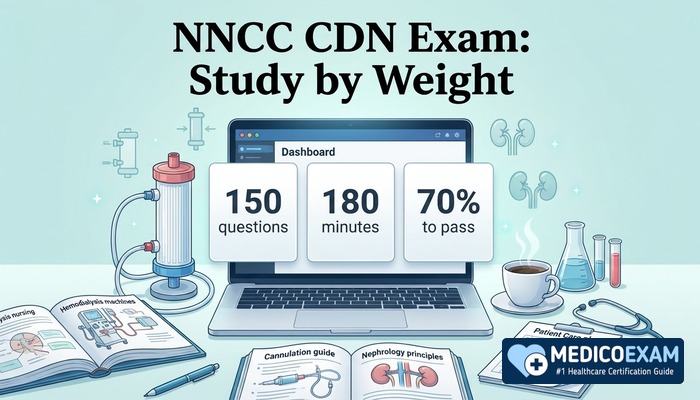
The NNCC Certified Dialysis Nurse (CDN) exam has 150 questions, a three-hour limit and a passing score of 70%. About 25 of the questions are unscored pilot items. More than half of the paper, 52%, comes from one area, chronic hemodialysis care for patients with end-stage renal disease. Here is how it is put together.
Curious how ready you are today? Try the CDN practice test first. The sections below show what your result should be measured against and how NNCC's blueprint becomes a plan.
What does the CDN certification prove, and who is eligible?
A dialysis nurse carries a very particular set of responsibilities. In one shift that can mean preparing and starting treatments, watching the machine and the patient at the same time, teaching a person with kidney failure how to manage fluid and diet, and keeping the water treatment system and the unit safe for everyone in the room. The Certified Dialysis Nurse credential is built around that work. It tells an employer and a patient that the nurse passed a standard examination written for registered nurses who practise in dialysis facilities.
The Nephrology Nursing Certification Commission (NNCC) is the certifying body, and NNCC's CDN page is where to verify details that may change. Today, that page sets three eligibility conditions for applicants in the United States and its territories. You must hold a full and unrestricted registered nurse license. You must have completed at least 2,500 hours as a registered nurse in nephrology nursing, caring for patients who need in-center hemodialysis or educating and supervising staff who do, within the two years before you apply. And you must have completed thirty contact hours of nephrology continuing education from approved providers within the same two years.
The continuing education has to come from a provider that one of several bodies approves. NNCC names organizations accredited by the American Nurses Credentialing Center Commission on Accreditation, the American Association of Critical-Care Nurses, the Council of Continuing Education and all state boards of nursing. It adds a warning that a program accepted by another state board may still fail NNCC's own criteria, so check a course against NNCC's list before you pay for it.
Nurses educated or licensed outside the United States face the same conditions plus extra ones. NNCC's preparation guide asks for a current, full and unrestricted license as a first-level general nurse, and for the applicant to meet the requirements of TruMerit, formerly the Commission on Graduates of Foreign Nursing Schools. Those cover secondary school, a government-approved general nursing program of at least two years, and theory and clinical education in adult, maternal and infant, child and psychiatric nursing.
A second NNCC credential is easy to confuse with this one. NNCC describes the CDN exam as tailored to registered nurses who specialise in dialysis and the care of people with chronic kidney disease stage 5. Its Certified Nephrology Nurse exam is for nurses who practise across several areas of nephrology and care for people with chronic kidney disease stages 3 to 5. If your daily work is in a hemodialysis unit, the CDN is the exam written around it.
How is the CDN exam laid out, and what is the fee?
The CDN exam is a computer-based test of 150 multiple-choice questions with 180 minutes to finish. Of the 150, 125 are scored and 25 are unscored. NNCC calls the unscored ones experimental or pilot items: new questions placed in the paper so their difficulty can be measured before they count toward anyone's result. You cannot tell which ones they are, so every question deserves a full answer.
The table below gathers the figures from the MedicoExam exam database, which match what NNCC publishes on its CDN page. Where a cell holds two values, both are given and labelled.
| Item | CDN exam |
|---|---|
| Certifying body | Nephrology Nursing Certification Commission (NNCC) |
| Questions | 150 (125 scored and 25 unscored) |
| Time allowed | 180 minutes (three hours) |
| Passing score | 70% |
| Fee (USD, as of October 2026) | Standard fee - $350; NNCC partner organization member - $300 |
| Certification valid for | 3 years |
| Content areas | Four, weighted 52%, 32%, 8% and 8% |
The passing score deserves a careful sentence. The database lists 70%, and NNCC explains in its preparation guide that a panel of dialysis nurses sets the standard using an Angoff procedure, in which each question is reviewed for the level of difficulty a minimally competent nurse should handle. The guide adds that the standard is fixed in advance, so your result is measured against it and not against how other candidates performed. It also tells readers to look at NNCC's website for the current percent correct, so confirm the figure there before your sitting.
On price, the database gives two figures and the difference depends on who you are. The standard fee is $350. Candidates from an NNCC partner organization that is a member pay $300. Fees are set by NNCC and can change, which is why the table dates them. Someone who fails gets one chance to retest within a year at a reduced rate, with instructions on the score report.
Passing earns certification that the database lists as valid for three years. NNCC publishes its renewal requirements on a separate recertification page, and those rules belong to NNCC, so read them there when the time comes and not in a summary written months earlier.
What are the four CDN content areas, and how much does each weigh?
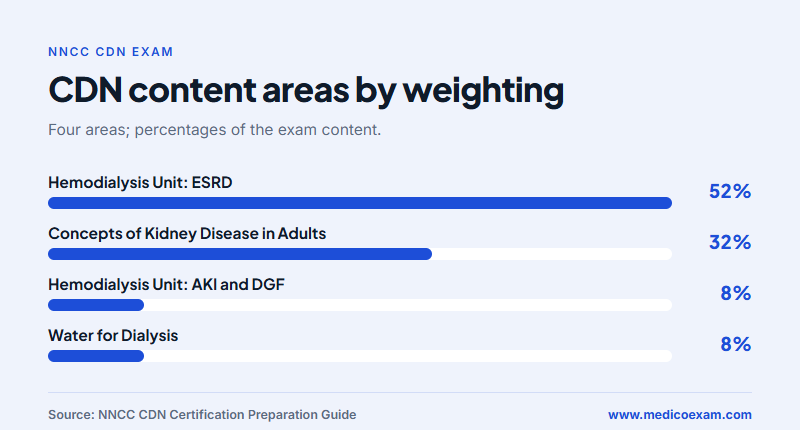
Every CDN question belongs to one of four content areas, and NNCC publishes the weight of each in its preparation guide. Two areas carry 84% of the exam between them, and the other two split the remaining 16% equally. That lopsided shape is the most useful fact in this guide, because it tells you where an hour of study returns the most.
MedicoExam's exam syllabus sets out the same four areas in outline form, which is handy to keep beside you while you work through the detail below.
Chronic Hemodialysis Unit: End-Stage Renal Disease (52%)
This is the largest area by a wide margin. NNCC says its questions deal with the physiological and technical principles of hemodialysis and ask the nurse to choose appropriate actions while caring for patients with end-stage renal disease on hemodialysis. The activities it lists include preparing, initiating, monitoring and discontinuing the treatment, and recognising and troubleshooting variations in blood flow through the extracorporeal circuit, such as arterial pressure, venous pressure and blood flow rate.
The same list covers administering medications, following protocol when a dialysis-related problem or symptom appears, and teaching patients and caregivers why the dialysis prescription matters. In the blueprint grid, this one area accounts for roughly 77 to 78 of the 150 questions, which is more than the other three areas combined can offer.
Concepts of Kidney Disease in Adults (32%)
The second area covers the wider care of a person receiving hemodialysis. NNCC names infection prevention and control, teaching patients and significant others about the effects of kidney disease, taking part in care planning, and considering how a person responds to illness and what it means for their life. Its examples include using clean or aseptic technique to start and end treatments, keeping the work environment safe for patient and staff, joining interdisciplinary rounds, and evaluating how well a patient and family are adapting. This area accounts for about 47 to 48 questions.
Chronic Hemodialysis Unit: Acute Kidney Injury and Delayed Graft Function (8%)
Outpatient hemodialysis facilities have been able to treat patients with acute kidney injury, and kidney transplant recipients whose new kidney has not yet started to work, since 2017, according to NNCC. Because that group is relatively small, the area makes up 8% of the exam, or about 11 to 12 questions. It asks you to recognise how acute kidney injury and delayed graft function differ from end-stage renal disease in presentation and treatment, to assess and care for vascular access in these patients, to identify the most serious complications, and to manage a higher risk of infection.
Water for Dialysis (8%)
The last area is the one most often skipped by candidates who work on the floor and leave the water room to technicians. NNCC explains that the water used to prepare dialysate must be highly processed and continuously monitored, and that nurses need to understand the water treatment system and its role in patient safety. The activities tested include explaining to staff why each water treatment task is necessary, describing the functions of the parts of the system, identifying problems related to bacteria and pyrogens, confirming that required tests are documented, and recognising how a patient reacts to contaminated water. It also holds about 11 to 12 questions, which is the same as the acute kidney injury area, so it deserves a proper study block and not a last-night skim.
How do the seven objectives and three question levels shape the paper?
The content areas are only one way to slice the exam. NNCC's blueprint also assigns every question to one of seven objectives, so each item sits in a grid cell made of one content area and one objective. Knowing the objectives tells you what kind of thinking each question demands, which matters as much as the topic.
The objectives and their shares of the 150 questions are listed below.
- Recognise pathologic processes and complications of kidney disease or its treatments: 18%.
- Select interventions suited to those processes and complications: 22%.
- Apply physiologic and technical principles of renal replacement therapies: 20%.
- Choose teaching and learning strategies for patients, families, other professionals and the public: 10%.
- Select appropriate actions in administering medications to a patient treated for kidney disease: 14%.
- Apply principles of infection control: 8%.
- Promote positive outcomes through collaboration, including psychological and cultural effects, staff development and quality improvement: 8%.
Read the first three together. Recognising complications, selecting interventions and applying technical principles add up to 60% of the paper, and all three are about acting correctly while treatment is under way. The teaching, medication, infection control and collaboration objectives add the remaining 40%, which is why a candidate who studies only machines and numbers leaves a large share of the paper to chance.
NNCC also states how hard the questions are meant to be. Its guide groups them into three levels: recall of knowledge at 10%, comprehension at 25% and application of knowledge at 65%. Recall questions ask you to remember facts, terms and definitions. Comprehension questions ask you to interpret, compare or explain. Application questions present a clinical situation and ask what is happening or what action to take, and they make up nearly two thirds of the exam.
That ratio changes how you should practise. Memorising a definition earns you the small recall share, but most marks require you to read a short scenario, work out which fact applies and choose the best of four options. Some questions in the preparation guide follow a single patient through several linked items, so you may need to hold a case in mind while you answer more than one question about it.
How should you study for the CDN exam, and in what order?
A study order built on the blueprint gives each area time in proportion to its weight, then adjusts for your own gaps. The sequence below suits a nurse who already works in a dialysis unit and wants to turn daily experience into exam answers.
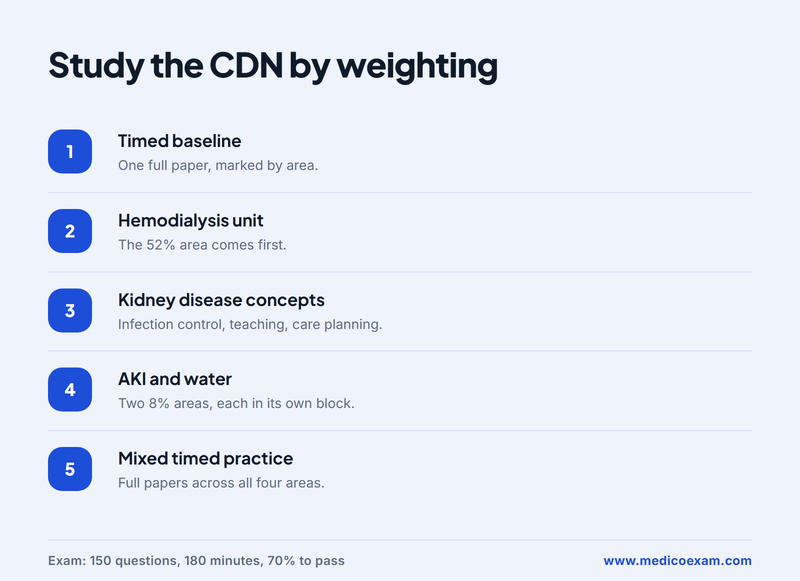
- Measure where you start. Answer a full set against the clock, then score it separately for each content area. One overall percentage hides the area pulling it down.
- Start with the 52% area. Work through the hemodialysis unit topics in the order you meet them in practice: setting up, initiating, monitoring, troubleshooting and discontinuing, then vascular access and medications.
- Move to the 32% area. Concentrate on infection control, patient teaching, care planning and the way people adapt to chronic illness. These questions reward reading carefully more than raw memory.
- Give the two 8% areas their own blocks. Study acute kidney injury and delayed graft function as a comparison with end-stage renal disease, and study the water treatment system part by part.
- Finish with mixed, timed sets. Long sets drawn from every area show whether your pace survives 150 questions.
Pacing is worth rehearsing on its own. Three hours for 150 questions is an average of 72 seconds each. Recall items take far less than that and multi-step scenarios take more, so a timed set is the only reliable way to learn which questions you spend too long on.
For source material, NNCC's CDN preparation guide lists the references its question writers use: the ANNA Core Curriculum for Nephrology Nursing, the Daugirdas Handbook of Dialysis, Review of Hemodialysis for Nurses and Dialysis Personnel, Primer on Kidney Diseases and the CMS Conditions for Coverage for End-Stage Renal Disease Facilities. NNCC says each question is supported by the most recent edition of the core curriculum or another listed reference, so use the current editions and not an older copy from a colleague.
NNCC also sells an online practice test of 50 multiple-choice questions. It has a practice mode that gives the answer and rationale after each question and a test mode that holds results until the end, shows the percentage correct by blueprint area, and gives 90 days of access. It is short, so use it as a checkpoint and add longer timed sets for stamina.
What happens on exam day, and how do you read the result?
After NNCC accepts your application you receive an examination permit with instructions for scheduling. NNCC advises arriving 30 minutes before your appointment and bringing a valid government-issued photo ID together with the permit. The name on both must match. Personal items are not allowed in the testing room, and cell phones and other electronic devices are not permitted at all, so plan to leave everything at home or in a locker where the center has them.
At the testing center you hand the proctor your ID, have your photo taken and sign a roster and regulation sheets. Once seated at the computer you complete a short tutorial on the test layout and keyboard keys, and then your three hours begin. NNCC suggests using all the time you need to think each question through, even if other candidates finish early.
The result arrives quickly. The score report is ready when you finish the test. A passing report shows your score and says when to expect your certificate and when your name will appear in the online NNCC certified directory. A report for a candidate who did not pass shows the score and the percentage of questions answered correctly in each content area, which tells you exactly which parts of the blueprint to rebuild before a retest.
Which mistakes cost CDN candidates the most marks?
These are pitfalls drawn from how the exam is built, not from any published statistic.
- Studying in proportion to interest, not weight. Many nurses enjoy the water treatment system or the pathophysiology of kidney disease and spend weeks there, while the 52% area gets whatever time remains.
- Treating experience as preparation. Daily practice teaches how your own unit does things. The exam asks for the best answer by the standards in the reference texts, which may differ from local habit.
- Ignoring the unscored questions. Roughly one question in six does not count, but you cannot spot which, so skipping a hard-looking item on a guess is a gamble with no benefit.
- Practising only recall. With 65% of the paper at application level, flash cards alone leave the largest share of marks unprepared.
- Looking for shortcuts. NNCC states that test-preparation sites offering tricks should be avoided, that exam content is confidential, and that it tests content and not test-taking skills. Build knowledge instead.
- Leaving timing untested. A candidate who has only ever done untimed question sets meets the 72-second average for the first time in the exam room.
NNCC announced changes to the CDN program in 2026. What should you check?
Alongside the exam details, NNCC's CDN page carries an announcement about upcoming changes to the CDN and Certified Nephrology Nurse programs, effective summer 2026. The announcement is NNCC's to explain, and this guide does not repeat details it cannot verify. What it can do is tell you how to protect your preparation: before you commit weeks to a blueprint, open the current preparation guide and check which version of the test specifications it prints.
The guide used for this article carries a 2026 copyright date and prints a blueprint approved in 2025, with the four content areas and the 150-question distribution described above. If NNCC revises the weights or the question count later, its page and guide will show it first. Comparing the figures here with the guide takes minutes and spares you from studying a blueprint that has moved on.
The same applies to eligibility. NNCC states the hours and continuing education rules on its own page, and a different site may quote older numbers. Take the requirement from NNCC, apply only when you meet it, and keep copies of your contact hour certificates and license verification ready, because the application asks for them.
Bringing it together
The CDN exam rewards a candidate who studies in proportion to the blueprint: 52% hemodialysis unit care, 32% broader kidney disease concepts, and 8% each for acute kidney injury and water for dialysis. Plan around those weights, practise application-level scenarios against the clock, and confirm the current figures with NNCC before you apply. When you are ready to measure yourself, sit a timed practice set and compare your area scores with the weights above.
Frequently Asked Questions
How many questions are on the NNCC CDN exam?
The NNCC Certified Dialysis Nurse exam has 150 questions, of which 125 are scored and 25 are unscored pilot items. You get 180 minutes to finish. That averages 72 seconds per question, so practise at that pace with a timer well before test day.
What is the passing score for the CDN exam?
The exam database lists a passing score of 70%. NNCC sets the standard with a panel of dialysis nurses and measures you against that standard, not against other candidates. Its guide tells readers to check NNCC's website for the current percent correct before they sit.
How much does the CDN exam cost?
The standard fee is $350 as of October 2026, falling to $300 for members of an NNCC partner organization. NNCC can change these amounts, so confirm them when you apply.
What are the content areas on the CDN exam?
NNCC publishes four areas: Chronic Hemodialysis Unit for end-stage renal disease at 52%, Concepts of Kidney Disease in Adults at 32%, Chronic Hemodialysis Unit for acute kidney injury and delayed graft function at 8%, and Water for Dialysis at 8%.
Who is eligible to take the CDN exam?
US applicants need a full, unrestricted registered nurse license, at least 2,500 hours of nephrology nursing in in-center hemodialysis within the past two years, and thirty nephrology contact hours from approved providers in the same period. International nurses must also meet TruMerit requirements. Confirm the rules on NNCC's page.
How long is the CDN certification valid?
The exam database lists the certification as valid for three years. Renewal requirements are published by NNCC on its recertification page, so read the current rules there before your expiry date and not in a summary written earlier.
When do you get your CDN exam result?
You see it as soon as you finish. A pass shows your score and when the certificate should arrive. Otherwise the report lists the percentage correct in each content area, pointing to what to restudy.


